Most advice about what is Agentic RAG starts with answer quality. The pitch is familiar: let the model plan, retrieve more than once, use tools, and you'll get better responses.
That framing is incomplete.
The bigger architectural change is that retrieval stops being a passive lookup and becomes an active control loop. Once the model can decompose a task, choose tools, retry retrieval, and reflect on its own progress, it isn't just reading from your knowledge base. It's operating across it. For teams building support automation, internal copilots, or multi-tenant AI features, that means the retrieval layer becomes part of your security boundary.
If you handle sensitive data, the first question isn't just whether the agent can reason. It's whether every step in that reasoning loop is grounded, authorized, bounded, and observable.
Why Agentic RAG Is a Control Problem Before It Is a Reasoning Upgrade
The shift toward agentic retrieval is driven by the desire for better answers to hard questions. That's reasonable. But the more important change is operational: the retriever now executes a multi-step policy with side effects.
In standard RAG, the control surface is narrow. A user asks a question, the system retrieves context once, and the model answers. In Agentic RAG, the system can decide what to ask next, which source to query, whether to reformulate the query, and when to stop. That expands the trust boundary around your corpus.
Three control surfaces appear immediately
The first is query planning. The model can break one request into several sub-questions. That helps with ambiguous or multi-hop tasks, but it also creates a new failure mode. A plan can contain ungrounded assumptions before retrieval even starts.
The second is tool selection. The agent may choose between a vector index, a SQL backend, a CRM API, or a policy store. Each tool choice is effectively a routing decision over data authority.
The third is reflection. The model can inspect intermediate results and decide whether to continue. Reflection can improve outcomes, but it can also create silent loops that burn latency and budget without improving evidence quality.
Practical rule: If the model can choose the next retrieval step, retrieval is no longer just relevance infrastructure. It's control infrastructure.
This is why I think many explanations miss the hardest part. They treat Agentic RAG as a reasoning pattern when platform teams should treat it first as a bounded decision system. That same control problem sits close to broader alignment questions about who decides, under what constraints, and with what authority, which is also why the AI alignment problem matters in production systems long before anyone discusses AGI.
The failure modes are concrete
Three risks show up quickly in real deployments:
- Ungrounded planning: the agent invents a sub-question that doesn't match the user's actual task.
- Unauthorized retrieval: the agent fetches evidence from documents the caller isn't entitled to see.
- Unbounded iteration: the agent keeps retrying because stopping logic is weak or missing.
A useful mental model is simple. Grounding is a verifiable property, not a vibe. Authorization is a retrieval constraint, not a filter you bolt on after generation.
From Standard RAG to Agentic RAG in Five Years
Agentic RAG didn't appear out of nowhere. It sits on top of a short but fast-moving lineage.
A later systematic review described retrieval-augmented generation as being formally introduced in 2020, and that year is widely treated as the point when RAG became a recognized architecture for knowledge-intensive NLP tasks, as summarized in the Agentic RAG survey on arXiv. The original pattern was simple: retrieve relevant context, then generate an answer from that context.
That baseline worked well for scoped questions. It struggled when the answer depended on several hops, conflicting sources, or retrieval decisions that couldn't be known upfront.
The progression was evolutionary
Teams responded by splitting the pipeline into modules. Instead of one retrieval step, they added separate retrievers, rerankers, chunking strategies, filters, and generation policies. This made RAG more tunable, but the workflow was still mostly fixed.
Agentic RAG pushes the control point into the model loop. The transformer, vector search, and storage primitives are still familiar. What's changed is who decides the sequence of retrieval actions.
A practical way to think about that transition is this:
- Standard RAG asks, "What context should we fetch once?"
- Modular RAG asks, "How should we optimize each stage of the fixed pipeline?"
- Agentic RAG asks, "What should the system do next, based on what it just learned?"
Research activity around the term accelerated quickly. A time-series analysis paper on Agentic RAG was submitted on August 18, 2024, and the field-level survey first posted in January 2025 was authored by five researchers and revised through at least April 1, 2026, which signals sustained development rather than a one-off naming event, according to the time-series Agentic RAG paper on arXiv.
Why the term matters
The naming matters because it marks a shift from a fixed retrieve-then-generate pipeline to systems that can plan, use tools, and self-correct iteratively. If you're evaluating broader patterns around agentic AI for business automation, this is the version of that idea applied specifically to knowledge retrieval and evidence assembly.
Agentic RAG is best understood as the next control layer in the RAG lineage, not as a replacement for retrieval itself.
How the Agentic Retrieval Loop Actually Works
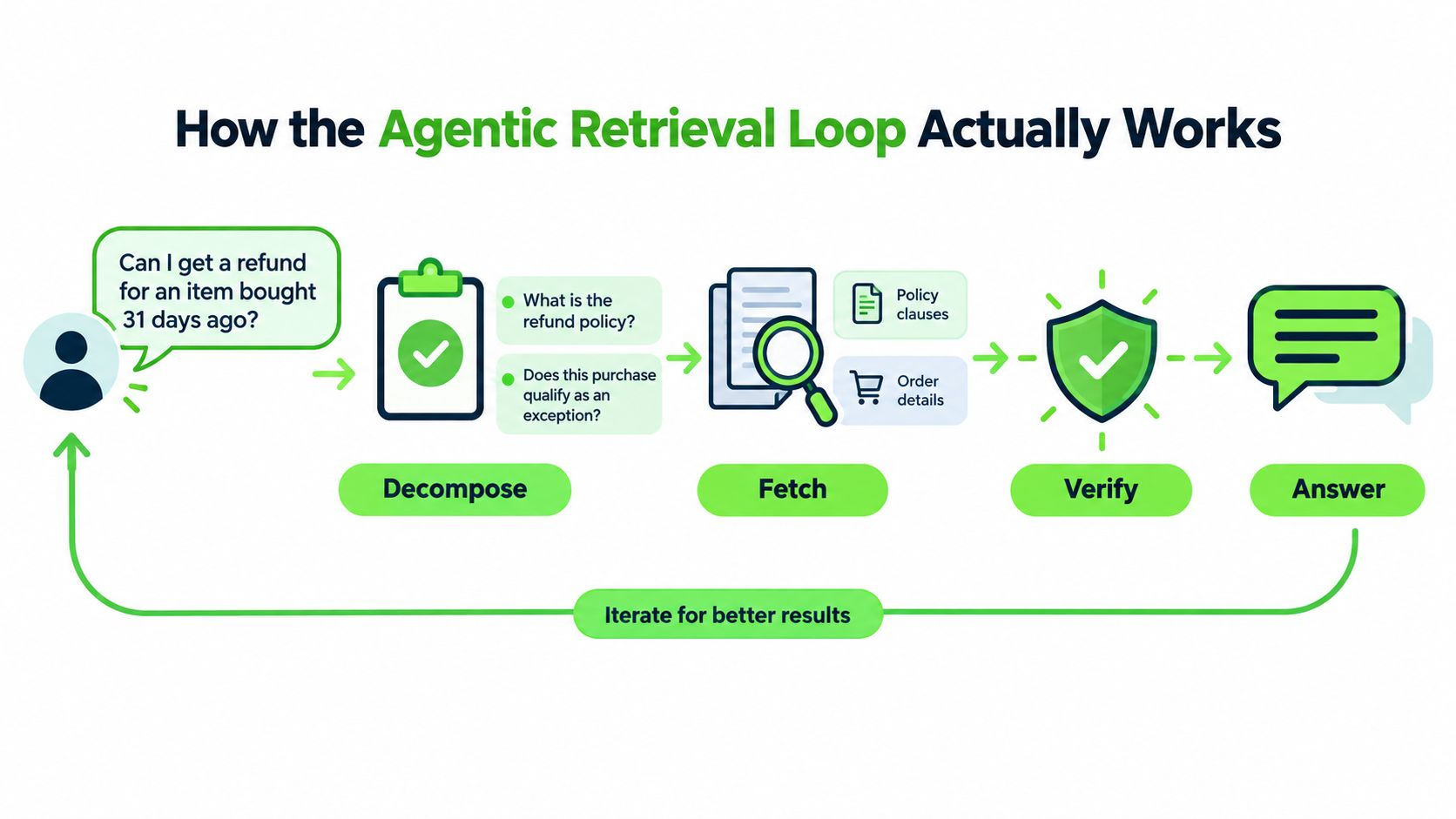
A customer asks: "Can I get a refund for an item bought 31 days ago?"
That looks simple. It often isn't. The answer might depend on the written refund policy, the order timestamp, the product category, a regional exception, and any active support override. A one-shot retriever may miss that structure.
The named components
A useful implementation has five explicit components:
- Planner decides what must be answered first.
- Retriever selects which source to query.
- Reranker scores retrieved candidates against the current sub-task.
- Reader drafts the answer from authorized evidence.
- Reflector decides whether evidence is sufficient, whether to retrieve again, or whether to escalate.
If you need a baseline refresher on the underlying pattern, this overview of retrieval-augmented generation is the right starting point before layering on agent behavior.
Step by step through the refund case
The Planner decomposes the user request into sub-questions such as: What is the formal refund window? Does this product type allow exceptions? Does this specific order qualify for an override?
The Retriever then chooses between three sources. It might query a policy vector index for the refund rules, an order database for transaction details, and a support knowledge base for exception handling guidance. That choice is the first place where Agentic RAG differs sharply from standard RAG. The system isn't just searching. It's deciding where to search.
Next, the Reranker scores the candidate passages and records. It pushes the most relevant policy clause above vaguely similar text, and it can prefer structured order facts over free-text notes when the sub-question is eligibility.
The Reader drafts a partial answer. At this point the answer might still be conditional: "The standard window is 30 days, but I need to verify whether this order falls under an exception policy."
Then the Reflector inspects the draft and evidence trail. If the policy text mentions damaged items, loyalty status, or holiday extensions, the system can loop back for one more retrieval pass. If the evidence remains ambiguous, the system should stop and escalate instead of guessing.
Keep the two loops separate in your design. The inner loop handles retrieval and evidence collection. The outer loop decides whether another cycle is justified.
Where the controls attach
The control surfaces from the opening section map cleanly to this loop:
- Planning control sits in the Planner.
- Tool and source control sits in the Retriever.
- Budget and stopping control sits in the Reflector.
That division helps with debugging. When the answer fails, you can inspect whether the system misunderstood the task, chose the wrong source, or iterated without gaining stronger evidence.
What Changes When the Retriever Becomes an Agent
The easiest way to evaluate Agentic RAG is to compare it with standard RAG across the engineering surfaces that change. The model may look smarter, but the shift is in system behavior.
Standard RAG vs. Agentic RAG What Actually Changes
| Dimension | Standard RAG | Agentic RAG |
|---|---|---|
| Planning | One-shot retrieval from the original user query | Query decomposition, reformulation, and multi-step planning |
| Tool use | Usually one retrieval path, often vector search plus filters | Chooses among tools and data sources during execution |
| Evaluation surface | Mostly final answer quality and retrieval relevance | Must evaluate planning, routing, evidence use, and stopping |
| Cost | More predictable | Expands with each retrieval, reflection, and tool call |
Planning adds power, but it also adds a new category of defects. A bad decomposition can send the whole system off course before retrieval quality even matters.
Tool use changes the failure profile too. Once the retriever can switch between vector search, SQL filters, ticket systems, or policy stores, you need idempotent tool behavior, explicit permissions, and traces for every call. Teams exploring patterns like the Hermes AI agent will recognize this quickly. Tool orchestration isn't just a UX feature. It's an operational surface.
The evaluation target gets wider
Standard RAG often lets you ask one blunt question: did the answer match the source? Agentic RAG requires several narrower questions.
- Did the planner create retrievable sub-questions?
- Did the system choose the correct tool?
- Did each hop preserve evidence support?
- Did the loop stop for the right reason?
The unit of evaluation shifts from answer quality alone to trajectory quality.
Cost becomes harder to reason about
A one-shot retriever is usually easy to size and audit. Agentic loops aren't. Every extra cycle can add another model invocation, another retrieval path, and another chance to widen scope.
That doesn't make Agentic RAG a bad idea. It means the architecture should earn its complexity with a clearly named failure it fixes.
When Agentic RAG Is and Is Not Worth the Complexity
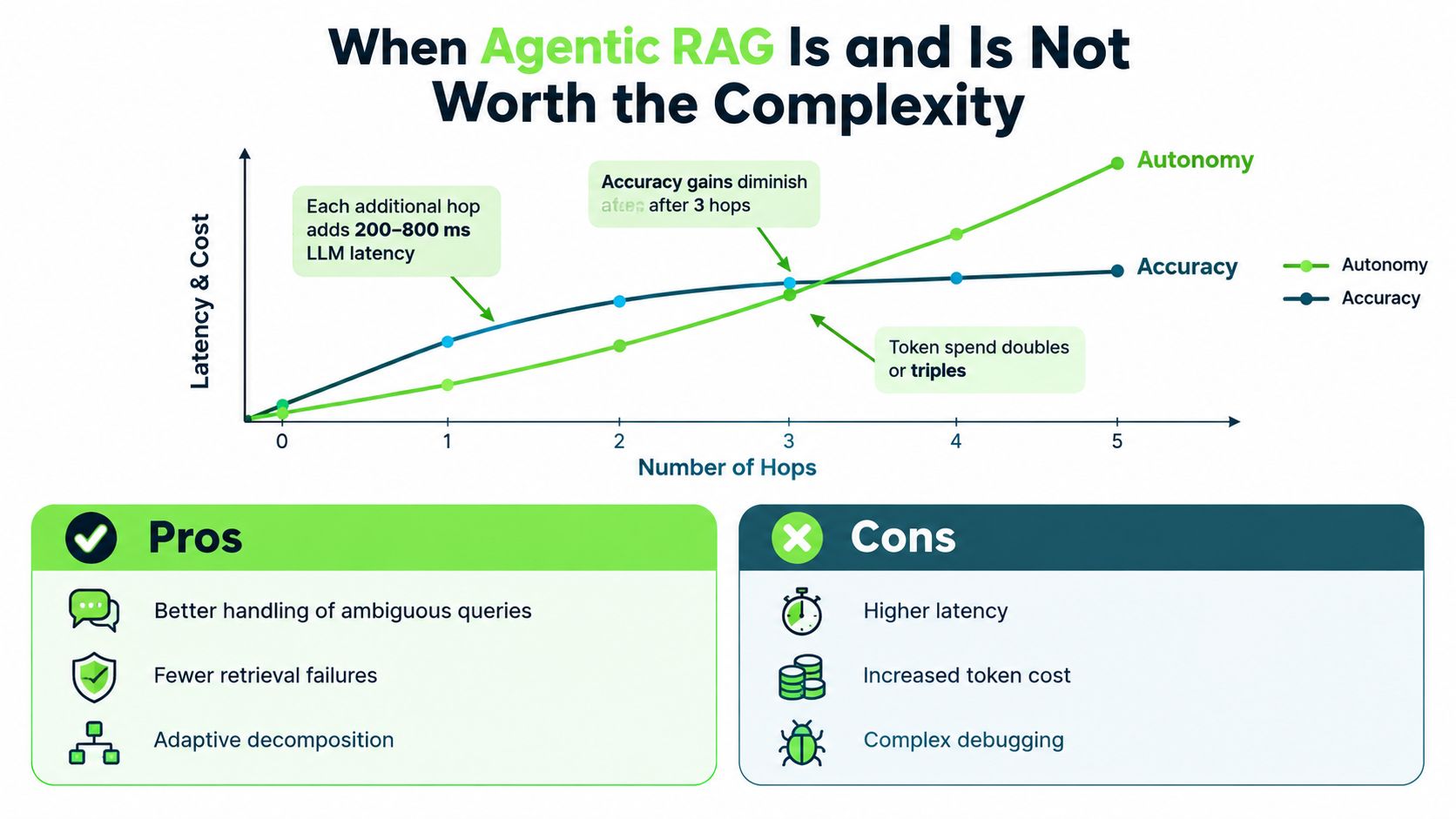
The common assumption is that more autonomy produces better answers. That isn't established as a universal rule.
Recent research frames the value question directly: Agentic RAG should be compared against simpler pipelines rather than treated as an automatic upgrade, and the literature still doesn't offer broadly accepted deployment thresholds for when the extra cost, latency, and control complexity are justified, as discussed in the HTML version of the Agentic RAG survey.
Cases where the complexity usually earns its place
Agentic RAG tends to make the most sense when questions are:
- Multi-intent: one user request implies several dependent sub-tasks.
- Cross-source: the answer spans policy docs, tickets, account state, and structured records.
- Iterative: the first retrieval result often isn't enough to resolve ambiguity.
Examples include policy-heavy support flows, internal enterprise assistants that reconcile conflicting documentation, and research workflows where the system has to compare evidence rather than just find it.
Cases where standard RAG is often the better system
If the question is narrow, the corpus is clean, and one retrieval pass usually returns the right evidence, standard RAG is usually easier to audit and operate.
That applies to things like:
- Single-source FAQs
- Scoped document assistants
- Simple support lookups with stable schemas
The issue isn't whether the model can perform multi-step reasoning. It's whether your product benefits enough to justify the wider failure surface.
A short walkthrough helps make that trade-off concrete:
Use justified complexity as the standard
A good platform rule is simple. Each extra layer should remove a known failure mode. If it doesn't, cut it.
That means you shouldn't deploy agentic retrieval because it's fashionable. Deploy it when one-shot retrieval keeps failing for reasons that planning, routing, or reflection can fix.
Grounding, Authorization, and Cross-Tenant Isolation
If your system serves multiple customers or handles sensitive records, retrieval isn't just a relevance problem. It's a security boundary.
The safest pattern is authorization-first retrieval. In that design, the candidate set is constrained by policy before any learned component consumes it. A TrustNLP paper states that if a candidate is derived from a restricted source, it is authorized for a user only if the source is authorized for that user, unless the system certifies a policy-compliant transformation, as described in the authorization-first retrieval paper.
What that means in practice
Every request should carry a user or tenant identity. The retriever should apply namespace filters, metadata scopes, or row-level policies before ranking and generation.
Three implementation patterns matter most:
- Namespace isolation: keep tenants separated with distinct indexes or strict metadata-scoped partitions.
- Structured backend controls: enforce row-level access in SQL or API layers, not just in prompts.
- Integrity verification: sign or verify sensitive retrieval payloads so downstream services can detect tampering.
AWS's Agentic AI guidance makes this concrete. It recommends hierarchical namespaces, namespace-scoped IAM roles, application-layer checks so each agent retrieves only from authorized namespaces, blocking cross-tenant data both at the authorization layer and in agent code, plus HMAC integrity verification and CloudWatch alarms for cross-namespace retrieval attempts in production systems, according to the AWS Agentic AI Lens guidance.
The failure modes are predictable
A planner rewrites a query and accidentally drops the tenant filter. A tool bypasses the retriever and hits a database directly. A cache returns chunks generated for one tenant to another. None of these failures are exotic.
For enterprise teams evaluating RAG for enterprise, the retrieval path should be designed to fail closed:
- Re-inject identity filters in middleware even if the planner rewrites the query.
- Use per-tenant caches rather than shared semantic caches for sensitive workloads.
- Allow-list tools by agent role so support agents can't access finance systems.
- Refuse unsupported answers when the authorized evidence set is empty or ambiguous.
A retriever should never fetch first and ask permission later.
This is also the right place for a grounding layer. AletheionAGI fits here as one option for teams that want evidence control in front of existing LLMs, vector stores, RAG pipelines, and memory systems rather than replacing those components.
Evaluating Agentic RAG Beyond Final Answer Accuracy
A single end-to-end score hides too much. If the agent gives a wrong answer, you still need to know whether the problem came from decomposition, source choice, evidence support, or hop chaining.
Recent benchmarking points in the same direction. InfoDeepSeek introduced a dynamic web-agent evaluation framework with fine-grained metrics for accuracy, utility, and compactness because agentic systems can fail inside the retrieval-planning loop before final generation. Related work on Search-MM uses 3,333 examples with golden hop-wise reasoning chains and a verification step to filter hallucinated or redundant steps, which supports evaluating retrieval fidelity at the chain level rather than only the final response, as described in the InfoDeepSeek and Search-MM benchmarking paper.
Evaluation Layers for Agentic RAG
| Evaluation Layer | What It Measures | Example Metric |
|---|---|---|
| Sub-question generation | Whether the planner decomposes the task into retrievable units | Sub-question recall |
| Retrieval choice | Whether the agent picked the right tool, corpus, or filter | Precision@k per tool |
| Evidence support | Whether cited passages actually support the generated claims | Entailment score |
| Hop-wise verification | Whether intermediate conclusions remain valid before chaining | Intermediate-answer faithfulness |
That layered view is more useful than one headline accuracy number. It tells you where to intervene.
Add provenance checks, but don't confuse them with full safety
Two supporting benchmarks are useful here.
RAGTruth is a hallucination corpus for standard RAG with more than 18,000 examples and four hallucination types, with span-level annotations that help separate response-level faithfulness from localized grounding errors, according to the RAGTruth overview.
A separate provenance fact-checking paper for retrieval-augmented generation reports high ROC-AUC across a wide range of open-source datasets, which suggests lightweight post-generation claim validation can help identify unsupported output. But that result is about classification performance on benchmark datasets, not a guarantee for live multi-tenant systems, as noted in the EMNLP Industry provenance paper.
For teams building QA pipelines around agents, this kind of layered instrumentation aligns well with practical work on quality assurance for agentic AI. The key is to record the full trajectory, not just the answer.
When a final answer fails, the trace should tell you which hop broke, what evidence it used, and why the loop stopped.
Practical Takeaways and a Decision Checklist
The cleanest way to think about Agentic RAG is this: it isn't the default next step after standard RAG. It's a justified complexity for retrieval problems that require planning, source routing, and iterative verification.
Keep these defaults even in early systems
- Authorization-first retrieval: constrain the candidate set before ranking or generation.
- Integrity checks on evidence flow: verify sensitive retrieval payloads and preserve provenance across tool calls.
- Trajectory-level logging: store planner output, tool choices, retrieved evidence, stop reasons, and abstentions.
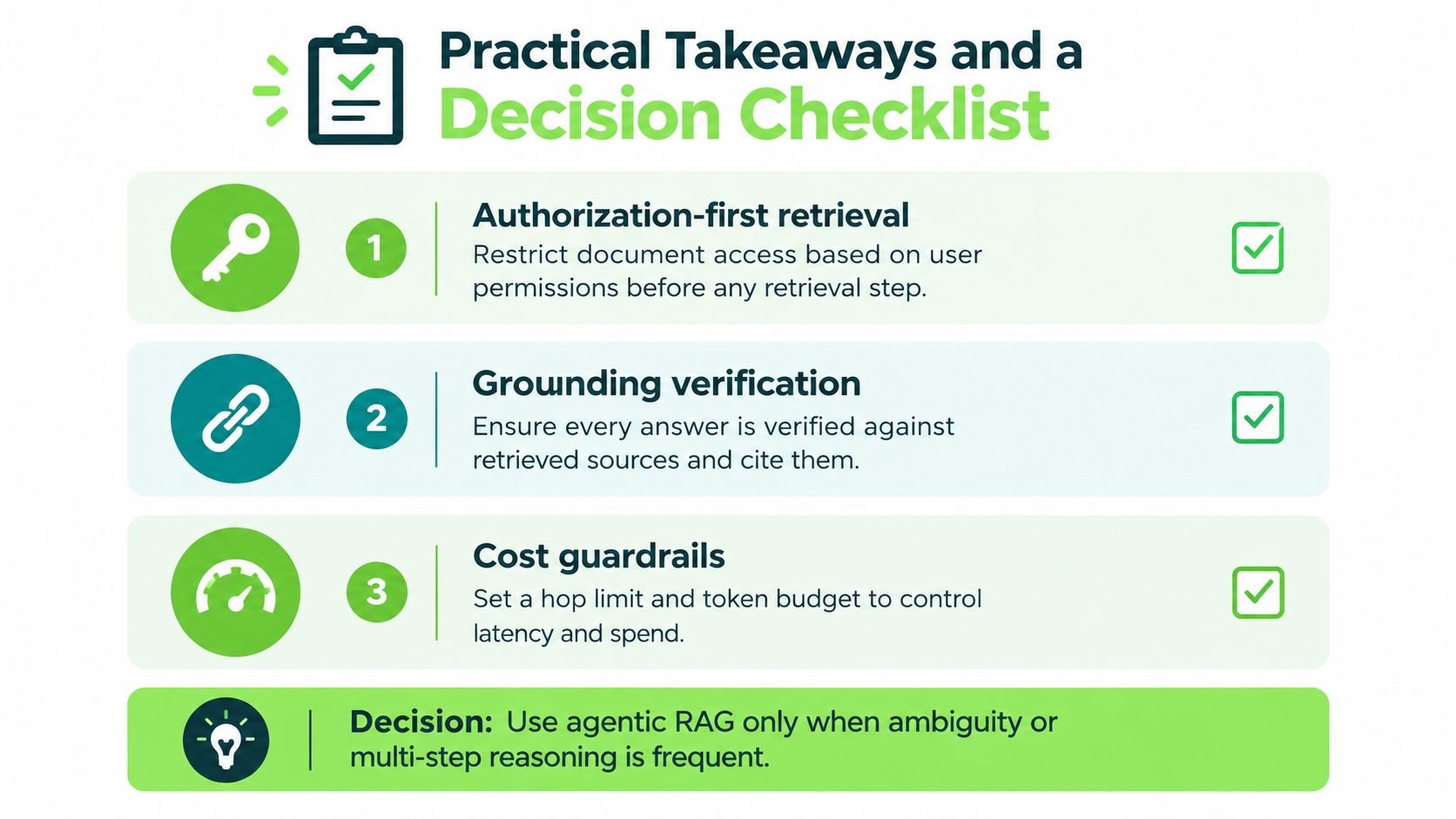
Use this decision checklist before adopting it
- The queries are multi-step. One retrieval pass often fails for understandable reasons.
- The sources are heterogeneous. The task spans text, structured data, APIs, or changing knowledge stores.
- The team can evaluate trajectories. You can measure more than final-answer quality.
- The system can absorb overhead. Latency, token spend, and operational complexity fit the product.
- The retrieval boundary is enforceable. Tenant isolation, tool permissions, and fail-closed behavior are in place.
If several of those are missing, standard RAG is usually the better architecture. If they're present, Agentic RAG can be a strong fit, but only when grounding and authorization are designed as first-class controls.
AletheionAGI offers a grounding and evidence-control layer for teams building on existing LLMs, RAG pipelines, vector databases, and memory systems. If you're implementing Agentic RAG and need authorized retrieval, fail-closed grounding, and inspectable evidence flow before generation, it's worth reviewing how their infrastructure fits into a production stack.