Most advice about RAG for enterprise starts in the wrong place. Teams obsess over embeddings, chunk size, and vector similarity, then act surprised when the system still leaks data, answers out of policy, or refuses to explain why it surfaced a document at all. Better retrieval helps, but it doesn't make an enterprise system safe, compliant, or operationally trustworthy.
The harder problem is that enterprise questions are rarely just lookup tasks. They mix facts, permissions, unresolved context, policy exceptions, and intent that has to be interpreted before any answer should be generated. Recent benchmark coverage shows why that matters, because systems may satisfy individual constraints at high rates, yet only 26.8% of responses met all requirements under strict orchestration, with a 57-point gap between loose and strict compliance, and best rejection accuracy only 42.7%. That means knowing when not to answer is still a production weakness, not a solved problem, especially in support, CX, and workflow automation. Enterprise benchmark coverage on orchestration and abstention gaps
Why Better Embeddings Won't Fix Your Enterprise RAG
The strongest enterprise systems I've seen don't fail because the embedding model was weak. They fail because the request was underspecified, the policy layer was loose, or the orchestration logic treated a partial retrieval as if it were a complete answer. In other words, retrieval quality is necessary, but it's not the same thing as production readiness.
Query understanding beats raw similarity in real workflows
Support agents, finance teams, and compliance reviewers don't ask one-dimensional questions. They ask for facts, exclusions, policy constraints, and exceptions in the same sentence, then expect the system to know when to answer and when to stop. That's why the industry is moving toward hybrid retrieval and intent-aware architectures, not just better vector indexes. The recent shift is a quiet admission that query interpretation is often the bottleneck.
Practical rule: if your system can retrieve the right document but still violates one user constraint, it's not production-safe.
The benchmark data backs this up. Loose compliance can look good in demos, but strict orchestration exposes the core failure mode, which is partial satisfaction. A system that returns the right policy but misses a constraint on audience, date, scope, or tenant is still wrong. That's the gap most RAG tutorials ignore because it's easier to measure retrieval quality than it is to measure end-to-end obedience to constraints.
Governance gaps show up before model gaps do
Enterprise teams often blame hallucination when the issue is unauthorized grounding. A model can produce a fluent answer from retrieved text and still be unsafe if it crossed an access boundary or skipped required logic. This is why production RAG has to be designed around authorization, abstention, and traceable evidence, not just semantic similarity.
A useful framing is simple. Retrieval answers the question, “What could support this response?” Governance answers, “Should this user see it?” Orchestration answers, “Do we have enough to answer at all?” If those three layers don't agree, the stack is unstable.
The historical arc of RAG supports that view. The original framework introduced by Lewis et al. in 2020 combined a sequence-to-sequence generator with dense retrieval over Wikipedia, building on earlier retrieval work like kNN-LM, REALM, and DPR. That lineage matters because enterprise RAG inherits the same core idea, language models become much more useful when they sit on top of explicit memory instead of trying to store everything in parameters. RAG history and timeline
The Architecture of Production-Ready Enterprise RAG
Production RAG lives or dies as a pipeline. Retrieval, generation, governance, and evaluation each have their own failure modes, and a strong score in one layer can hide a bad assumption in another. Informal demos miss that because they rarely stress permissions, policy boundaries, or evaluation protocol.
| Benchmark | Scale | Primary Focus | Key Metric |
|---|---|---|---|
| RAGBench | 100k examples across five industry domains | Retrieval and generation evaluation with explainable metrics | TRACe framework |
| MIRAGE | 7,560 curated QA instances mapped to 37,800 retrieval-pool entries | Precise measurement of retrieval and generation | Frozen QA and retrieval mapping |
| EnterpriseRAG-Bench | Company-internal retrieval setup | Retrieval quality under enterprise conditions | Correctness and document recall |
The pattern is consistent. Benchmarks that split retrieval from generation expose problems that single-score leaderboards smooth over. They also make it obvious how much enterprise results depend on retrieval protocol, denominator definition, and dataset coverage. For that reason, RAGBench and MIRAGE benchmark framing is more useful than generic “did the answer look right?” evaluation.
BM25 can beat vectors when the retrieval job is narrow
One of the more useful benchmark findings for practitioners is also one of the least flashy. In a company-internal retrieval setup, BM25 outperformed vector search on core retrieval quality, reaching 68.8% correctness and 68.4% document recall, while vector search reached 51.4% correctness and 46.0% recall. That does not mean lexical retrieval always wins. It means retrieval method has to match query shape, corpus quality, and how much structured vocabulary the domain carries. EnterpriseRAG-Bench results
I stop trusting teams that default to vector search as a design rule. If the corpus contains product names, policy codes, ticket IDs, legal terms, or inventory identifiers, lexical retrieval often deserves a serious look. In production, the better pattern is usually hybrid retrieval, tuned to the actual question class instead of to a fashionable default.
Frozen evaluation beats ad hoc confidence
Production RAG needs frozen benchmarks, versioned prompts, versioned corpora, and a protocol that keeps the denominator fixed. Without that, every improvement claim gets hard to verify and easy to game. A lot of teams drift into self-deception here. They test on live data, tweak prompts, then call the result “better” because the demo feels cleaner.
The stronger approach is to measure retrieval quality, answer faithfulness, and domain coverage separately, then combine them only after each layer has been inspected. That lets platform teams see whether failures come from missing documents, weak generation, or a policy bug. It also gives compliance reviewers something defensible, because each score can be traced back to a frozen protocol.
For teams building an AI knowledge base, centralized search is only the starting point. Retrieval has to be measured as a controlled system, not as an impression, as outlined in AI knowledge base architecture notes.
Implementing Multi-Tenant Isolation That Actually Works
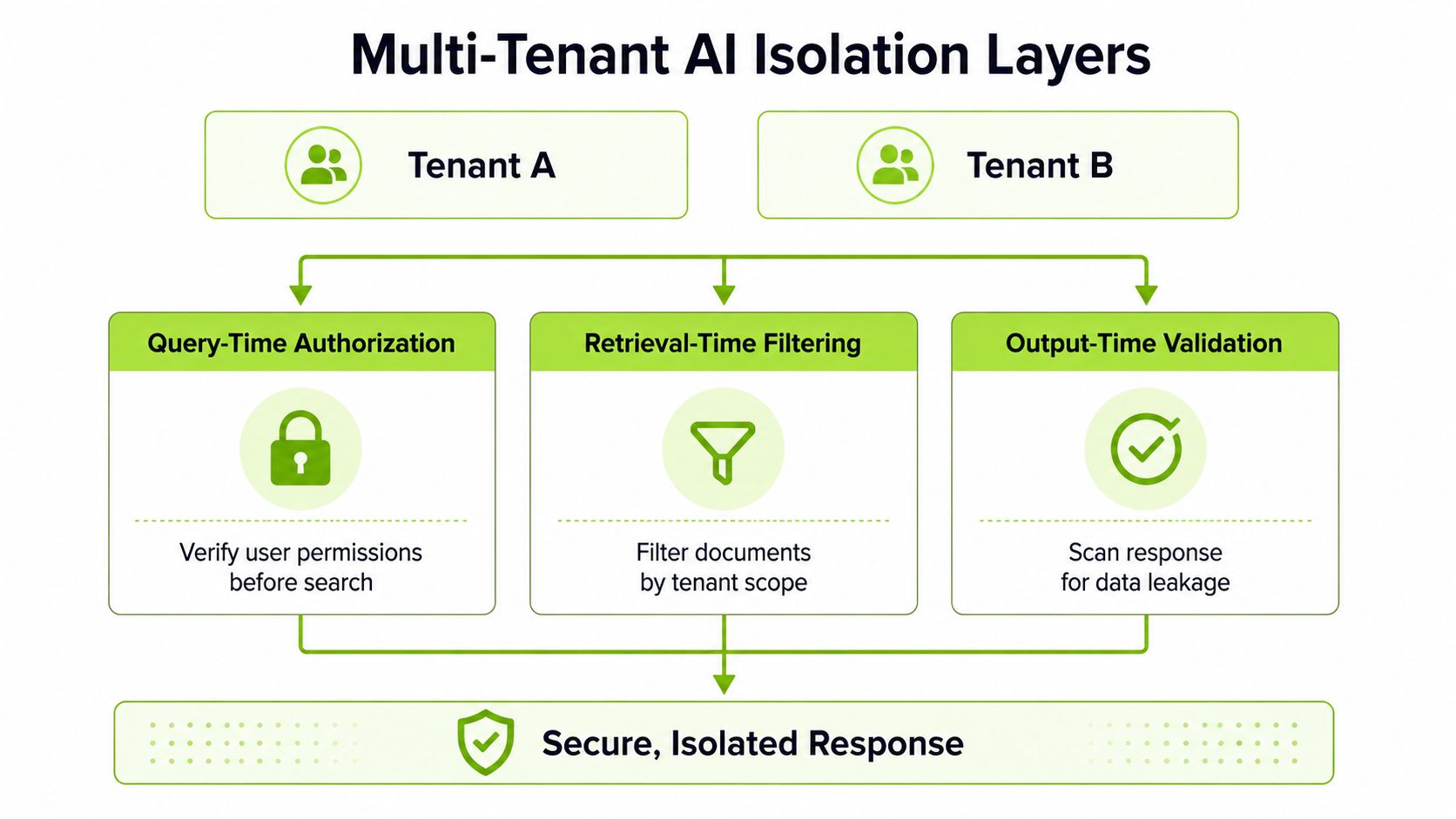
Multi-tenant isolation fails most often because teams stop after namespace separation. That looks tidy in architecture diagrams, but it doesn't prevent cross-tenant leakage if authorization, retrieval filtering, and output validation don't all agree on the same tenant context. The model should never see content that hasn't already passed policy checks.
Start with hard tenant boundaries in retrieval
Use hard tenant namespaces or separate per-tenant collections, not soft tags that can be forgotten under pressure. Inject immutable tenant filters through policy middleware, and make sure the query path carries tenant identity from authentication all the way into retrieval. If tenant context is missing, retrieval should fail closed. That's the only safe default in a shared environment.
Separate credentials matter too. Read, write, and maintenance operations should not share the same authority, because operational shortcuts tend to become security incidents later. Continuous tests should probe for nearest-neighbor leakage across tenants, because a passing unit test won't catch the wrong document surfacing under a borderline query.
Put access metadata on the chunk, not just the source document
OWASP's RAG guidance is clear that access-control metadata belongs alongside each vector chunk, not only at the document level. That means classification, owner, permitted roles, and permitted tenants should travel with the retrieved unit itself. If a source document contains mixed permissions, chunk-level metadata gives you the granularity you need to enforce policy before generation. OWASP RAG Security Cheat Sheet
The retrieval layer should know less than the policy layer, not more.
That same logic applies to output-time validation. Even if retrieval was correct, the answer can still leak tenant-specific details if the final response isn't scanned against scope before delivery. I've seen teams spend months optimizing retrievers and then lose the whole program because the response layer had no boundary check.
Make tenancy a first-class orchestration concern
The right pattern is a three-part check. Query-time authorization verifies the caller, retrieval-time filtering limits what can be surfaced, and output-time validation inspects the generated text for leakage. None of those controls can be optional in a multi-tenant support or workflow system.
AletheionAGI fits here as one grounding and evidence-control layer among others, because the design problem isn't model capability alone, it's how evidence is authorized and delivered. Used well, this kind of layer sits between raw retrieval and final response, and that's exactly where enterprise systems need control points.
Policy Enforcement and Provenance at Retrieval Time
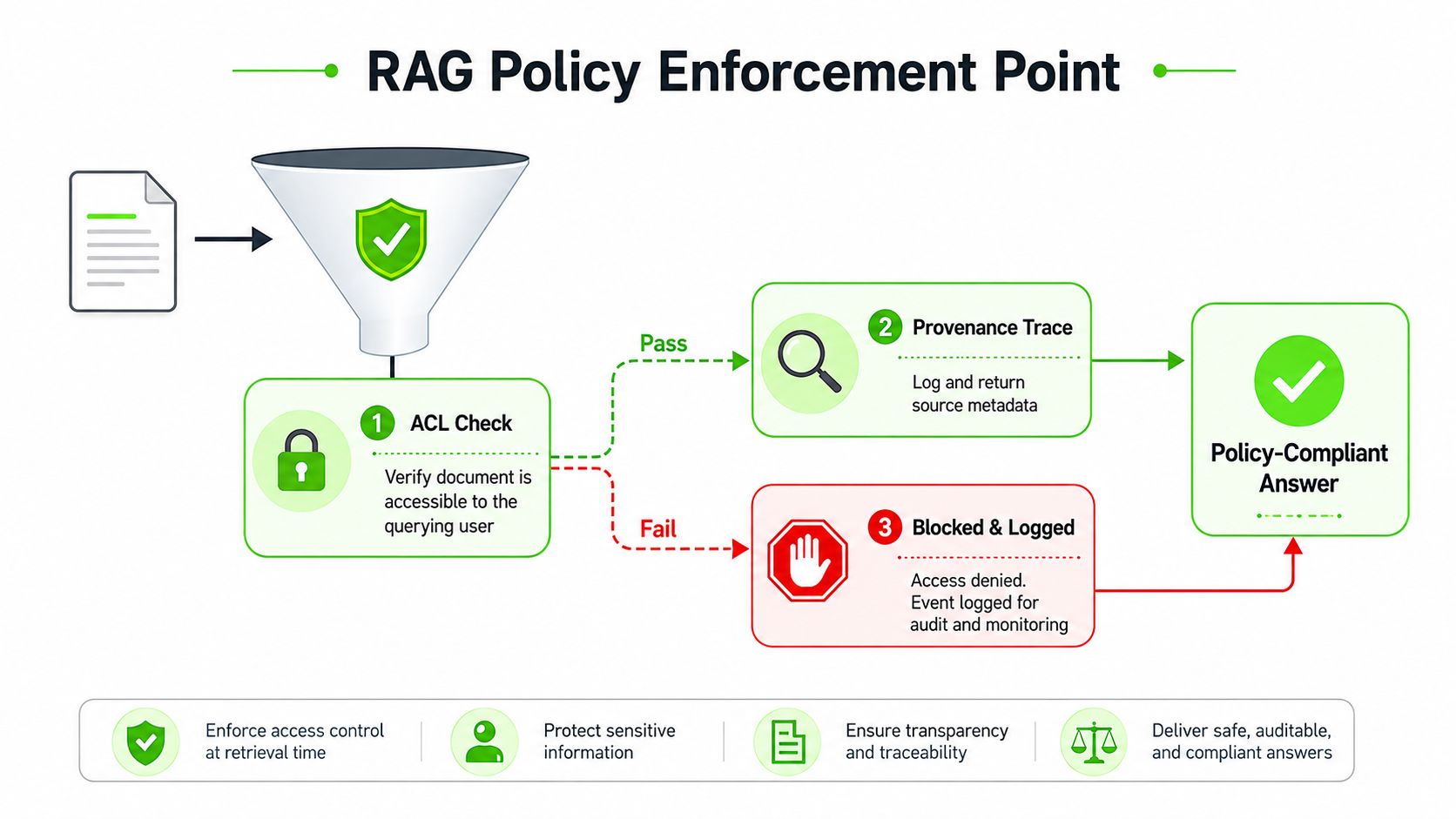
Enterprise RAG becomes unsafe the moment it can't explain why a document was surfaced. That isn't a theoretical issue. In regulated environments, a correct answer that came from the wrong source, or a permitted source exposed to the wrong user, is still a defect. The enforcement point has to sit before the model sees the chunk, not after the answer is already composed.
Enforce ACLs, labels, and deletion state before generation
A secure retrieval path should check source ACLs, tenant IDs, labels, provenance, masking, audit state, and deletion state before any chunk is handed to the model. Oracle's enterprise RAG guidance makes that explicit, and it's the right posture for regulated workloads. If a document is deleted, expired, masked, or out of scope, it should not be eligible for retrieval in the first place. Oracle secure enterprise RAG guidance
Identity integration matters here because retrieval is a policy decision, not just a search operation. The system should know which tenant, which role, which data residency rules, and which document version are in play for every request. If those controls live outside the retrieval path, they're too easy to bypass during an incident or a rushed feature rollout.
Audit trails need source-level fidelity
Every generated answer should be traceable back to the document or table source, source version, chunk or row ID, retrieval route, user and tenant scope, tool call or SQL query, and timestamp. That level of traceability is not bureaucratic overhead. It's what lets security and compliance teams reconstruct a response later without guessing which corpus, filter, or prompt version was used.
OWASP also recommends signed source attribution for every RAG response. That's valuable because it turns provenance into something verifiable instead of decorative. If the response can't show where it came from, the system has no proof of authorized evidence.
Defensible RAG is a governance pattern, not a slogan
The market language around “defensible” RAG makes sense because the requirement is accountability. Teams need centralized governance, retrieval logging, and explicit ownership of policy decisions. That's particularly important in legal, healthcare, finance, and support systems where the cost of a boundary violation is much higher than the cost of a refusal.
The video below is a useful reference point for teams thinking about retrieval-time enforcement and evidence controls.
For engineering teams building internal tooling, the safest posture is to treat retrieval as a policy gate and not just a ranking step. The same control mindset applies to the broader AI safety stack as well. AI safety tools and control patterns
Measuring Reliability with Frozen Benchmarks
A fluent answer is not a reliable one.
Abstention has to be measured, not assumed. AbstentionBench evaluates refusal behavior across 20 diverse datasets, including unknown answers, underspecification, false premises, subjective interpretations, and outdated information. That matters in enterprise RAG because the system often needs to decline cleanly when evidence is thin, the request is malformed, or the policy boundary is unclear. AbstentionBench
A model that answers every prompt can still fail the job. In support automation, risk review, or policy lookup, a confident guess can be worse than a short refusal that preserves trust and reduces downstream cleanup.
Separate retrieval, faithfulness, and coverage
A frozen evaluation protocol should score the retriever, the generator, and the domain boundary independently. When an answer is wrong, teams need to know whether the failure came from missing evidence, poor ranking, a weak prompt, or a generator that filled gaps too aggressively. Without that separation, fixes turn into guesswork.
The same idea applies to abstention. If the system should refuse on unsupported or out-of-scope requests, benchmark that refusal path directly instead of treating it as a side effect of answer quality. A system that only looks strong on answered questions can still be brittle where enterprise risk is highest.
Measure the system you actually ship
If the production stack includes hybrid retrieval, policy middleware, fallback rules, and abstention logic, benchmark the full path. A toy retriever can look fine in isolation while the live system breaks on invalid premises, missing context, cross-tenant requests, or policy conflicts.
Frozen benchmarks also help teams settle release reviews without re-litigating opinions. Legal, security, and product can inspect whether the system improved on the same fixed set, then decide whether the refusal rate is acceptable for the use case. That keeps the conversation on repeatable evidence instead of anecdote.
From Implementation to Production Readiness
The teams that ship trustworthy enterprise RAG systems don't try to perfect everything at once. They scope the data sources, define the policy surface, freeze the benchmark, and decide where abstention is acceptable before the first production rollout. That sequence keeps the system inspectable.
Engineering teams need a control plane, not just retrieval code
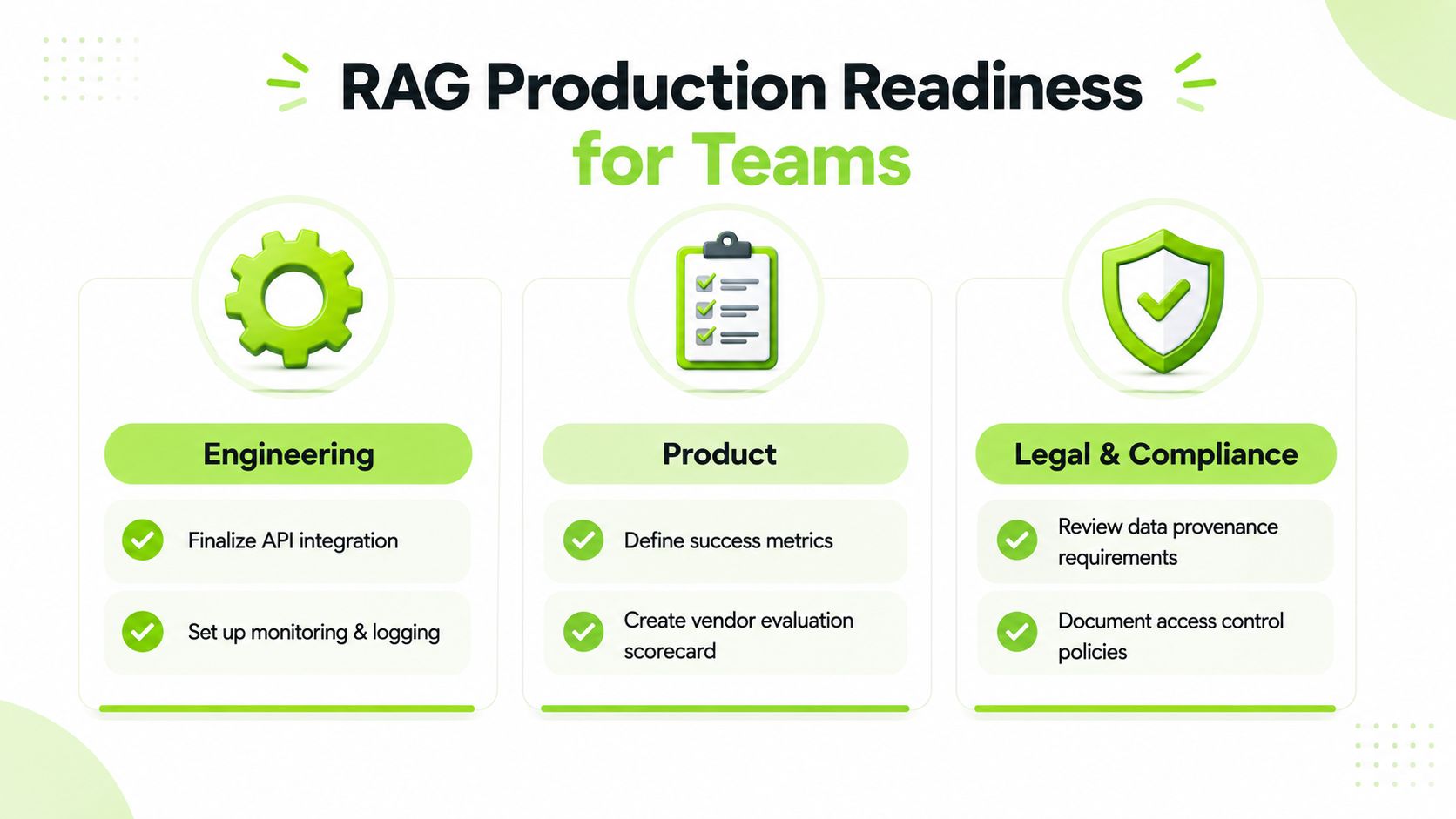
For platform engineers, the important integration points are grounding, vector storage, policy middleware, and logging. Finalize API integration, wire monitoring and audit logs into the retrieval path, and make sure the system can fail closed if identity or tenant context is missing. That's the difference between a demo and a service.
Product teams need realistic success criteria
Product managers should define success metrics that include answer usefulness, refusal behavior, and scope adherence, not just fluency. Vendor scorecards should ask whether the system can separate retrieval from generation, whether it supports provenance, and whether it can enforce boundaries in multi-tenant environments. If a vendor can't answer those questions clearly, the risk lands on your team later.
Legal and compliance teams need evidence, not reassurance
Risk, compliance, and security teams should ask for provenance rules, access control policies, deletion handling, and audit replay capability. They should also check whether the system can show which source version supported which answer and whether unauthorized content is excluded before generation. That's the audit trail that survives scrutiny.
For teams evaluating a grounding layer, AletheionAGI offers one way to combine authorized evidence, persistent context, and fail-closed delivery around existing LLM and RAG stacks. If you're building enterprise retrieval systems that handle sensitive or multi-tenant data, use that standard of evidence control as the baseline, then pressure-test your current architecture against it.
Prepared with Outrank