A support agent asks an internal assistant, “What's our current refund policy?” The RAG system retrieves a policy document that looks highly relevant, and the language model produces a polished answer with a confident citation. The problem is that the policy was retired two quarters earlier. The customer receives the wrong guidance, and the support team begins a compliance review.
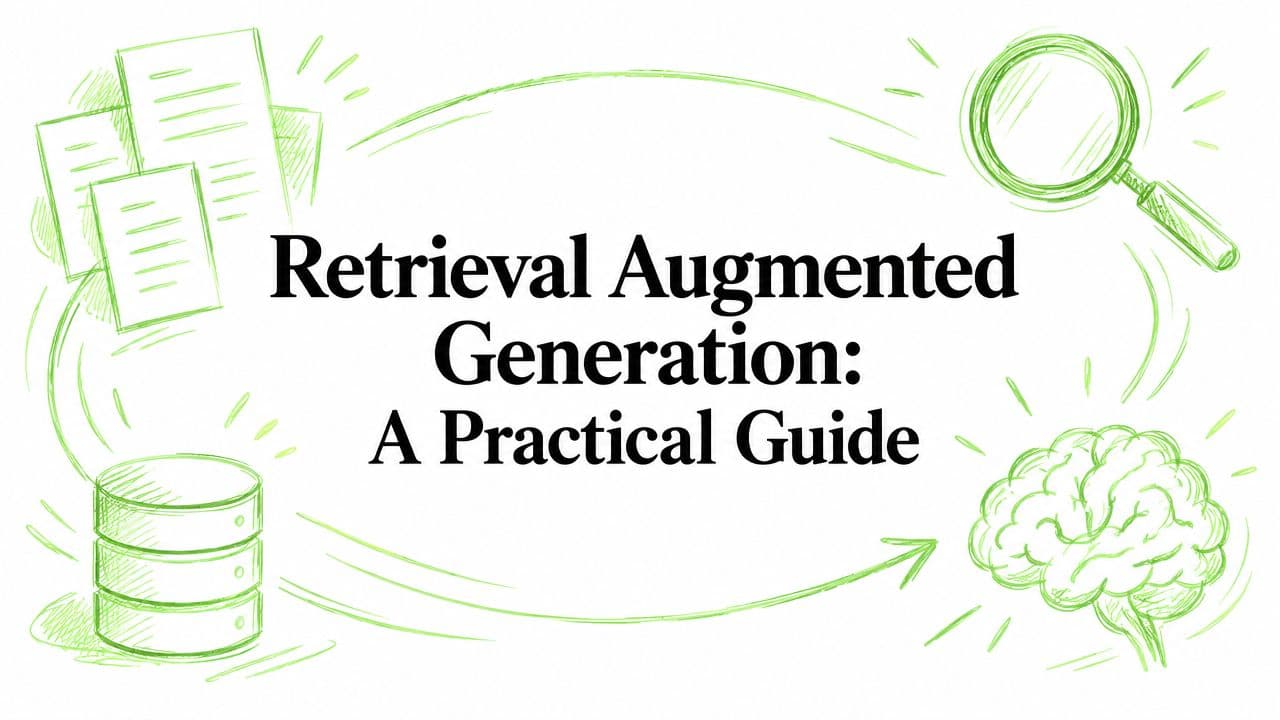
That incident is common enough to change how production teams should think about retrieval augmented generation. RAG isn't “chat with your docs,” and it isn't a prompt pattern that makes a language model reliable by itself. It's a system composed of content ingestion, indexing, retrieval, filtering, ranking, context assembly, generation, authorization, and evaluation.
The original RAG architecture was formally introduced in 2020 through the paper Retrieval-Augmented Generation for Knowledge-Intensive NLP Tasks, submitted on May 22, 2020 and later accepted at NeurIPS 2020. It combined a parametric generator with a non-parametric retriever, creating the baseline architecture that shaped much of the later field (the original RAG architecture and publication history).
In production, a fluent answer isn't the same as a correct answer. The corpus may contain stale or conflicting material, the index may not have been refreshed, a chunk may have split a table in half, or an access-control boundary may have allowed the retriever to see information the user shouldn't receive.
Why Retrieval Augmented Generation Matters in Production
The support incident above wasn't a prompt failure. The model followed the context it received, or at least behaved as though it did. The pipeline failed to establish which document was authoritative, whether the retrieved evidence was current, and whether the answer could be traced to evidence the requester was allowed to use.
That distinction matters because enterprise teams increasingly expect AI applications to answer from private, changing knowledge. By 2024, RAG had become a major NLP evaluation area, supported by dedicated surveys and benchmark collections covering open-domain question answering, factoid QA, multi-hop QA, and dialogue. A 2025 ACL evaluation paper summarized benchmark sets including 2,837 Natural Questions items, 5,359 TriviaQA items, 5,600 HotpotQA items, 958 ASQA items, and 1,000 WoW items, evidence that RAG evaluation had matured beyond a single retrieval technique (the ACL evaluation paper and its benchmark scope).
The vocabulary matters
A corpus is the evidence collection the system is permitted to search. A chunk is a retrievable unit extracted from a document. The retriever finds candidate chunks, while an optional reranker orders those candidates using a more precise relevance model. The generator is the language model that turns the assembled context into an answer.
Groundedness asks whether the answer aligns with the supplied evidence without adding unsupported material. Provenance records where a statement came from, ideally down to a document version and source span. Evidence is the actual text that supports a claim, not merely a document that appears related.
Production rule: Treat every RAG answer as a claim delivery event. The system must know what evidence existed, what evidence it retrieved, and what evidence the user was authorized to receive.
Stale indexes, fragmented sources, malicious instructions embedded in documents, and tenant boundaries all sit upstream of generation. That's why “the model hallucinated” is often an incomplete diagnosis. The more useful question is: which pipeline stage allowed an unsupported claim to reach the model or the user?
How a RAG Pipeline Actually Works
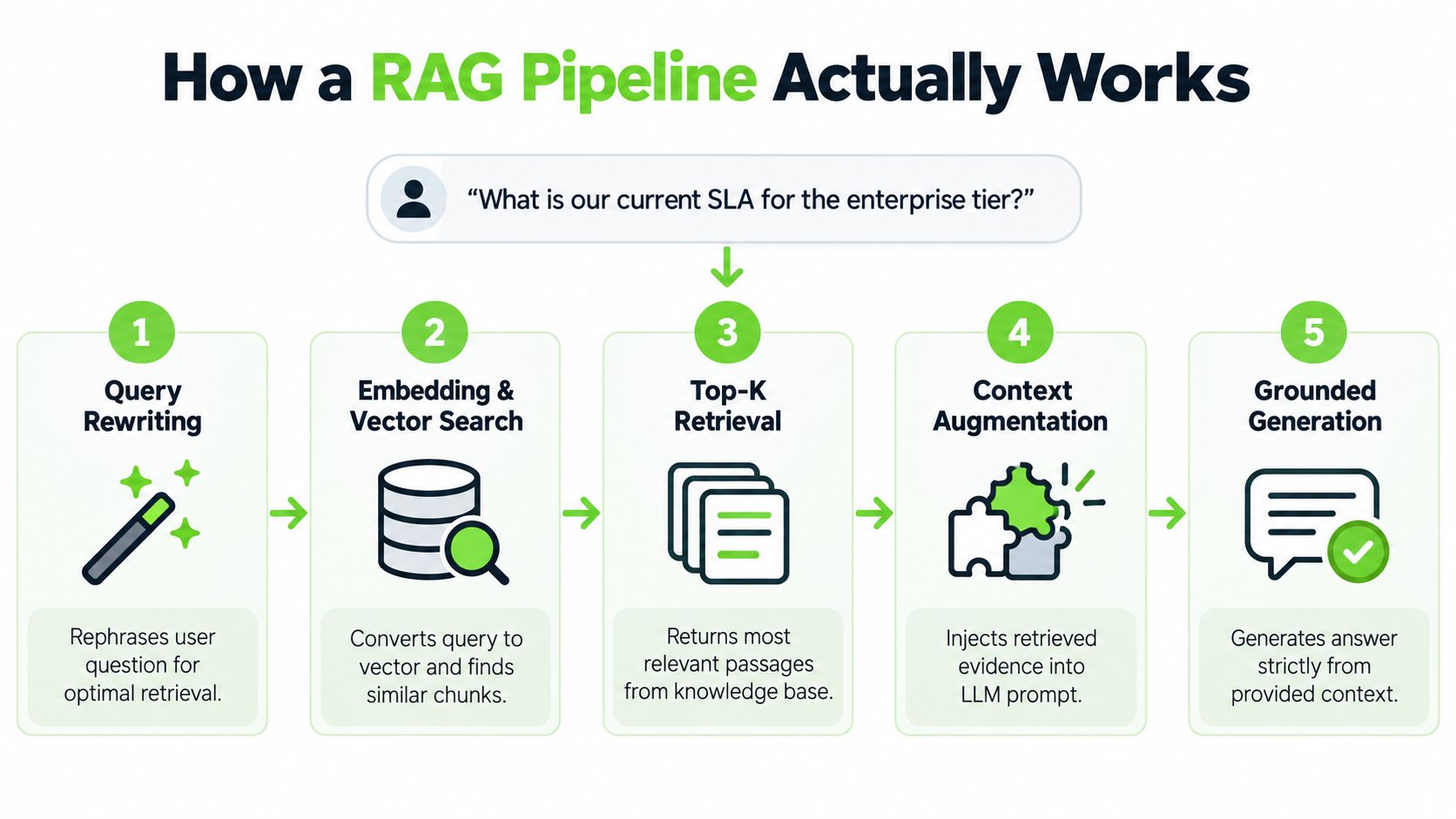
Consider the request, “What is our current SLA for the enterprise tier?” A production pipeline should process it as a sequence of controlled transformations, not as a single similarity search.
From question to candidate evidence
Query rewriting expands or rephrases the request. “Enterprise SLA” might become a search representation that includes service-level agreement, response time, resolution target, and the relevant product tier. Rewriting helps when users use informal terms, but it can also introduce assumptions, so the original query should remain available for audit and validation.
Embedding and vector search convert the query into a numerical representation and compare it with indexed chunks. Dense retrieval is useful when the request paraphrases the source, but semantic similarity doesn't establish authority, freshness, or authorization.
Candidate retrieval returns a broader set of passages. Many systems combine vector search with lexical matching, metadata filters, or both. Filters can remove irrelevant tenants and document types, yet an incorrectly applied filter can also eliminate the only answer.
Reranking and context assembly reorder candidates and construct the prompt context. The assembler must enforce a token budget, preserve source metadata, and avoid burying the strongest passage beneath repetitive material. Tables deserve special handling because naive chunking can separate headers, rows, and footnotes.
Grounded generation produces an answer from the assembled evidence, ideally with citations and an abstention path. The generator can only ground its response in what survives every earlier filter.
The most important hidden property is lossiness. Each stage can discard information, and a reranker can't recover a document that retrieval never returned. A reranker often improves ordering, but it doesn't make an incomplete candidate pool complete.
For a concise explanation of the relationship between retrieved context and model output, how RAG architecture reduces hallucinations is a useful companion resource. Its value is conceptual, but production teams still need to validate the actual evidence path in their own systems.
The pipeline can also fail during prompt assembly. A relevant chunk may be included but weakened by contradictory passages, excessive context, or an instruction embedded inside retrieved content. Grounding belongs to the assembled context window and its controls, not to the model in isolation.
Choosing a Retrieval Strategy for Your Corpus
Retrieval quality depends on the shape of the corpus and the way users ask questions. A dense embedding index may understand that “cancel my subscription” and “terminate my plan” are related, but it can struggle with exact part numbers, policy identifiers, error codes, or rare technical terminology.
Sparse retrieval, including BM25-style lexical search, remains valuable when wording carries meaning. Legal clauses, API names, SKU identifiers, and compliance terms often reward exact matches. Dense retrieval is stronger when users paraphrase, omit the source's terminology, or describe a concept indirectly.
| Strategy | Strengths | Failure Modes | Best Fit |
|---|---|---|---|
| Dense retrieval | Handles semantic similarity and paraphrase | Misses exact identifiers and rare jargon | Natural-language questions over varied prose |
| Sparse retrieval | Preserves exact terminology and lexical signals | Weak when the user's wording differs from the corpus | Legal, technical, and identifier-heavy content |
| Hybrid retrieval | Combines semantic and lexical recall | Fusion bugs, duplicates, and conflicting rank signals | Enterprise corpora with mixed query styles |
| Reranked retrieval | Improves ordering among candidates | Can't recover an answer absent from the candidate pool | High-value answers requiring stronger top-k precision |
A practical default
For a mixed enterprise corpus, I'd start with hybrid retrieval, apply authorization and metadata filters before ranking, then use a cross-encoder reranker on a constrained candidate set. The exact candidate and final context sizes should come from evaluation, not folklore. The key is to keep enough candidates for recall without allowing redundant or contradictory text to dominate the generator's context.
Reciprocal rank fusion can combine dense and sparse result lists effectively, but it introduces its own engineering surface. Deduplicate by canonical document and span identifiers, preserve the original rank signals, and test cases where both retrievers return different versions of the same policy.
Embedding integration also deserves operational discipline. Teams working in Python can use a focused guide to Python integration for embeddings, but the implementation detail matters less than version control. Store the embedding model, preprocessing configuration, source hash, and index version alongside every vector.
Corpus design should influence retrieval design. A structured AI knowledge base can expose status, ownership, product scope, effective dates, and document relationships that raw text alone can't reliably convey.
Selection test: Ask whether the strategy retrieves the right evidence for your actual identifiers, paraphrases, conflicts, and permissions. A fashionable index that fails those queries isn't a production strategy.
Where RAG Quietly Fails
The answer may exist in the source system and still be unreachable. Suppose a twelve-chunk policy document contains the current SLA in chunk seven. The retriever returns chunks two, three, and eleven because their wording resembles the question. The generator then answers from what it received, not from the document's missing seventh chunk.
That failure can originate in several places:
- Chunk boundary loss: A heading, table label, or qualifying exception lands in a different chunk from the main rule.
- Embedding mismatch: The embedding model doesn't represent specialized vocabulary in a way that matches user queries.
- Stale indexing: The source document changed, but the production index still contains an older version.
- Weak fusion: Dense and sparse results combine poorly, producing duplicates or pushing useful candidates down.
- Context overflow: The strongest passage enters the prompt but is buried under irrelevant or contradictory text.
- Generation drift: The model misquotes or extends evidence even when the correct passage is present.
A 2026 failure taxonomy identifies 14 distinct failure modes across retrieval, fusion, and generation. It reports that retrieval-side failures account for 52% of errors at low corpus quality, fusion-side failures account for 47% at high corpus quality, and pure generation hallucinations remain at 9% to 12% across regimes (the RAG failure taxonomy and its stated distribution). Those figures describe the taxonomy's reported evaluation regimes, not a universal production constant, so teams shouldn't transplant them into a dashboard without matching the corpus and test design.
| Failure Stage | Typical Share | Example Symptom |
|---|---|---|
| Retrieval | 52% at low corpus quality | The answer is in the corpus but absent from retrieved context |
| Fusion | 47% at high corpus quality | Strong candidates are displaced by poor rank combination or duplicates |
| Generation | 9% to 12% across regimes | The model adds unsupported content despite useful evidence |
Diagnose the stage, not the symptom
A wrong answer that cites a real document can still be a retrieval or data-governance incident. Check whether the document was current, whether the right chunk was returned, whether conflicting versions were visible, and whether the assembled context preserved the relevant qualification.
Changing the system prompt is often the first step teams take. That may alter behavior at the margin, but it won't repair missing coverage, stale metadata, or an index that returns the wrong policy version. Improve observability first. Log query rewrites, filters, candidates, ranks, context assembly, citations, and the final answer as one trace.
The research literature now treats missing coverage, noisy evidence, contradictory sources, and grounding fidelity as core RAG challenges rather than edge cases (the taxonomy and survey discussion of unresolved RAG failure modes). That's the right framing for incident response: generation is only one possible failure boundary.
Grounding, Provenance, and Knowing When to Abstain
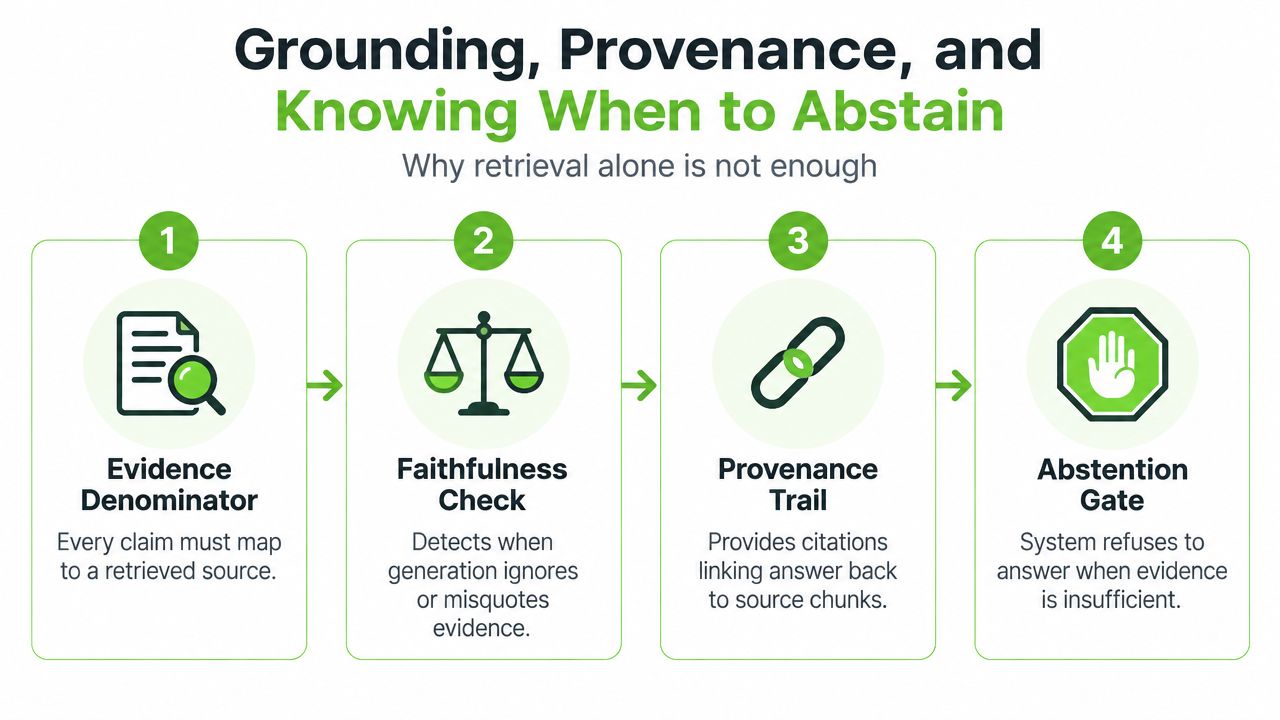
Better retrieval doesn't guarantee a supported answer. A model can ignore a retrieved passage, combine two unrelated passages, misquote a qualification, or turn an example into a policy. “Answer only from the context” is a useful instruction, but it's not an enforcement mechanism.
Establish an evidence denominator
For each material claim, require a trace to a specific span in a specific document version. That span must be part of the context delivered to the model and must pass the same authorization checks as the initial retrieval.
Useful provenance surfaces include:
- Inline citations: Link each answer claim to a document and section.
- Structured source objects: Return source IDs, versions, spans, retrieval scores, and authorization decisions separately from the prose.
- Signed references: Attach tamper-evident identifiers when downstream systems need stronger auditability.
- Audit records: Preserve the query, available evidence, selected evidence, answer, and abstention decision.
Microsoft's RAG evaluation guidance separates groundedness from relevance. Its groundedness evaluator checks whether a generated response aligns with the provided grounding context without fabricating outside it, using a binary pass or fail outcome derived from a 1 to 5 threshold. Groundedness Pro provides a stricter true or false, service-backed evaluation (Microsoft's groundedness evaluator guidance).
A practical grounding check should operate at claim or span level, not only on the whole answer. If the user asks for the current enterprise SLA and the evidence supports response time but not resolution time, the system should answer the supported portion and clearly abstain from the rest.
AI safety tools fit into a broader control plane. The useful category isn't a magic prompt. It's the combination of citation verification, claim-to-evidence alignment, refusal logic, policy checks, and reconstructable logs.
Abstention is a valid result. A clean refusal is safer than a confident answer whose evidence denominator is empty.
Multi-Tenant Isolation as an Authorization Problem
A vector database answers a similarity question. It doesn't answer whether the requester is entitled to see the matching content. That makes multi-tenant RAG an authorization problem, not a relevance problem.
Consider three common deployment patterns:
| Pattern | Blast Radius | Cost | Leakage Risk | Best Fit |
|---|---|---|---|---|
| Shared index with tenant filtering | Broadest if filters fail | Lowest operational cost | Hardest to verify under filter defects | Large populations with strong centralized controls |
| Index per tenant | Limited to an index boundary | Higher indexing and management overhead | Lower than shared filtering | Customers requiring stronger separation |
| Service or store per tenant | Strongest separation | Highest infrastructure and operational cost | Lowest architectural exposure | Highly sensitive or heavily isolated workloads |
A shared index can work when every query carries an authenticated tenant filter and the system rejects requests that lack a valid tenant context. Index-per-tenant designs reduce the blast radius but introduce more lifecycle, capacity, and migration work. Service-per-tenant isolation offers the clearest boundary, but it costs more to operate and can complicate fleet-wide updates.
Why prompts can't enforce access
A prompt instruction such as “don't reveal another customer's data” runs after retrieval. If unauthorized chunks have already entered the context, the system has already crossed the boundary. Similarity search may surface competitive information, confidential documents may appear in suggestions, and post-filtering can fail if the application assembles context before applying the final policy decision.
Security guidance recommends immutable provenance metadata on every chunk, including tenant and resource IDs, document version, chunk ID, content hash, ingestion time, pipeline version, and access-control attributes. Retrieval should compare the resource tenant with the authenticated tenant, discard mismatches, and recheck against authoritative policy before prompt assembly (multi-tenant RAG provenance and fail-closed controls).
Encrypting embeddings can reduce exposure in storage, but encryption doesn't replace authorization. Add query audit trails, document-level ACLs in the index, and tests that deliberately attempt cross-tenant retrieval.
The RAG for enterprise perspective is useful here because enterprise deployment changes the design target. The system must prove not only that it found evidence, but also that it was allowed to use and deliver that evidence.
Evaluating RAG Beyond Demo Answers
A demo asks whether the answer sounds good. A production evaluation asks whether the system retrieved the right evidence, respected permissions, answered the actual question, and stayed within what the evidence supports.
Separate the signals. Groundedness measures support from the supplied context. Relevance measures whether the answer addresses the user's request. Faithfulness measures whether the answer stays aligned with retrieved context instead of inventing or distorting spans. These dimensions can fail independently. An answer can be relevant but unsupported, grounded but incomplete, or faithful to irrelevant context.
| Stage | Metric | What It Measures | Production Caveat |
|---|---|---|---|
| Retrieval | Recall@k | Whether gold evidence appears in retrieved candidates | Requires credible held-out evidence labels |
| Retrieval | MRR | How early the first relevant result appears | Sensitive to how “first relevant” is defined |
| Retrieval | nDCG | Rank quality across graded relevance levels | Relevance judgments need consistent grading |
| Answer | Groundedness | Whether claims align with provided evidence | Judge thresholds and evaluators can disagree |
| Answer | Citation precision | Whether cited sources actually support claims | A source can be relevant without supporting every sentence |
| Answer | Rubric-based judging | Quality against task-specific criteria | LLM judges inherit bias and can reward style |
| System | Abstention rate | How often the system declines unsupported requests | High or low values need query-segment context |
Build a held-out evaluation set from real traffic, then stratify it by query type, tenant, document status, language, ambiguity, and risk. Keep retrieval metrics separate from answer metrics so a prompt change doesn't conceal a recall regression.
Version the corpus, chunker, embedding model, index, reranker, prompt, generator, and evaluator. Run shadow evaluations before promoting an index or model change. Compare the new trace against the previous version using the same requests and authorization context.
The research field has moved toward broad, multi-task evaluation rather than one benchmark, as reflected in the benchmark collections summarized by the ACL paper cited earlier. Those benchmark sizes provide scope, not a guarantee that a system will behave safely on your support or compliance workload.
Avoid overfitting to your own grader. Use rubric examples, inspect disagreements, sample difficult cases manually, and track unsupported claims directly. A system that scores well with a judge but can't show the evidence behind its answers isn't ready for sensitive workflows.
Engineering RAG as Governance Infrastructure
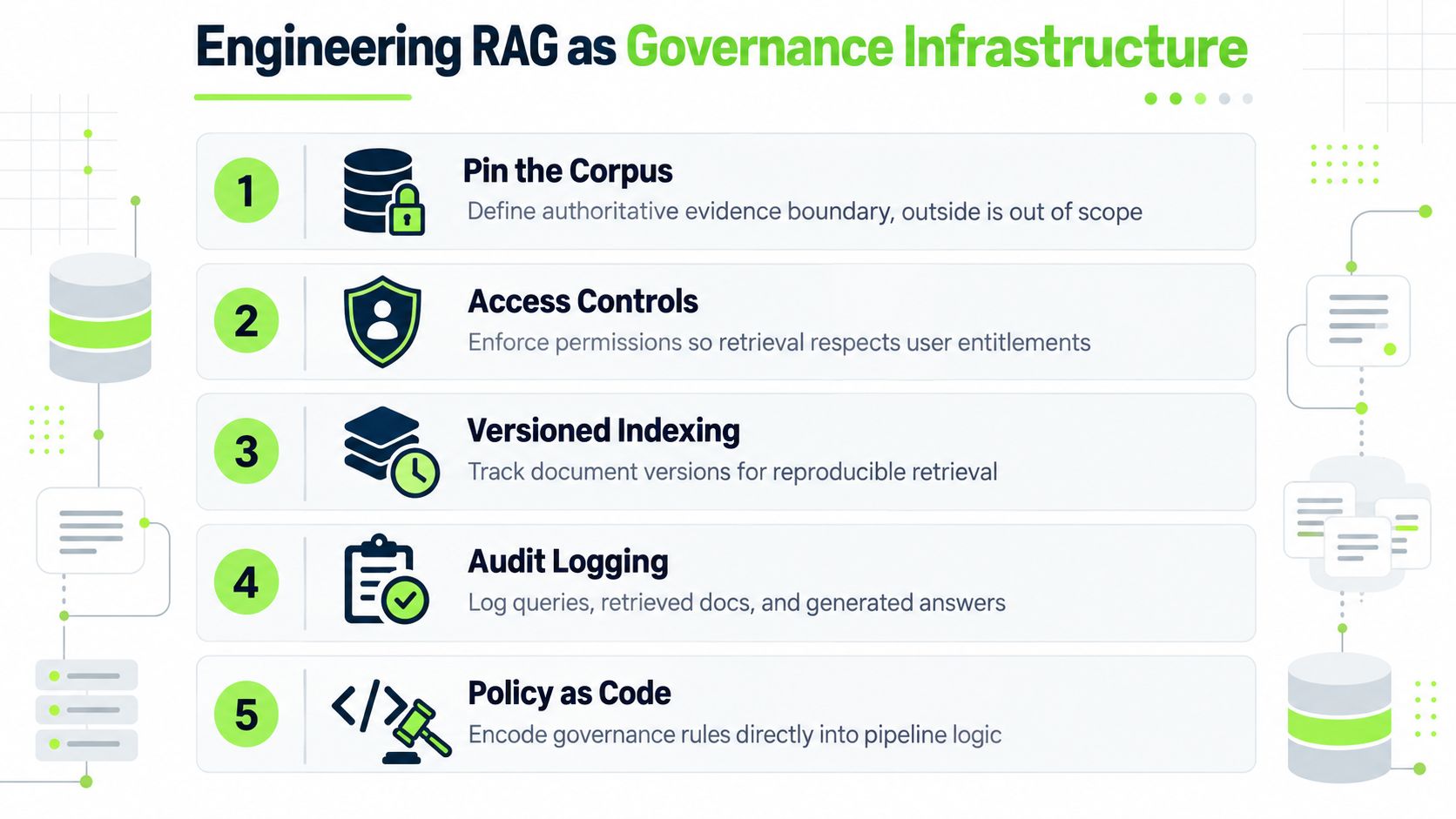
A production RAG platform needs enforceable policy, not prompt conventions. Before several teams share the same foundation, define which corpus is authoritative, which evidence each identity may use, how indexes change, and what an answer must show.
Five decisions belong in the platform
Pin the corpus. Set the evidence boundary explicitly. A claim absent from that corpus is unverifiable, even if the base model appears to know it.
Make access control executable. Apply tenant scope, row-level permissions, document ACLs, and resource restrictions during retrieval. Prompts can guide wording, but they do not grant authority. Evidence that exists in storage is not automatically evidence the system may use.
Version ingestion and indexing. Centralize chunking, preprocessing, embedding versions, metadata schemas, and index promotion. Regenerated corpora should be reproducible, diffable, and reversible.
Standardize provenance and abstention. Use one citation object and one defined refusal path across applications. Each product should not invent its own meaning for insufficient evidence.
Log enough to reconstruct behavior. Record the request, authenticated identity, filters, retrieved documents, document versions, assembled context, model version, answer, citations, and policy decisions. Apply separate retention and access controls to sensitive logs.
Treat model swaps and embedding migrations as deployments. Build a shadow index, replay representative traffic, compare retrieval and grounding results, and promote the change only after authorization and citation checks pass.
One option is AletheionAGI, a grounding and evidence-control layer intended to work with existing LLMs, RAG pipelines, vector databases, and memory systems. Its documented scope covers persistent memory, authorized retrieval, fail-closed grounding, evidence handling, and audit-oriented infrastructure. Teams can assess it as a control layer rather than a replacement for their model or search stack.
The goal is explicit system behavior: what it knows, what it may use, what it can prove, and when it must stop. That distinction turns retrieval from a relevance feature into governed infrastructure.