Many teams still treat an AI knowledge base like a better search box. That's the wrong mental model. In production, the hard part isn't finding text, it's deciding which evidence is allowed to leave the system, which evidence is stale, and when the answer should stop instead of improvising.
That shift matters because retrieval-augmented generation, or RAG, was introduced in 2020 as a retriever-reader architecture that conditions generation on external evidence at inference time, and the original paper reported state-of-the-art results on three open-domain QA tasks (Lewis et al., 2020 overview). Since then, RAG has moved from a research pattern into the default architecture for knowledge-grounded enterprise systems. The lesson from production isn't “add more chunks.” It's that an ai knowledge base has to behave like an evidence-control system.
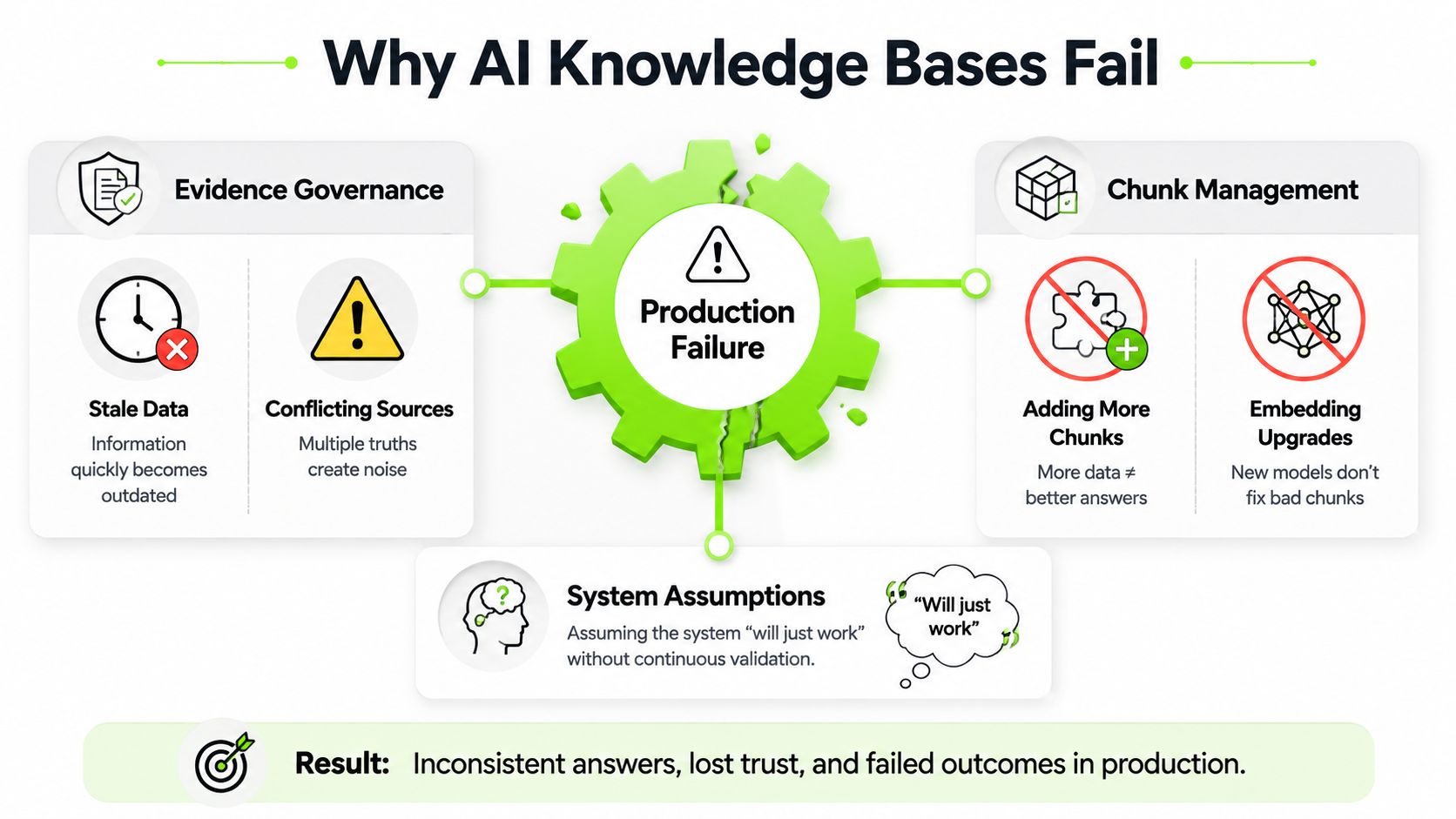
Why Most AI Knowledge Bases Fail in Production
The usual failure is not weak embeddings. It is a weak boundary. Teams improve vector models, add rerankers, and expand chunking strategies, then still ship answers that sound polished but rest on stale, mismatched, or unauthorized evidence. Once that happens, the system stops acting like a knowledge layer and starts acting like a confidence amplifier.
Evidence drift beats model quality
Evidence drift happens when the corpus no longer matches the business. A policy article stays indexed after the policy changed. A support playbook gets rewritten, but the old chunk still ranks higher because it shares more terms. The user gets a fluent answer that is grounded in the wrong version of reality.
That is why the adoption story matters. A 2026 industry summary says 38% of enterprises already had RAG in production for internal knowledge retrieval, 29% were in pilot or proof-of-concept, and 33% had not started a RAG initiative (enterprise AI knowledge management statistics, 2026). Analysts at the same source say employees can spend 19% of the workweek, or roughly 7.5 hours, searching for information that already exists internally. Those numbers do not prove retrieval alone solves anything. They show why stale answers become operational debt.
Practical rule: if the retrieval layer cannot tell you which version of a document it used, you do not have a knowledge base yet, you have a document pile.
Scope violations and hallucinated attribution
The second failure mode is scope leakage. A tenant asks for its own evidence, and the system pulls from another tenant, another business unit, or a retired source. The problem gets worse when the model is trusted to clean up missing context, because it will fill gaps with plausible language that reads like a citation even when no support exists.
Recent evidence on retrieval-augmented generation shows why this is dangerous. When answers were fully supported, reported hallucination or fabrication rates were near 2%. Under partial evidence, they rose to about 48%, and under unsupported evidence, to 65% (RAG hallucination and legal audit findings). A knowledge base fails most sharply when it looks almost right.
The core mistake is treating the KB as a retrieval pipeline alone. Retrieval is only one gate. The delivery boundary, authorization model, and abstention behavior decide whether the user gets grounded evidence or a confident fabrication.
Designing Canonical Memory and Namespace Architecture
A production ai knowledge base needs a canonical memory model before anyone debates embeddings. If the source of truth is fuzzy, every downstream retrieval choice inherits that ambiguity. The architecture has to answer a simple question, which copy of this fact is authoritative right now?
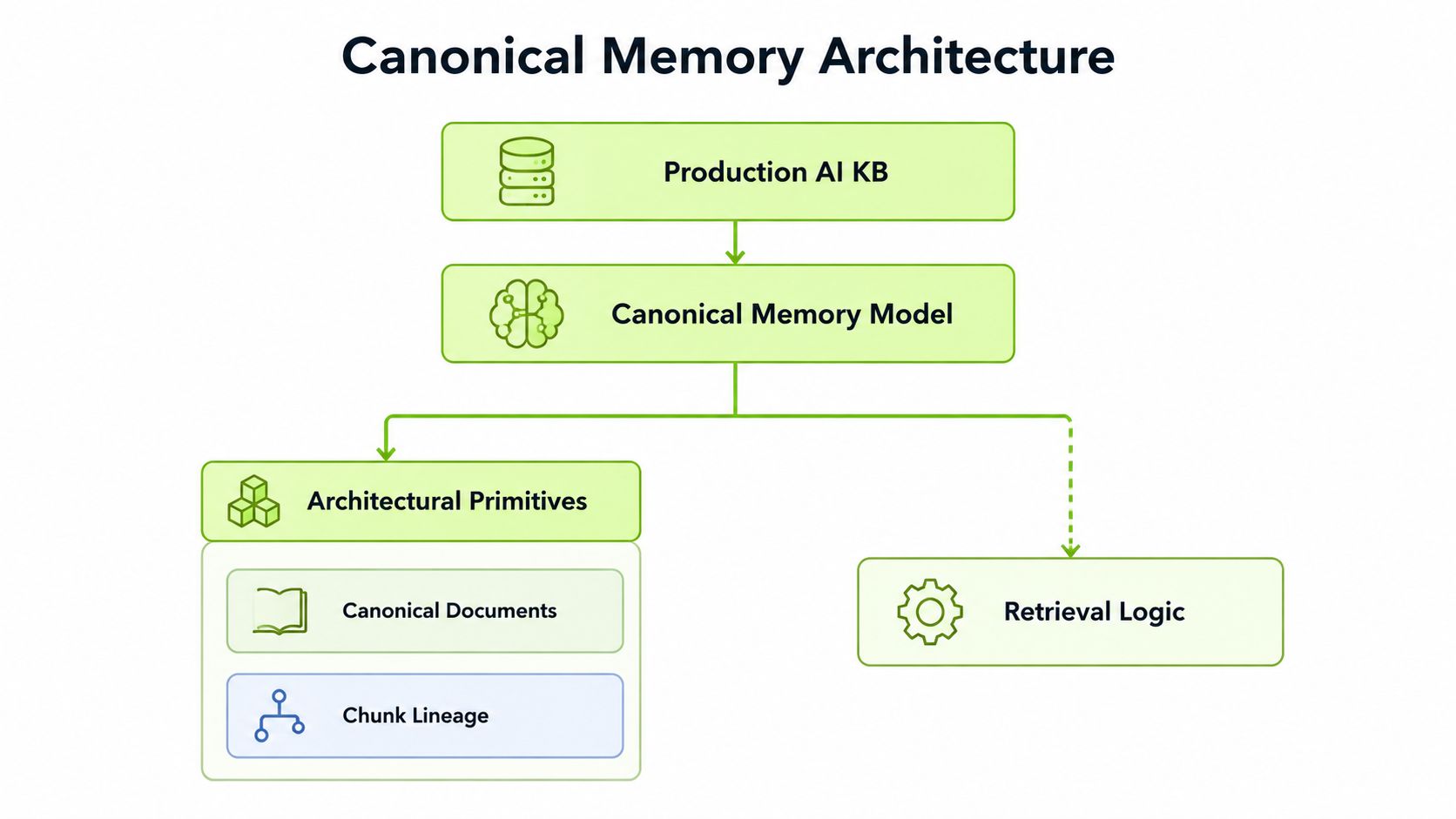
Canonical documents and chunk lineage
Canonical memory means one authoritative record per unit of evidence, with every derived chunk traceable back to that record. In practice, that means stable document IDs, versioned source records, and chunk metadata that carries origin, scope, and freshness. If a chunk can't be traced, it shouldn't be allowed to answer anything sensitive.
For multi-product SaaS, I like to separate memory by product surface and by lifecycle stage. Drafts, approved docs, and revoked content should not share the same retrieval path. Regulated industries need even tighter separation, often by tenant, domain, and legal authority. That doesn't mean every collection needs to be physically isolated, but it does mean the system must preserve lineage and make revocation explicit.
Namespace separation versus shared collections
Published multi-tenant vector-store patterns usually boil down to three options, dedicated collections, shared collections with namespace or partition-key separation, and shared collections with tenant-ID metadata filtering (multi-tenancy vector database patterns). Dedicated collections give the clearest physical boundary. Shared collections are easier to operate, but every query has to carry the correct tenant scope.
Independent security guidance goes a step further. It recommends enforcing isolation at the vector-store query layer using a signed JWT claim for tenant ID, plus one namespace per tenant or a dedicated index for high-compliance tenants (strict data isolation in multi-tenant RAG). That's the right instinct. Tenant identity should come from authenticated context, not user input.
A namespace is not a policy. If authorization isn't checked at retrieval time and output time, the model can still see too much.
The operational takeaway is straightforward. Use shared infrastructure if you need it, but require authoritative metadata, immutable lineage, and server-side scope checks on every read path. If you can't prove a chunk's origin and permission state, don't let it participate in answer generation.
Implementing Hybrid Retrieval That Improves Recall
Hybrid retrieval is one of the few changes that can raise recall, but only when you measure it against real failures. The common mistake is to mix BM25 and dense search because it sounds modern, then never verify whether the extra complexity closes a specific gap. In production, retrieval should miss less often, not produce a more polished miss.
The pattern that usually holds up is sparse retrieval, dense retrieval, fusion, then reranking. A measured benchmark reports recall@10 rising from 0.65 to 0.78 for sparse-only or dense-only retrieval to 0.91 for hybrid fusion, with reranking pushing it to 0.93+. Another domain-specific evaluation reports Recall@5 improving from 0.72 with dense-only retrieval to 0.91 with hybrid plus rerank (hybrid search benchmark details). Scope matters here. These results are benchmark-specific, not universal truth.
| Domain Type | Retrieval Method | Recall@10 | p95 Latency (ms) | Recommendation |
|---|---|---|---|---|
| Technical documentation | Single-mode sparse or dense | 0.65 to 0.78 | Not reported in the source | Start here only if queries are narrow and exact-match heavy |
| Technical documentation | Hybrid fusion | 0.91 | Not reported in the source | Add when single-mode misses exact terms or semantic equivalents |
| Technical documentation | Hybrid plus rerank | 0.93+ | Not reported in the source | Use when recall gaps remain after fusion |
| Conversational support logs | Single-mode sparse or dense | 0.65 to 0.78 | Not reported in the source | Usually insufficient when phrasing varies |
| Conversational support logs | Hybrid plus rerank | 0.91 to 0.93+ | Not reported in the source | Strong fit when intent and wording diverge |
| Structured policy documents | Dense-only | 0.72 | Not reported in the source | Risky if exact clause matching matters |
| Structured policy documents | Hybrid plus rerank | 0.91 | Not reported in the source | Better when policy language is precise and multi-part |
When hybrid search earns its keep
Use BM25 when exact terms matter, such as product codes, policy clauses, or legal phrases. Use dense retrieval when the user's phrasing varies and semantic similarity matters more than wording. Add hybrid fusion when the two modes fail differently, one on exact match, the other on semantic drift.
Reranking is the last mile, not a rescue engine. It can reorder what was retrieved, but it cannot recover evidence that never made it into the candidate set. That is why frozen query sets matter. Measure recall first, then add complexity only where the query type justifies it.
For teams comparing architecture trade-offs, the practical playbook is similar to the one I would apply around AI safety tools and review workflows. Start simple, measure on real queries, and only add components that close a documented gap.
Building a Fail-Closed Delivery Boundary
Most RAG pipelines fail open. Retrieval comes back weak, the prompt still gets sent, and the LLM fills the holes with something that sounds helpful. That's fine for low-risk brainstorming. It's a bad design for support automation, compliance workflows, or any buyer-facing answer that needs auditability.
What fail closed actually means
Fail closed means the system blocks unsupported claims before delivery. The boundary doesn't ask whether the model can produce a fluent response. It asks whether the retrieved evidence is sufficient, authorized, and consistent enough to justify a response at all. If not, the system abstains.
The simplest implementation is citation anchoring. Every claim in the draft answer needs a mapped evidence chunk, and every mapped chunk needs to pass a confidence threshold. If one claim can't be traced, the response should either remove it or return an explicit inability to answer safely.
A useful evaluation frame is to classify outputs as GROUNDED, MIXED_LEAKAGE, or ABSTENTION. That's more actionable than generic “good or bad” scoring because it separates supported content from unsupported content and makes the failure mode visible.
How to wire the boundary
Start with retrieval confidence, then add generation checks. A low retrieval score is not enough by itself, because some queries are hard but still answerable. Combine evidence coverage, semantic similarity between the answer and the retrieved text, and an explicit authorization check. If the evidence is partial, return the supported part and mark the gap.
Unsupported claims should be blocked before they reach the user, not patched after the fact.
The boundary can also use lightweight uncertainty signals from the model output, but don't trust logit confidence alone. I've seen fluent answers with good-looking scores that still drifted outside evidence. The safer pattern is to treat confidence as one input among several, then require a final policy decision that can choose abstain.
AletheionAGI fits as one option. It sits in front of existing LLMs, vector databases, and memory systems as a grounding and evidence-control layer, so unsupported claims are stopped before delivery rather than surfaced and flagged later.
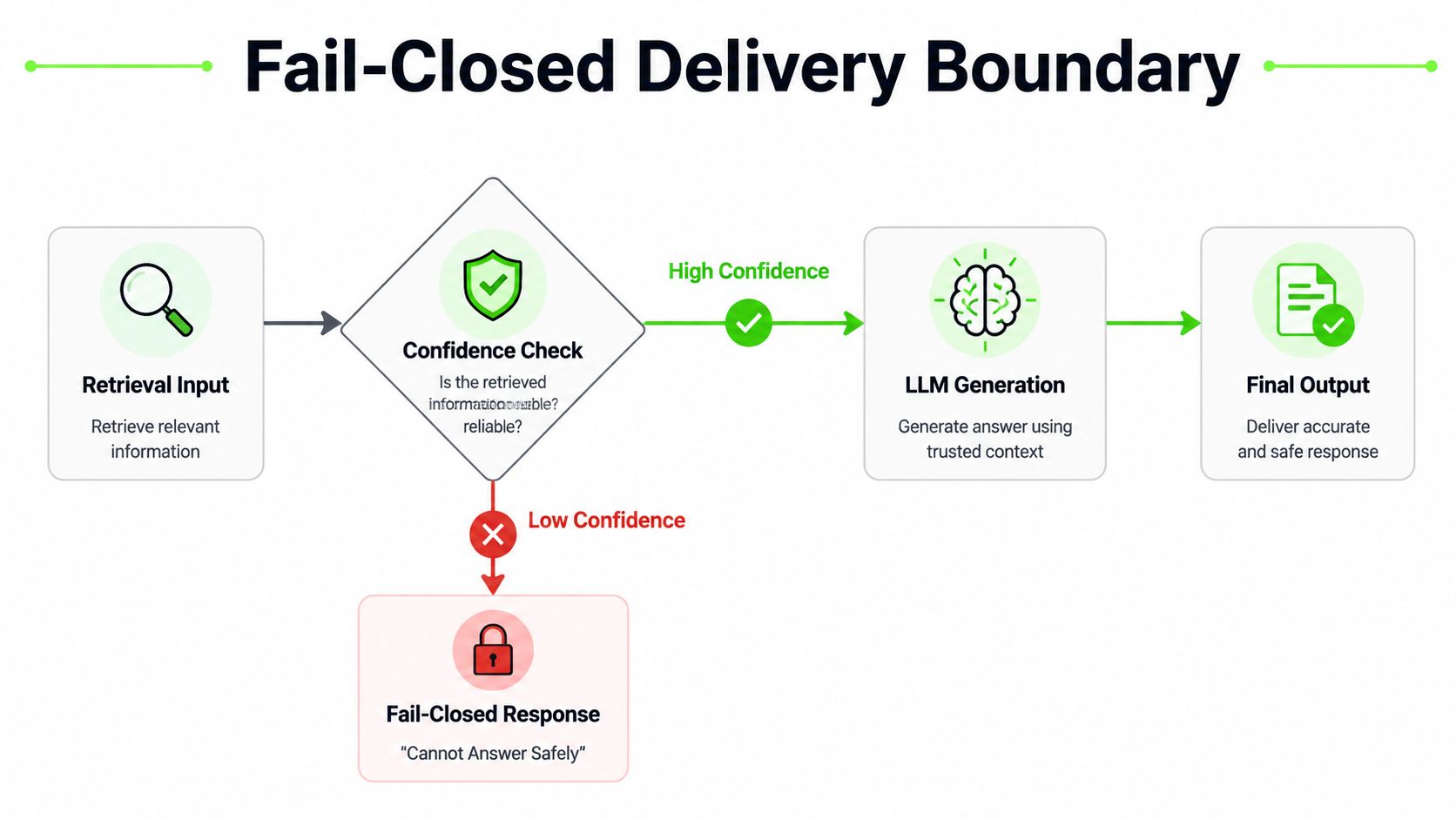
Enforcing Multi-Tenant Isolation at Every Layer
Multi-tenant isolation breaks in the gaps between systems. A prompt may be scoped correctly, while the vector query is not. Or the retrieval is filtered, but cached outputs and logs still expose cross-account content. That's why tenant isolation has to be enforced everywhere, not just in the UI or the prompt template.
Three isolation models and their trade-offs
Dedicated vector collections per tenant give the strongest separation because the tenant boundary is physical. The downside is operational sprawl, especially when you need analytics across many tenants or have large tenant counts. Namespace separation inside shared collections reduces overhead, but it depends on every query carrying the right scope, every time.
Metadata-based filtering is the most flexible and the easiest to retrofit. It's also the most fragile when the filter logic is wrong or missing. Several published patterns stress that tenant IDs should come from authenticated context rather than user input, and that negative tests are necessary so Tenant A can't access Tenant B's data (multi-tenant vector DB isolation patterns).
| Isolation Model | Security Guarantee | Operational Complexity | Cost at Scale | Best For |
|---|---|---|---|---|
| Dedicated collections per tenant | Strongest physical separation | High | Higher operational overhead | High-compliance workloads |
| Namespace separation | Good if query-time scope is enforced | Medium | Moderate | SaaS with manageable tenant counts |
| Metadata filtering | Flexible, but bug-prone | Low to medium | Efficient at large scale | Fast-moving systems with strong test coverage |
Defense in depth is non-negotiable
Security guidance for multi-tenant RAG recommends a signed JWT claim for tenant ID at the vector-store query layer, plus mirrored source-system ACLs in chunk metadata that refresh when permissions change (strict isolation guidance). That lines up with what breaks in production. Revocation is where many systems fail because permissions change after ingestion.
The operating principle is simple. Query-time authorization, namespace separation, and output-time validation all have to agree before content reaches the model. If tenant context is missing, the service should fail closed. Cross-tenant leakage can happen through retrieval, caching, logging, or generation, so every layer needs its own check.
Managing Versioning Freshness and Evidence Lifecycle
Freshness problems usually look like retrieval bugs, but they're really lifecycle bugs. The system found a document, just not the right version. Or it found two valid sources that disagree and had no policy for deciding which one should win. That's why evidence maintenance has to be designed into the knowledge base instead of bolted on after launch.
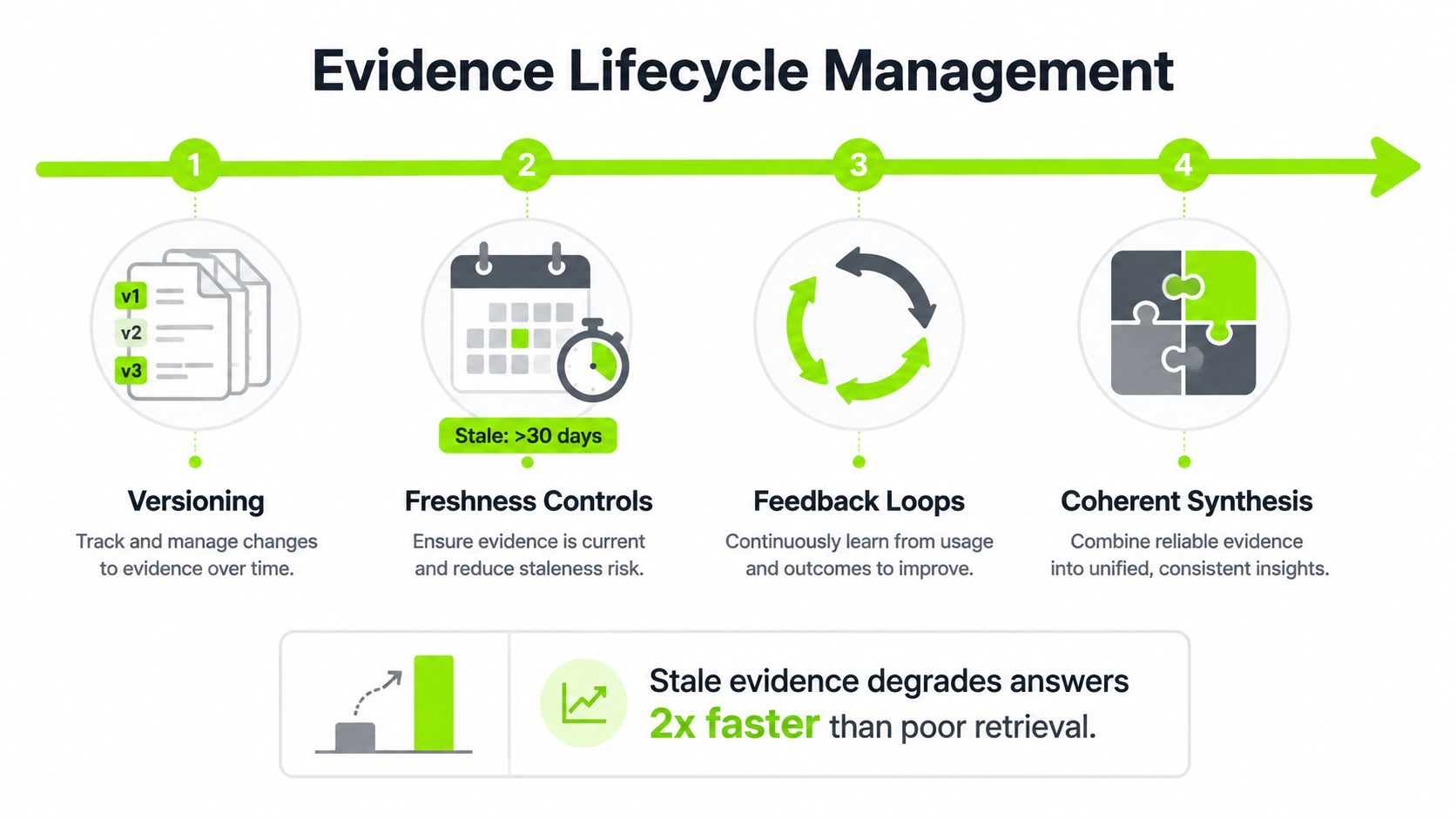
Versioning and freshness controls
A useful model is to keep historical versions for auditability while making the latest authoritative version easiest to retrieve. That usually means versioned document IDs, freshness metadata, and a ranking layer that favors current approved content without deleting the past. You want the system to remember old truth, but not confuse old truth with current truth.
The evidence lifecycle should include decay rules. Age alone isn't enough, because some policies change slowly and some product docs expire quickly. Source authority matters too, and contradiction signals from newer documents should reduce confidence in older chunks. TTL-based expiration works well for time-sensitive material, but it needs a human review path for sources that are old yet still valid.
Conflicts and feedback loops
When valid sources disagree, the answer should surface the conflict rather than arbitrarily picking one. That sounds obvious until you watch a support bot choose the newer article even though it refers to a narrower use case. Semantic similarity helps identify contradictions, but it won't replace human review when sources are in tension.
Don't hide conflict behind a confident summary. Expose the disagreement, then abstain on the unsupported part.
Feedback matters here too. User corrections and thumbs-down signals are useful only if they feed back into evidence scoring, not source memory itself. A feedback ledger should be reversible. It should improve ranking behavior without contaminating canonical content. That's especially important when source quality varies by team, region, or product line.
The lifecycle point that most guides miss is governance. Freshness, versioning, and source trust are not maintenance chores. They're part of the retrieval contract.
Measuring What Matters in Your Knowledge Base
Top-k accuracy is too shallow to judge an enterprise ai knowledge base. A system can retrieve the right chunk and still deliver a weak answer, or retrieve the wrong scope and still sound polished. The measurement model has to separate retrieval quality, delivery containment, and operational guarantees.
A practical three-tier scorecard
Retrieval quality starts with recall@k, MRR, and nDCG on a labeled query set. Those metrics tell you whether the right evidence is getting into the candidate pool. Delivery containment is different. It measures whether the system abstains when it should, avoids unsupported claims, and blocks mixed-leakage answers before they leave the boundary.
Operational guarantees are the last tier. Track p95 latency, index freshness lag, and tenant leakage incidents. If the system is fast but leaks scope, it's not production-ready. If it's safe but too slow for support workflows, it still fails the business.
| Tier | Metric | Target | Audit Frequency |
|---|---|---|---|
| Retrieval quality | Recall@k, MRR, nDCG | Must be defined on a frozen query set | Weekly |
| Delivery containment | Abstention rate, hallucination rate, unsupported claim frequency | Must trend downward on unsupported queries | Weekly |
| Operational guarantees | p95 latency, index freshness lag, tenant leakage incidents | Must stay within service and security limits | Continuous plus weekly review |
Build the evaluation set before shipping
The strongest teams I've seen maintain a golden set of 200+ queries with ground-truth evidence spans, then run weekly regressions against it. The queries should include fully supported, partially supported, unsupported, and scope-violating cases. That mix is what exposes whether the boundary really fails closed.
The log stream matters too. Every abstention and fallback should be stored as signal, not ignored as a dead-end. If the system abstains too often, you have a retrieval or coverage gap. If it never abstains, you probably have a hallucination problem hidden by confidence.
A knowledge base is only as trustworthy as its worst audited answer.
Before shipping, I'd require five gates. The query set has to be frozen, tenant isolation tests have to pass, unsupported queries have to abstain, freshness and revocation have to be verified, and every high-risk answer path needs an audit trail. If one of those gates fails, the right move is to hold the release, not tune the prompt.
If you want a grounding layer that enforces authorized evidence, fail-closed delivery, and namespace-isolated memory in front of your existing LLM stack, take a look at AletheionAGI. It's built for buyer-facing systems where stale, unsupported, or cross-tenant answers create real risk. If your team is shipping an AI knowledge base, it's worth comparing your current retrieval pipeline against a boundary that blocks unsafe claims before users see them.
Powered by Outrank app