Your support agent answers a customer's billing question in seconds. The response is clear, polite, and completely unsupported by the customer's contract. A retrieval step found an old document, the model filled the gaps with plausible language, and the application delivered the answer without checking whether the evidence applied to that tenant or claim.
That failure isn't primarily a prompt problem. It's an evidence-control problem. Production-grade AI hallucination prevention requires authorized retrieval, claim-level validation, provenance, and a deliberate refusal path when the system can't support an answer.
Why AI Hallucinations Persist in Production Systems
Language models generate likely sequences of text. They don't automatically distinguish a verified statement from a plausible one, and fluency can hide that distinction from users and developers alike. A prompt that says “be accurate” may influence style, but it doesn't create a source of truth, enforce permissions, or prove that each sentence follows from retrieved evidence.
That's why a RAG pipeline can still hallucinate. The retriever may return irrelevant chunks, the generator may ignore the context, the application may mix authorized and unauthorized documents, or the final response may introduce claims that never appeared in the evidence. Retrieval helps only when the system treats evidence as a constraint rather than optional background.
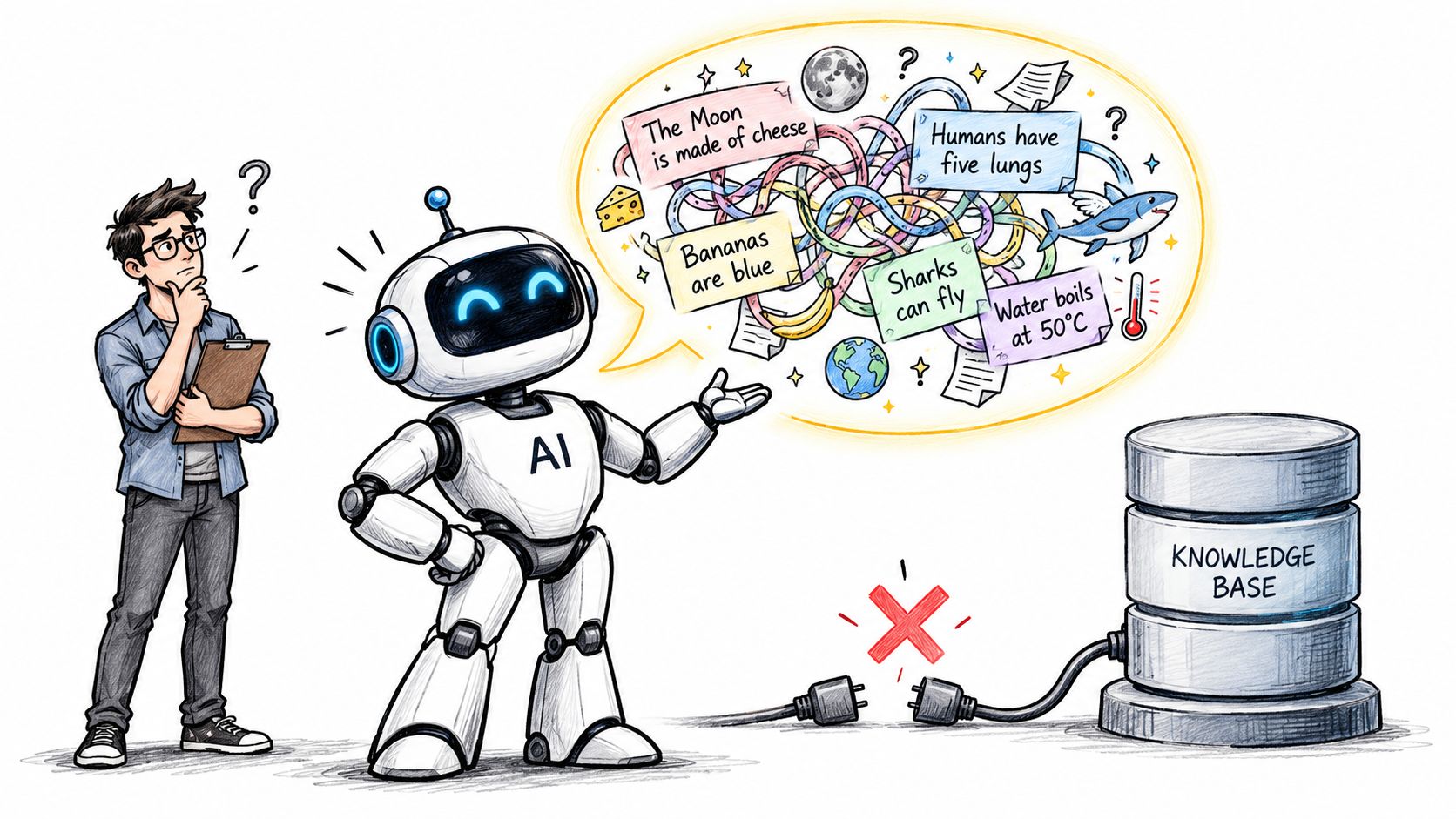
The production failure is usually architectural
A support workflow illustrates the problem. The user asks about an account policy, the system searches a vector database, and an LLM drafts an answer. If the application doesn't attach the authenticated tenant, user role, document version, and source identifiers to the retrieval request, the model can receive evidence that looks relevant but isn't authorized or current.
The same pattern appears in agents. An agent may use a memory store to remember a preference, a search tool to find a policy, and an action tool to update an account. Without explicit boundaries, remembered context can be mistaken for authority, and a proposed action can be treated as an approved one.
Practical rule: A model may propose an answer or action. Evidence, authorization, and policy must decide whether delivery or execution is allowed.
The AI alignment problem becomes operational here. Teams need a system that keeps model behavior aligned with authorized state and verifiable evidence, not merely a model that sounds cautious.
Grounding needs a bridge between systems
A useful grounding bridge connects four layers:
- Intent and request state, including what the user is asking, which constraints apply, and what remains ambiguous.
- Authorized retrieval, which filters every source using the authenticated principal and relevant tenant or workspace.
- Claim validation, which tests whether the drafted answer is supported at the level of individual assertions.
- Delivery policy, which cites, rewrites, routes, or refuses based on evidence.
AletheionAGI's GQueries fits this architecture as a composable grounding and memory layer. It works alongside existing LLMs, RAG pipelines, vector databases, and memory systems, providing persistent memory, authorized retrieval, and fail-closed grounding rather than replacing those components. IntentParse addresses the adjacent intent problem by turning raw user language into structured facts, constraints, preferences, unresolved dimensions, and provenance.
The trade-off is real. Hard evidence gates can increase refusal rates, latency, engineering effort, and review workload. Soft prompting is easier to deploy, but it leaves unsupported output in the system. For sensitive customer data and agent actions, that trade is usually preferable to optimizing for answer coverage at the expense of provenance.
Building Grounding Bridges That Enforce Evidence
A reliable RAG workflow should behave like a controlled pipeline, not a prompt with a search result pasted into it. The core sequence is retrieve first, gate evidence, generate from authorized context, validate claims, then deliver or abstain.
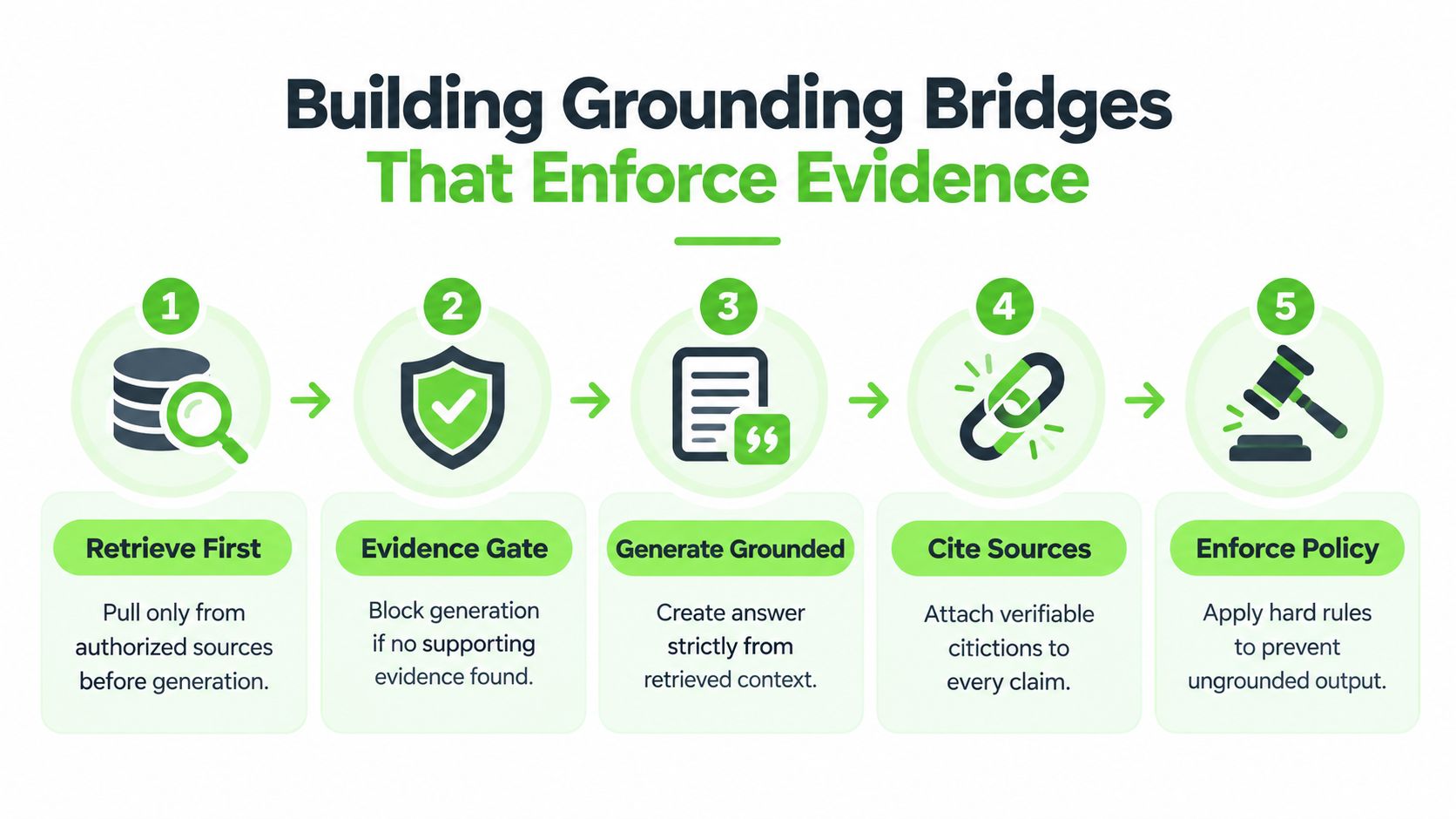
Start with authorized retrieval
The request should carry an authenticated principal into the retrieval layer. That principal drives tenant filters, workspace scope, document permissions, retention rules, and any policy constraints. The application shouldn't retrieve broadly and attempt to remove unauthorized content later. Authorization belongs inside the retrieval path.
Retrieve from approved sources before invoking generation. Those sources might include a product knowledge base, a contract repository, a policy database, or a structured business API. Source selection should preserve identifiers, document versions, timestamps, and access decisions so downstream components can reconstruct why a passage was returned.
The evidence gate then asks a binary question: is there enough authorized evidence to answer this request? If the answer is no, the system should stop or route the request. It shouldn't ask the model to “do its best.”
Generate under a hard evidence contract
The generation call should receive only the evidence selected by the gate, plus explicit output requirements. The contract can require:
- Claim scope, answer only what the retrieved material supports.
- Citation binding, attach a source identifier to every factual claim.
- No completion of gaps, leave unsupported fields unresolved.
- Structured uncertainty, distinguish supported facts from missing information.
- Action separation, propose actions without executing them unless policy authorizes execution.
Many RAG implementations fail. They retrieve documents, place them in a context window, and assume the model will obey. A 2026 multi-model study reported that generation-time retrieval grounding reduced citation hallucination by 75% to 90%, while prompting alone reduced it by 5% to 15%. The study's implementation lesson is specific: retrieval must function as a hard evidence gate, not a soft prompt. Read the study's grounding benchmark discussion.
Make the trail inspectable
Log the query, authenticated principal, tenant scope, retrieval channels, returned source IDs, ranking decisions, prompt or policy version, model version, generated claims, validation results, and final delivery decision. Keep enough information to reproduce the decision without exposing sensitive content unnecessarily.
A grounding layer such as GQueries can maintain persistent memory and authorized retrieval alongside an existing vector database. The design still needs explicit application policies, because a memory component shouldn't become an unbounded authority source.
For a practical foundation, teams can review enterprise AI knowledge-base design with attention to source ownership, freshness, access control, and provenance. The architecture should make unsupported output difficult to produce and easy to diagnose when it occurs.
A video can help teams visualize the workflow before translating it into services and evaluation cases:
The common failure modes are predictable: retrieving from the wrong tenant, allowing generation when retrieval returns nothing, passing entire documents without relevance controls, dropping citations during post-processing, and validating with the same model that generated the answer. Each failure weakens the evidence boundary.
Validating Every Claim Before Delivery
Generation controls reduce risk, but they don't prove that the final answer is supported. Delivery needs an independent validation stage that treats the response as a set of claims rather than a single polished object.
The RAG triad provides a practical frame: context relevance, groundedness, and answer relevance. Context relevance asks whether retrieved documents match the request. Groundedness asks whether the response's claims are supported by that context. Answer relevance asks whether the response addresses the user's actual question rather than producing a related essay. The RAG triad framework specifically aligns groundedness with splitting a response into individual claims and checking support independently.
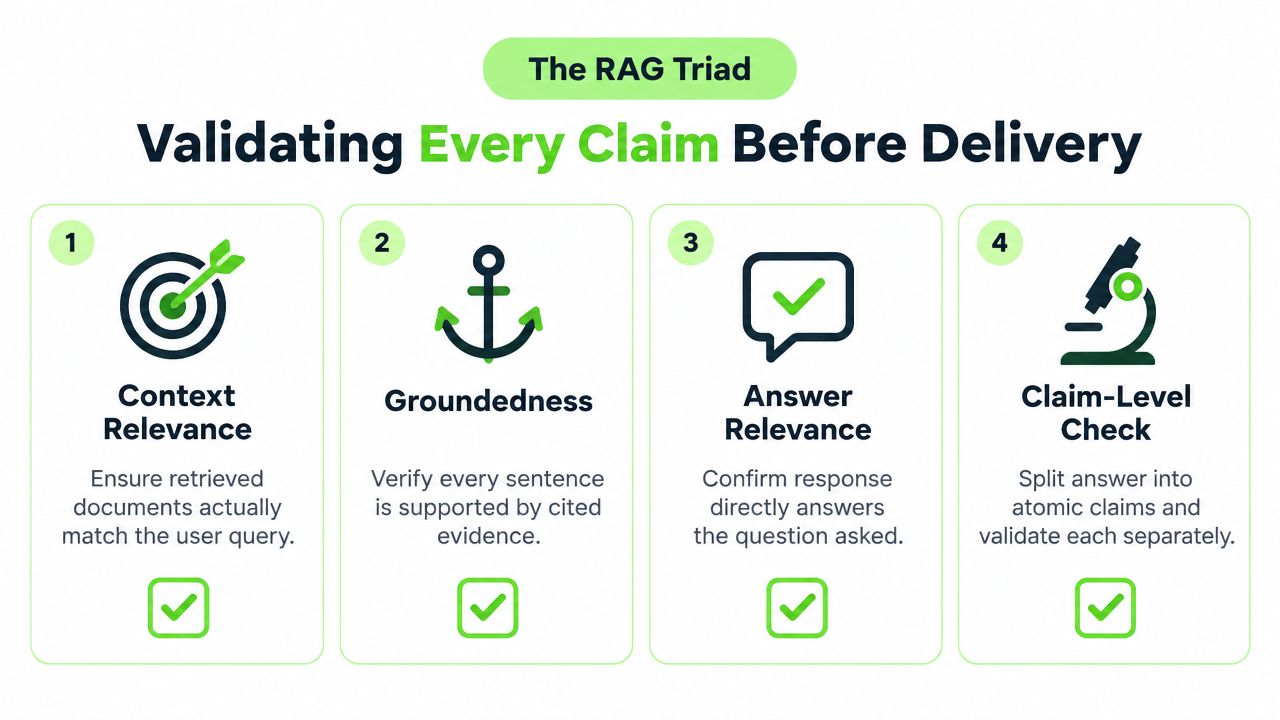
Split prose into atomic claims
Consider this answer:
“Your enterprise plan includes priority support, permits unlimited seats, and renews automatically each year.”
That's at least three claims. The contract may support priority support but say nothing about seats or renewal. A sentence-level check could mark the entire sentence as supported or unsupported and miss the partial failure. Claim-level validation exposes the exact unsupported assertion.
A validator can extract atomic claims, map each claim to cited evidence, and classify the result as supported, contradicted, ambiguous, or unsupported. The delivery policy can then remove unsupported claims, request clarification, route the request to a reviewer, or refuse the full answer when the missing claim is central.
The following table turns the RAG triad into an operational check:
| Check | What to Verify | Fail Action |
|---|---|---|
| Context relevance | Retrieved passages address the user's request and authorized scope | Retrieve again, narrow the query, or abstain |
| Groundedness | Each factual claim has supporting text in the retrieved context | Remove, rewrite, cite, or block the claim |
| Answer relevance | The response answers the user's actual intent and constraints | Regenerate against the normalized intent |
| Claim-level check | Atomic claims don't exceed the evidence or combine unrelated sources | Split the response, flag uncertainty, or refuse |
Keep validation independent
A second call to the same generator can help identify suspicious output, but it shouldn't be treated as proof. Independent checks can use deterministic rules, structured databases, source comparison, or a separate detector. Numbers, dates, product entitlements, and legal or medical terminology deserve specialized validation where authoritative systems exist.
A retrieval-based hallucination detector reported F1 = 0.83 on the RAGTruth response-level classification task, matching methods trained on that dataset while outperforming comparable similarly sized models. The result applies only to that benchmark and task setting, so it shouldn't be presented as a universal production accuracy guarantee. Review the detector's benchmark scope.
Provenance should remain visible to downstream systems, not just users. Store claim-to-source mappings in the response object, so a support console, audit service, or policy engine can inspect the evidence without parsing natural language. If a citation points to a source that the current user can't access, the system should not expose the claim or the protected citation.
Designing Abstention Policies That Fail Closed
A system that answers every question is often less reliable than one that knows when to stop. In customer support, a controlled refusal may create a small amount of friction. A confident answer based on missing or unauthorized evidence can create a larger operational, compliance, or trust problem.
Recent survey work describes a shift from trying to eliminate hallucinations entirely toward managing risk through detection, flagging, containment, and cross-validation. It also highlights a persistent gap in practical guidance around when retrieval should be mandatory, when the system should abstain, and how to compare false confidence with false refusal. Read the survey discussion of hallucination risk management.
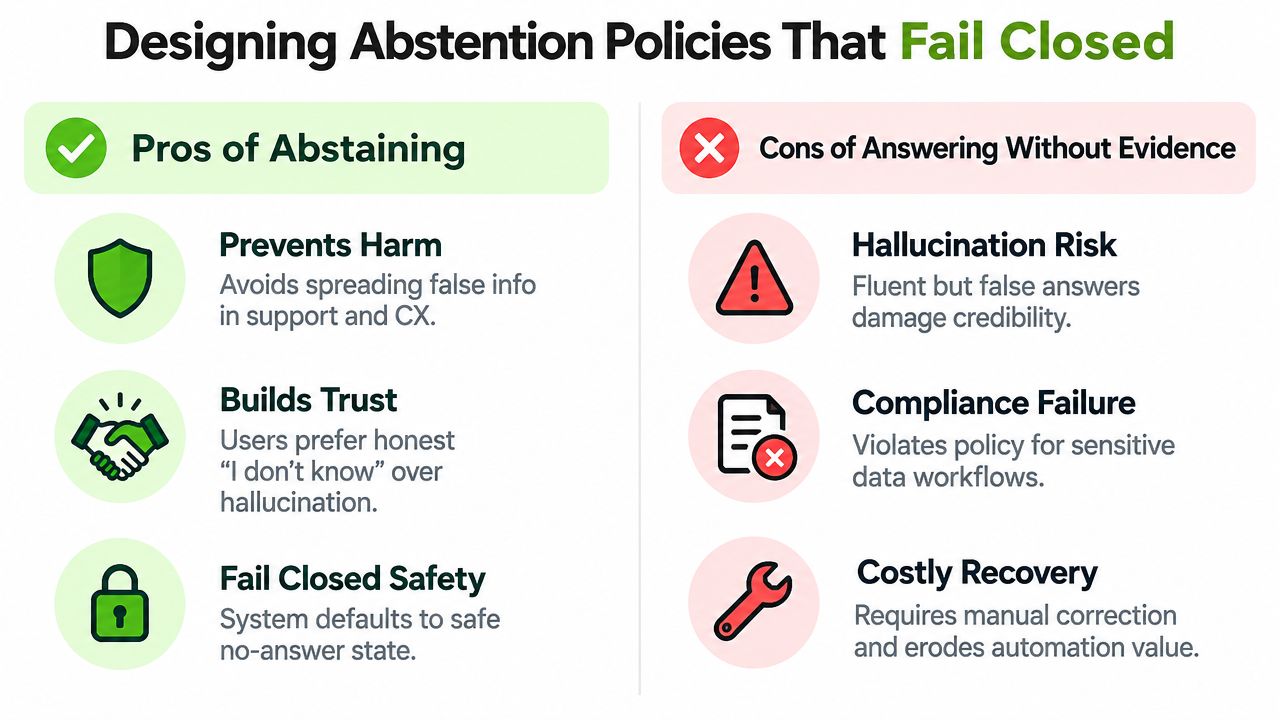
Define refusal conditions before launch
Abstention shouldn't be an improvised sentence generated after the model gets confused. Define policy conditions in code and test them as product behavior.
Mandatory retrieval is appropriate when the request concerns private account data, current policy, regulated guidance, contractual terms, or an action with external impact. The system should refuse or route when retrieval returns no authorized evidence, evidence conflicts, the user's intent remains materially ambiguous, or claim validation fails for a central assertion.
A useful refusal should explain the next safe step without pretending to know more than the system knows:
- “I couldn't verify that from the documents available to your workspace.”
- “I found conflicting policy versions, so this needs review.”
- “I can explain the documented process, but I can't approve the exception.”
- “Please clarify which account or product you mean.”
The response should expose uncertainty in a bounded way. Avoid invented confidence scores unless they're calibrated and understood by operators. A source list, missing-evidence reason, and escalation path are often more useful than a vague statement that the model is “not completely sure.”
Treat abstention rate as a health signal
Abstention isn't automatically good. A near-zero abstention rate can indicate that the gate is too permissive, while a sudden spike can indicate an ingestion failure, permission regression, stale index, or retrieval coverage problem. Graph-RAG operational guidance recommends logging the retrieval trail, cross-referencing source tags against original documents, and tracking abstention rate for exactly this reason. See the graph-RAG guidance on abstention and evidence trails.
Teams should audit refusals by reason, tenant, workflow, source collection, model version, and policy version. Review both false refusals and false acceptances. A support organization may choose broader escalation for account actions, while a low-risk product FAQ can tolerate a narrower refusal policy, provided the evidence and authorization boundaries remain intact.
A practical external reference for regulated workflows is this pharma-ready AI safety framework, which is useful when teams are translating general guardrail ideas into domain-specific controls. The key principle remains simple: missing evidence should produce a safe no-answer state, not a fluent guess.
Strengthening Retrieval Hygiene and Tenant Isolation
Hallucination prevention fails if retrieval itself violates data boundaries. A response can be factually correct about another customer and still be a severe production failure. In multi-tenant systems, authorization is part of evidence quality.
Put tenant identity inside the query path
The authenticated principal should drive filters at query time. Don't retrieve from a shared index and rely on a later middleware step to remove documents. Apply tenant, workspace, role, resource, and policy filters before ranking results or assembling context.
Every retrieval channel needs the same treatment:
- Vector search must enforce tenant and resource filters before results enter the context.
- Keyword search must apply equivalent authorization constraints.
- Graph traversal must prevent unauthorized nodes and edges from being explored.
- Metadata lookup must validate ownership and access independently.
- Memory retrieval must distinguish user, team, tenant, and system state.
Credentials should be explicit per call. A tool or memory service shouldn't infer authority from a conversational instruction such as “the customer approved this.” The authenticated policy layer must establish what the caller can read or do.
Test the negative path
Positive tests prove that an authorized user can retrieve expected evidence. They don't prove isolation. Maintain permission-negative tests where an unauthorized principal queries for known protected documents and receives nothing. Treat any returned passage, source identifier, citation, or derived answer as an evaluation failure.
Permission changes create another risk. When access is revoked, invalidate cached retrieval results, summaries, embeddings where necessary, generated memories, and other derived artifacts that could preserve the old authority. A permission update that changes the database but not the cache still leaves a leakage path.
Teams evaluating agent boundaries can use how isolates agents as a complementary resource, especially when one orchestration layer serves multiple customers. The implementation details will vary, but the control objective is consistent: a tenant boundary must survive retrieval, memory, tool calls, citations, logs, and downstream actions.
Audit the evidence supply chain
Ingestion should preserve source ownership, version, status, and provenance. Reject or quarantine documents with missing access metadata, ambiguous tenancy, broken source references, or failed parsing. When a graph or vector record cites a source tag, periodically cross-reference that tag against the original document.
The RAG for enterprise architecture guidance is relevant here because enterprise retrieval involves more than chunking and embeddings. It requires lifecycle controls, source authority, permission propagation, and reproducible retrieval decisions.
Use “authority before autonomy” as the design rule. Agents can suggest a response or action, but canonical state and authenticated policy must control what enters context and what executes.
Measuring and Operating Reliable Grounding Over Time
A grounded system needs an operating loop, not a one-time benchmark. Retrieval quality changes when documents are added, permissions change, chunking is revised, embedding models are replaced, prompts evolve, or an upstream API changes. A response that passed last month's evaluation may fail under a new protocol even if the model stayed the same.
Measure grounding, correction, and fact checks
Production teams should track at least three complementary signals:
- Grounding rate, the share of delivered factual claims that map to authorized retrieved evidence. One public benchmark recommendation targets grounding rates above 95%. See the grounding measurement guidance.
- User correction rate, the share of interactions where users report or operators confirm a factual correction. The same recommendation targets a rate below 10%.
- Fact-check pass rate, the share of sampled responses that pass independent verification. The cited recommendation targets above 97%.
These are targets, not universal guarantees. Define the denominator, sampling policy, claim extraction method, source eligibility rules, tenant scope, model version, and evaluation protocol before comparing results. Otherwise, teams can improve a dashboard by changing what counts as a claim.
A 2026 healthcare AI systematic review examined 427 retrieved studies and included 44 eligible papers, identifying seven strategy categories: RAG, knowledge graph integration, self-reflection frameworks, specialized evaluation metrics, human-in-the-loop approaches, specialized training techniques, and red teaming. In that review, RAG appeared in 18 of 44 studies, knowledge graphs in 12, and self-reflection or specialized training in 10 each. The review reported typical RAG reductions of 30% to 50%, human-in-the-loop reductions of up to 95% with scalability concerns, and interdisciplinary red-teaming improvements in hallucination detection of 20% to 40%. These findings span heterogeneous healthcare studies, so they should guide evaluation design rather than serve as a guaranteed production result. Review the healthcare AI mitigation findings.
Run a repeatable control loop
Freeze representative queries, adversarial prompts, permission cases, ambiguous requests, stale-document cases, and missing-evidence cases. Run them whenever retrieval, prompts, models, policies, ingestion, or memory changes. Record not only answer quality, but also retrieved sources, claim mappings, authorization decisions, abstentions, and tool actions.
A practical operating checklist is:
- Grounding: Can every delivered claim be traced to authorized evidence?
- Validation: Did an independent check detect unsupported, conflicting, or irrelevant claims?
- Abstention: Did missing or ambiguous evidence trigger the intended refusal policy?
- Isolation: Did unauthorized principals receive no protected evidence or derived output?
- Provenance: Can an operator reproduce why the system answered, refused, or acted?
The cancer chatbot study illustrates why source quality and grounding design must be measured together. Across 256 answered questions, the cancer information system produced hallucinations in 2 responses, or 2%, compared with 22 responses, or 18%, for a Google-retrieval chatbot and 48 responses, or 39%, for a conventional chatbot. At the model level, the cancer information system recorded 0% with GPT-4 and 6% with GPT-3.5, while Google-based retrieval recorded 6% and 10%, respectively. The study is specific to cancer information, its systems, questions, and evaluation method, so it doesn't establish a universal rate for all RAG applications. Read the clinical chatbot study.
The strongest production posture combines authorized retrieval, claim validation, fail-closed abstention, and continuous evaluation. AletheionAGI's GQueries can sit alongside existing LLMs, vector databases, RAG pipelines, and memory systems as a grounding and evidence-control layer, while teams retain responsibility for their own policies, data authority, and operational protocols.
AletheionAGI provides composable infrastructure for persistent memory, authorized retrieval, structured intent, provenance, and fail-closed grounding in production AI systems. Visit AletheionAGI to evaluate how an evidence-control layer can fit into your existing RAG, agent, and customer-support architecture.