Your support assistant passes the MMLU-style benchmark, produces polished answers, and still fails a production question. A customer asks about a contract clause, the retrieval layer returns a document from another tenant, and the model answers confidently without showing which passage supports the claim. The output sounds correct, but the system has violated the boundary that matters most.
That situation captures what is LLM evaluation in a production setting. It isn't just a score for a base model. It's a disciplined way to test whether the complete application, including prompts, retrieval, memory, decoding, parsing, policies, and delivery controls, behaves correctly under defined conditions. For teams shipping agents, RAG assistants, and customer-facing automation, evaluation is production QA for probabilistic software.
Why LLM Evaluation Matters Before Production
A leaderboard can tell you how a model performed on a benchmark. It can't tell you whether your support assistant used the right tenant's documents, whether an agent followed authorization rules, or whether a response made a claim that its retrieved evidence didn't support.
That distinction becomes visible during a familiar launch review. The product team sees fluent answers and strong general knowledge results. The platform team inspects traces and finds that the assistant occasionally answers from stale memory, cites a document outside the user's authorization scope, or fills a missing field instead of asking for clarification. A high model score hasn't disproved those failures. It measured a different object.
Production rule: Evaluate the system that users will operate, not only the model that generated the text.
A reliable evaluation must define the workflow, the allowed evidence, and the consequences of failure. For a customer support system, that may mean testing answer correctness, policy adherence, escalation behavior, and tenant isolation. For an agent, it may include tool selection, arguments, state transitions, and whether the agent stops when authority is missing. For a sensitive-data application, the test must include unauthorized retrieval attempts and deliberately incomplete context.
The risk isn't limited to hallucination. Missing provenance makes an answer difficult to audit. Unfrozen prompts and model versions make a regression difficult to reproduce. Incomplete traces hide whether the problem began in routing, retrieval, generation, or policy enforcement. A team can then mistake a system change for a model improvement, or approve a release without knowing which denominator produced the result.
The broader AI alignment problem becomes concrete here. Alignment isn't demonstrated by a persuasive answer alone. It must be tested through observable behavior, authorized evidence, explicit refusal conditions, and repeatable protocols.
A practical evaluation program therefore moves in stages. First define what the system must do. Then select metrics that correspond to those obligations. Next freeze the protocol and controls. Finally, test realistic scenarios continuously, including failure cases that static exams won't expose.
What LLM Evaluation Really Means for Production Systems
A useful analogy is the difference between testing an engine on a stand and testing the whole car on a wet road. Model benchmarks inspect the engine's capabilities. Production evaluation checks the car, including the transmission, brakes, navigation, driver controls, and the road conditions.
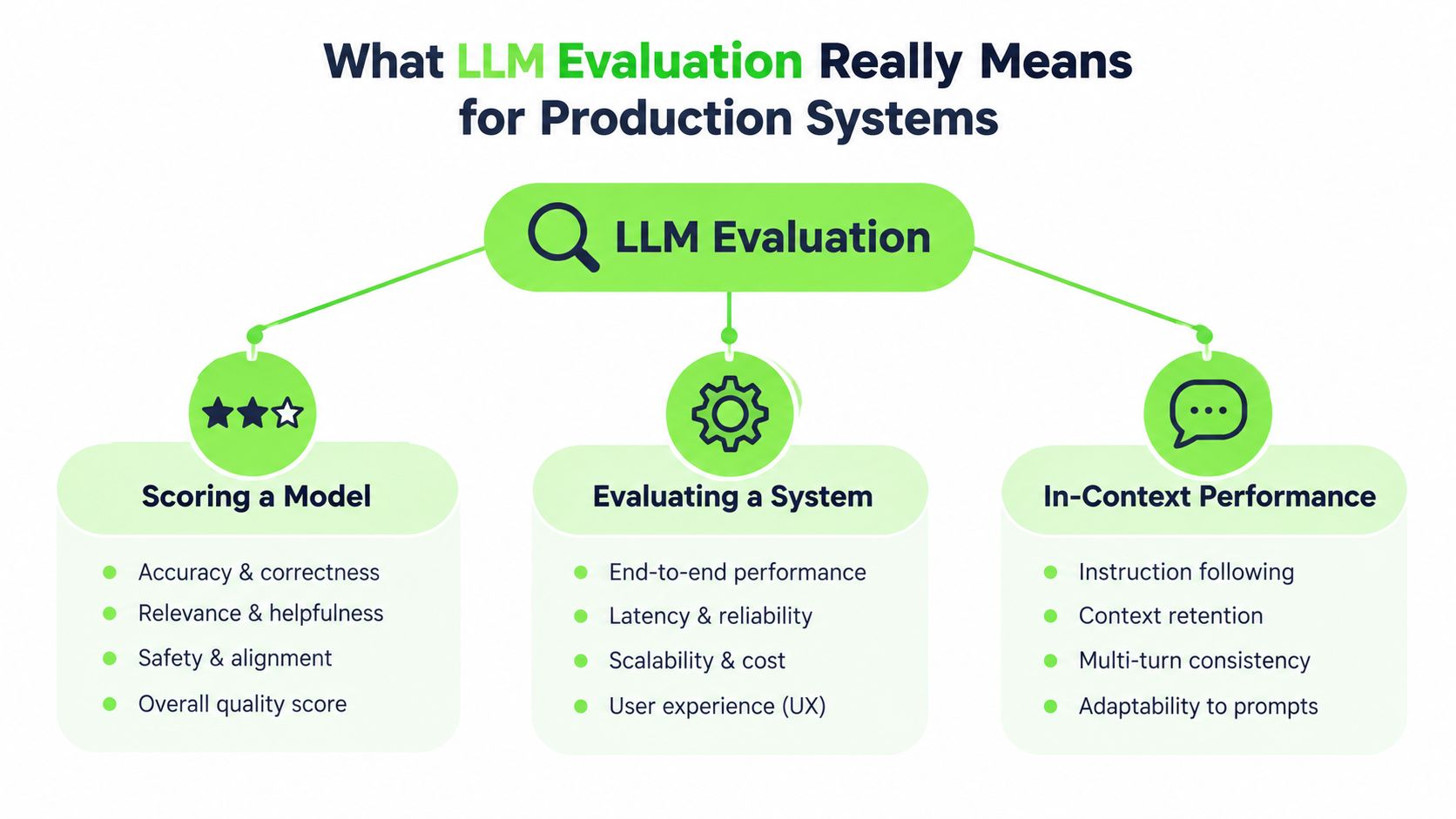
The narrow definition of LLM evaluation is measuring model output against a criterion such as correctness, relevance, or safety. The production definition is broader: measure whether an AI system produces acceptable behavior for a specific workflow under specified inputs, evidence, permissions, and operating controls.
Contemporary evaluation methods are often grouped into three families, intrinsic, extrinsic, and human-based evaluation. Intrinsic checks examine properties of the output or model behavior in isolation. Extrinsic checks measure performance on a task or within an application. Human-based assessment handles judgments that depend on context, nuance, safety, or subjective alignment.
Choose the evaluation scope deliberately
Survey work also separates evaluation by scope into task-specific, general-purpose, and domain-specific settings. Each scope answers a different question:
- Task-specific checks: Did the classifier route the request correctly? Did the agent call the required tool with valid arguments?
- General-purpose benchmarks: Can the model handle broad knowledge and reasoning tasks across many subjects?
- Domain-specific evaluation: Does the system apply your organization's policies, terminology, evidence rules, and escalation paths?
A RAG application needs more than a final-answer score. It needs retrieval checks, evidence checks, answer checks, and authorization checks. A memory-enabled agent needs tests for state persistence and state boundaries. The evaluation object includes the prompt template, retrieved context, memory selection, model configuration, output parser, tools, and policy layer.
Match the layer to the failure
Use automated metrics where the rule is explicit. Use benchmark suites to compare broad capabilities or domain coverage. Use interactive and human review where the result depends on safety, nuance, or workflow completion. The layers complement one another because each exposes different failure modes.
A fluent answer may pass a language-quality check and fail a grounding check. A benchmark may show broad competence and miss a distribution shift. A human reviewer may catch an unsafe implication that a string-based validator can't recognize. Evaluation becomes reliable when the team records those distinctions instead of compressing them into one headline number.
Key Metrics and Benchmarks Behind LLM Evaluation
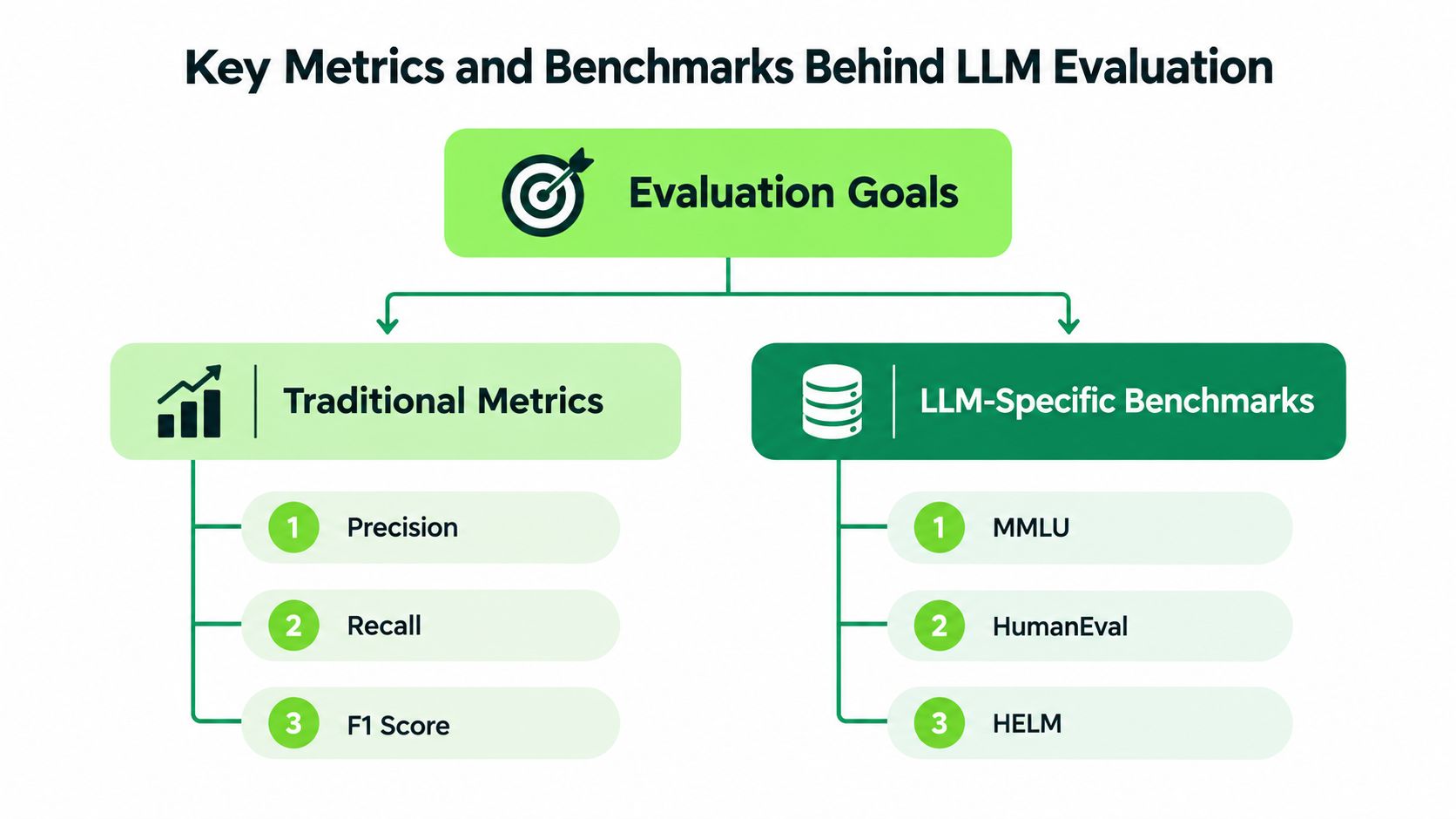
LLM evaluation developed from a long NLP benchmarking tradition. Early measures such as precision, recall, and F1 emerged during the 1950s to 1979 period, followed by task benchmarks including BLEU in 2002, ROUGE in 2004, GLUE in 2018, SuperGLUE in 2019, and MMLU in 2021. MMLU expanded evaluation across 57 subjects, while HELM in 2022 added dimensions such as fairness and sturdiness, and BIG-bench covered more than 200 diverse tasks. This history shows why evaluation evolved from a single score into a multi-dimensional measurement system. The benchmark history and scope are documented in this survey.
Read benchmark gains with context
Broad knowledge results can demonstrate progress without proving operational reliability. On MMLU, GPT-3 scored 43.9 in a 5-shot setting, GPT-4 scored 86.4, GPT-4o scored 88.7, and o1 scored 91.8. Those figures describe performance on that benchmark configuration, not the behavior of a complete application with retrieval, policy enforcement, and changing data. The reported MMLU results are provided in the referenced evaluation study.
The same study reports a different picture for a four-choice historical-history task. Accuracy ranged from 33.6% for Llama-3.1-8B to 46% for GPT-4-Turbo, compared with 25% for random guessing. The results illustrate both progress and the remaining distance between model output and expert-level understanding.
A practical metric selection process starts with the workflow rather than the leaderboard:
- Retrieval metrics: Check whether the system found relevant, authorized evidence.
- Grounding metrics: Check whether claims stay within the retrieved passages.
- Answer metrics: Check correctness, completeness, and relevance to the request.
- Safety and policy checks: Check refusal, escalation, data handling, and prohibited actions.
- Operational metrics: Check tool behavior, structured-output validity, latency, and trace completeness.
Reference-based measures such as BLEU and ROUGE can help when overlap with a reference answer matters. They can mislead when multiple valid answers use different wording or when the central question is whether a claim is supported by a source. Teams curating specialized data may also benefit from resources on teleoperation data providers, particularly when they need evaluation examples that reflect the actual task rather than generic language quality.
The decision is simple. Use benchmark scores to understand capability. Use workflow metrics to decide whether the system is safe and useful in context.
How Frozen Protocols and Deterministic Controls Make Results Verifiable
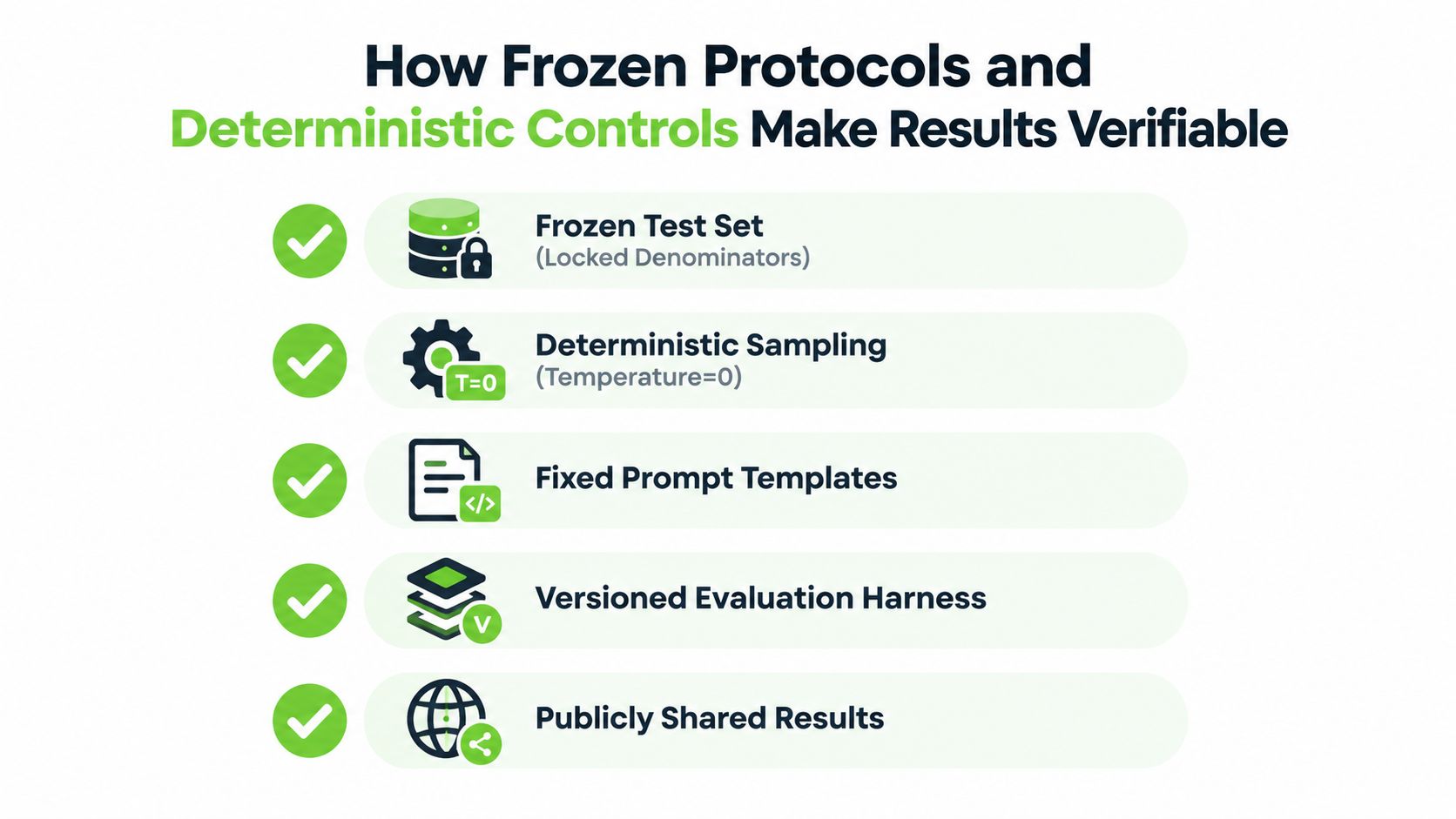
A result becomes useful only when another engineer can understand what was measured and reproduce the comparison. That requires a frozen evaluation protocol, written before the run, that defines the test set, denominator, versions, scoring rules, and known limitations.
Benchmark quality also deserves its own measurement. A 2026 systematic study proposed Cross-Benchmark Ranking Consistency, Discriminability Score, and Capability Alignment Deviation as diagnostic metrics. These measures ask whether a benchmark ranks models consistently with peer benchmarks, separates stronger systems from weaker ones, and avoids contradictory failure patterns within a model family. The benchmark-quality study describes these diagnostic goals.
Lock the experimental recipe
A reproducible run should record:
- Test-set identity: Dataset version, item identifiers, inclusion rules, and the locked denominator.
- System versions: Model, prompt templates, retrieval index, embedding configuration, memory state, tools, parser, and policy code.
- Sampling behavior: Temperature, seeds where applicable, retry rules, and any randomness controls.
- Execution traces: Inputs, retrieved passages, tool calls, intermediate states, final output, evaluator version, and timestamps.
- Scoring policy: Rubrics, thresholds, aggregation rules, missing-value handling, and abstention treatment.
- Security context: Tenant identity, authorization decision, evidence scope, and whether any cross-boundary access was attempted.
The last item matters because an answer can be textually correct and still be a security failure if the system used evidence the user wasn't authorized to see.
Treat missing controls as a result limitation
A 2024 systematic review found that evaluation setups vary enough to produce inconsistent findings and interpretations. A 2026 reporting-standard paper found that randomness controls were missing in 75% of papers, while intermediate execution traces were missing in 61%. Those omissions limit reproducibility because readers can't tell whether a result came from the model, the prompt, the data, or an uncontrolled execution path. The systematic review discusses reproducibility weaknesses in LLM evaluation.
AletheionAGI fits this discipline as a grounding and evidence-control layer that can work with existing LLMs, RAG pipelines, vector databases, and memory systems. Its relevant design principle is evidence-bounded output: preserve provenance, enforce retrieval authority, and allow insufficient evidence to produce an abstention rather than an invented claim. That describes a control objective, not a claim that every failure disappears.
Audit question: Could a different engineer rerun this evaluation and identify exactly which evidence authorized each answer?
Grounding Faithfulness and Abstention in RAG Evaluation
RAG evaluation should separate three questions that teams often collapse into one. Context relevance asks whether retrieval returned useful passages. Faithfulness or grounding asks whether the answer is supported by those passages. Answer relevance and correctness asks whether the response addresses the user's request accurately. This structure is commonly called the RAG Triad, and it prevents fluent prose from being mistaken for evidence-backed behavior. Amazon's RAG evaluation guidance describes these three checks.
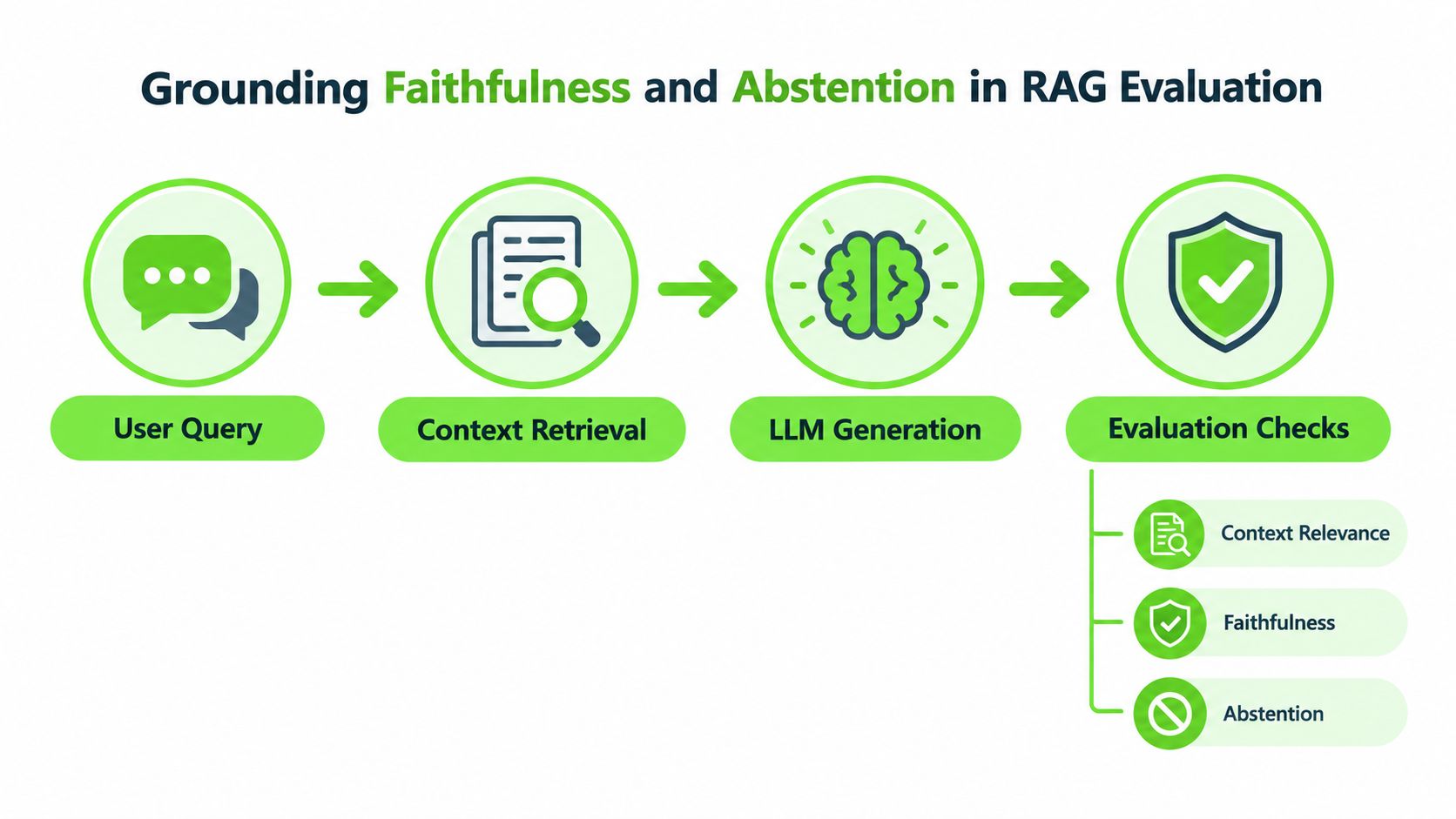
A production trace should make the path inspectable. Start with the user query. Record the tenant and authorization context. Capture the retrieved document identifiers and passages. Record the model input, output claims, citations, policy decision, and delivery result. If the system can't show which authorized passage supports a material claim, the answer should fail the grounding check or trigger a controlled refusal.
| Evaluation Check | What It Measures | Failure Mode It Catches |
|---|---|---|
| Context relevance | Whether retrieved passages address the query | Irrelevant or stale retrieval |
| Faithfulness | Whether answer claims are supported by retrieved evidence | Unsupported assertions and citation drift |
| Abstention | Whether the system refuses when evidence is insufficient | Confident guessing under uncertainty |
Make refusal testable
Abstention isn't merely an error case. Survey work defines measures such as Abstention Accuracy and Abstain Expected Calibration Error, which assess whether a model refuses when evidence is inadequate and whether its refusal confidence is calibrated. The abstention survey defines these evaluation concepts.
Test both sides of the boundary. Give the system sufficient evidence and expect a supported answer. Remove the relevant passage, introduce conflicting documents, or request another tenant's information and expect a refusal, clarification, or escalation. A fail-closed design should stop unsupported delivery rather than let the generator fill the gap.
For sensitive workflows, review adjacent controls such as patient data safeguards in finance, especially when teams need to reason about authorization, provenance, and the consequences of exposing records across boundaries. A practical overview of retrieval-augmented generation can help teams map those controls onto their existing retrieval architecture.
The following video provides a visual explanation of RAG evaluation flow.
Designing a Test Plan for Production QA
A production test plan starts with the denominator. Define which requests count, which cases are excluded, how multi-turn sessions are grouped, and how abstentions are scored. Without those decisions, a quality percentage can look precise while hiding the cases that matter most.
Build the plan around scenarios, not only exam questions. Include ordinary requests, ambiguous requests, missing-evidence requests, conflicting-source requests, prompt-injection attempts, tool failures, stale records, and cross-tenant access attempts. Each scenario should specify the expected behavior, the permitted evidence, the allowed actions, and the required trace fields.
Version the whole path
Treat every component that can change output as part of the evaluated artifact:
- Prompts and policies: Store templates, policy rules, routing instructions, and refusal language in version control.
- Retrieval and memory: Version indexes, document snapshots, chunking logic, filters, memory selection, and authorization rules.
- Execution: Record model configuration, decoding controls, tools, retries, parsers, and fallback behavior.
- Evidence: Preserve document identifiers, source spans, access decisions, and claim-to-evidence links.
A model-only regression suite won't identify whether retrieval returned the wrong document or whether the policy layer allowed an unauthorized one. Trace-level evaluation lets engineers locate the failing stage instead of merely observing a bad final answer.
Combine automation with review
Use deterministic validators for schema, required fields, tool arguments, and authorization outcomes. Use semantic evaluators for faithfulness and answer quality, but calibrate them against human-reviewed examples and inspect disagreements. Human reviewers remain important for safety, domain nuance, and cases where a formally valid answer creates an unacceptable operational outcome.
Clinical results demonstrate why static knowledge tests need a practice layer. A 2025 JMIR study reported 84% to 90% accuracy on knowledge-based medical exams, but only 45% to 69% on practice-based competence, a 39 to 45 percentage point gap. The JMIR study reports the distinction between exam performance and practice-based competence.
Run the suite before releases, then evaluate sampled production traces for drift and newly emerging failure modes. Feed reviewed failures back into the frozen test set, while preserving the older versions so improvements remain comparable. For additional guidance on reducing unsupported output, see AI hallucination prevention.
Putting LLM Evaluation Into Practice With Confidence
Reliable LLM evaluation is a chain of evidence. Start with a clear workflow contract, then measure the model, retrieval, generation, policy behavior, and delivery path separately. A benchmark can inform model selection, but it can't replace scenario tests for grounding, abstention, authorization, or tenant isolation.
Use a compact decision checklist:
- Define the object: Name the exact application version, not only the base model.
- Freeze the protocol: Lock the dataset, denominator, prompts, retrieval state, decoding controls, and evaluator.
- Inspect the trace: Preserve retrieved evidence, intermediate steps, policy decisions, and final claims.
- Test failure paths: Include missing evidence, conflicting sources, tool errors, and unauthorized requests.
- Review limitations: Document what the test doesn't measure and where the result may not transfer.
- Continue monitoring: Compare production scenarios with the same criteria and add validated failures to future runs.
Teams building agents should also connect evaluation to secure implementation practices. A practical secure agentic development guide can complement QA by treating tools, credentials, and authority as separate control surfaces.
Start with one high-risk workflow and a small, inspectable test set. Measure whether every material answer is grounded in authorized evidence, whether the system abstains when it lacks support, and whether another engineer can reproduce the result.
AletheionAGI provides grounding and memory infrastructure for production AI, including authorized retrieval, persistent state, provenance, and fail-closed behavior that can be evaluated alongside existing LLMs, RAG pipelines, vector databases, and memory systems. Visit AletheionAGI to explore evidence-controlled infrastructure for building AI systems whose claims and boundaries can be inspected.