You're probably dealing with some version of this right now. A product team wants an AI assistant in customer support. Another team wants retrieval over account documents. Security asks how you'll stop cross-tenant leaks. Compliance asks who approves actions. The model works in demos, but the hard questions begin the moment it touches real users, live systems, and sensitive data.
That's where most discussions about guardrails meaning in business fall apart. People define guardrails as “safety measures” and stop there. In production systems, that's not enough. A useful definition has to explain what gets enforced, where it gets enforced, who decides, what happens under uncertainty, and how you measure whether the controls are working.
When a Business System Has No Guardrails
A mid-sized fintech launches an internal AI assistant for account operations. This example is a composite, not a real incident, but the pattern is familiar.
An operations analyst asks the assistant to summarize a customer's invoice dispute. The retriever searches a shared vector index with weak scoping. It finds a similar dispute from another tenant and passes those chunks into the prompt. The model answers fluently, and no one notices that some of the details came from the wrong account.
Later that day, a support manager asks whether the assistant can issue a billing adjustment. The model has no real action boundary, only a prompt telling it to “be careful.” It recommends a step outside the manager's delegated authority. A downstream workflow accepts the recommendation because nothing checks approval rights at runtime.
The team reviews logs the next morning and sees very little. There's no structured record of what was retrieved, what policy checks ran, or whether the model should have abstained. The system produced output, but it didn't produce evidence about its own decision path.
Three failure surfaces show up first
- Data leakage between users: Retrieval wasn't constrained tightly enough, so another tenant's material entered the prompt.
- Unauthorized decisions: The system crossed from suggestion into action without checking approval scope.
- No signal that anything broke: There was no measurement loop for refusal, escalation, or policy violations.
This is why “just add a prompt” isn't a guardrail strategy. The failure path usually starts before generation and continues after it.
If your organization is still separating policy conversations from runtime enforcement, it helps to compare DMBOK COBIT ISO models because those frameworks clarify who defines control objectives and who operates them. The AI version of the same issue shows up in system alignment too, especially once models start mediating actions and memory across workflows, which is why the AI alignment problem becomes operational rather than purely theoretical.
A business system without guardrails doesn't only answer badly. It can retrieve from the wrong boundary, act without authority, and leave no audit trail.
Defining Guardrails in a Business Context
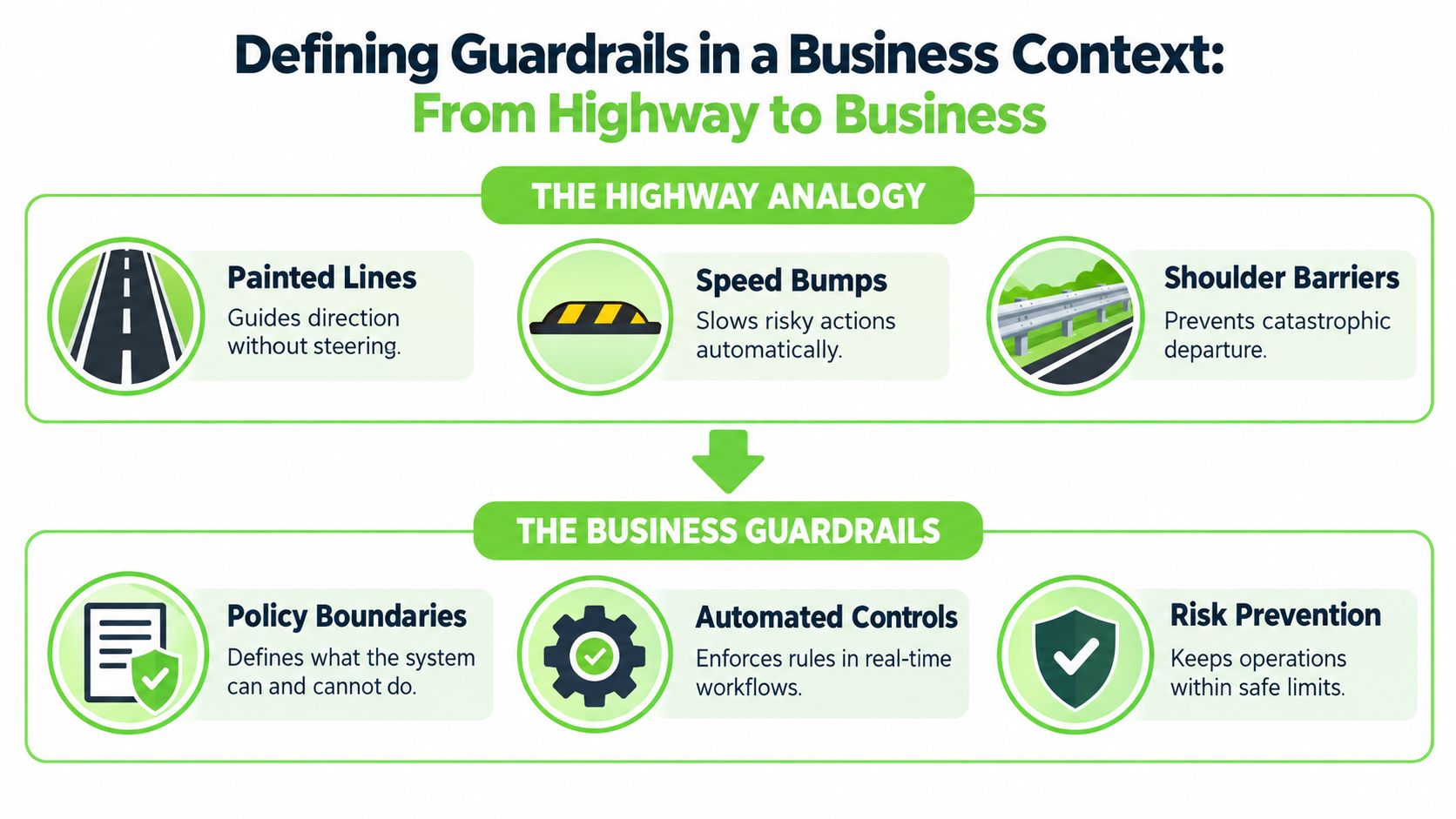
Think about a highway. Painted lines don't steer the car. Speed bumps don't decide your destination. Shoulder barriers don't choose your route. They shape behavior by setting boundaries and preventing certain kinds of failure.
Business guardrails work the same way. They are not the steering wheel. They are the constraints and controls around action.
The simple definition
In business experimentation, industry guidance commonly defines guardrails as metrics that keep a company within acceptable risk boundaries while it optimizes a primary goal. They act as alerts or safety checks that flag unintended harm, such as higher churn, refunds, or support tickets, even when the main metric improves, which is why current product and analytics guidance treats guardrails as an “early warning” layer against local wins becoming global losses (Harness guide to guardrail metrics).
That's the older and still useful meaning. In AI systems, the term needs to be broader.
Governance and controls are not the same thing
Governance defines what's allowed, who owns the rule, who can approve exceptions, and what evidence must be logged. Guardrails are the runtime mechanisms that enforce those decisions.
Public enterprise guidance increasingly draws this line clearly. Governance sets policy, accountability, and oversight. Guardrails are the technical controls that enforce policy across data, model, application, and infrastructure layers (AtScale glossary on AI guardrails).
That distinction matters because teams often mistake principles for controls. “Protect customer trust” is a principle. “Block retrieval outside tenant scope and escalate unsupported actions to review” is a guardrail.
For teams designing practical checks, a compact way to calibrate runtime behavior is to browse safety reference material that organizes refusal, filtering, and review patterns as implementation choices rather than slogans. Evaluation discipline matters too, especially once you start asking whether a block, pass, or escalation was correct in context, which is where LLM evaluation stops being a research exercise and becomes a production requirement.
Practical rule: If a policy can't produce a runtime outcome such as pass, block, escalate, or abstain, it isn't a guardrail yet.
The Four Operational Layers of Business Guardrails
A system without layers usually fails at the first unusual request. A policy says refunds over a threshold need review, but the agent can still trigger the action. A retriever is supposed to stay inside tenant scope, but one loose filter pulls the wrong document. An output validator exists, but an engineer disables it after a latency spike. The architecture still looks complete on a diagram. The boundary is already gone.
That is why business guardrails work as an operational stack with four layers: policy, technical controls, workflow, and measurement. Each layer answers a different question. Who decides the rule? Where is it enforced? What happens on edge cases? How do you know the control still works under production load?
What each layer does
| Layer | What It Enforces | Common Failure Mode | Measurable Signal |
|---|---|---|---|
| Policy | Allowed actions, ownership, approval rights | Rules exist but nobody translates them into system behavior | Exceptions, approvals, policy coverage |
| Technical | Runtime checks on input, retrieval, generation, and action | Controls are bypassable or data access is unscoped | Block rates, authorization denials, validation failures |
| Workflow | Escalation paths and human review | Review queues bottleneck or reviewers approve without scrutiny | Escalation volume, review turnaround, override patterns |
| Measurement | Telemetry for safety and performance | Teams collect logs but do not tune controls or change process | Attack success rate, compliance coverage, latency overhead |
Policy sets the boundary
Policy is the contract. It defines which actions are allowed, who owns the decision, what evidence is required, and when the system must stop instead of guessing.
In practice, many programs become vague. A team writes “protect regulated data,” but nobody specifies whether that means masking fields, blocking retrieval, requiring approval, or refusing the task entirely. A policy only becomes useful when an engineer can map it to an outcome such as pass, block, escalate, or abstain.
Policy also sets the fail-closed rule. If tenant identity is missing, retrieval should stop. If approval state is unclear, the action should not fire. That feels strict, but the alternative is hidden fail-open behavior.
Technical controls turn rules into runtime enforcement
Technical controls are the mechanisms that intercept requests. They include prompt screening, scoped retrieval, policy checks before tool use, output validation, schema enforcement, and action gating.
A good comparison is network security. Firewall policy matters, but packets are filtered by devices in the request path, not by a paragraph in a wiki. Guardrails work the same way. If the control is not in the path of retrieval, generation, or execution, it is advisory, not enforced.
That is also why layered enforcement matters. One check rarely carries the full load. Tenant isolation may start in identity and authorization, continue in metadata filters during retrieval, and end with output validation that catches quoted content from the wrong source. Teams building RAG for enterprise architectures usually discover that a single prompt instruction cannot substitute for those control points.
Research on organizational AI guardrails makes a similar point. The guardrail is not only an output filter. It is a sociotechnical control made of policy, runtime checks, monitoring, and human review paths that stop unsupported actions before they reach downstream systems, as noted in earlier source material.
Workflow handles the cases automation should not decide
Some requests should pause. High-value refunds, weakly supported answers, regulated records, and actions with external side effects all need a defined review path.
“Human in the loop” is too loose to run in production. You need named reviewers, queue ownership, timeout rules, override logging, and criteria for when the model can retry versus when it must abstain. Otherwise, review becomes a bottleneck on busy days and a rubber stamp on the rest.
This layer is where governance and controls meet operational reality. Governance may say a human must approve an exception. Workflow decides which human, within what time, using which evidence.
Measurement shows whether the stack is doing its job
A guardrail you cannot measure will drift. Latency rises, so a validator gets bypassed. Review queues grow, so reviewers start approving with less context. Retrieval recall improves, but tenant isolation weakens because filters get broader.
The useful signals are specific. Measure defense rate for known attack patterns. Measure latency overhead introduced by each check. Measure tenant isolation with access tests that should fail. Measure abstention and escalation rates alongside false blocks, so the team can tune precision instead of rewarding permissiveness.
The goal is not maximum blocking. The goal is controlled behavior under pressure. A guardrail system is healthy when it enforces boundaries consistently, fails closed when context is missing, and produces logs that let engineering, product, and risk teams verify what happened.
Guardrails Across Experimentation AI and Multi-Tenant Systems
A product team can run a clean A/B test, an AI team can block unsafe outputs, and a platform team can still ship a system that leaks one tenant's data into another tenant's answer. All three teams will say they have guardrails. They are talking about different boundaries.
That distinction matters because the business meaning of a guardrail depends on what must be protected and where enforcement happens.
| Context | Protected boundary | Typical enforcement point | Common failure mode | Measurable signal |
|---|---|---|---|---|
| Experimentation | Business health outside the primary KPI | Metric thresholds, launch criteria, alerting | A local win harms retention, trust, or support load | Guardrail metric breach |
| Enterprise AI | Policy and decision rights | Input checks, output checks, action approval paths | A disallowed request or action passes through | Policy violations, review escalations, abstention rate |
| Multi-tenant RAG | Tenant isolation | Retrieval filters, ranking scope, caches, logs | One tenant's data appears in another tenant's context | Unauthorized retrievals, isolation test failures |
Experimentation uses guardrails the way a circuit breaker uses limits. You can push for a lift in conversion, but only inside preset bounds for other metrics that matter to the business. The guardrail is not the experiment itself. It is the condition that stops rollout when the local optimization starts harming the wider system.
Enterprise AI shifts the boundary. Here, the question is less about aggregate metrics and more about whether the system stays inside policy during each request. A useful business lens is decision rights: who can approve an autonomous action, what evidence they see, and what must be logged for later review. As noted earlier, that distinction matters because governance names who has authority, while controls enforce the rule in software.
Multi-tenant RAG raises the bar again.
The boundary is no longer only answer quality or policy compliance. The boundary is whether tenant A can ever influence what the system retrieves, ranks, caches, or cites for tenant B. That is why guardrails in shared AI systems need layered enforcement and fail-closed behavior. If tenant context is missing, stale, or ambiguous, the safe outcome is to stop, abstain, or return nothing, not to guess.
This also ties guardrails to adjacent governance work such as inventory, provenance, and component ownership. If you are mapping which model, retriever, cache, policy engine, and approval path participate in a production decision, from source code to AI governance offers a useful frame.
The common pattern across all three contexts is straightforward. A guardrail is a control attached to a specific boundary, with an expected failure mode and a way to measure whether enforcement is working. In experimentation, the boundary protects overall business performance. In enterprise AI, it protects policy and approval authority. In multi-tenant systems, it protects customer separation, which is why isolation tests, defense rate, and latency overhead belong in the same conversation rather than in separate governance and engineering tracks.
A Concrete Architecture for Multi-Tenant RAG Guardrails
The safest way to think about guardrails in RAG is as executable boundaries, not guidance text.
Request boundary and retrieval boundary
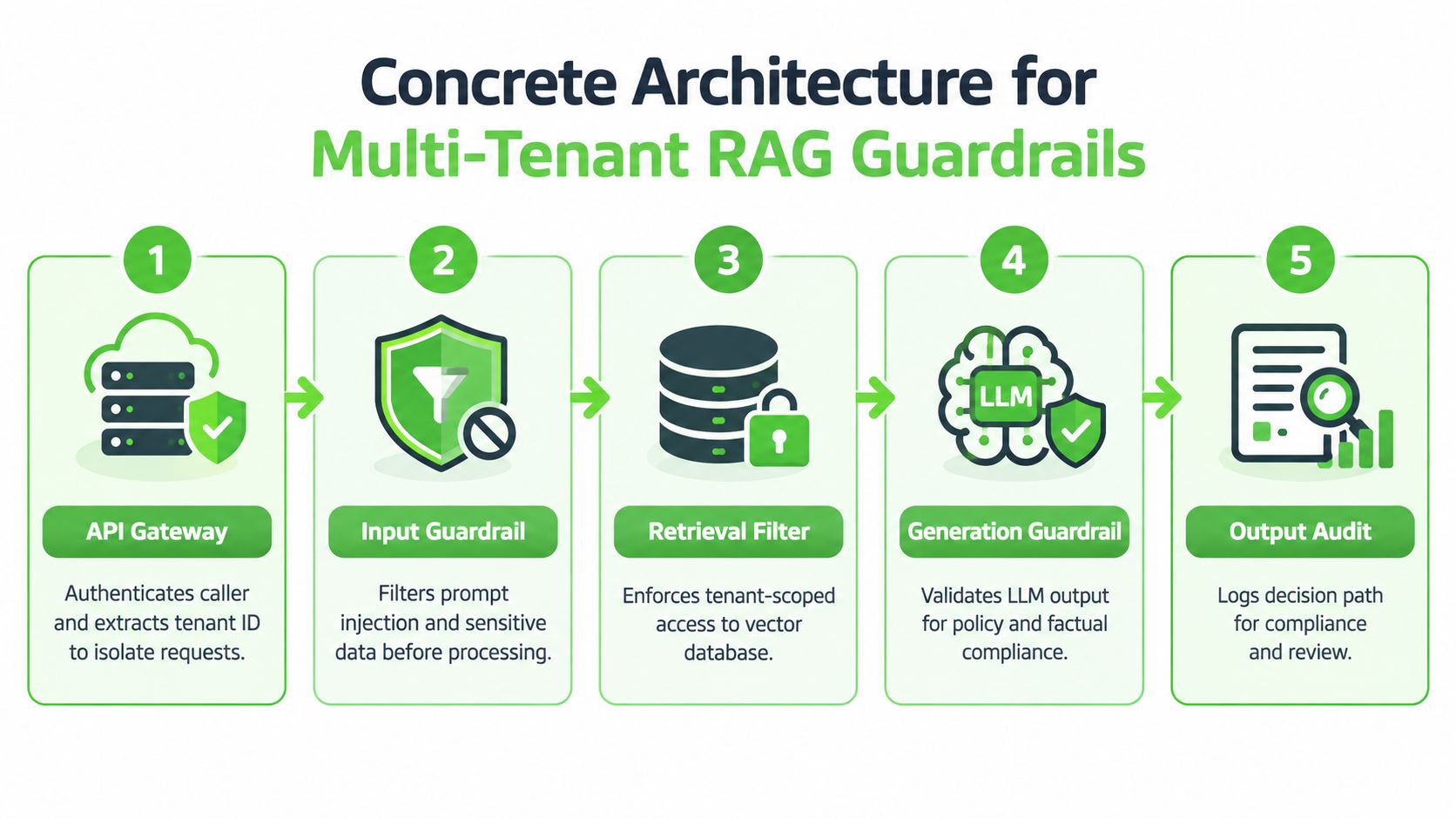
Start at the edge. An API gateway authenticates the caller, resolves tenant identity, and passes a signed context object downstream. Every service should consume that context rather than reconstructing authority from prompt text or session hints.
Then the retriever enforces access at query time. For multi-tenant RAG, fine-grained authorization should happen at retrieval time, not only around the application, because candidate chunks must be filtered before prompt assembly. One documented pattern states that an authenticated request for tenant A should read, retrieve, rank, cache, log, or generate only from resources that tenant A and the current user are authorized to access (CtxWire on multi-tenant RAG security).
A stronger isolation pattern uses tenant-scoped namespaces or collections. Each tenant's documents live in a separate vector index, and queries are scoped to a single namespace so there is no cross-namespace search. That creates a hard boundary even if a metadata ACL filter is bypassed (AI Patterns secure RAG pattern).
Generation guardrails and audit trail
After retrieval, a policy layer can re-rank or filter chunks using source allowlists, topic restrictions, or redaction rules before the prompt is assembled. Then the generation step should be checked again. Output validation can inspect citation support, policy violations, and whether the response should abstain because the evidence set is too weak.
For teams that want a grounding and evidence-control layer without replacing their existing stack, AletheionAGI fits at this point as one option alongside your current LLM, vector database, and memory system. The role is narrow and operational: enforce authorized evidence flow, validate provenance, and keep unsupported material from crossing into generation.
A short walkthrough helps make the flow concrete.
The final piece is logging. Every block, refusal, retrieval decision, and policy exception should emit a structured audit record. If compliance asks why the system answered, refused, or escalated, you should be able to replay the full path.
Safe multi-tenant RAG starts before prompting. If the wrong chunk is retrieved, no downstream prompt instruction can reliably undo that mistake.
Why Abstention and Latency Are Valid Guardrail Outcomes
A finance user asks an internal assistant for a contract summary five minutes before a customer call. The assistant finds related material, but the user is missing permission for the signed agreement and the retrieved evidence does not fully support the requested answer. In that moment, a refusal or an escalation is not a product failure. It is the control working as designed.
Guardrails are different from broad governance statements because they act at runtime. A policy may say, "only authorized users can view tenant contracts." A guardrail has to enforce that rule on the actual request, with the actual user identity, retrieved documents, and model output. If the conditions are not met, the correct outcome is often abstention.
Refusal can be correct
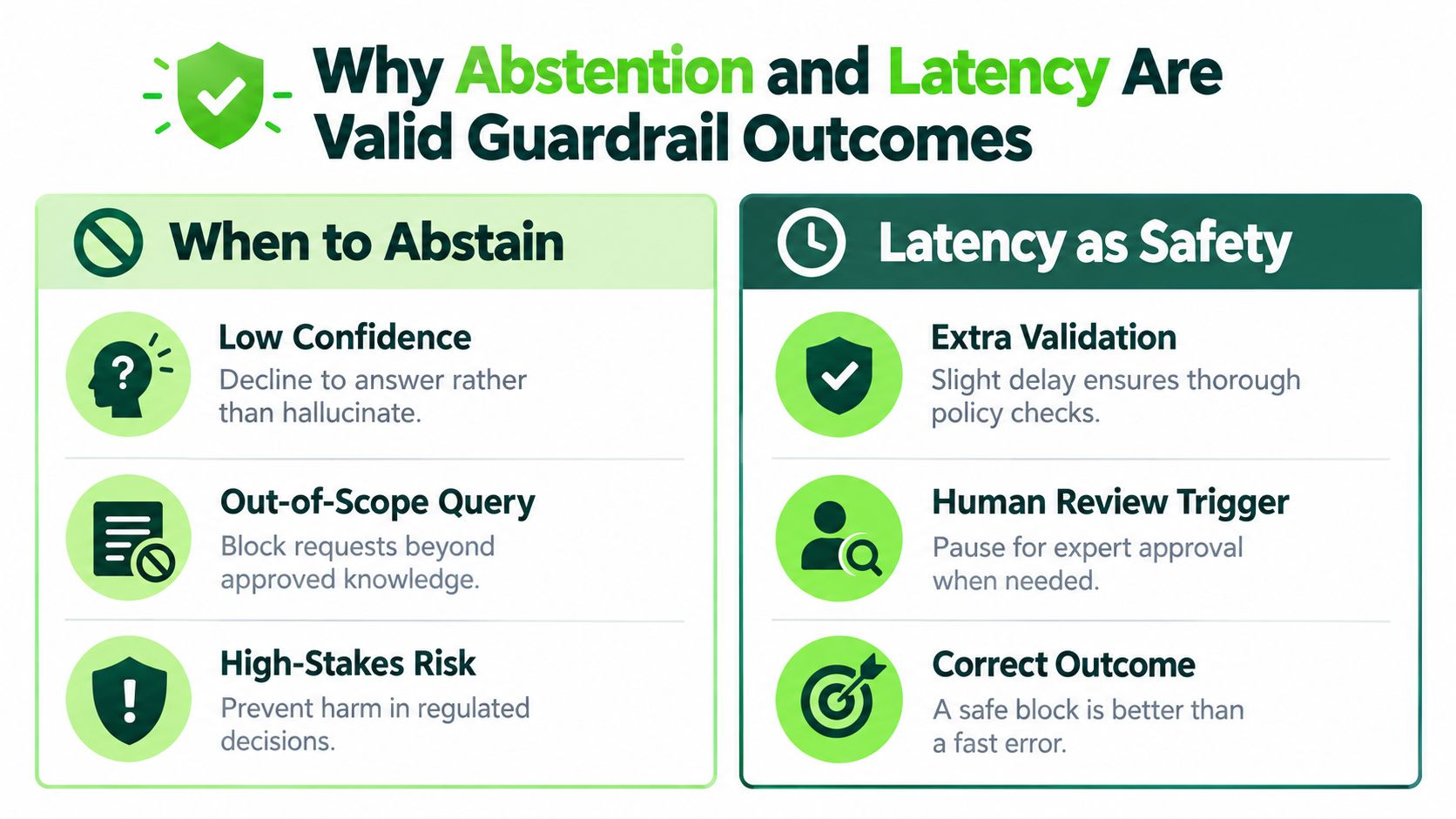
In business systems, abstention usually means one of three things happened.
The system could not verify permission. The evidence set was too weak to support the claim. Or the request crossed a policy boundary that requires human review.
That pattern is easier to accept if you treat the assistant less like a search box and more like a controlled workflow step. A loading dock does not release inventory because a request sounds plausible. It checks badge access, order details, and destination first. AI guardrails work the same way. They should fail closed when identity, evidence, or policy checks do not pass.
This is also where the governance-versus-controls distinction matters. Governance defines the rule. Runtime controls decide whether this request, right now, is allowed, blocked, or sent to review. Without that distinction, teams often misread refusals as poor user experience when they are evidence that the enforcement layer is doing its job.
Latency is part of the trade-off
Latency belongs in the same conversation.
Every useful control adds work to the request path: permission checks, retrieval validation, output review, redaction, audit logging, and sometimes escalation. That extra time is not automatically waste. It is the cost of checking before release instead of apologizing after exposure.
The practical question is not whether latency exists. The question is whether the added time buys measurable risk reduction. Security benchmark work gives a concrete reference point. The Aegis benchmark report found that layered guardrail designs improved defense rates while keeping latency within a measurable envelope. The exact numbers are less important than the operating model: more layers can block more bad requests, but each layer consumes part of your latency budget.
That trade-off looks different by workflow. A customer support copilot may tolerate a short delay for citation checks and permission validation. A real-time chat surface may need a lighter first-pass filter and a stricter second-pass review for sensitive actions. In both cases, the guardrail is still successful if it slows the request enough to verify access or decides not to answer at all.
A fast unsafe answer creates downstream work. A slower validated answer, or a clear refusal, often reduces business risk, support cost, and tenant exposure.
Measuring Guardrail Success and Implementation Checklist
A business guardrail is only real if you can tell whether it blocked the wrong thing, allowed the right thing, and did so within an acceptable operating cost. That calls for a scorecard tied to control behavior, not a broad trust label.
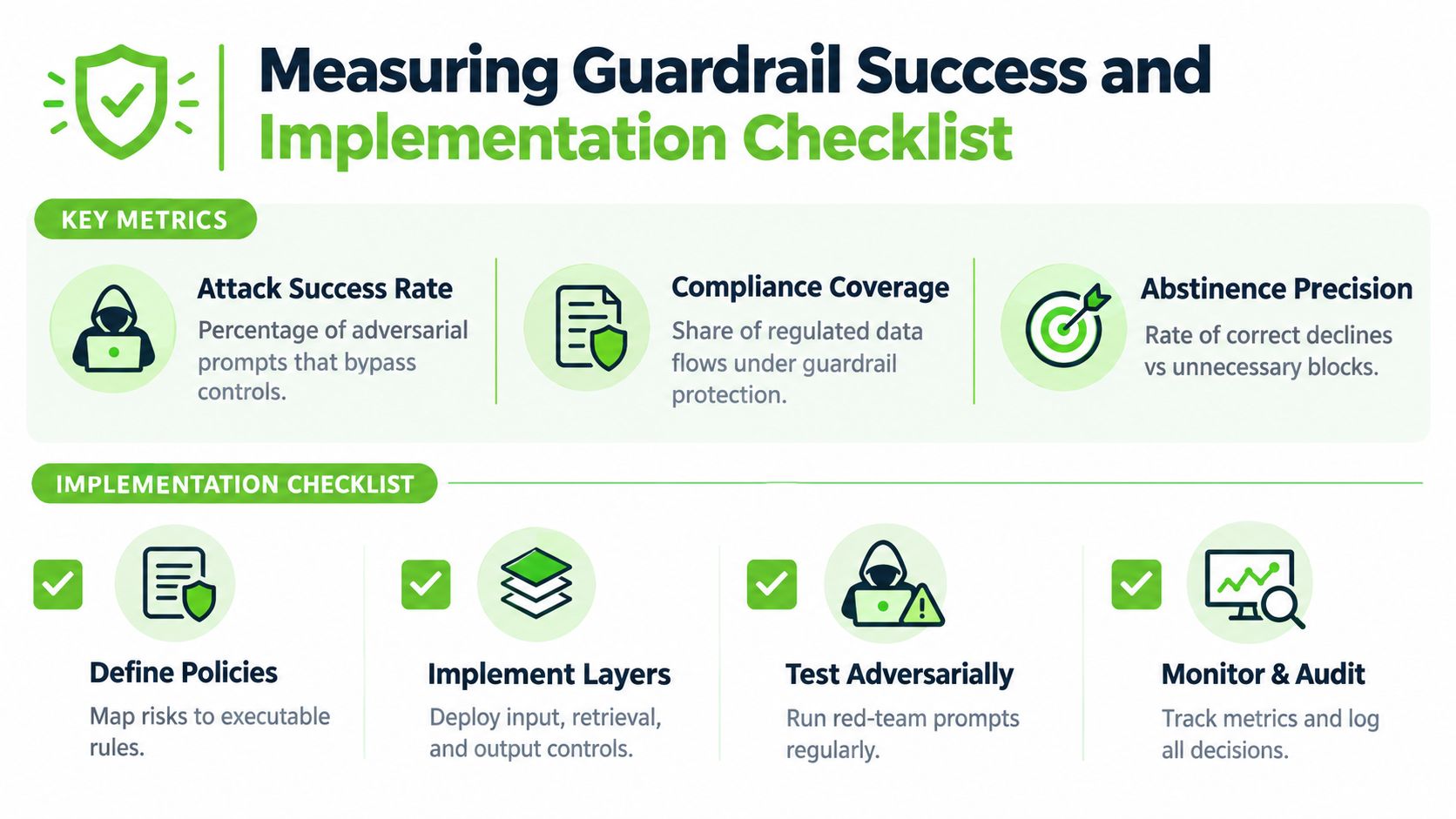
A useful model tracks three measurement families: attack success rate, compliance coverage, and latency overhead. Together, they separate governance from controls. Governance sets the rule. The metrics show whether the runtime system enforced it, where it failed, and what it cost.
What to measure
- Attack success rate: How often jailbreaks, prompt injection attempts, unauthorized retrieval requests, or boundary probes get through. Lower is better, but break it down by attack type so you can see which layer failed.
- Compliance coverage: How much of the sensitive path is under enforcement and logging. A written policy does not count as coverage if no control checks it at retrieval, generation, action execution, or audit time.
- Latency overhead: What each layer adds to request time, review time, queue time, and human escalation load. Measure per layer when possible, because a single end-to-end average can hide an expensive control.
The pattern matters as much as the metric names. If attack success rate drops but only because the system is refusing nearly everything, the control is not tuned well. If compliance coverage looks high but tenant filters are missing from retrieval or cache keys, the measured safety is overstated. If latency stays low because sensitive checks were skipped on one path, that is a control gap, not an efficiency gain.
For AI systems that touch protected or tenant-scoped data, the test set should include permission-negative cases in a frozen harness. Those are prompts where the answer exists somewhere in the corpus, but the current user should receive nothing or a clear denial. That design catches one of the easiest failure modes to miss in demos: a system that retrieves correctly for allowed users and still leaks across boundaries for disallowed ones, as discussed in the Changegamer note on multi-tenant RAG permissions testing.
A short implementation checklist
- Define executable policy: Turn data classes, action rights, refusal rules, escalation paths, and approval requirements into conditions the system can evaluate at runtime.
- Map controls by layer: Identify which rules are enforced at identity, retrieval, generation, action, and audit layers. The governance-versus-controls distinction becomes concrete.
- Enforce authorization at retrieval: Scope indexes, metadata filters, caches, rerankers, and citation paths to tenant and user authority before content reaches the model.
- Default to fail-closed behavior: If authorization, provenance, or confidence checks do not pass, return a refusal, partial response, or escalation instead of continuing.
- Instrument every boundary: Log retrieval decisions, denials, abstentions, overrides, approvals, and policy exceptions in a structured format that supports review.
- Run recurring adversarial tests: Include prompt injection, unauthorized retrieval, tool misuse, and permission-negative cases in a stable evaluation harness.
- Review thresholds and drift: Model behavior changes, corpus shape changes, and attack patterns change. Thresholds that were acceptable last quarter may be too loose now.
One practical way to read the checklist is as a sequence of questions. What policy exists on paper. Which layer enforces it. What signal proves that enforcement happened. What should the system do when the signal is missing.
AletheionAGI provides a grounding and evidence-control layer for teams building AI agents, RAG pipelines, and multi-tenant applications that need authorized retrieval, provenance, and fail-closed behavior. If you're working through the gap between written policy and enforceable runtime controls, visit AletheionAGI to see how it fits alongside your existing LLMs, vector databases, and memory systems.