Your team probably already has a confidence field somewhere in the stack. The model returns a score, the retriever ranks passages, and the agent logs a “likely correct” answer. Then a customer asks a messy policy question, the system pulls the wrong chunk, and the response sounds certain anyway. If you run multi-tenant RAG or support automation, that's usually when uncertainty in artificial intelligence stops being an academic topic and becomes an incident review.
In production, uncertainty rarely shows up as a single number problem. It shows up as an answer with no authorized evidence, a retrieval path that crosses a tenant boundary, or a workflow that should have asked one clarifying question before taking action. Teams that treat uncertainty as a model evaluation issue usually discover too late that core controls belong in retrieval, authorization, claim validation, and routing.
Why Uncertainty Breaks Production AI Systems
A common failure pattern looks mundane at first. A support agent asks an internal assistant, “Can I refund this customer under the enterprise policy?” The assistant retrieves a policy chunk, combines it with an older exception note, and answers in fluent prose. The answer is wrong. Worse, the cited note belonged to a different account tier, or a different tenant altogether.
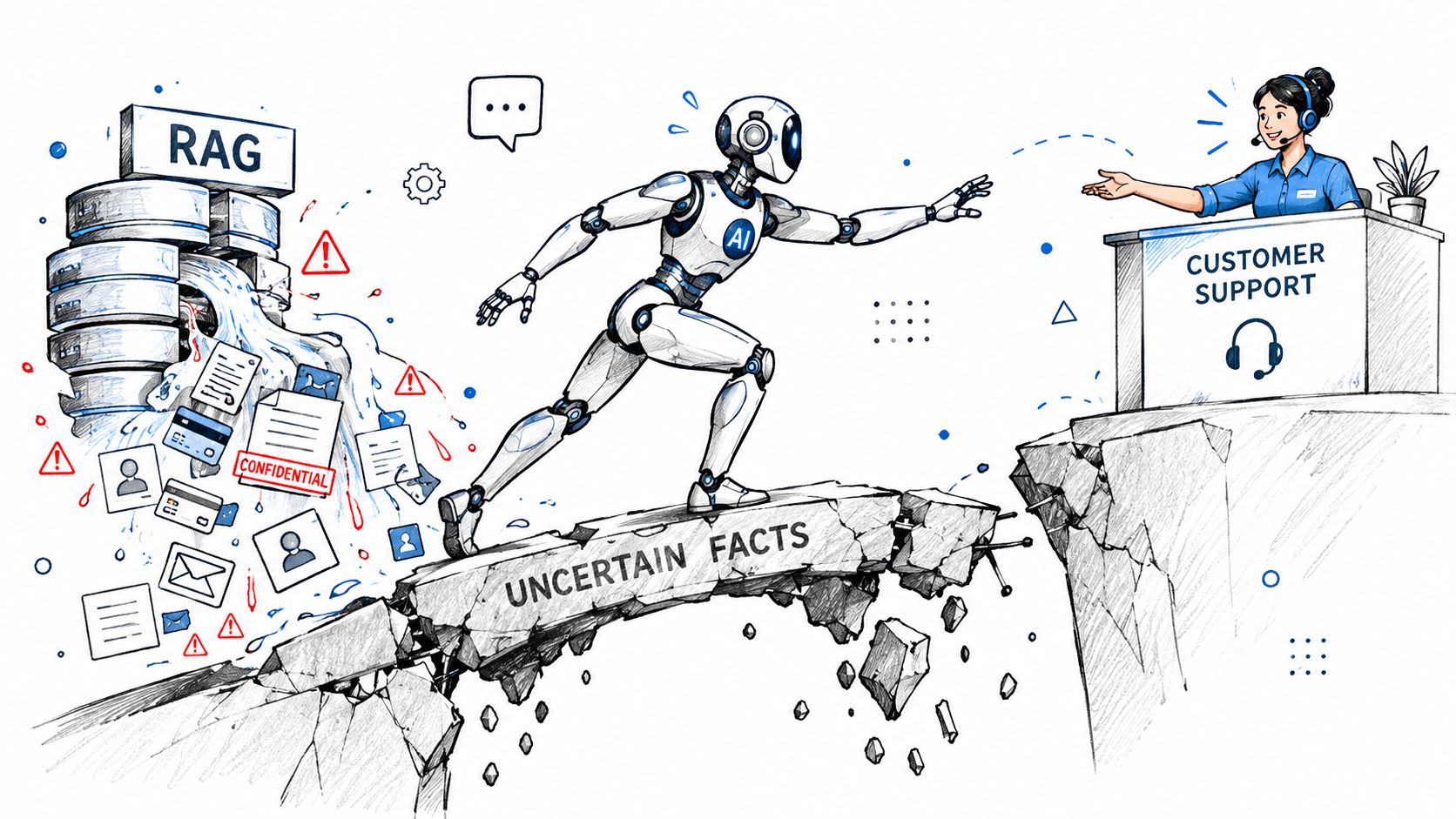
Raw confidence scores don't catch this well. A language model can sound certain while relying on unsupported claims. A retriever can return top-ranked passages that are semantically close but operationally forbidden. An agent can misread a vague request, choose the wrong workflow, and still produce a coherent response.
Three production failures that get mislabeled as model quality
Teams often call all of these “hallucinations,” but the fixes are different.
- Unsupported claims: The model answers beyond the evidence it received.
- Authorization failures: The system found something in an index that the caller wasn't allowed to use.
- Ambiguous intent: The user request lacked a required constraint, but the workflow answered instead of clarifying.
Only the first problem sits mainly in generation. The other two start earlier.
Practical rule: If the system can generate before it proves evidence scope, tenant scope, and intent completeness, uncertainty has already escaped containment.
Why post-hoc explanations aren't enough
Many stacks add uncertainty after generation. They score the answer, show a confidence badge, or ask a second model to critique the first. That can help with observability, but it doesn't prevent the original failure. By the time you're decorating the answer with confidence, the dangerous step may already have happened.
In production AI, uncertainty needs to act as a control layer. It should block generation when retrieval is unauthorized, when evidence conflicts in unresolved ways, or when the user intent is underspecified for the action requested. That's infrastructure work. It belongs with identity propagation, retrieval filtering, provenance, and routing rules.
What breaks first in B2B deployments
Consumer chatbots can sometimes tolerate graceful vagueness. B2B systems handling customer support, internal knowledge, or regulated workflows usually can't. They need deterministic boundaries.
A simple way to consider this:
| Failure mode | What the user sees | What actually failed | Better system response |
|---|---|---|---|
| Unsupported answer | Fluent but ungrounded response | Claim not backed by evidence | Abstain or answer with cited evidence only |
| Cross-tenant leak | Helpful answer with wrong source | Retrieval authorization failure | Deny request, fail closed |
| Ambiguous request | Wrong action on plausible interpretation | Missing constraint or unresolved intent | Ask a follow-up |
When teams fix uncertainty at the system level, these incidents become easier to reason about. The question shifts from “Why was the model overconfident?” to “Why did the pipeline permit an answer without enough authorized evidence?”
Understanding Aleatoric and Epistemic Uncertainty
A support assistant receives “Cancel the plan from last month.” The account contains several active subscriptions, and two internal systems show different renewal dates. A fluent answer could trigger the wrong action. The system needs to identify what kind of uncertainty it faces before choosing whether to answer, ask for clarification, or abstain.
The standard starting point is the distinction between aleatoric uncertainty and epistemic uncertainty. Aleatoric uncertainty comes from randomness, noise, or ambiguity in the data-generating process. Epistemic uncertainty comes from incomplete knowledge in the model or system. More data can often reduce epistemic uncertainty, while aleatoric uncertainty remains part of the problem, as summarized in this overview of uncertainty in AI systems.
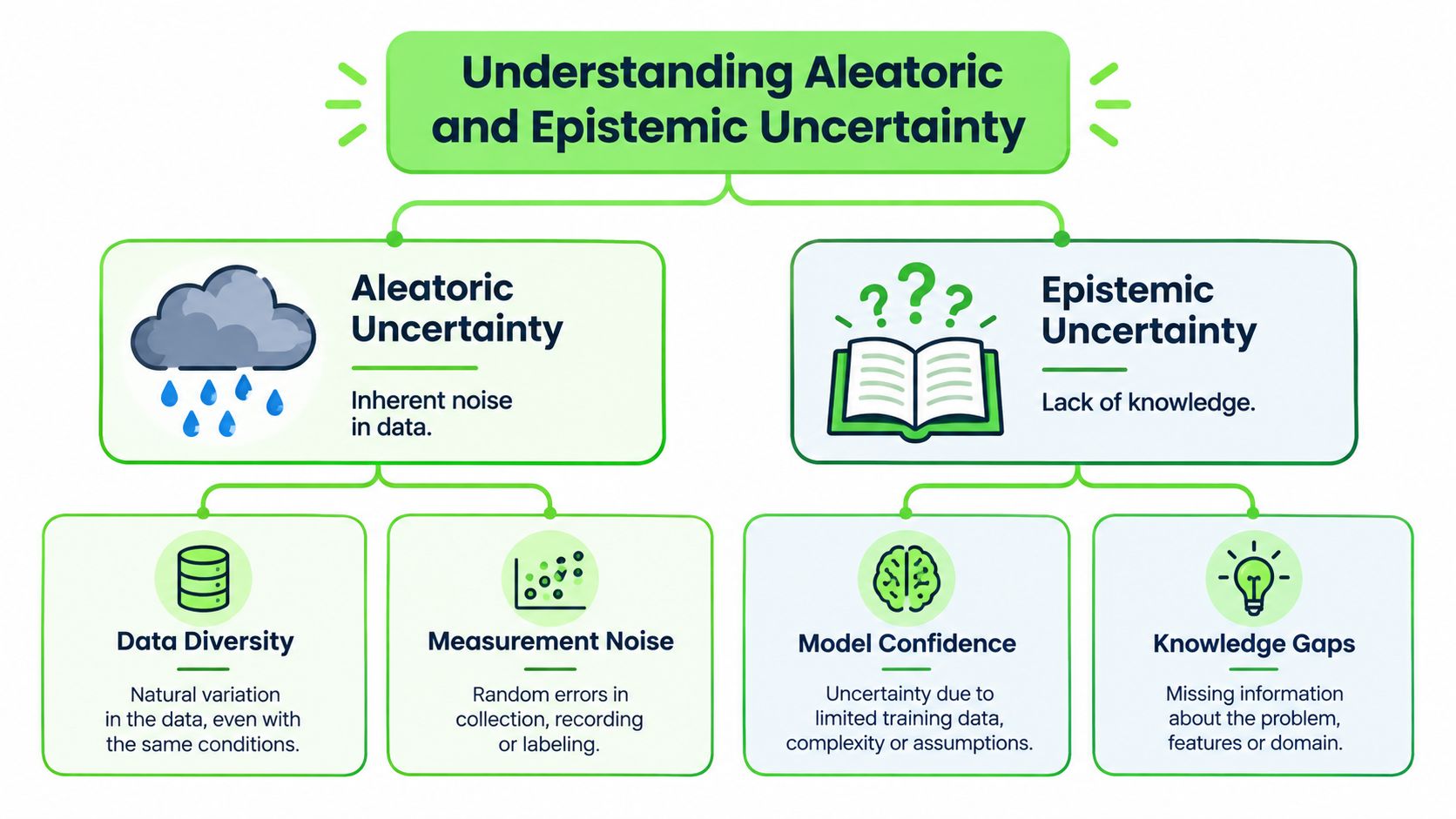
The distinction determines the control the pipeline should apply. Ambiguous user intent calls for clarification. Missing domain knowledge, weak retrieval, or absent authorized evidence calls for abstention or a narrower response. Treating both cases as a generic low-confidence score hides the operational difference.
What aleatoric uncertainty looks like in deployed systems
Aleatoric uncertainty appears when the input or underlying world does not provide one reliable interpretation.
Examples include:
- Messy user inputs: “Cancel the plan from last month” when the account has multiple active subscriptions.
- Conflicting source records: Two operational systems disagree because synchronization delays or manual entry introduced inconsistent values.
- Ambiguous multimodal content: An invoice screenshot is blurry, cropped, or missing the fields needed to identify the transaction.
Retraining does not resolve these cases by itself. A better response is procedural: ask a focused follow-up, expose the conflicting values, request a clearer file, or route the decision to an authorized human. In a multi-tenant system, clarification should preserve the user's access scope and avoid revealing records that belong to another tenant.
A support automation stack should represent ambiguity as a first-class state. It should not treat unresolved inputs as permission to produce the most plausible completion.
What epistemic uncertainty looks like
Epistemic uncertainty occurs when the system lacks enough knowledge to justify an answer. Common causes include missing documents, limited coverage of a product area, failed retrieval, stale indexes, and requests outside the model's prepared domain. In a B2B retrieval system, a relevant document that the user cannot access is not usable evidence. Authorization constraints can therefore create an operational knowledge gap even when the information exists somewhere in the organization.
AI systems may represent uncertainty with probability distributions, class probabilities, or credibility intervals instead of a single-point output. Those representations help describe a prediction, but they do not decide whether generation is safe. The production decision still depends on evidence quality, retrieval sufficiency, user intent, and authorization.
Multimodal systems add another distinction. The Microsoft Research publication on multimodal uncertainty awareness separates epistemic and aleatoric uncertainty and introduces confidence-weighted accuracy, which considers confidence alongside accuracy and calibration.
Confidence alone cannot show whether the input is ambiguous or the system lacks knowledge. Those states require different actions. A blurry invoice should prompt a cleaner upload. A policy assistant that finds no authorized source should abstain. The visible symptom is uncertainty, but the correct control depends on its cause.
Measuring and Calibrating Uncertainty in Practice
Most production teams don't need another abstract confidence score. They need prediction-specific uncertainty quantification tied to actual outputs and workflows. A 2026 review defines uncertainty quantification as explicit numerical estimates, distributions, intervals, prediction sets, or spatial maps attached to each output, and notes calibration metrics such as expected calibration error, Brier score, and negative log-likelihood in this review of uncertainty quantification and calibration.
What to measure instead of “the model feels confident”
Start with artifacts your system can validate:
Answer support status
Is every material claim backed by retrieved evidence?Retrieval sufficiency
Did the system retrieve enough relevant, authorized evidence to answer the user's exact request?Intent completeness
Are the required constraints present, or is a follow-up question still needed?Calibration quality
When the system says an answer is likely correct, does that match empirical correctness over time?
That last point matters because miscalibrated confidence is where real damage starts. The review above makes the implication direct: if predicted confidence is miscalibrated, the stated probability no longer matches observed correctness. In high-stakes systems, that's where selective prediction, triage, and post-processing stop being optional.
A practical calibration loop for RAG and agents
For support and internal knowledge systems, I'd keep calibration concrete.
- Log answer decisions, not just model scores: Store whether the system answered, clarified, or abstained.
- Evaluate by route: A clarification failure isn't the same as a wrong direct answer.
- Track evidence-backed correctness: Separate “linguistically good” from “operationally justified.”
- Use monitoring that spans the full stack: Retrieval latency, pipeline failures, permission misses, fallback paths, and answer route frequencies all matter. Teams comparing top AI app monitoring platforms usually get more value when they include RAG-specific observability requirements instead of evaluating generic app telemetry only.
Where teams usually get this wrong
A frequent mistake is calibrating only the model layer. But in deployed agents, uncertainty is often produced by the composition of retrieval, ranking, context assembly, tool execution, and policy checks. A beautifully calibrated base model won't save a badly authorized retrieval path.
Another mistake is treating “high confidence” as a release criterion. It's better to ask whether confidence is well-calibrated under your actual workflow.
A related operational habit is to test claim support directly. That's where work on the accuracy of artificial intelligence becomes more useful than generic benchmark chasing. In production, the answer that matters isn't “Can the model answer this benchmark question?” It's “Did this system answer within evidence and policy boundaries?”
Calibration is only useful when it changes routing. If nothing different happens when uncertainty rises, you don't have a control system. You have a dashboard.
Retrieval-First Authorization and Cross-Tenant Isolation
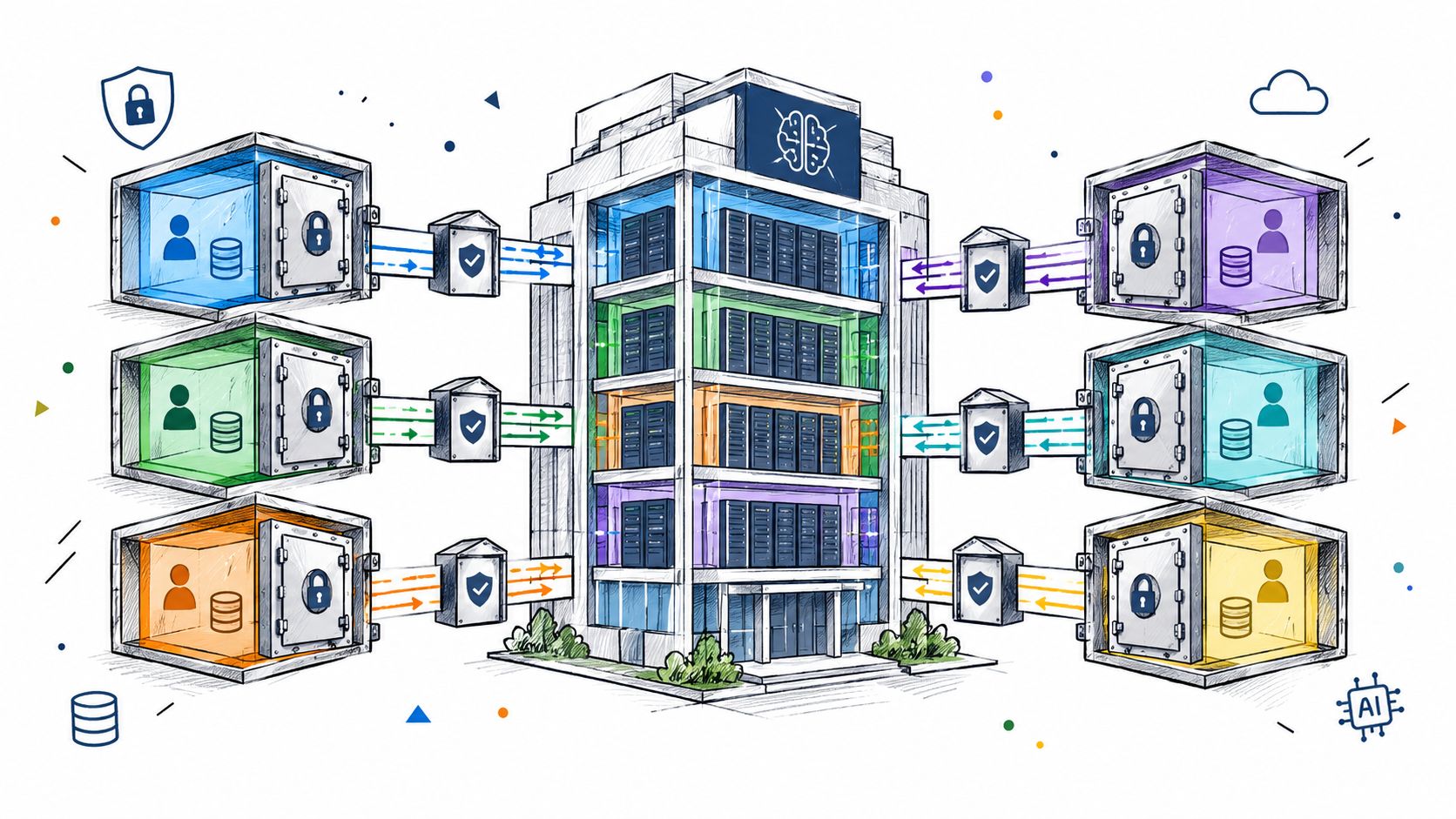
Standard RAG diagrams still hide the dangerous assumption: if a document made it into the index, the model can probably use it. That assumption breaks immediately in multi-tenant B2B systems.
OWASP's guidance for RAG security is explicit that access control must be enforced at retrieval time, not only at ingestion time, and that multi-tenant vector stores should isolate tenants so chunks from tenant A are never retrieved by tenant B. It also recommends fail-closed behavior across the pipeline so a component failure denies the request rather than falling back to unsafe behavior, as laid out in the OWASP RAG Security Cheat Sheet.
Why standard RAG falls short
A conventional stack often works like this:
| Standard pattern | Retrieval-first pattern |
|---|---|
| Retrieve top chunks from index | Authorize caller and scope retrieval first |
| Filter or trust later | Only retrieve what caller may use |
| Let model summarize results | Preserve source identity and claim provenance |
| Fallback on partial failure | Fail closed on identity or permission uncertainty |
The standard pattern treats authorization as cleanup. The retrieval-first pattern treats it as a precondition.
The confused deputy problem in agents
This gets worse with tool-using agents. A recent paper on retrieval-first authorization points out the classic confused deputy risk: the agent may operate with broader privileges than the calling user, so the system must distinguish what was found in the index from what the caller is allowed to use, as described in this paper on retrieval-first authorization.
That distinction is operational, not theoretical. An internal assistant may have service-level access for indexing, ranking, or orchestration. If you don't propagate caller identity and policy into retrieval, the agent can become an accidental privilege escalator.
What robust evidence control looks like
A source-grounded internal knowledge assistant design recommends several mechanics that are worth treating as baseline requirements: enforce trusted identity and source permissions before evidence reaches the model, preserve source identity and exact spans for material claims, choose among answer, clarify, or abstain based on observable evidence conditions rather than model self-confidence, and fail closed when identity or permission context is missing, stale, or unevaluable, as described in this source-grounded assistant design.
In practice, that means:
- Identity propagation: The retrieval request carries the caller's tenant and permission context.
- Source-preserving context assembly: The model receives evidence with durable provenance, not flattened text blobs.
- No silent fallback: If permission evaluation fails, the system denies or pauses. It doesn't “try its best.”
- Delivery controls: The final answer can't introduce claims that weren't justified by the authorized evidence path.
If you're building enterprise retrieval workflows, the architectural patterns in RAG for enterprise systems become much more useful once you treat uncertainty and authorization as the same operational surface. The system shouldn't answer confidently when it's uncertain about access rights.
Building Uncertainty-Aware Routing and Abstention Logic
The operational gap isn't “How do we estimate uncertainty in large language models?” It's “When should the system answer, clarify, or abstain?” Recent survey work notes that uncertainty estimation research is expanding, but there's still a lack of coverage connecting those methods to practical decision rules and evaluation for production systems, as discussed in this ACL findings survey on uncertainty estimation for language models.
Route on evidence conditions, not model self-confidence
A reliable architecture starts with a simple rule: the model doesn't decide whether it has enough evidence. The platform does.
I'd model the pipeline as four checks in sequence:
- identity and authorization
- intent completeness
- evidence sufficiency
- claim consistency
Only after those checks pass should generation proceed.
That sounds strict because it is. But strictness is the point when the alternative is unsupported certainty.
A word diagram for the architecture
Think of the stack as this flow:
- User request enters
- Intent parser extracts facts, constraints, preferences, unresolved dimensions, and requested action
- Policy layer validates caller identity, tenant scope, and source permissions
- Retriever gathers only authorized evidence
- Claim layer converts evidence into candidate claims
- Validator checks support, contradiction, ambiguity, and missing fields
- Router chooses answer, clarify, or abstain
- Generator produces only the permitted form of output with provenance attached
That architecture turns uncertainty into an explicit routing input. It doesn't bury uncertainty in a decoder score.
Preserving conflict instead of flattening it away
Recent evidential RAG work is useful here because it treats retrieved chunks as candidate claims, normalizes equivalent claims so paraphrases don't create fake conflict, and fuses evidence with a Dempster-Shafer operator that preserves unresolved conflict as epistemic uncertainty before routing to direct answering, conflict-aware answering, or abstention, as described in this evidential RAG paper.
That last point matters. Many pipelines accidentally erase uncertainty by over-summarizing. They merge documents too early, compress conflicting passages into one “best effort” context, and then ask the model to sound decisive. A better design preserves disagreement long enough for the router to notice it.
If two authorized sources disagree, the system shouldn't pick a winner by style. It should surface the conflict or abstain.
Implementation patterns that hold up in production
For teams shipping now, I'd prioritize these mechanisms:
- Structured intent before retrieval: Capture facts, constraints, preferences, unresolved dimensions, and provenance needs before querying the index.
- Authorized evidence as a gate: No evidence, no answer. Weak evidence, ask a narrower question.
- Claim-level validation: Evaluate material claims individually, not just the final paragraph.
- Abstention as a valid outcome: Make it a first-class route in APIs, UI states, and analytics.
- Deterministic follow-up rules: If a missing field blocks action, ask for that field directly instead of generating an open-ended clarification.
This is also where one infrastructure layer can help if you don't want to wire every control yourself. AletheionAGI fits here as a grounding and evidence-control layer that works with existing LLMs, RAG pipelines, vector databases, and memory systems. The useful part isn't replacement. It's enforcing fail-closed grounding, authorized retrieval, and abstention when evidence doesn't justify a response.
If you're operationalizing this rigorously, testing matters as much as architecture. A practical next step is adding route-level checks and evidence assertions into your AI unit tests, not just prompt snapshots.
Communicating Uncertainty to Users Without Overbuilding Trust
A support lead asks an AI assistant whether a refund is allowed. The answer cites a policy, but the policy belongs to another tenant and the contract tier is missing. A confidence badge cannot resolve either problem. The interface must show what the system knows, what it cannot verify, and which action is safe next.
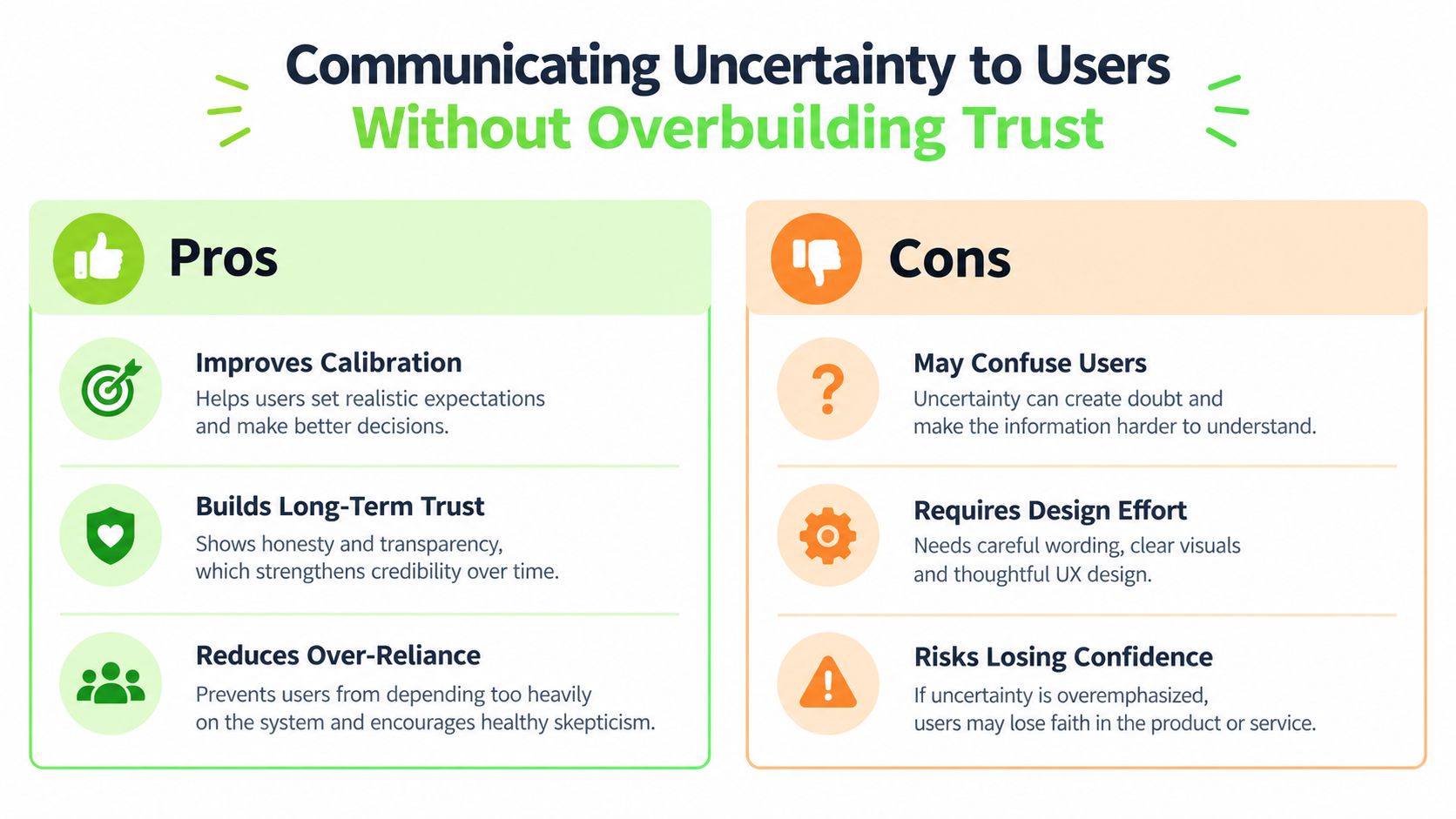
Uncertainty communication works when it changes the workflow. Research on trustworthy AI suggests that uncertainty visualizations can improve trust calibration by reducing both blind reliance and undue skepticism, according to this review on communicating uncertainty in trustworthy AI. For an enterprise product, that means exposing decision-relevant evidence rather than displaying a generic probability.
What users need to know
B2B users generally need four practical answers:
| User question | Better UI response |
|---|---|
| Can I trust this answer? | Show which claims have authorized supporting evidence |
| What is it based on? | Preserve provenance and the relevant source spans |
| What remains unresolved? | Name the missing field, source conflict, or ambiguity |
| What should I do next? | Offer verify, approve, escalate, or clarify paths |
A naked score provides little operational value. “0.82 confidence” does not tell a support lead whether a refund-policy answer came from the current tenant policy, a stale note, or an inference. Claim-level evidence, source age, authorization status, and unresolved conditions provide information the user can act on.
Patterns that connect uncertainty to action
Use distinct interface states instead of one confidence badge:
- Supported answer with citations: Present when authorized evidence is sufficient and aligned.
- Clarification prompt with a reason: Ask for the exact missing constraint, such as the contract tier.
- Conflict-aware answer: State that authorized sources disagree and identify the conflicting passages.
- Abstention with a next action: Explain that the answer cannot be verified from permitted sources, then offer escalation to the policy owner.
The route should match the failure mode. Clarification is appropriate when one user-provided field would resolve the question. Abstention is safer when evidence is absent, contradictory, or outside the user's permissions. The wording should explain the operational consequence without pretending that a model score measures truth.
The goal is appropriate user behavior, not cautious-sounding output.
Human review needs explicit gates
Escalation needs an owner, an approval condition, and a visible handoff state. “Please double-check” leaves the risk and responsibility undefined. Product teams can apply practical patterns for approval gates to make review a defined workflow rather than a generic fallback.
Trust also depends on how users interpret uncertainty beyond a single answer. The same review describes uncertainty as affecting adoption and trust, and discusses broad uncertainty about AI's trajectory alongside a survey in which workers were split 50/50 on whether AI would create new jobs or eliminate them. That division has a practical enterprise parallel: unclear uncertainty signals lead some users to over-trust the system, while others stop using it.
Design the interface around verifiable claims and permitted evidence. Make answer, clarification, and abstention visibly different states. Users can then choose the appropriate next action instead of treating every fluent response as equally reliable.
Implementation Roadmap for Production AI Systems
Start with the control points that prevent unsafe answers before you tune model behavior.
- Enforce retrieval-time authorization with tenant isolation and fail-closed behavior.
- Add structured intent parsing so missing constraints trigger clarification instead of guesses.
- Gate generation on authorized evidence and preserve provenance for each material claim.
- Implement explicit routes for answer, clarify, and abstain.
- Evaluate calibration by workflow outcome rather than by model score alone.
- Test conflict, ambiguity, and permission failures as first-class cases in staging and production monitoring.
A simple decision matrix helps: answer when evidence is authorized and sufficient, clarify when key dimensions are unresolved, and abstain when support is missing, conflicting, or permission context can't be trusted. That's how uncertainty in artificial intelligence becomes a production control surface instead of a postmortem topic.
AletheionAGI provides grounding and evidence-control infrastructure for teams that need AI systems to answer within authorized evidence boundaries, preserve provenance, and abstain when support is missing. If you're building RAG or agent workflows where uncertainty, retrieval authorization, and fail-closed behavior all matter, visit AletheionAGI to see how it fits alongside existing LLMs, vector databases, and memory systems.