Guardrail effectiveness across major cloud LLM platforms ranged from about 53% to 92% on the same malicious prompt set, which means “guardrails” are not a single product category. In production, they behave more like a control plane, and the difference between a good deployment and a weak one is often the difference between layered enforcement and simple text filtering.
The mistake many teams make is treating ai agent guardrails as input-output moderation. That misses the actual failure surface, where the agent decides whether to call a tool, what arguments to pass, whether to trust retrieved evidence, and whether to keep acting after the first failure.
Where Agent Guardrails Fail in Production
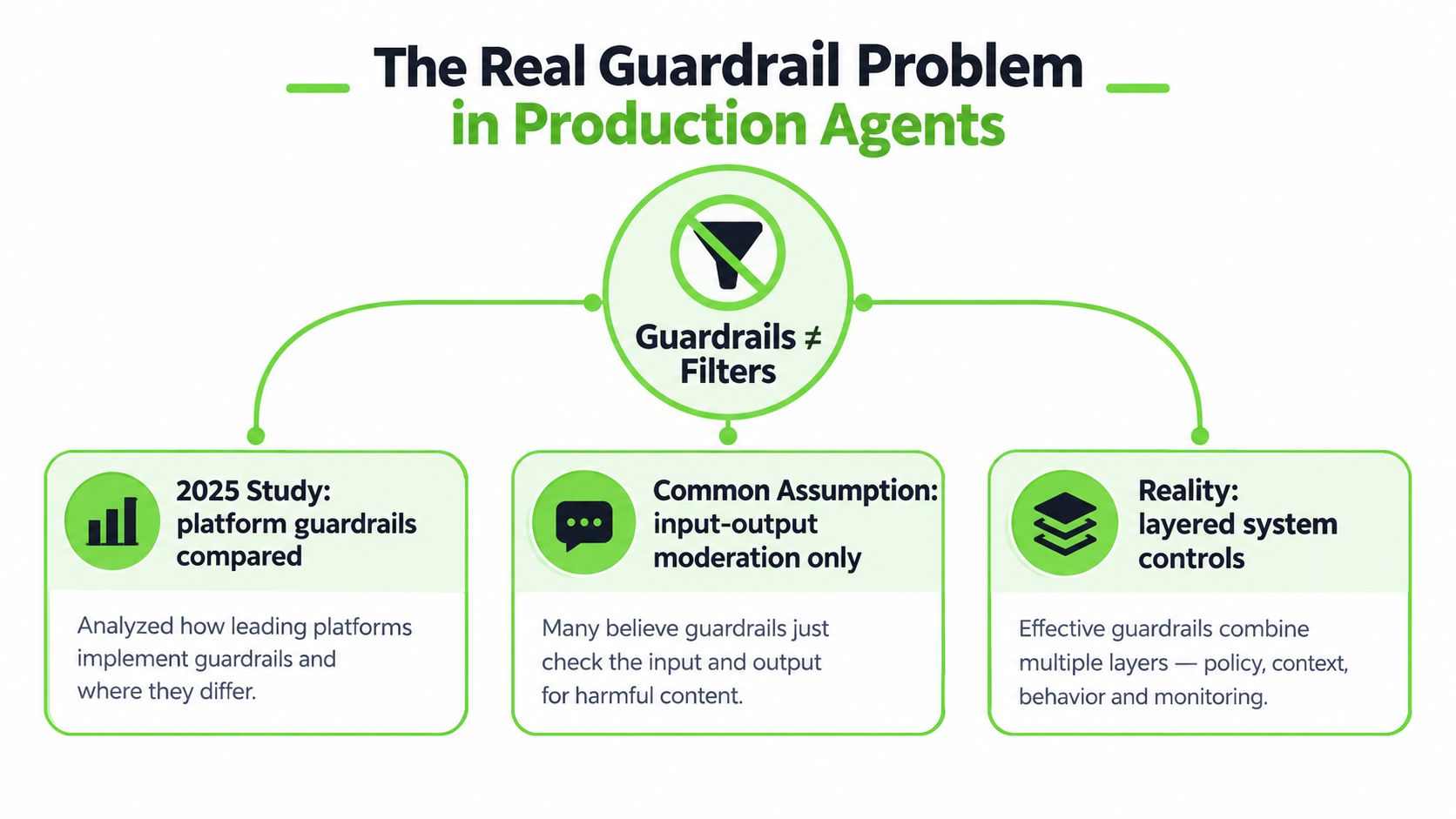
A 2025 comparative study of built-in guardrails across three major cloud LLM platforms found that one blocked 114 of 123 malicious prompts, another blocked 112 of 123, and a third blocked only 65 of 123 through input filtering. Effectiveness ranged from about 53% to 92% on the test set. The spread reflects different threat assumptions, enforcement points, and failure modes, not a uniform product category.
Why the same prompt can pass on one stack and fail on another
The engineering question is where enforcement occurs. A control may run before retrieval, before tool execution, before response delivery, or only at the text boundary after the model has acted. Those placements produce different risk profiles.
Practical rule: if the control cannot inspect the action, tool call, or evidence trail, it is a content filter, not a production guardrail.
A layered design separates these decisions. Policy checks determine whether a request is authorized. Evidence-grounded retrieval tests whether an answer is supportable. Authorized memory limits the state an agent may rely on. Runtime abstention stops execution when evidence or authority is insufficient. Fail-closed controls prevent a failed tool call or ambiguous result from becoming permission for the next action.
The operational boundary matters most during multi-turn interaction, where individually acceptable requests can accumulate into an unsafe sequence. Tool selection, argument passing, evidence trust, and post-failure behavior all require inspection.
What production teams need
The useful mental model is whether each workflow step is authorized, grounded, and reversible. That standard separates a conversational interface from an operational system.
For a view of how these execution boundaries appear in live deployments, see harnessing AI in production. The same controls matter whenever AI can make or trigger decisions.
Three Guardrail Types Every System Needs
A production agent needs three distinct kinds of control. Policy enforcement governs whether the action is allowed. Grounding controls govern whether the statement is supportable. Abstention mechanisms govern whether the system should stop and ask for clarification instead of inventing a path forward.
Policy enforcement protects the action layer
A policy guardrail sits before tool execution. If an agent tries to write to a tenant it doesn't own, access a restricted ticket queue, or invoke a payment workflow outside its scope, the policy layer should block the call before anything downstream changes state. That's not a language problem, it's an authorization problem.
AletheionAGI says hallucination prevention is a grounding problem, but the same logic applies to policy, because the agent should only act on authorized state.
Grounding controls protect the factual layer
A grounding guardrail checks whether the answer is backed by evidence from authorized sources. If retrieval returns nothing relevant, the model should not fill the gap with a polished answer. The right behavior is either a refusal or a clarified request, depending on the task.
That distinction matters in RAG systems. A factual answer without provenance is not just weak, it's operationally unsafe when the response affects customers, compliance, or internal decisions.
Abstention mechanisms protect the ambiguity layer
Some prompts are not blocked by policy and are not answerable from evidence. They're just underspecified. That's where abstention comes in. If the user asks for “the latest policy” but doesn't name the region, tenant, or product line, the safest action is to pause and ask a targeted clarification.
Engineering takeaway: the best guardrail is often a refusal with context, not a forced answer with confidence language.
The trade-off is straightforward. Overly aggressive checks reduce utility, especially in support automation where users expect the system to keep moving. Too-lenient checks invite unsupported claims and risky actions. A usable system needs precision at the policy layer and restraint at the response layer.
Design Patterns for Safe Agentic Architecture
The cleanest architecture separates responsibility into three layers, each with a narrow job. Input intent validation translates user language into structured constraints. Tool-call authorization decides whether the proposed action is allowed. Output verification checks the response against evidence and policy before delivery.
A layered flow that avoids duplicated responsibility
A practical flow looks like this.
User input enters intent parsing, where the system extracts facts, constraints, and unresolved dimensions. The agent then proposes one or more tool calls. A policy layer checks permissions, tenant boundaries, and action scope. If the call survives, the grounding layer retrieves evidence from authorized stores and verifies whether the response can be supported. An abstention mechanism watches for low confidence, missing provenance, or conflicting state, then blocks or redirects the action if needed.
This design works because each layer owns a different risk. Credentials, billing, data authority, and operational responsibility should stay separate. When those boundaries blur, teams end up with agents that can propose actions but can't explain who authorized them or why they were allowed.
For a broader implementation perspective on agent systems, real-world AI agent system design is useful because it treats agent behavior as an execution problem, not just a prompt problem.
Where to place controls in existing stacks
The safest pattern is to hook policy at the tool boundary, grounding at retrieval and generation time, and abstention at the final response gate. That means your LLM can still draft, your vector database can still retrieve, but the system won't release an unsupported answer or an unauthorized action.
If you're extending an existing platform, that usually means three integration points:
- Before the model call, validate intent and strip disallowed context.
- Before the tool call, verify permissions and tenant scope.
- Before the response leaves the system, require evidence and provenance.
Why Multi-Turn and Tool-Layer Controls Matter
Single-turn evaluation misses how agents fail. A stateful agent can look safe on the first prompt and then drift, adapt, or get manipulated over several turns. That's why session-level enforcement is different from token-level filtering, and why trajectory-level inspection matters.
Multi-turn attacks change the threat model
A 2025 systematization of jailbreaking defenses evaluated 13 mainstream guardrail methods across multiple LLMs and nine jailbreak attack types. It found that GuardReasoner achieved the lowest average attack success rate at 0.135, while SmoothLLM reached 0.303, more than double that level (systematization study). The same work reported that session-level guardrails can lower false-positive rates compared with token-level or sequence-level approaches, but multi-turn adaptive attacks still achieved success rates above 90%.
That tells you something uncomfortable. A defense can look good in a single exchange and still fail badly once the attacker gets to adapt.
Trajectory-level benchmarks expose what output checks miss
TraceSafe-Bench is a trace-level safety benchmark for multi-step agentic workflows with 12 risk categories, including prompt injection, privacy leaks, hallucinations, and interface inconsistencies, and it contains over 1,000 unique execution instances (TraceSafe-Bench). The important detail isn't the benchmark size. It's the method. It mutates pre-invocation traces, so guardrail performance is tested against the actual workflow, not just the final sentence.
That matters because an input-only filter can't see a bad tool selection, repeated tool calls, or a manipulated state transition. It only sees text. Production incidents usually happen after the text.
GuardianAgentBench adds another useful signal. It evaluates 580 scenarios across six domains on three production frameworks and reports that a guardrail implementation recovered 19.9% of failures at a false-positive rate of just 0.5%, outperforming system-prompt-based defenses across all models (GuardianAgentBench). The lesson is narrow but important. Explicit controls at the tool and action layer do real work that prompts alone don't.
Production Scenarios and Failure Modes
The failures that hurt teams are usually boring in hindsight. A support bot answers too confidently. A marketplace agent sees the wrong tenant's data. An autonomous workflow keeps calling tools after the trace has been poisoned. Each failure maps to a missing layer, not a missing model capability.
A RAG support agent that answers without evidence
An internal support assistant receives a policy question, retrieves nothing relevant, and still returns a polished answer. The root cause is a missing grounding check. Retrieval produced no matching evidence, but the system had no mechanism to abstain.
The fix is evidence-bounded generation with explicit provenance. OWASP's RAG Security Cheat Sheet recommends verifying document hashes before retrieval, rejecting mismatched documents, recording provenance metadata such as who uploaded a document, when, from what source, and with what approval, and returning source attribution for every RAG response so the recipient can verify which documents and chunks were used (OWASP RAG Security Cheat Sheet). For support teams, that means a response should be explainable back to the exact documents it used, or it should stop.
A multi-tenant marketplace agent leaks pricing data
A tenant-specific agent can retrieve competitor pricing because access was enforced at ingestion, not at query time. The failure is cross-tenant leakage at retrieval time, not a model hallucination. AWS Prescriptive Guidance for agentic AI multitenancy says tenant isolation means one tenant cannot access another tenant's resources, and that credentials control access to each tenant's resources (AWS multitenancy guidance).
Google Cloud's multi-tenant agentic AI architecture adds a concrete pattern for strict boundaries. It recommends tenant project-level isolation, a project-level VPC Service Controls perimeter, and a PAB Policy at the organization level, plus custom IAM roles so a developer in one tenant can't access data in another (Google Cloud architecture).
An autonomous workflow keeps acting after trace manipulation
A prompt injection mutates the agent's trace, and the workflow keeps making repeated tool calls. The missing guardrail is runtime trajectory validation. The system needs schema checks, tool-coverage checks, and state validation at each step, not just a one-time prompt screen.
For teams building this kind of stack, the most useful mental model is to test the trace, not just the answer. If the action path is wrong, the text output will usually be wrong too, just later.
Building Your Guardrail Checklist
A usable guardrail program starts with the narrowest controls that stop the most common failures. You don't need to solve everything at once, but you do need a checklist that maps control to failure mode and can be audited later.
| Layer | Purpose | Implementation Pattern | Key Failure Mode Prevented |
|---|---|---|---|
| Input Validation | Block hostile or malformed requests early | Intent parsing, schema checks, prompt-injection screening | Malicious or ambiguous input reaching the agent loop |
| Tool Authorization | Allow only permitted actions | Per-call credentials, tenant checks, permission policy | Unauthorized tool use or cross-boundary actions |
| Grounding & Evidence | Tie claims to verifiable sources | Authorized retrieval, provenance metadata, claim validation | Unsupported factual output |
| Abstention & Provenance | Stop when confidence or evidence is insufficient | Refusal triggers, citation requirements, audit logging | Confident guessing and untraceable answers |
A practical rollout usually follows the same sequence. Verify tenant identity before every retrieval. Validate tool-call arguments against schemas. Require provenance for every factual claim. Abstain when evidence confidence falls below your defined threshold. Log the full execution trace so you can reconstruct what happened later. Re-evaluate authorization at each step instead of assuming it persists.
AletheionAGI frames this as authority-before-autonomy, and that's the right default for production systems.
For teams comparing implementation options, AI agents testing is worth pairing with this checklist because guardrails are only useful if you can measure them against frozen scenarios and explicit denominators.
Operational note: guardrails reduce risk, they don't eliminate adversarial adaptation. Their usefulness depends on the quality of the evidence store, the specificity of policy definitions, and whether you keep benchmarking against the attack surface you actually face.
Frequently Asked Questions About Agent Guardrails
What should guardrails do when an action is permitted but still risky
Authorization is not the same as operational safety. A policy layer has to encode context, not just permission, because some actions are technically allowed and still bad for the situation. That matters because a recent survey-style benchmark review found that 85% of evaluated benchmarks lack concrete policies and rely on vague goals or common sense, which makes many guardrail claims hard to reproduce or generalize (benchmark review).
The practical answer is to separate “allowed” from “wise.” If the action is permitted but the context is unclear, the agent should ask for clarification or escalate instead of executing by default.
Should guardrails live inside the model or outside it
Outside. External enforcement is easier to audit, easier to version, and less exposed to prompt manipulation. The strongest enterprise pattern is an enforcement layer outside the model that validates tool calls, retrievals, and outputs before the system acts on them.
That doesn't mean the model is irrelevant. It means the model proposes, while the surrounding system decides whether the proposal can proceed.
How often should guardrail benchmarks be re-evaluated
Continuously, with frozen benchmarks and versioned claims. If the benchmark, policy, or evidence set changes, the result changed too, even if the number on the slide did not.
Keep the protocol explicit. Disclose the denominator, the version, and the limitation before you narrow any claim. That's the only way a guardrail benchmark stays meaningful when the attack surface shifts.
AletheionAGI builds grounding and evidence-control infrastructure for AI systems that need authorized retrieval, fail-closed behavior, and auditable claim validation. If you're designing ai agent guardrails for RAG pipelines, memory systems, or multi-tenant workflows, visit AletheionAGI to see how those controls can fit into your stack.