Most advice about DevOps vs. MLOps starts in the wrong place. It treats MLOps like a tooling upgrade, as if you can bolt a model registry onto a CI/CD pipeline and call it production AI. That mindset burns time because the hard problem isn't the pipeline, it's deciding which outputs, datasets, retraining events, and rollouts must stay authority-gated and auditable.
DevOps already solved a different problem. It gave teams a mature way to ship deterministic software changes with clear ownership, repeatable releases, and strong operational feedback. Production AI breaks that model the moment the system can answer differently without any code change, because the thing that changed might be data, retrieval context, or the model itself.
| Dimension | DevOps | MLOps |
|---|---|---|
| Core question | Can we ship and run software reliably? | Can we ship and keep a probabilistic system trustworthy? |
| Primary artifacts | Code, infrastructure, runtime config | Code, data, models, evidence |
| Main failure signal | Service breaks, latency spikes, deployment errors | Quiet degradation, drift, weak grounding, stale outputs |
| Governance focus | Change control for software releases | Change control for data, models, prompts, and evidence |
| Best fit | Deterministic applications | AI systems that can regress without crashing |
The CTO mistake is obvious once you name it. If your team is arguing about orchestration before it has defined who approves a retraining run, who signs off on a model promotion, and who owns the evidence trail after a bad answer, you're not missing a tool. You're missing the operating model.
Why DevOps vs. MLOps Is the Wrong Question Most Teams Ask
The popular framing, “MLOps is DevOps plus models,” is too shallow to be useful. It pushes leaders toward platform shopping when the failure mode is governance ambiguity. If an AI feature causes a customer incident, the important question isn't which workflow engine ran the job, it's who authorized the evidence behind the answer and who can explain the decision chain later.
Authority matters more than automation
DevOps matured around a clean control point, source control and release flow. A pull request, a build, a deploy, and a rollback are all meaningful because the artifact is deterministic and the owner is known. Production AI has a messier boundary because the service can appear healthy while the output quality degrades under new data, new prompts, or a changed retrieval corpus.
That's why the right starting point is not pipeline design, it's decision design. Who can promote a new model? Who can change the grounding corpus? Who can override a failed eval and ship anyway? Those are the questions that decide whether your AI stack is safe enough to face customers.
Practical rule: if you can't name the human who can say “no” to a model rollout, you don't have MLOps yet, you have an automation script with optimism attached.
Google Cloud's long-running State of DevOps survey had already run for nine years by 2023 and had collected data from more than 36,000 professionals worldwide, which is why DevOps language is so standardized today. That scale matters because DevOps patterns have been measured repeatedly, while MLOps is still building comparable longitudinal evidence. Google Cloud's summary of the State of DevOps survey shows why leaders inherit a mature operating model for software, but only a newer and still-evolving one for AI.
Defining DevOps and MLOps Without the Marketing Layer
DevOps is the operating discipline for shipping software changes continuously without losing control of reliability. In practice, that means teams govern code, infrastructure manifests, container images, and runtime configuration through repeatable release processes. The usual scaffolding is CI/CD, immutable builds, observability, and rollback discipline.
MLOps keeps that foundation but adds a different class of managed assets. It governs datasets, trained model artifacts, and evidence about evaluation quality alongside the code that produced them. That shift is why MLOps is not a rebrand of DevOps, it's a specialization for systems whose behavior depends on statistical inputs and whose outputs can regress without a binary failure.
A useful vocabulary keeps teams honest:
- Code artifacts are the deterministic parts, application logic, prompt templates, orchestration, and infrastructure definitions.
- Data artifacts are the training, validation, and retrieval inputs, including labels and feature sets.
- Model artifacts are weights, adapters, embeddings, or other learned parameters.
- Evidence artifacts are evaluation results, lineage records, approval notes, and reproducibility metadata.
A good overview of how teams scale AI with MLOps is available in ThirstySprout's practical guide, which is useful because it keeps the conversation tied to workflow shape rather than hype. The key point for a CTO is simple, a “model version” is rarely a single object. It's a bundle pointer that only makes sense when it's tied back to the code, data, and evaluation context that created it.
| Dimension | DevOps | MLOps |
|---|---|---|
| Governs | Code and runtime state | Code, data, models, evidence |
| Release unit | Application build | Model bundle plus its lineage |
| Reproducibility anchor | Commit hash and environment | Commit hash, dataset version, model artifact, evaluation history |
| Rollback target | Previous release | Previous release plus prior data and model lineage |
| Main risk | Broken software | Broken behavior with a healthy service |
Lifecycle, Metrics, and Where the Two Pipelines Diverge
The lifecycles look similar on paper, which is why teams get misled. Both disciplines pass through plan, build, test, release, deploy, operate, and retire. The difference shows up when the system starts serving real traffic and the question changes from “did we deploy?” to “is the answer still correct?”
The point where DevOps metrics stop being enough
DevOps measurement is built around deployment frequency, lead time for changes, mean time to restore, and change failure percentage, the DORA family of metrics and related delivery signals. Those still matter in MLOps, because code still ships, services still fail, and engineers still need a rollback path. But once the model is in the operate stage, those metrics stop telling the full story.
The operating question changes. For production AI you need signals like distribution shift, retrieval relevance, grounding fidelity, hallucination rate, fairness deltas across cohorts, and outcome quality on a held-out eval set. A healthy service can pass every infrastructure check and still answer worse than last week because its inputs moved or its retrieval layer went stale.
DevOps asks whether the service is up. MLOps asks whether the answer is still defensible.
That's why the MLOps principles discussed by the MLOps community map the same delivery metrics to a broader operational surface, adding model-specific signals such as data drift, model drift, retraining triggers, and monitoring coverage. See the formal framing in the MLOps principles overview. For evaluation design in practice, the discipline quickly becomes inseparable from how you structure tests, thresholds, and review gates, which is why teams often pair it with a dedicated LLM evaluation workflow.
| Lifecycle Stage | DevOps Metrics | MLOps-Specific Signals |
|---|---|---|
| Plan | Release scope, service SLOs | Data availability, label quality, evaluation design |
| Build | Build success, artifact integrity | Training reproducibility, feature consistency |
| Test | Unit, integration, regression tests | Golden-set evals, bias checks, drift simulations |
| Release | Approval to deploy, change failure risk | Model approval, evidence review, rollback readiness |
| Deploy | Deployment frequency, lead time | Model deployment latency, inference readiness |
| Operate | Mean time to restore, uptime, error rate | Drift, grounding decay, hallucination regression, retraining triggers |
| Retire | Service decommissioning | Model deprecation, dataset lineage retention |
The Code, Data, and Model Artifact Trinity
Shipping AI means versioning more than code, and that's where classic DevOps assumptions break. A software commit can be diffed, reviewed, and reverted with high confidence. A model system needs the code, the data, and the model artifact to stay linked, because any one of them can change behavior.
Why one commit hash is never enough
Code is still the easiest artifact to manage. It's deterministic, reviewable, and revertible. Data is not. Training data shifts, labels age, retrieval corpora change, and feature pipelines can subtly alter the input surface even when the application code is untouched. The model artifact itself adds another layer, because weights, prompts, embeddings, or adapters may be the thing customers experience.
That's why reproducibility in MLOps means pinning the whole bundle, not just the repository state. You need the training recipe, the feature transforms, the dataset snapshot, the model version, and the evaluation history that justified promotion. A vendor-neutral production overview makes the point directly, each model version should stay connected to the code, training data, features, parameters, dependencies, and evaluation results that produced it. Snowflake's MLOps overview captures this bundle-based reality well.
| Attribute | Code | Data | Model |
|---|---|---|---|
| Change pattern | Intentional and reviewable | Often external and shifting | Learned from prior runs |
| Diffability | High | Medium to low | Low |
| Rollback semantics | Straightforward | Requires lineage and snapshots | Requires bundle-level restore |
| Typical owner | Software engineering | Data engineering, ML engineering | ML engineering, platform |
| What breaks if unmanaged | Bugs | Drift, bad labels, stale retrieval | Regressed behavior |
The operating implication is blunt. If the data changes and the code does not, the service can still fail in production. That's a foreign concept for pure DevOps teams, but it's the norm for AI systems.
Silent Failure Modes DevOps Alerts Were Never Built to Catch
Uptime dashboards are necessary, but they're not enough for AI. A model can stay online, meet latency SLOs, and still get worse every week. That's the silent-failure problem, and it's why DevOps-style alerting misses the most expensive regressions.
The failures that don't page you
Data drift means the input distribution changes. Concept drift means the relationship between inputs and the target changes. Embedding staleness means the retrieval layer is using representations that no longer match the current corpus. Grounding decay happens when the answer still looks fluent but the evidence behind it is weak or outdated. Prompt injection impact appears when hostile or malformed inputs alter the system's behavior. Hallucination regression shows up when the model starts producing plausible but unsupported claims more often than before.
These are not infrastructure failures, so Prometheus and standard SRE alerts won't catch them by default. You need held-out evals, shadow traffic, retrieval quality checks, and human review gates. The failure mode isn't “service down,” it's “answer untrustworthy,” and that requires a different monitoring stack.
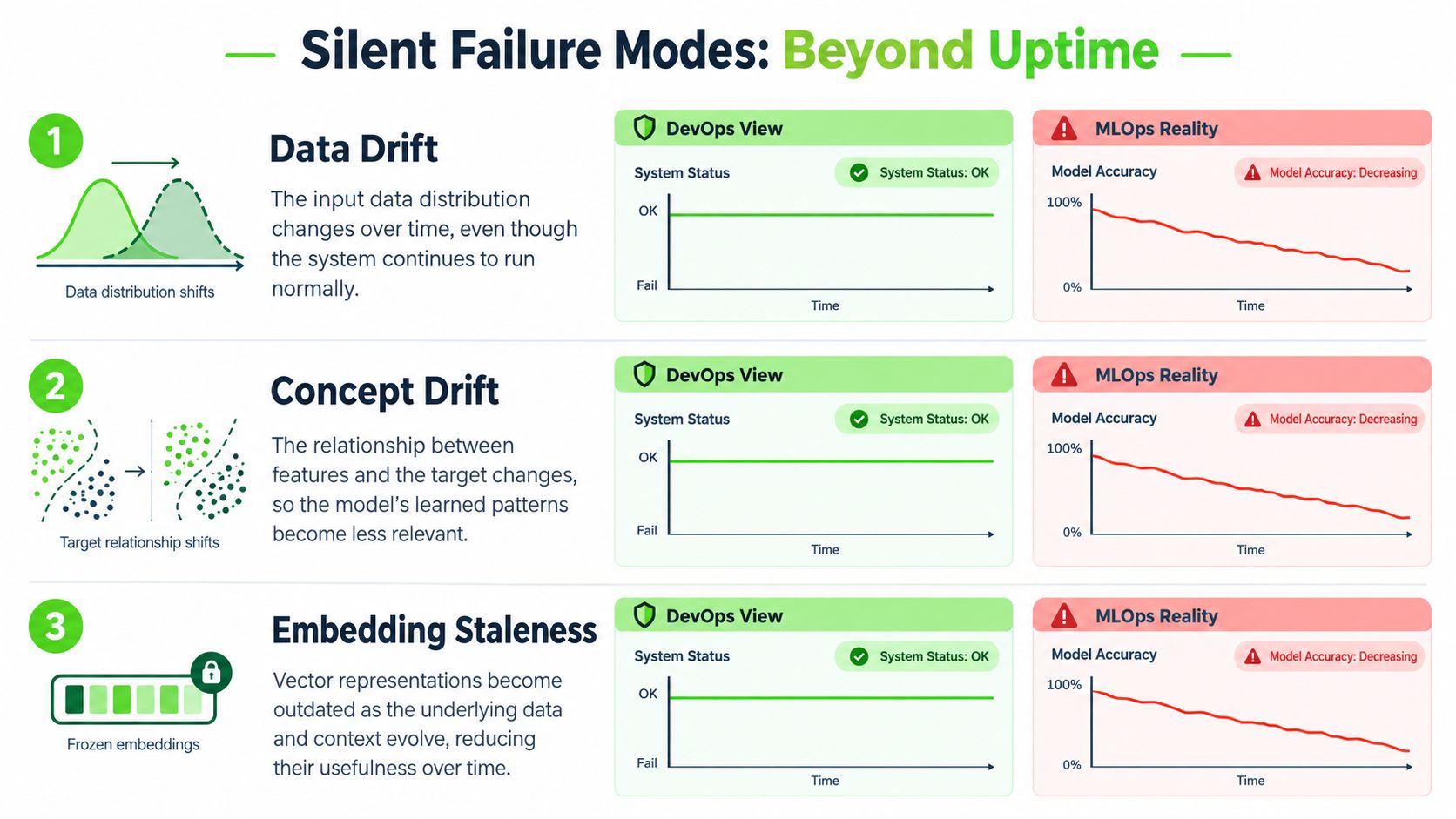
If your team works on customer support automation or RAG systems, the practical difference is brutal. A green service can still hallucinate on a high-value customer query, and you won't know from latency graphs alone. That's why AI evaluation work has to sit inside the delivery path, not outside it as a periodic audit.
For a focused treatment of answer quality failure, the hallucination prevention guide is worth reading alongside your internal eval design. The operational takeaway is simple, if you're only monitoring whether the app is alive, you're missing the question that matters.
Governance, Provenance, and the Authority-Gated Steps MLOps Cannot Skip
Most MLOps failures are not caused by missing automation. They're caused by letting the wrong things run without a human owner. A mature AI stack still needs checkpoints where someone with authority approves data changes, eval results, or rollout scope, especially when the blast radius includes customers or regulated data.
What should stay gated
Training data approval needs a real owner. Eval-set sign-off needs a real owner. Production rollout for a customer-facing model needs a real owner. Deletion of training data, access to PII features, and changes to high-blast-radius prompts all deserve explicit approval because those are policy decisions, not just technical steps.
A multivocal review of MLOps research makes the socio-technical issue plain, the hardest problem is often culture and silo-breaking, not tooling. It also points to compliance, fairness, security, and the automation dilemma, where some checks still need human review. That lines up with the governance posture described in Server Scheduler's infrastructure governance models, which is useful because the core lesson is the same, not every automated action should also be autonomous.
Practical rule: automate linting, regression tests, and reproducibility checks. Keep rollout, deletion, and sensitive-data access behind authority-gated approval.
Governance is not paperwork in MLOps, it's the load-bearing wall. NIST's Generative AI Risk Management Framework explicitly calls for inventory entries that include data provenance such as source, signatures, versioning, and watermarks, along with known issues, human oversight roles, and special rights for sensitive data. See the framework's inventory guidance in NIST AI 600-1. If you can't trace a bad answer back through retrieval, model, and data lineage, you don't have governance, you have guesswork.
The internal benchmark for modern AI risk management is straightforward. Models may propose actions, but authenticated policy and canonical state should make the deciding move.
For teams that want a sharper business framing of those gates, the article on guardrails in business operations fits well with this control model.
Matching the Operating Model to Your AI Workload
Not every AI feature needs the same operating discipline. A CTO should match the model to the blast radius, not to the enthusiasm level of the team. The wrong answer is either overbuilding MLOps for a contained internal tool or underbuilding it for a customer-facing system with weak observability.
Support automation, RAG, and multi-tenant SaaS are not the same problem
Internal support automation with a private corpus can often ship on an extended DevOps foundation. Keep prompts and grounding content version-controlled, sample retrieval quality on a regular cadence, and log every answer with enough context to reconstruct what happened. If the output stays inside the company and humans can catch mistakes before customers see them, you can delay the full MLOps stack.
Customer-facing RAG is a different bar. Silent hallucination is reputational damage, not just a bug, so you need drift monitoring, golden-set evaluation, and human-in-the-loop review for retrieval regressions. The system may still look healthy from an infrastructure perspective, but the answer quality has to be measured as a first-class product signal.
Multi-tenant SaaS AI features push hardest toward full MLOps. Per-tenant governance, audit trails, and rollback by cohort become mandatory because one tenant's data, prompt, or retrieval change can't bleed into another tenant's experience. The isolation problem is no longer theoretical, it's the operational boundary of the product.
| Workload | DevOps Carryover | Required MLOps Components | Main Trade-Off |
|---|---|---|---|
| Internal support automation | CI/CD, observability, rollback | Prompt versioning, grounding logs, sampled retrieval evaluation | Faster delivery with weaker model governance |
| Customer-facing RAG | Deployment automation, monitoring, incident response | Drift checks, golden-set evals, human review gates | More control, slower promotion |
| Multi-tenant SaaS AI | Release automation, infra as code, alerting | Tenant-level lineage, audit trails, cohort rollback, evidence packs | Highest safety, highest operational overhead |
The heuristic is plain. If a wrong answer reaches a customer and you can't debug it from logs alone, treat it as MLOps from day one. If the answer is still contained and reviewable, extend DevOps first and add MLOps where the evidence gap appears.
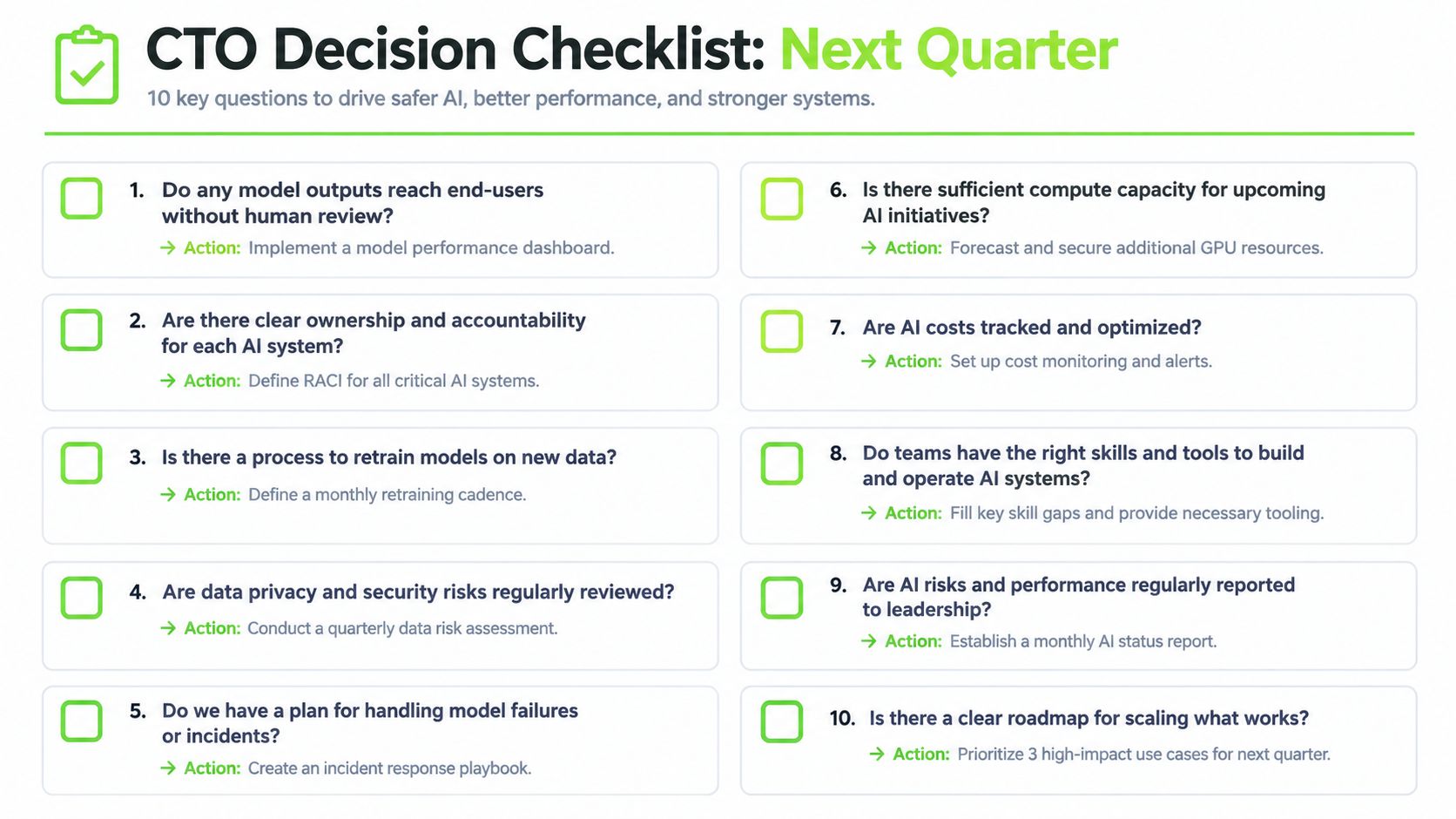
A CTO's Short Decision Checklist for the Next Quarter
Run this list in the next planning cycle, not next year. If the answer to more than three items is unclear, don't ship to customers yet.
- Do any model outputs reach external users? If yes, add evaluation gates and a clear rollback path before launch.
- Do training or grounding data change without a code deploy? If yes, add data and model lineage, because code-only release tracking won't cover you.
- Can a wrong answer be reconstructed from logs alone? If no, add retrieval traces, model versioning, and prompt storage with the answer record.
- Do you need rollback by tenant or cohort? If yes, treat the system as multi-tenant MLOps, not generic app ops.
- Do regulators or customers want an evidence trail? If yes, formalize approval artifacts, eval history, and provenance capture.
- Are model and prompt versions stored with evaluation scores? If no, your release process is incomplete.
- Are drift and grounding freshness monitored continuously? If not, add feature drift and retrieval quality monitoring now.
- Can engineering tell which data changed a prediction? If no, your lineage is too weak to support production AI.
- Do humans still approve high-blast-radius changes? If not, restore authority-gated review immediately.
- Would a bad answer create support, compliance, or trust damage? If yes, stand up a full MLOps platform instead of extending DevOps ad hoc.
AletheionAGI builds grounding and evidence-control infrastructure for production AI, which is exactly the gap DevOps leaves open when models start handling sensitive or multi-tenant data. If you need a layer that keeps outputs tied to provenance, authorization, and auditable evidence without replacing your existing LLMs, RAG pipelines, vector databases, or memory systems, visit AletheionAGI and evaluate whether your current stack can prove what it says before it says it.