The most common advice about grounding is also the least useful: retrieve a few documents, attach citations, and assume the model is now trustworthy. That approach confuses visible evidence with authorized, current, task-relevant evidence. A response can contain links and still rely on stale policy, incomplete context, or data the requesting user shouldn't see.
So, what is grounding and why is it important? In production AI, grounding is the discipline of constraining model outputs to evidence the system has authenticated, retrieved for the current task, validated for integrity, and permitted to expose. It isn't a prompt-engineering trick or a citation-generation feature. It's a reliability and access-control mechanism for agents that answer customers, update records, recommend actions, or operate across organizational boundaries.
Redefining Grounding for Production AI
A language model can produce a fluent answer from patterns learned during training. That capability is useful for drafting and summarization, but it doesn't establish that the answer reflects canonical application state. Customer entitlements, pricing rules, account ownership, legal policies, and incident status change outside the model's memory. A production system must therefore decide which evidence is authoritative before generation begins.
This changes the architecture. Instead of asking a model to “use the context below,” treat the model as one component inside an evidence-control path:
- The application authenticates the request.
- A policy layer determines which sources and records are available.
- Retrieval selects evidence within those boundaries.
- Validation checks freshness, provenance, integrity, and task fit.
- The model produces a bounded response or abstains.
- A delivery layer blocks unsupported claims and unauthorized actions.
The distinction matters for customer support and AI agents. A support assistant might retrieve a product document that accurately describes a feature, but that document doesn't prove the current customer has access to it. A billing assistant might find a plan page while missing a tenant-specific contract. A model can combine both into a confident answer unless the system separates general knowledge from authenticated account state.
Practical rule: Ground the decision, not just the prose. If an answer can trigger an action, the system must verify the state that authorizes that action.
RAG remains an important building block, but it isn't synonymous with grounding. Teams implementing it should distinguish retrieval mechanics from evidence governance. This retrieval-augmented generation overview provides useful context for the underlying pattern, while the production question is whether retrieved material is valid for this user, tenant, task, and point in time.
The same principle applies to memory. Persistent conversation history can improve continuity, yet memory may contain obsolete preferences, accidental disclosures, or information inherited from another boundary. A reliable memory system needs ownership, retention, provenance, and authorization controls. Prompt instructions such as “never reveal another tenant's data” can't compensate for a retriever that has already delivered that data to the model.
Grounding therefore has two gates. Evidence must be relevant and supported, and evidence must be authorized. If either gate fails, the safe result may be a clarification request, a restricted answer, or an explicit abstention. That behavior can feel less polished than a complete response, but it is far safer than allowing fluent language to conceal an authority failure.
The Evolution of Evidence-Bounded Generation
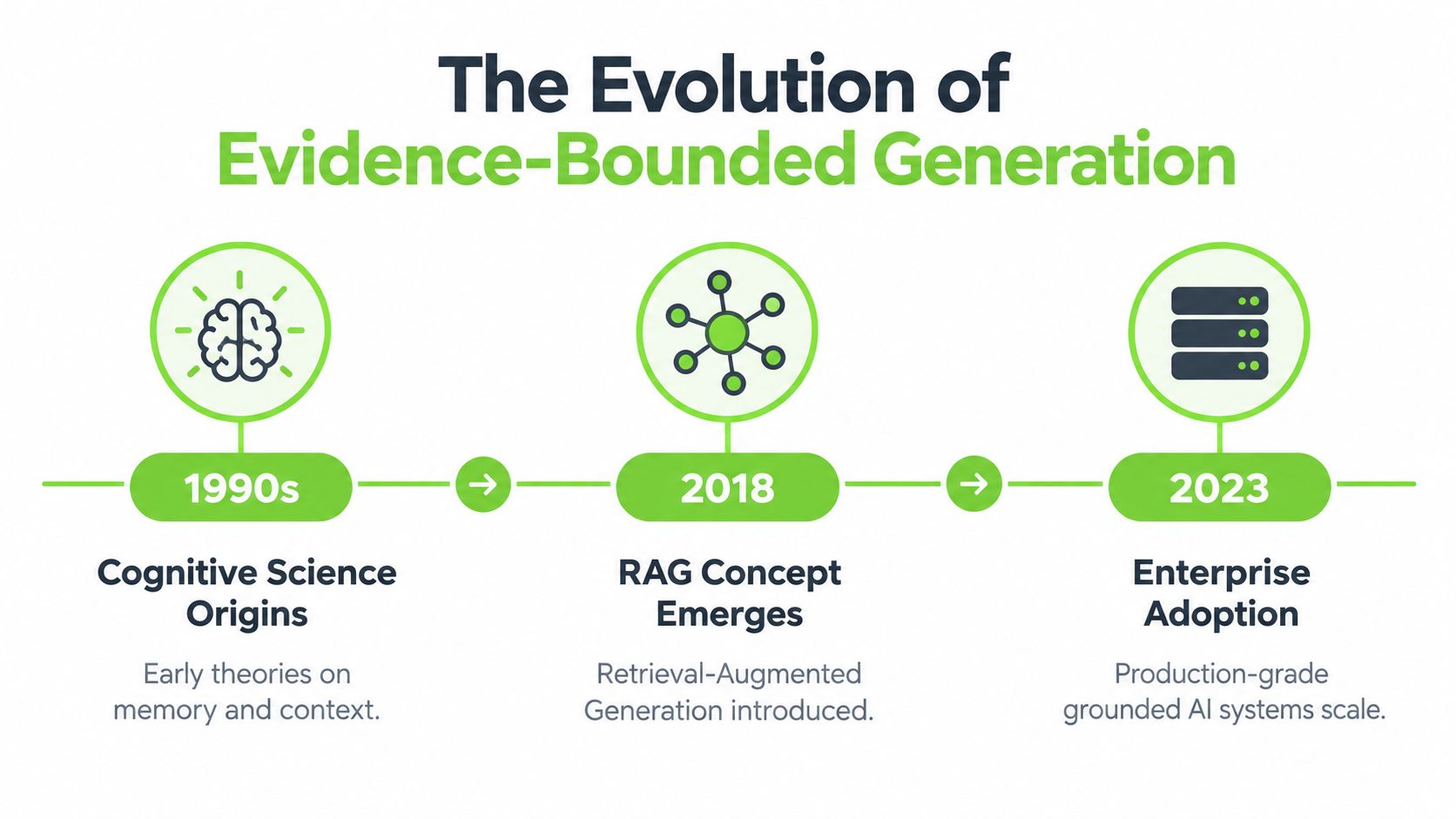
The idea behind grounding predates current RAG products. In 1990, cognitive scientist Stevan Harnad formally posed the symbol grounding problem, asking how computational symbols could acquire intrinsic meaning rather than merely receiving interpretations from humans. The question was conceptual, but it anticipated a practical concern that now sits at the center of AI infrastructure: how can a system connect an output to something outside its own internal representations?
Retrieval-augmented generation made that concern operational. The foundational RAG paper was published on May 22, 2020, and the pattern was commercialized broadly across major cloud platforms during 2024–2025. The timeline matters because it shows grounding moving from a theory of meaning to an infrastructure pattern used in customer-facing and decision-support systems. As models began to write answers that people could act on, fluency alone stopped being a sufficient quality signal.
Retrieval narrows the generation space
A basic language model can select a plausible continuation from a broad learned distribution. RAG adds an external evidence path, usually combining retrieval with a prompt or model interface. The model still generates language, but the application supplies material that should constrain what the model can responsibly claim.
That constraint is only as strong as the retrieval and fusion process. Recent benchmark-based work discusses HotpotQA, HaluBench, and MEGA-RAG as evidence that retrieval quality and stronger evidence fusion are associated with fewer unsupported claims (research on retrieval quality and grounded generation). The implication is straightforward: adding context isn't enough. The system needs accurate, diverse evidence that bears directly on the requested task.
This is why a grounding layer should work with existing components rather than replace them. LLMs remain responsible for language generation, vector databases remain useful for similarity search, and RAG pipelines remain valuable for assembling context. A separate evidence-control layer can validate candidate sources, apply authorization, detect unsupported claims, and decide whether the response should be delivered.
From citations to inspectability
Grounding creates an opportunity for traceability. A reviewer should be able to identify which records supported a claim, which policy permitted their use, when the records were retrieved, and which version of the system generated the response. That audit path is more valuable than a citation list that merely looks authoritative.
The architecture also needs explicit boundaries. Evidence from a CRM, a private support ticket, and a public documentation page shouldn't automatically receive the same authority. A production system can rank sources, define source-specific use cases, require structured fields for action-taking, and prevent the model from treating an unverified passage as a command.
AletheionAGI's GQueries is one example of infrastructure positioned in this category. It provides persistent memory, authorized retrieval, and fail-closed grounding alongside existing LLMs, retrieval systems, and memory architectures. The important design choice isn't the product label. It's the separation between retrieving information and deciding whether that information is safe and sufficient to support an answer.
Why Ungrounded Models Fail in Enterprise Environments
Ungrounded output fails in enterprise settings because the model has no dependable mechanism to distinguish known evidence from plausible completion. An incorrect answer in a casual brainstorming session may be inconvenient. An incorrect entitlement, price, compliance instruction, or support commitment can create operational and legal exposure.
One recent industry summary reports that 30–45% of ungrounded model outputs contain at least one factual error, while more than 60% of hallucination cases in enterprise pilots were tied to missing or outdated context (industry summary of grounding risks). Those figures aren't a universal benchmark for every model or workflow, but they show why leadership teams shouldn't evaluate grounding through demos alone. The relevant question is whether the system can control the conditions that produce unsupported answers.
The same source describes systems with live grounding sources as grounded in 97.5% to 98.4% of answers, using an average of 4.6 to 14.1 sources per answer (grounding coverage and source-use summary). These measurements have scope and methodology limitations, so they shouldn't be treated as a guarantee for a new implementation. They do, however, illustrate the direction of production systems, where answers increasingly depend on retrieved evidence rather than model memory alone.
Why basic RAG can still mislead
A pipeline can retrieve the wrong document, return a stale version, or select several passages that each appear relevant but conflict in a material way. The model may then synthesize a polished answer and place citations beside it. The citations make the response easier to inspect, but they don't prove that the conclusion follows from the evidence.
Typical failure modes include:
- Stale evidence: A superseded policy remains searchable and outranks the current version.
- Incomplete evidence: The retriever finds a product rule but misses an account-level exception.
- Low diversity: Several chunks originate from the same flawed or duplicated source.
- Weak task coupling: Documents mention the subject but don't answer the user's actual operational question.
- Citation decoration: The response includes sources that support a nearby statement, not the central claim.
The benchmark literature reinforces this distinction. Better retrieval and stronger fusion are linked to fewer unsupported claims, but grounding in the abstract doesn't guarantee correctness. Teams should test retrieval recall, source conflict handling, freshness, authorization, and claim-level support separately.
A citation is evidence of retrieval, not evidence of correctness.
For support automation, the safest design often combines answer generation with structured checks. A response about a refund should reference the applicable policy, verify the customer's account state, and avoid promising an action until the transactional system confirms authority. If those checks can't pass, the agent should explain the limitation or route the case to a human. That may reduce apparent automation coverage, but it protects the workflows where an attractive answer is the wrong outcome.
Enforcing Multi-Tenant Isolation and Authorization
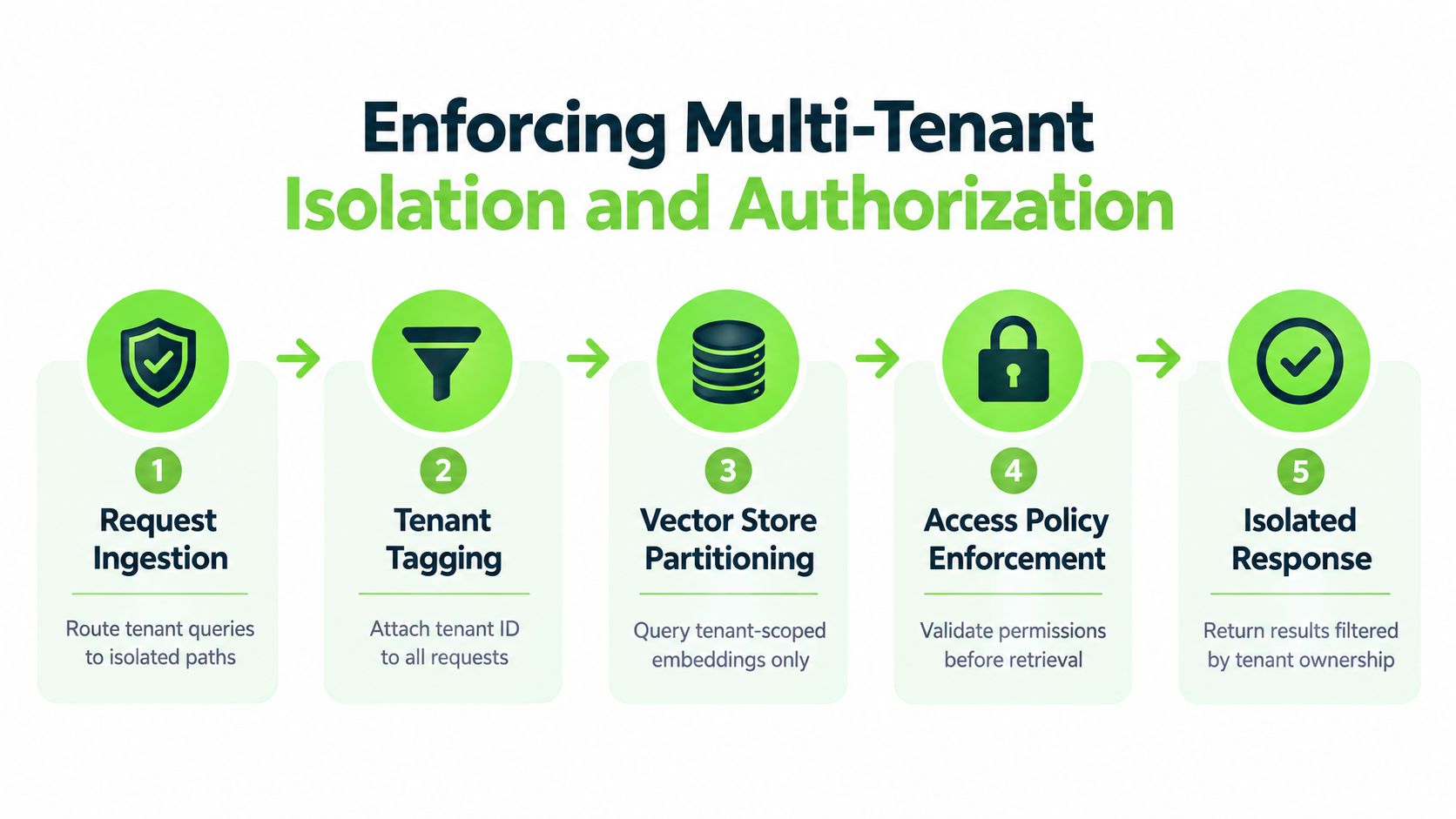
Multi-tenant grounding is an access-control problem. The system must ensure that a retrieval request carries the identity and tenant boundary needed to filter evidence before the model receives it. Prompt-level instructions can't provide that guarantee because the model can't enforce database permissions on context it has already been shown.
Microsoft's secure multi-tenant RAG guidance specifies that only data the user is authorized to access should be used as grounding data. It also requires every retrieval request to include a tenant discriminator and applicable user-level authorization filters (Microsoft's secure multi-tenant RAG architecture). The mechanism is important: authorization happens at retrieval time, not after generation.
Build the boundary into the request path
A request path should carry tenant and user context as authenticated metadata, not as free-form text supplied by the user. The retriever should reject requests without valid scope, and downstream services should preserve that scope rather than reconstructing it from the conversation.
A practical sequence looks like this:
- Authenticate the caller. Establish user identity, application identity, and session context before search.
- Resolve tenant ownership. Derive the tenant discriminator from trusted identity claims or an authoritative session record.
- Apply user permissions. Add role, object, region, and record-level filters required by the product.
- Retrieve within scope. Query tenant-partitioned indexes or enforce equivalent server-side filters.
- Validate delivery. Recheck that every candidate belongs to the permitted boundary before passing it to the model.
Tenant separation should exist in the data model and service contracts. Microsoft's broader multitenant AI guidance warns against unauthorized or unwanted access to another tenant's data or models, which means teams need tenant-scoped retrieval and explicit model and data boundaries rather than relying on a system prompt (Microsoft's multitenant AI guidance).
Keep security controls operational
Cross-tenant risk also appears in adjacent systems, including support tooling, identity management, and social channels. Teams designing enterprise social care security should apply the same principle to AI retrieval: a support conversation may contain sensitive customer data, but relevance doesn't grant permission to expose it elsewhere.
Use separate credentials and responsibility boundaries for ingestion, retrieval, policy evaluation, and action execution. A service that can read every tenant's data shouldn't automatically be able to answer every user's request. The model can propose a response, while authenticated policy determines which evidence and actions are allowed.
Managing Failure Modes and System Abstention
Grounding introduces a difficult prioritization problem. Factuality, actionability, and compliance are related but not identical objectives.
A factual answer may quote a valid document while failing to answer the customer's account-specific question. An actionable answer may be useful but unauthorized. A compliant answer may refuse too broadly and frustrate users. Technical leaders should define which objective has priority for each workflow instead of optimizing a single generic “grounded answer” score.
| Objective | What it asks | Typical failure |
|---|---|---|
| Factuality | Is the claim supported by valid evidence? | The evidence is stale or incomplete |
| Actionability | Can the user act on the answer? | The action exceeds the user's authority |
| Compliance | Does the response respect policy? | The system discloses restricted information |
Treat abstention as a result
A grounded system shouldn't fill gaps with confident language. If the evidence is missing, conflicting, stale, or unauthorized, the response should expose that condition. The system might ask for a missing identifier, provide a limited general explanation, or route the request for review.
This requires an explicit claim-validation layer. One 2025 retrieval-based framework reported F1 = 0.83 on the response-level classification task in RAGTruth, matching methods trained on the dataset and outperforming comparable systems with similarly sized models (the 2025 response-level unsupported-claim framework). That result is evidence that unsupported-claim detection can be implemented as an inspectable control, not just described as a prompting preference. It isn't a universal production guarantee, and teams still need to validate behavior on their own domains, policies, and failure costs.
A practical policy can classify each claim as supported, contradicted, unresolved, or outside authorization. The delivery layer then applies workflow-specific thresholds. A low-risk informational answer may tolerate unresolved details with an explicit caveat. A refund, access change, or compliance instruction may require complete support and current authorization.
Make uncertainty visible
Don't hide retrieval failures behind generic language. Log why the system abstained, which evidence was considered, which policy blocked delivery, and whether the failure came from retrieval, freshness, permissions, or claim validation. Those categories help engineering teams improve the correct layer rather than tuning the model to sound more certain.
Implementing Provenance and Security Controls
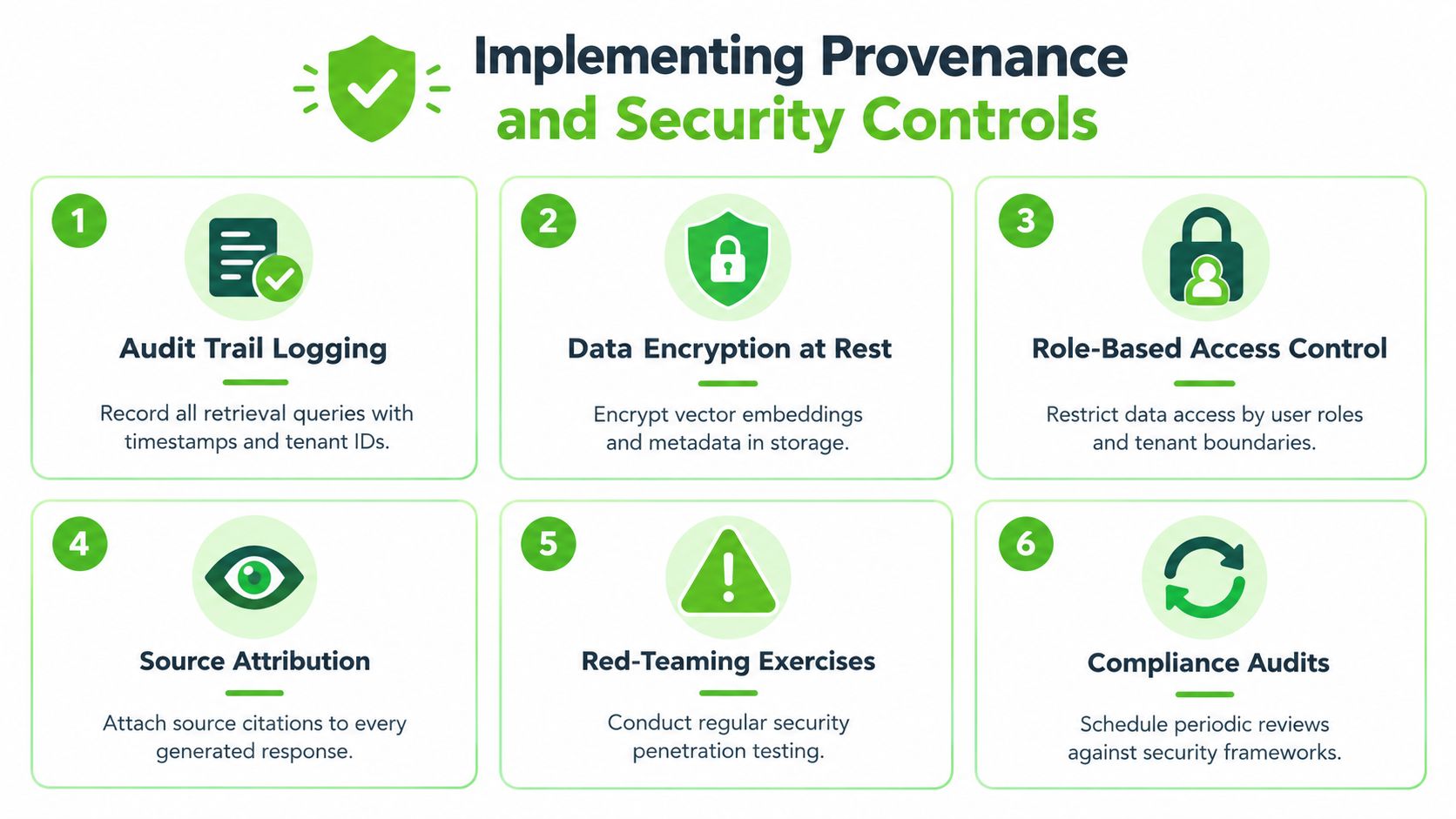
A production RAG pipeline needs more than embeddings and a prompt template. It needs a record of where each document came from, who was allowed to submit it, which version the retriever used, and whether the content remained intact. Provenance turns an answer from an opaque model event into an auditable chain.
OWASP's RAG Security Cheat Sheet recommends hashing every ingested document with at least SHA-256, storing the hash with document metadata, and verifying the hash before retrieval. If the hash doesn't match, the document should be rejected and security alerted (OWASP's RAG security controls).
Establish an evidence record
At ingestion, store the document hash beside source identity, ownership, approval state, effective date, and version metadata. Record who uploaded it, when it entered the system, where it came from, and which approval authorized its use. These fields support reproducibility and help investigators distinguish a bad source from a retrieval defect.
At retrieval, capture the query identity, tenant scope, authorization decision, selected documents, document versions, and freshness evaluation. At generation, preserve the evidence set and model configuration needed to understand the response. OWASP also recommends provenance tracking with uploader, time, source, and approval details, plus source attribution in every response.
The response itself should expose sources at the right granularity. A citation should identify the supporting record or passage, not merely the index or collection. For sensitive applications, the user-facing citation may need redaction while the internal audit record retains the full provenance chain.
Separate authority from autonomy
Composable infrastructure helps teams introduce these controls without replacing every existing system. A grounding layer can sit between a vector database and an LLM, while policy services remain responsible for identity and application state. Credentials, billing, data authority, and operational ownership should remain separate so a model cannot turn broad read access into broad action authority.
For teams designing controls around autonomous workflows, this overview of agent gateway security on PlatformDTC offers relevant context on placing policy and inspection at the boundary between agents and downstream systems. The same boundary principle applies to retrieval and memory.
Evaluation must cover the entire chain, not only answer quality. Test unauthorized retrieval, poisoned documents, stale versions, conflicting sources, prompt injection inside documents, unsupported claims, and incorrect abstention. A practical LLM evaluation framework should preserve dataset versions, retrieval configuration, policy state, and failure categories so results remain interpretable.
Strategic Takeaways for AI Infrastructure Leaders
Grounding should be evaluated as evidence-bounded infrastructure, not as a cosmetic accuracy feature. A system is production-ready only when it can show why an answer was allowed, which evidence supported it, whether that evidence was authorized and current, and what happens when the evidence is insufficient.
Use this decision framework:
- Evidence boundary: Can every material claim be traced to a source that is relevant to the task?
- Authorization boundary: Does retrieval enforce tenant and user permissions before the model sees context?
- State boundary: Does canonical application state override model suggestions when an action is proposed?
- Failure boundary: Does the system abstain when evidence is missing, stale, contradictory, or unauthorized?
- Audit boundary: Can your team reproduce the evidence, policy, and configuration behind a response?
Teams should also treat intent as structured state. A request such as “cancel my account and refund the last charge” contains multiple actions, constraints, and authorization requirements. Parsing those dimensions before retrieval and execution helps prevent the model from collapsing a complex request into a single unverified instruction.
Reliable AI doesn't mean eliminating uncertainty. It means exposing uncertainty before it becomes an unsupported claim or an unauthorized action. Leaders evaluating platforms should trace your data's journey, from ingestion and approval through retrieval, generation, delivery, and audit.
AletheionAGI offers GQueries as a grounding and evidence-control layer for existing LLMs, RAG pipelines, vector databases, and memory systems, with authorized retrieval, persistent memory, and fail-closed delivery controls. Visit AletheionAGI to evaluate how evidence validation, provenance, abstention, and authority-before-autonomy policies could fit into your AI architecture.