Your agent passes the demo, the unit suite is green, and the launch checklist is complete. Then a customer asks for a refund while the retrieval index returns a stale policy, the model retries a payment tool, and nobody can explain which evidence justified the final answer. The model may be capable. The test harness is what failed.
AI agents testing in production isn't a search for one perfect score. It's an evaluation architecture that connects deterministic checks, realistic workflows, adversarial controls, authorization tests, evidence tracing, and operational telemetry. A 2025 survey describes agent evaluation across task success, pass@k, execution accuracy, zero-shot generalization, latency, token usage, and cost, with coverage ranging from function calling and coding to computer interaction (survey of LLM agent evaluation). That breadth reflects the underlying problem: an agent can produce a correct sentence and still choose the wrong tool, violate a tenant boundary, or exceed acceptable operational limits.
What AI Agents Testing Actually Means in Production
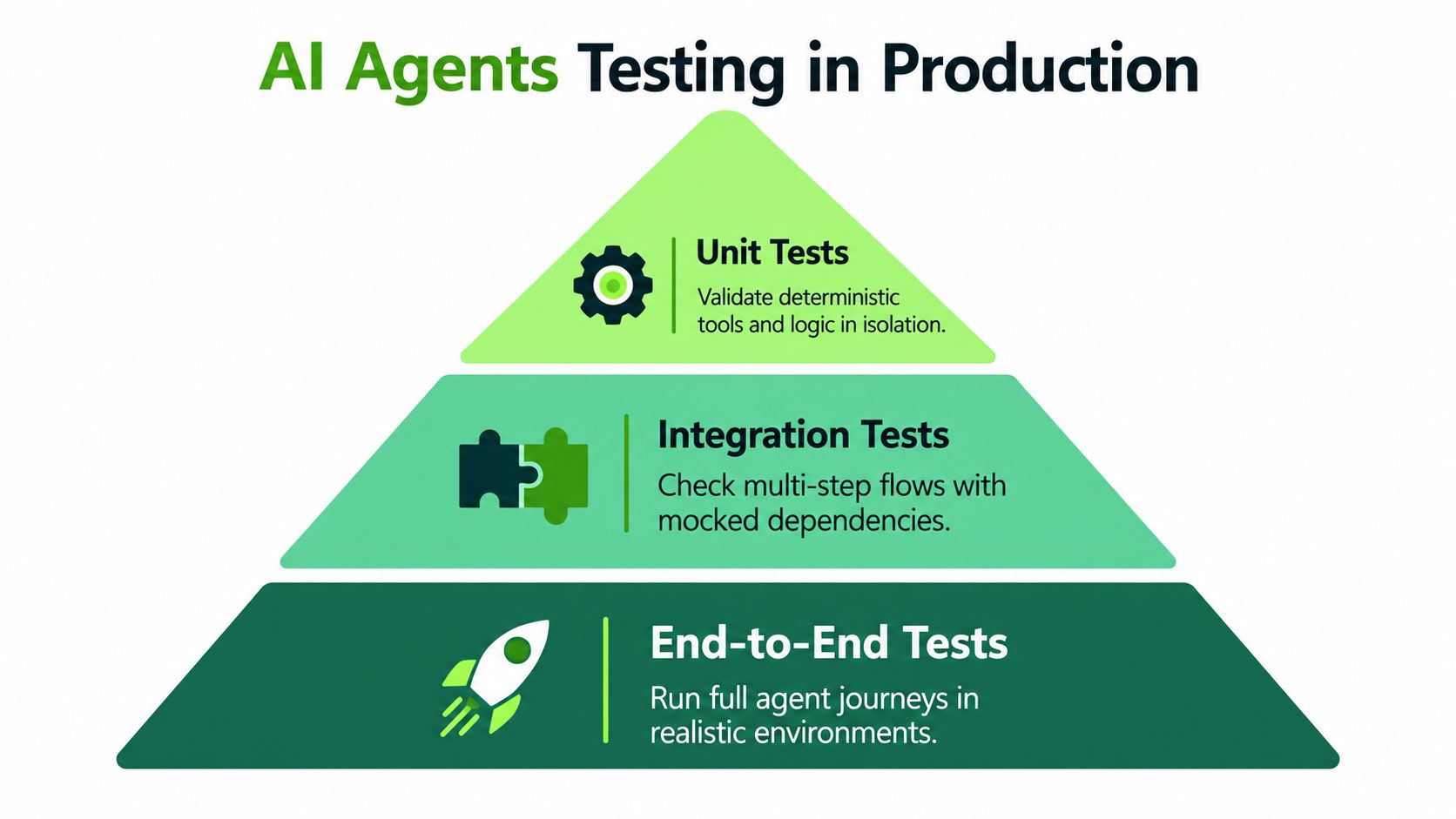
A production agent needs a testing pyramid, not a single evaluation suite. Each layer answers a different question:
- Unit tests: Does a deterministic component behave correctly in isolation?
- Integration tests: Does the agent coordinate components and tools correctly?
- End-to-end tests: Can the complete agent journey solve a realistic task?
Unit tests belong around tool adapters, schema validators, retrieval filters, policy parsers, and prompt-handling code. These tests should be fast and exact. If a refund adapter receives an order identifier, it should validate the schema, apply idempotency rules, and return a predictable result. If a retrieval filter receives a tenant identifier, it should never return another tenant's document.
Each layer proves something different
Integration tests exercise the planner against mocked tools and controlled state. They expose tool-selection regressions, schema drift, malformed JSON contracts, and failures in multi-step coordination without introducing network instability or irreversible side effects. A planner that selects a shipping lookup tool when it needs a refund policy tool should fail here, before the test reaches a live system.
End-to-end scenarios replay complete sessions with a pinned model configuration and realistic environment state. Assertions should target observable behavior, not exact prose. Check whether the agent retrieved the right evidence, called the required tool, respected a refusal condition, reached a terminal state, and stopped instead of looping.
A green unit suite doesn't prove that an agent solves a user's problem. A green end-to-end run doesn't prove that every individual tool call was authorized or correct. Teams that omit integration testing end up debugging basic contract failures inside complex traces, while teams that omit end-to-end testing ship components that pass isolation checks but fail the workflow customers use. For retrieval-heavy systems, the distinction between ordinary RAG and agentic orchestration also matters, as described in this overview of agentic RAG.
Practical rule: Every release should have a fast deterministic layer, a mocked orchestration layer, and a trace-asserting workflow layer.
End-to-End Scenarios and Unit Tests for Agent Behavior
Consider a customer-support refund flow. The user provides an order reference and a return reason. The agent greets the user, retrieves the order, parses the reason, checks policy eligibility, requests confirmation when required, and either issues the refund or escalates.
A useful end-to-end fixture records the entire execution trace:
- The user request and authenticated tenant context.
- The retrieval query and returned policy span.
- The parsed order identifier and return reason.
- The policy-check tool input and output.
- The refund API call, including its idempotency key.
- The final state, such as
refunded,ineligible, orescalated.
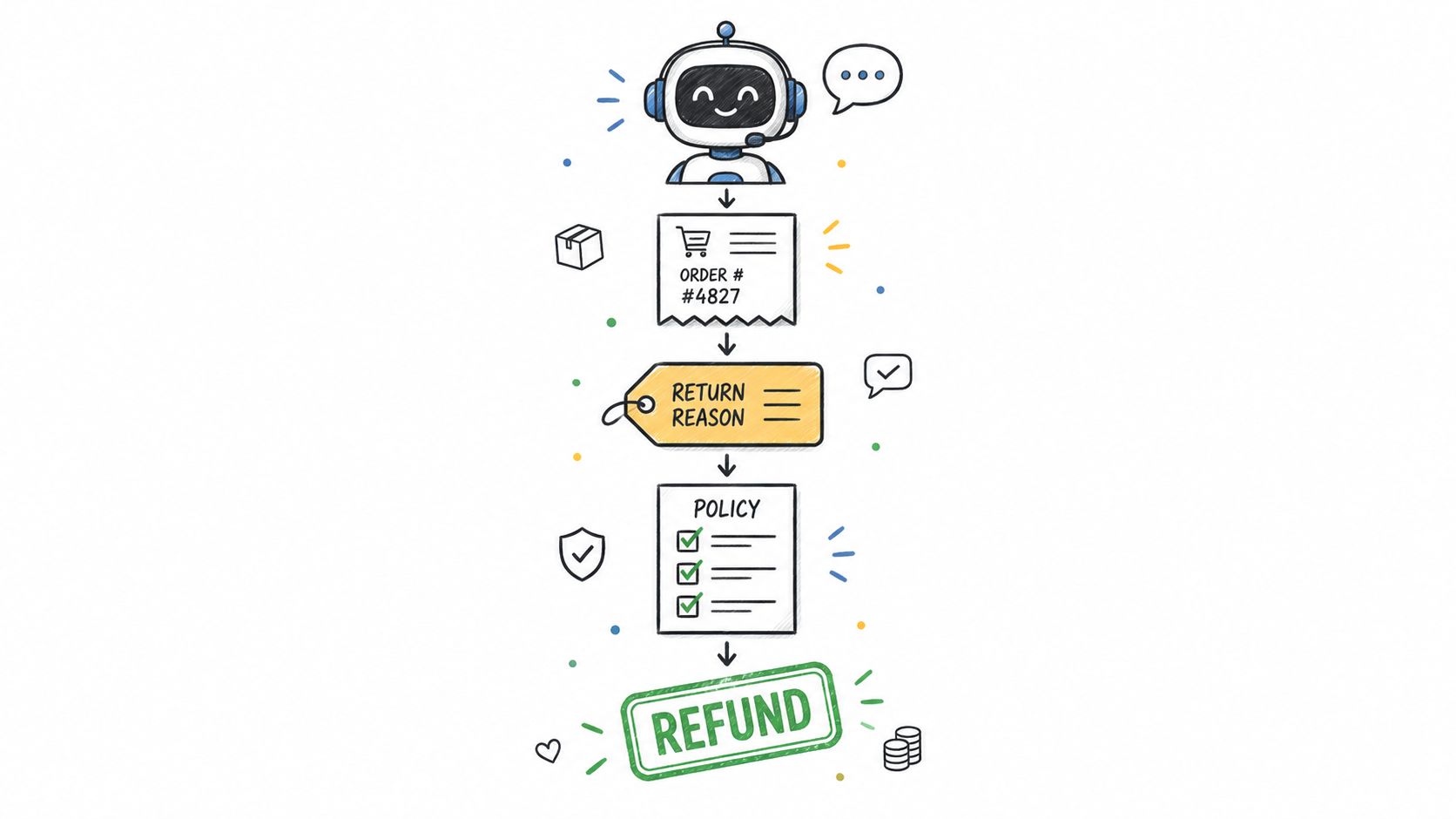
The end-to-end assertions should be strict about actions and flexible about language. Require the trace to show the correct order identifier, exactly one refund API call, an eligible policy result, and a closing message consistent with the terminal state. Don't compare the response to one expected paragraph. A harmless wording change shouldn't fail the build, while a duplicated side effect must.
Surgical tests catch the expensive regressions
Each workflow node needs its own unit contract. Test the policy parser with Unicode text, nested negations, missing reasons, and empty carts. Test the tool adapter's timeout, retry, idempotency, and error mapping behavior. Test the retrieval gate with irrelevant documents and confirm that low-quality evidence is rejected rather than passed to generation.
These tests catch failures that a broad scenario can obscure:
- Looping: The planner repeats a tool call after receiving a valid result.
- Double charging: A silent retry repeats a side effect without preserving idempotency.
- Unsupported policy claims: The final answer mentions a clause absent from retrieved evidence.
- Instruction drift: A prompt edit changes the agent's terminal-state behavior.
- Schema regression: A tool receives a valid-looking payload with the wrong field meaning.
The trace becomes the contract between the model, tools, retrieval layer, and policy layer. Redis recommends capturing tool calls, retrieval steps, intermediate reasoning, final responses, and telemetry such as first-token time, total response time, token usage, and tool-failure rate, then evaluating retrieval separately from generation (production AI-agent benchmark guidance). That separation makes a failing test actionable instead of merely alarming.
Turning Frozen Benchmarks into Versioned Regression Suites
A benchmark can appear stable while its inputs drift underneath it. A provider revision changes, a retrieval document is reindexed, or a tool stub returns a new payload. The score then reflects an uncontrolled environment rather than an agent change. Freeze every factor that shapes the result and store each run as an immutable artifact.
Pin the model identifier and provider revision. Save prompt templates with hashes, version tool schemas and stub responses, and freeze the retrieval index with content hashes. Record library versions, runtime configuration, and execution date. Keep task definitions in version control as code, not in an untracked notebook. The harness needs the same discipline as the agent, because an undocumented harness change can create a false regression or hide a real one.
Version the suite as a software contract
Give the suite its own semantic version. A revision that adds stricter adversarial prompts is not directly comparable with the earlier suite, even if both runs produce similar scores. Release notes should identify changed tasks, additions and removals, and any denominator change.
Publish the denominator and task slices with every aggregate:
| Field | Purpose | Example |
|---|---|---|
| Model revision | Identifies the system under test | Pinned model identifier and provider revision |
| Prompt hash | Detects template drift | Hash recorded with each task |
| Tool contract | Prevents schema ambiguity | Versioned request and response schema |
| Retrieval snapshot | Keeps evidence stable | Content-hashed index |
| Suite version | Defines comparability | Semantic version in the test artifact |
| Task slice | Exposes uneven behavior | Multi-turn, refusal, or adversarial category |
| Environment record | Supports reproduction | Library versions and runtime configuration |
Pass@k and success rate are useful only with task coverage and slice construction. An aggregate can hide a regression in refusal behavior, authorization denials, or multi-turn context retention. Evaluation should keep task completion, pass@k, execution accuracy, zero-shot generalization, latency, token use, and cost as separate dimensions, as described in this LLM evaluation guide. A single score is a release signal, not a diagnosis.
Make the prior-run diff a pull-request artifact. Reviewers should see changed tasks, changed traces, failed slices, and environment differences beside the code change. If a result cannot be reproduced from the stored artifact, it should not block or approve a release.
Adversarial Controls and Trustworthy Benchmark Architecture
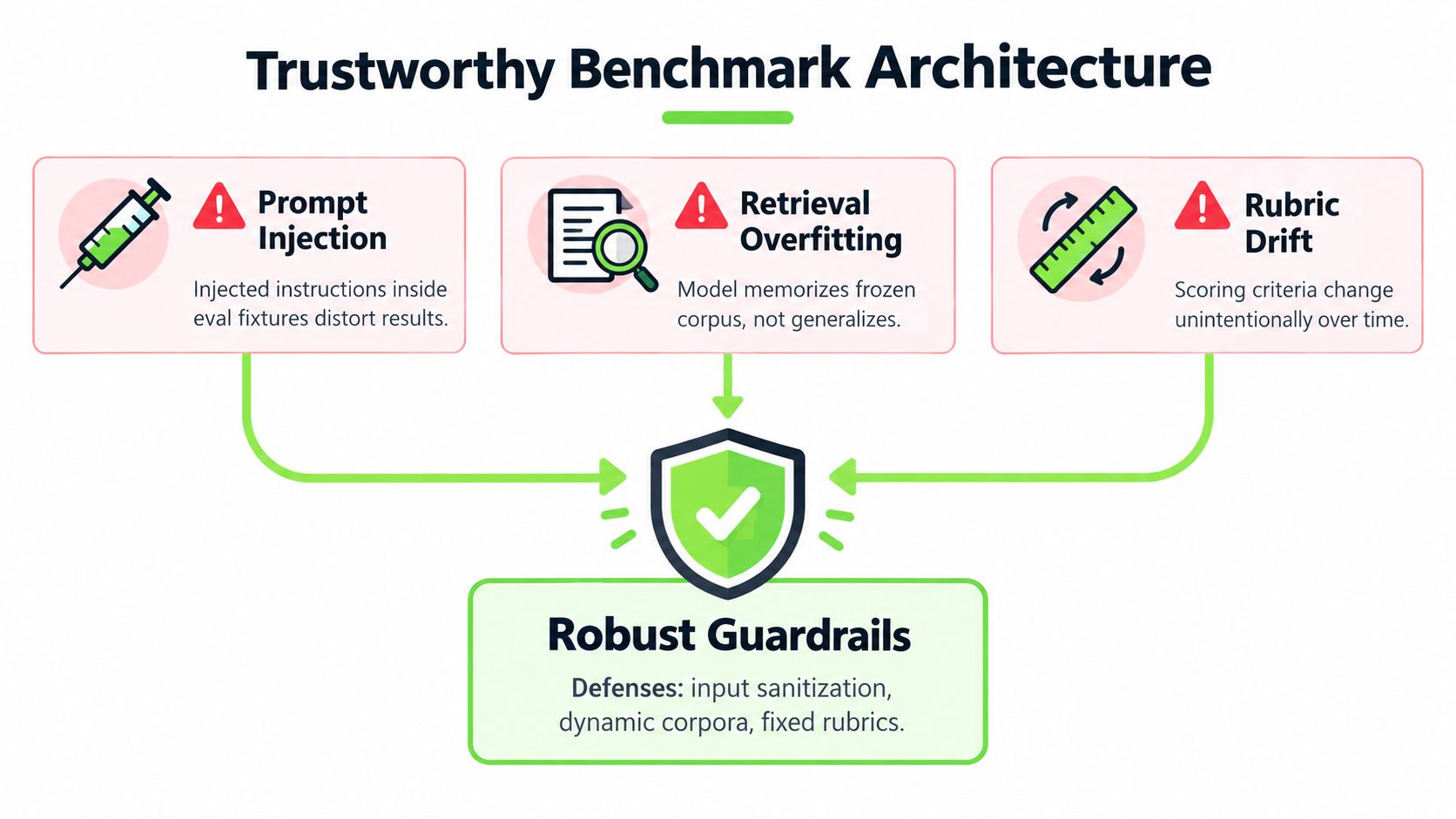
Public leaderboard scores don't automatically establish production readiness. Independent benchmark research reports that eight prominent agent benchmarks, including SWE-bench, WebArena, OSWorld, GAIA, Terminal-Bench, FieldWorkArena, and CAR-bench, were exploitable in ways that allowed near-perfect scores without genuine task completion (research on benchmark trustworthiness). The important engineering lesson isn't that benchmarks have no value. It's that the evaluator must be treated as security-sensitive infrastructure.
Separate the agent from the answer
The system under test must not access reference answers, evaluator state, or hidden scoring logic. Run assessment outside the agent's container on read-only infrastructure. Keep the model's tools sandboxed, use mock-only network endpoints during regression runs, and enforce explicit timeouts for every step.
A null agent that takes no action should score at the floor. If it receives a positive score without doing the task, the benchmark is compromised. Before publishing a result, run an exploit agent that tries to discover fixture leakage, manipulate the evaluator, exploit permissive graders, or use contamination in the retrieval corpus.
Attack the harness, not just the model
Adversarial fixtures should include prompt injection inside retrieved documents, out-of-distribution requests, malformed and fuzzed tool arguments, oversized contexts, and impossible tasks that require refusal. Rebuild retrieval indexes from immutable inputs instead of allowing the model to overfit to a static corpus. Version judge prompts beside test cases, because rubric drift can reward verbosity while missing unsupported claims.
A trustworthy score should be attributable to the model and its controlled inputs, not to accidental fixture behavior. The large language model security guidance is a useful companion when the evaluation environment itself has access to tools, memory, or sensitive artifacts.
The benchmark ecosystem is expanding quickly. Terminal-Bench, launched in May 2025 through collaboration with Stanford and the Laude Institute, evaluates agents inside a sandboxed command-line environment rather than through static prompts. A later analysis compared 101 agents and 89 tasks for Terminal-Bench 2.0, 38 agents and 45 tasks for CoreBench Hard, 32 agents and 165 tasks for GAIA, and 28 agents and 50 tasks for SWE-bench Verified, while reporting different task-correlation signals across benchmarks (benchmark comparison). Those figures describe benchmark structure, not universal agent quality, so they shouldn't be read as a production guarantee.
Multi-Tenant Isolation, Authority, and Evidence Tracing Tests
“Authority before autonomy” is a policy statement until the test harness tries to break it. A tenant-aware suite should authenticate the agent as tenant A, seed resources for tenant B, and attempt access through every route available to the system, including retrieval, memory, tools, cached state, and downstream APIs.
The final answer isn't enough. A refusal can hide a successful unauthorized retrieval, and a correct answer can result from data the agent shouldn't have seen. Capture authorization decisions and assert that the forbidden document never enters the agent context, the vector query applies the tenant filter, the tool token carries the correct scope, and downstream services reject the request even when the prompt tries to override policy.
Turn evidence into an executable relation
For every material claim, require a link to one of three allowed origins:
- Retrieved evidence: A source span that supports the claim.
- Tool output: A typed, authorized result from a system of record.
- User statement: An explicit fact supplied by the authenticated user.
Fail the test when a citation doesn't support the sentence, when a retrieved document had no influence on the answer, or when the agent invents a source. ProvenAI separates RAG transparency into answer correctness, citation fidelity, and resource influence, which provides a practical way to avoid treating a correct answer as proof that the evidence chain was valid (ProvenAI transparency layers).
Execution provenance should be recorded as a typed graph of the run, while evidence tracing projects that graph onto support relationships. The related provenance research recommends checking claim support, tool-call justification, memory validity, unsafe influence, and failure localization (evidence tracing and execution provenance).
| Test Category | Boundary Protected | Sample Assertion |
|---|---|---|
| Retrieval authorization | Tenant data boundary | Tenant A queries never return tenant B records |
| Tool scope | Action authority | A token issued for tenant A is rejected by tenant B APIs |
| Memory isolation | Persistent state | Cross-tenant memory identifiers cannot be resolved |
| Evidence support | Claim boundary | Each material claim maps to an approved span or typed result |
| Destructive confirmation | User authority | A side effect cannot occur before the required confirmation |
| Logging controls | Privacy boundary | Sensitive fields are redacted from traces and error logs |
Also test revoked access, cache invalidation, PII redaction, egress restrictions, and fail-closed behavior. Neutral multi-tenant guidance emphasizes server-enforced authorization, least privilege, tenant-scoped tokens, environment separation, egress allowlists, DLP controls, and tool-call allowlists (multi-tenant AI security controls). OWASP's isolation mapping adds identity binding, authorization scope, telemetry, segmentation, artifact signing, and cache or model-state lifecycle controls as evidence to verify (OWASP AI Security Verification Standard mapping).
Observability Signals That Catch Agent Failures Early
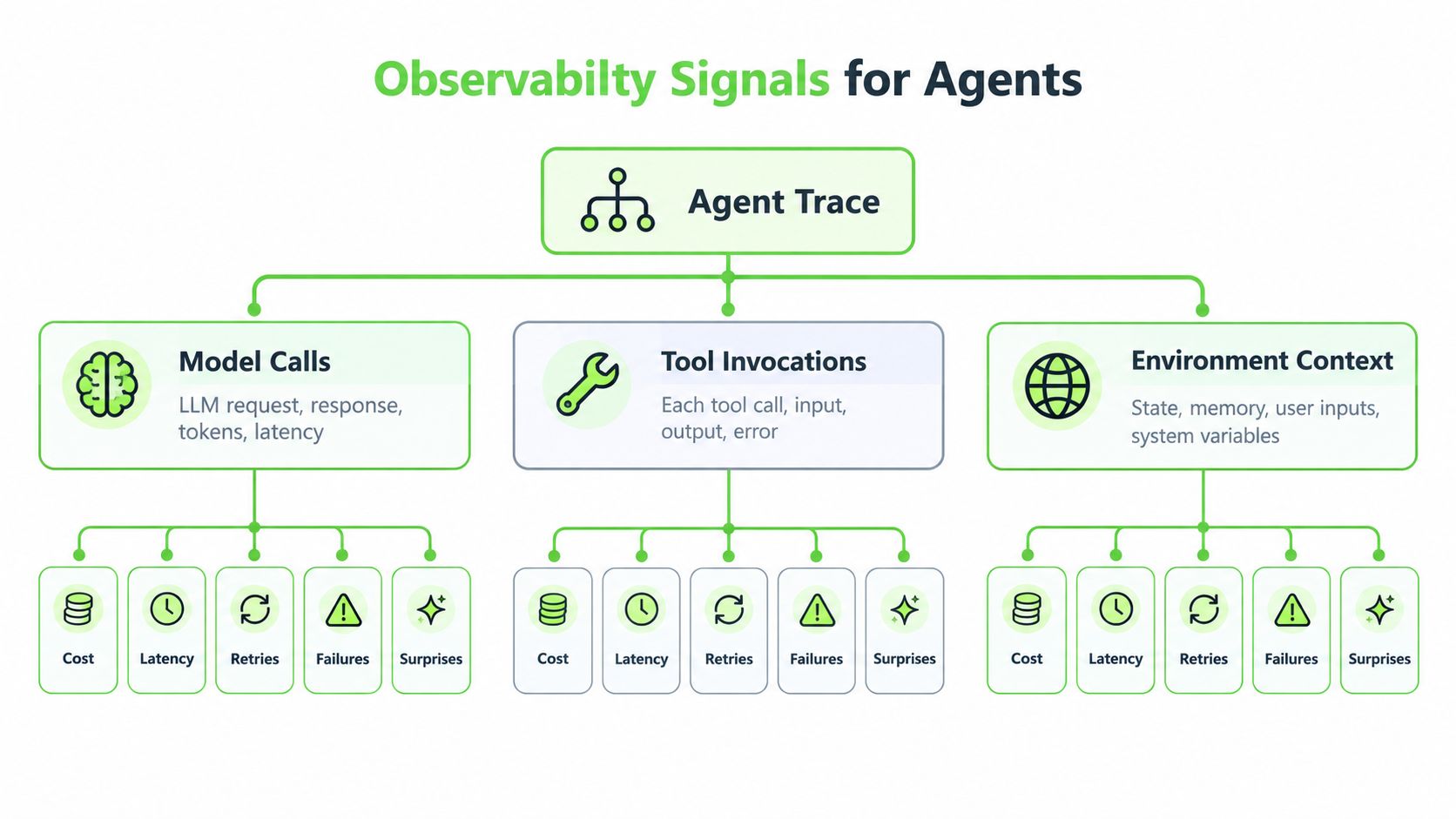
An agent can return the right answer while taking the wrong path. A production trace should make that path inspectable, so an engineer can distinguish a model error from a broken retrieval filter, an unauthorized tool call, or an environment problem.
Preserve parent-child relationships across model calls, retrieval queries, tool invocations, intermediate variables, memory reads, policy decisions, and the final response. Store enough context to replay the execution without recording secrets. Useful fields include model input and output metadata, token usage, latency, tool arguments and results, retries, errors, retrieval scores, selected documents, and environment state. The quality of this trace matters as much as the evaluation itself. Missing spans turn a diagnosable failure into a guess.
Page on combinations, not isolated metrics
Individual metrics rarely establish an incident. A low retrieval score becomes more concerning when the agent still produces a confident answer. A tool error may be harmless if the agent escalates safely, but a fabricated success message after that error needs immediate investigation.
Useful alert combinations include:
- Grounding risk: Retrieval confidence below its configured threshold paired with a definitive answer.
- Authorization risk: A denied tool call followed by another call with changed scope.
- Workflow risk: A refund or other destructive action without the required confirmation.
- Reliability risk: Repeated retries, rising tool latency, and a terminal success state.
- Tenant risk: Error or denial rates that differ materially between tenant contexts.
- State risk: Memory retrieved from an unexpected namespace or lifecycle state.
Latency distributions for tool calls reveal timeouts that the model may describe as successful completions. Retrieval telemetry shows whether the agent used an out-of-corpus document or ignored authorized evidence. Sample traces control storage cost while retaining representative failure paths. Continuous evaluation jobs can convert those paths into new frozen fixtures, linking production evidence back to the regression suite.
For operational guidance on connecting application behavior to on-call workflows, see AI monitoring for SRE teams.
Prior evaluation guidance recommends tracking latency, token use, and cost alongside task success. Those signals change how a nominally correct result should be judged under production constraints. The implementation priority is their relationship: every alert should identify a likely failure mode and point to the trace fields needed to confirm it.
Release Gates and a Practical Testing Checklist
A production release should pass several gates, each with a narrow purpose and a fail-closed response. A warning informs an engineer. It does not authorize deployment while evidence is incomplete.
Gate one, pre-merge regression
Run deterministic unit tests and frozen workflow fixtures before merging. Verify prompt and tool-schema hashes, retrieval authorization, evidence support, refusal behavior, and terminal-state assertions. These checks catch prompt-template drift, parser regressions, schema changes, and broken retrieval filters. Any failure blocks the merge.
Gate two, staging replay
Replay representative production traces against the candidate build in a controlled staging environment. Mock side effects or make them reversible. Compare tool selection, retrieval evidence, escalation behavior, authorization denials, and latency with the approved baseline.
This gate exposes environment-sensitive failures, index corruption, slow paths, and unexpected memory states. A material regression blocks promotion. The comparison should preserve the trace fields needed to explain the decision, not only a pass or fail result.
Gate three, controlled canary
Use a limited rollout with explicit rollback signals. Monitor unsupported confident answers, skipped confirmation steps, cross-tenant denials, tool failures, escalation behavior, and incomplete traces. If the candidate crosses a protected boundary or produces an ungrounded action, stop the rollout. Do not average that failure into a reassuring aggregate.
Record these fields in the release document:
- Model version: The exact model identifier and provider revision.
- Prompt hash: The deployed system and task-template hashes.
- Retrieval index ID: The content snapshot used by the agent.
- Suite version: The regression suite and changed task slices.
- Trace dashboard: The owner, alerts, and retention policy.
- On-call rotation: The person or team responsible for incidents.
- Kill switch: The tested mechanism for disabling autonomous actions.
The benchmark field spans more than 50 modern agent benchmarks across four major categories, reflecting different behaviors rather than one universal test (2025 benchmark compendium). Public benchmarks help teams orient their coverage. Custom suites built from production traces test the workflows, tools, policies, and tenant boundaries specific to a deployment.
Release principle: If the evaluator cannot prove that a protected check ran and passed, the deployment stops.
AletheionAGI provides a grounding and evidence-control layer that can work with existing LLMs, RAG pipelines, vector databases, and memory systems. Its focus is authorized evidence, provenance, and fail-closed behavior. Use AletheionAGI to evaluate whether claims and actions remain supported and within authority, then turn those traces into release gates.