The most common advice on agentic AI implementation gets the order wrong. Teams start with model choice, prompt polish, and clever orchestration, then act surprised when the system leaks data, loops forever, or produces claims nobody can trace back to a source. In production, the hard part isn't getting an agent to talk. It's making sure every retrieval, tool call, and state change happens inside a control plane that knows who asked, what they're allowed to see, and when the system must stop.
That framing matters because agent builds rarely fail for one dramatic reason. They usually stall in the gap between a promising prototype and an auditable system that can survive real tenants, real permissions, and real incident review. A useful mental model is simple, the model can suggest, but the runtime has to decide.
Why Most Agent Builds Stall Before They Ship
Many teams spend too long optimizing the visible part of the system and too little time on the invisible one. The visible part is the language model, the prompt, and the glossy demo. The invisible part is the control plane, the runtime policy, the retrieval boundary, and the audit trail that decides whether an action should happen at all.
Practical rule: if the agent can't explain why it retrieved something, who authorized it, and what state it changed, it isn't production-ready.
The failure modes show up early
The first failure is silent cross-tenant leakage. A retrieval layer that doesn't enforce identity and authorization at query time can hand the model chunks it should never see, and once those chunks enter the prompt, downstream validation is already too late.
The second failure is a runaway loop. Agents that don't have explicit termination conditions keep re-planning, re-calling tools, and burning tokens while producing no durable result. The third failure is weaker but just as dangerous, unverifiable claims. If grounding is treated as an afterthought, the system starts sounding confident while its outputs drift away from evidence.
A lot of teams discover this after they've already shipped a prototype internally. That prototype works because the data is small, the permissions are soft, and everyone is looking at the same screen. Production changes all three assumptions.
For a useful adjacent read on the operational side of browser-driven automation, the de-Googled browser agents page is worth a look because it frames agent behavior as a constrained runtime problem, not a magic prompt problem.
One more lens helps here. If your organization still treats AI work like a side project, the operating model will lag. The comparison in DevOps vs MLOps becomes relevant fast because agents force software engineering, policy, and data access to meet in one runtime.
Design Decisions You Must Lock In First
The biggest mistake in agentic AI implementation is to start coding before the system's boundaries are fixed. Once you know where autonomy ends, where state lives, who owns identity, and how the agent stops, the rest becomes implementation detail. Before that, every “feature” is just a future incident.
Lock the autonomy scope
For production, default to bounded tools, not open-ended planning. A bounded agent can choose among approved actions, but it can't invent new authority or wander into unsupported workflows. If you ignore that default, the failure mode is obvious, auditability collapses because no one can tell whether the model followed policy or invented a path on the fly.
Decide where state lives
Use server-owned persistent state for anything that affects future actions, especially pending work, verified facts, and unresolved errors. Ephemeral chat memory is fine for short interactions, but it's a bad foundation for workflow continuity because it can't reliably distinguish a remembered fact from a hallucinated one. If you skip this, replay becomes messy and cost rises because the model has to re-infer context it should already have.
Propagate identity through every hop
User identity can't stop at the UI or API gateway. It has to flow into retrieval, plan generation, and tool dispatch, because ambient trust breaks tenant isolation the moment a tool sees more than it should. If this is ignored, the failure mode is not subtle, a low-privilege user can trigger an action using context that came from a higher-privilege tenant boundary.
Make termination explicit
Production systems need explicit stop conditions. Don't rely on “the model knows it's done,” because completion detection by vibe is how loops survive to incident review. When termination is implicit, agents keep trying to be useful after they should have stopped.
| Decision | Default for Production | Failure Mode if Ignored |
|---|---|---|
| Autonomy scope | Bounded tools with explicit allowlists | Unbounded actions, weak auditability |
| State model | Server-owned persistent state | Lost context, replay drift |
| Identity propagation | End-to-end principal and tenant scoping | Cross-tenant access through ambient trust |
| Termination policy | Explicit stop conditions | Runaway loops and repeated tool calls |
For teams building customer workflows, the Agentic GTM system explained is a useful reminder that operational rules matter more than clever prompts when an agent touches real process boundaries. The same principle applies in support, operations, and data-heavy internal tools.
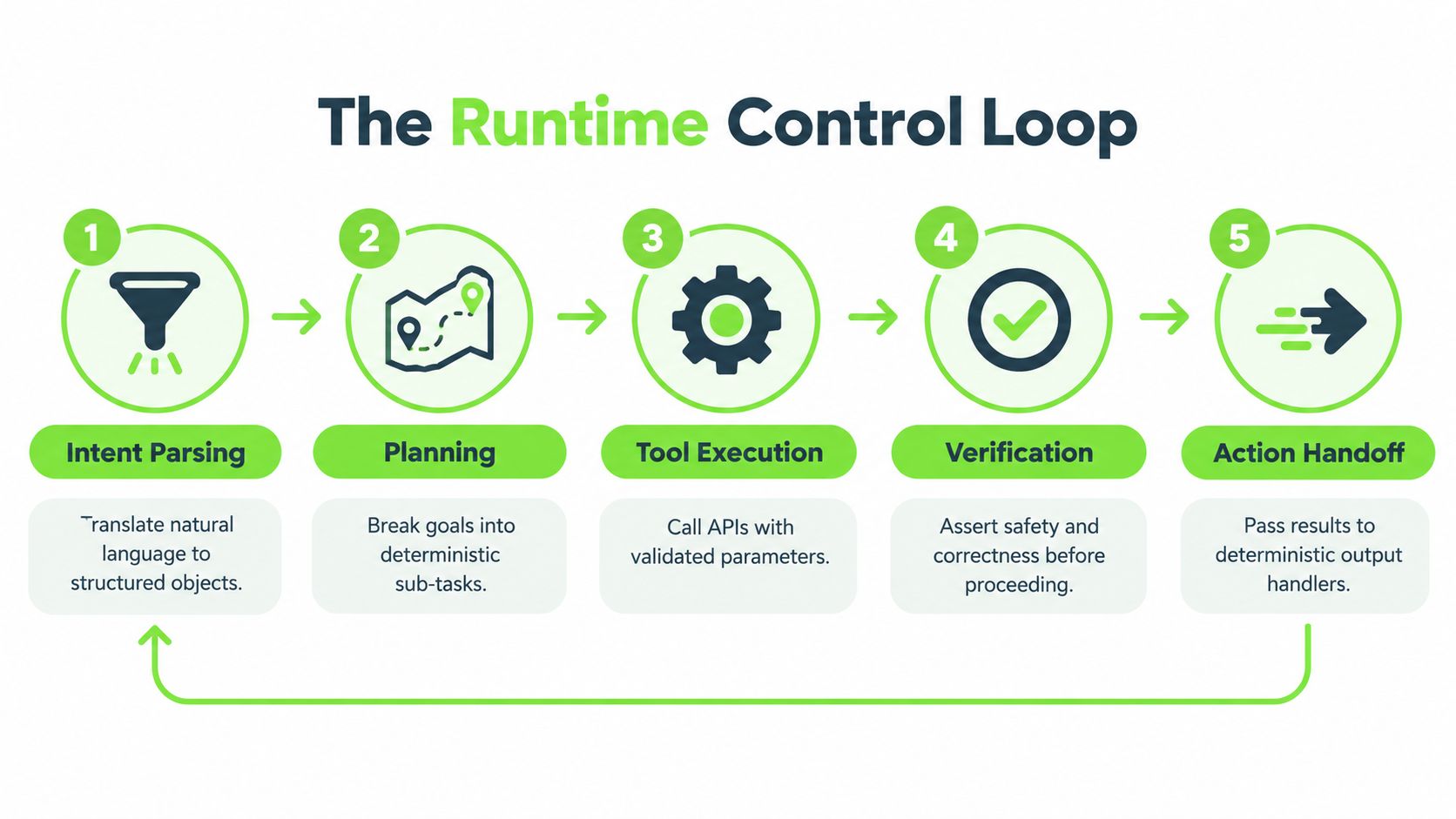
The Runtime Control Loop from Intent to Action
A working runtime treats the model as one component in a deterministic chain. The model can interpret, plan, and synthesize. The runtime must own authorization, dispatch, verification, and side effects. That division is the difference between a useful agent and an expensive guessing engine.
Stage by stage, the contracts are different
Intent classification should turn user language into a typed request, not a free-form conversation blob. The deterministic contract is simple, identify action class, target, and required scope. The model can vary in phrasing or confidence, but the runtime must reject anything that doesn't fit the schema.
Retrieval grounding is a policy-controlled read. The system must check whether the principal can see the requested content before any chunk reaches the prompt. The model can rank or summarize the authorized set, but it can't be allowed to see unauthorized data and “handle it carefully.”
Plan generation is where the model can do useful work, but only inside hard constraints. It can order steps, choose between approved paths, and propose tool usage. What it can't do is expand scope or invent a new authority boundary.
Tool execution is where most outages become visible. Every call needs validated parameters, a pre-action gate, and a clear rollback story if the tool has side effects. The runtime should never dispatch a tool because the model sounded sure.
Response synthesis should map verified outputs back to the user in a constrained form. It can explain, summarize, and cite, but it shouldn't introduce new claims that weren't grounded or executed.
The two handoffs that break systems most often are retrieval to planning, where unauthorized chunks leak forward, and planning to tool execution, where side effects happen before a gate checks policy.
The stronger your handoff boundaries, the less your agent depends on luck. That's the actual architecture of agentic AI implementation, not “prompt harder,” but “make each stage narrow enough to fail safely.”
The What is agentic RAG article is a useful complement here because it shows how retrieval and action can be coordinated without pretending the model is in charge of policy.
Grounding Retrieval with Authorization and Provenance
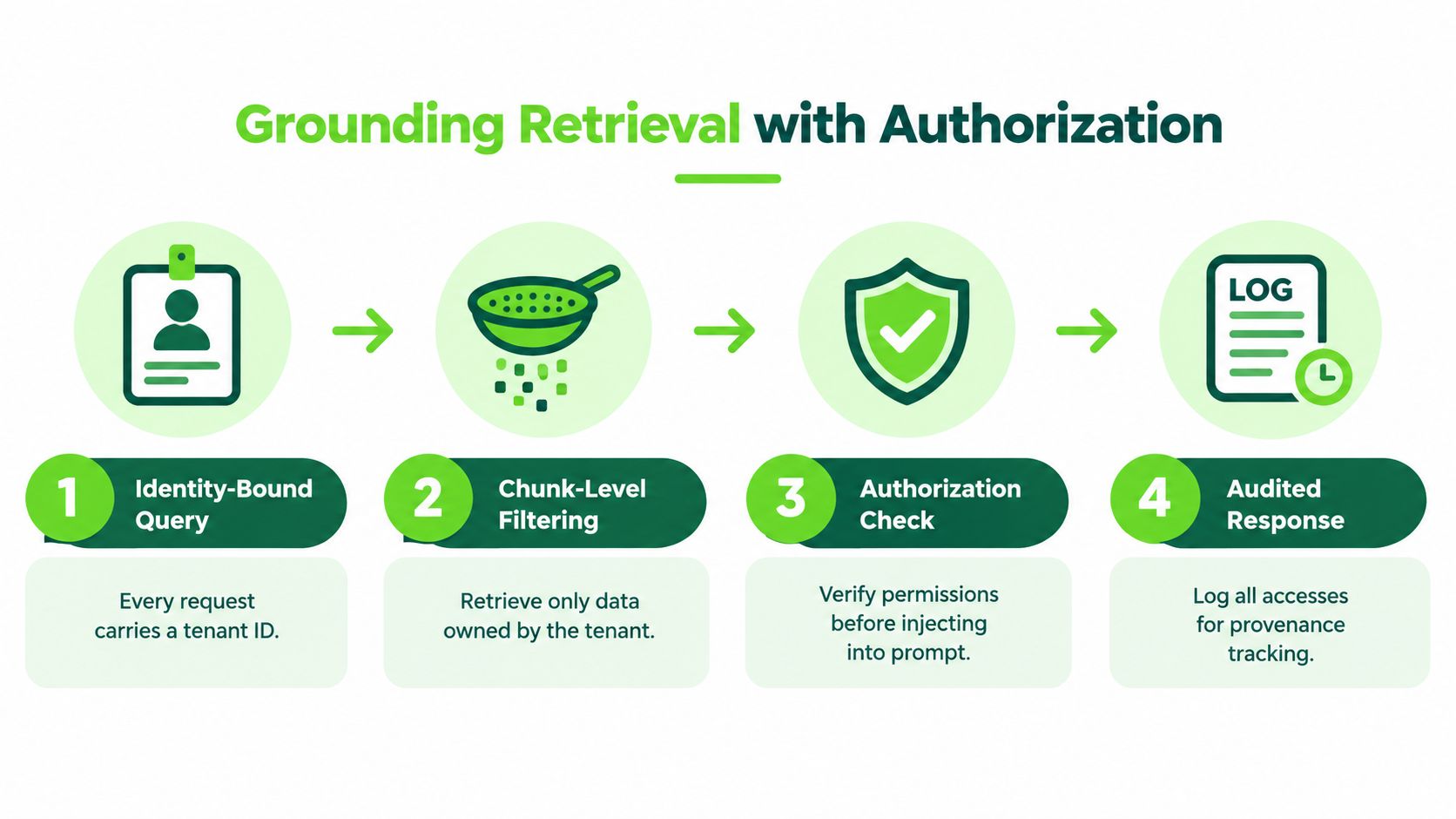
Retrieval is not search with extra steps. In a production agent, it is an authorized read against tenant-scoped data, and it has to behave that way before the model sees a token. Once retrieval is treated as a permissioned action, the rest of the design gets clearer.
Start with identity-bound queries
Every retrieval request should carry a tenant ID and a principal. The search layer should filter by access control before results are returned, not after. OWASP's RAG Security Cheat Sheet recommends storing access-control metadata on each vector chunk and enforcing classification, owner, permitted roles, and permitted tenants at retrieval time, which matches the operational pattern I trust in production.
That means the chunking pipeline cannot strip away the fields you need later. If ACLs disappear during ingestion, retrieval turns into guesswork and the model sees whatever the index happened to return.
Make provenance part of the payload
Authorized chunks should carry provenance metadata, including source ID, tenant ID, version, and retrieval timestamp. That metadata belongs in the prompt context and the audit log, because citations are evidence, not decoration. See what LLM evaluation looks like when grounded for how to measure grounding hit rates against frozen protocols.
Chunk-level filtering should happen first, reranking should happen second, and citation hooks should happen last. Reverse that order and you end up ranking material the user never had a right to see. Skip provenance and you lose the ability to trace a claim back when something looks off.
Microsoft's agent guidance for Azure makes the same point from a platform angle. Tenant-isolated retrieval matters because agents depend heavily on context, and per-tenant indexes or partitions with Managed Identity-based access control help keep that context scoped. Retrieval stays local to the tenant, not global to the world.
Operational takeaway: do not pass raw chunks into a prompt and hope the model behaves. Filter first, authorize second, cite third.
For teams that want a layered formalization of this pattern, the secure multitenant retrieval paper on server-side authorization and chunk filtering aligns with the same principle, resource-level authorization before search and chunk-level filtering after retrieval. That split matters when state, search, and tool use all share the same identity boundary.
Intent Parsing and State Handling Done Right
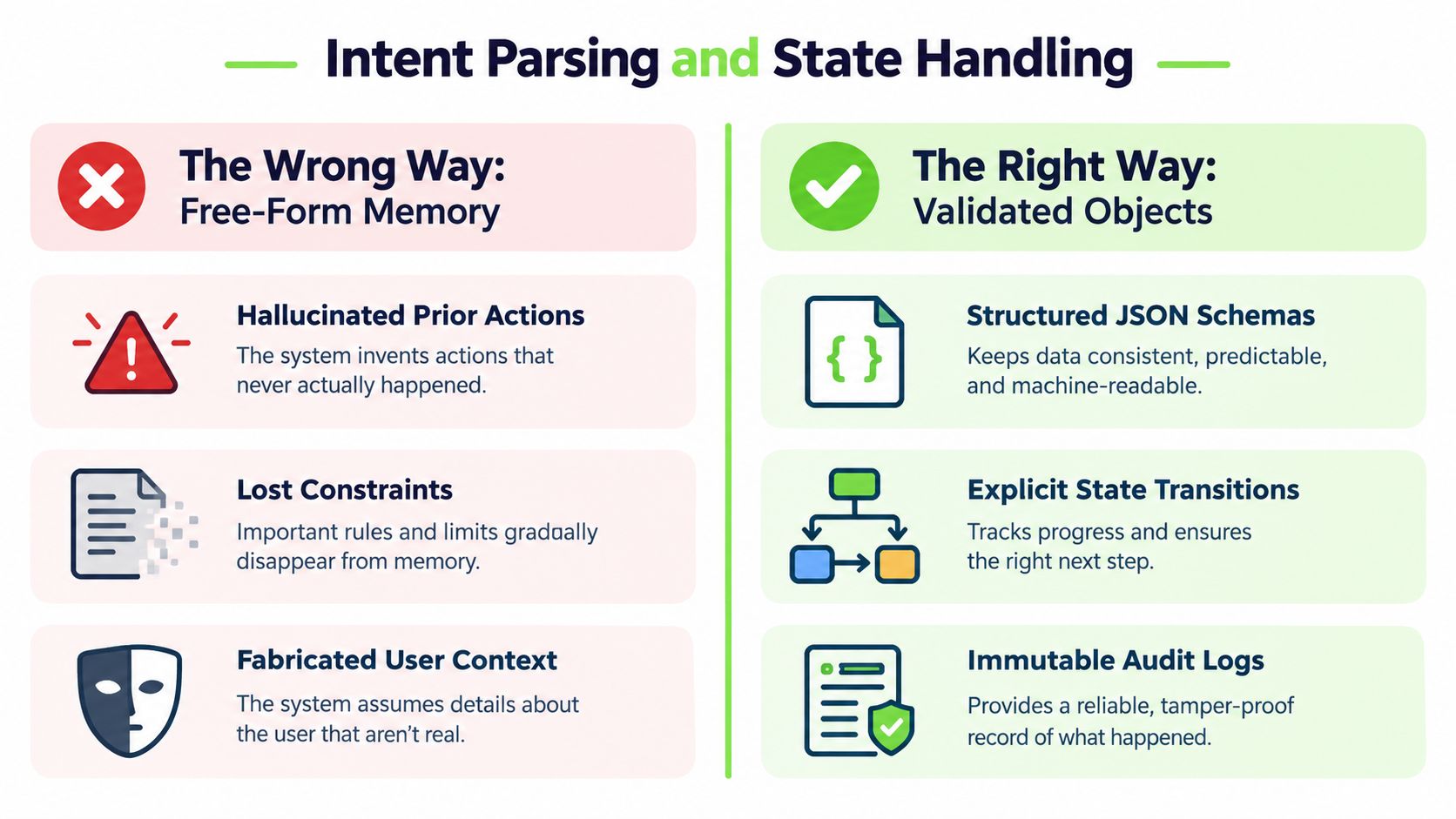
Free-form memory feels natural because chat interfaces make it look cheap. In production, it gets expensive fast. The model starts “remembering” prior actions that never happened, carrying forward constraints that were never validated, and fabricating user commitments that the state layer never approved.
Use typed intent, not conversational residue
Intent should be a structured object with fields like action, target, parameters, and confidence. A deterministic classifier or a constrained decoder can produce that object, but the result should always be schema-validated before anything else moves forward. Raw dialogue history shouldn't be the source of truth.
The reason is simple, language is flexible, state is not. When an agent decides based on memory blobs, it can't tell whether an old sentence was a confirmed instruction, a hypothetical, or a rejected branch.
Keep state server-owned and explicit
State should live in a server-owned object keyed to a session or task ID. It should include pending actions, last verified facts, authority scopes, and unresolved errors. The model can propose updates to that object, but the runtime should reject updates that conflict with already validated state.
That boundary is where drift stops. It also gives replay something real to work with, because a later run can inspect what was approved instead of reconstructing intent from a messy transcript.
| Approach | What It Optimizes | What Breaks |
|---|---|---|
| Free-form memory | Convenience and short-term continuity | Hallucinated prior actions, lost constraints |
| Validated state objects | Auditability and replay | More upfront schema work, less drift |
The implementation pattern is boring in the best way. Parse intent into a typed object, validate it, store it, and make the model operate against that object instead of against the raw chat log. That's the control-plane move that separates a demo from a system.
Safety Gates and Fail-Closed Behavior
Production agents need more than one check, because a single gate rarely covers all the ways a model can go wrong. The goal isn't to make the agent cautious in a vague sense. The goal is to make every unsafe path stop before it becomes an action.
The gates that have to fire
The first gate is authority before autonomy. Confirm the principal identity, tenant scope, and action-level permission for every tool invocation. If the call can't be mapped to an allowed action, it should stop right there.
The second gate is claim validation. If the model proposes a fact, compare it against grounded retrieval responses and reject anything that can't be traced back to an authorized source. Provenance stops being optional.
The third gate is a policy screen. Check for prompt injection patterns, off-tenant references, and restricted topics before prompt assembly. If malicious content gets into the assembled prompt, downstream handling gets harder.
Fail closed, always
Timeouts, unresolved intents, missing authorization, and schema mismatches should abort the action. They should not trigger a “best effort” fallback that guesses, improvises, or downgrades safety. A structured error is better than a quiet failure that looks like success.
That's the operational lesson from enterprises that are already running agents. Deloitte reports that only one in five companies has a mature governance model for autonomous AI agents, and 48% have no clear roles or responsibilities. The same source says roughly half haven't updated governance frameworks for agentic-specific risks, which is exactly why the runtime has to enforce gates rather than trust policy documents to do it.
| Safety Gate | Failure Mode Prevented | Fail-Closed Default |
|---|---|---|
| Authority before autonomy | Unauthorized tool use | Abort on missing permission |
| Claim validation | Unsupported assertions | Reject uncited facts |
| Policy screening | Prompt injection and off-tenant leakage | Block prompt assembly |
| Schema validation | Malformed actions | Stop and return structured error |
| Timeout handling | Endless execution | Terminate and log incident |
The logging requirement is not optional either. Every gate decision should be recorded for review, especially denials, timeouts, and policy blocks. Without that trail, you can't tell whether the system was safe or merely silent.
An Operational Checklist for Going to Production
Treat deployment as a repeatable review, not a launch moment. Agentic AI implementation changes every time the model changes, the prompt changes, or the retrieval index changes, so the checklist has to run again whenever the control plane shifts.
Pre-deployment checks that catch real failures
Run retrieval authorization tests across tenant boundaries first. If one tenant can retrieve another tenant's data in staging, production will find the same bug faster and with more damage.
Replay intent and state against golden traces next. That catches drift between what the agent thinks happened and what the state store recorded. Then run safety gate dry runs with adversarial prompts, especially injection attempts that try to override policy or smuggle in off-tenant context.
Rate-limit and budget enforcement should also be verified in staging, because runaway loops and repeated retries can turn into surprise cost before anyone notices. The point is to make the control plane observable before it has to absorb real traffic.
Launch-day controls that keep the blast radius small
Use feature flags and a kill switch from day one. Route early traffic through canary cohorts, and make sure there's a manual escalation path when the agent refuses an action or returns a structured error. On-call runbooks should name the deterministic subsystem that failed, not the model that was involved.
That distinction matters. If a retrieval filter fails, the fix is not “try a different prompt.” It's a permissions or indexing problem.
For teams building internal process automation, how to implement AI successfully is a helpful companion piece because it stresses practical rollout discipline over novelty.
Post-deployment metrics that actually mean something
Track claim-fidelity sampling, grounding hit rates, authorization denials, loop-iteration counts, and cost-per-resolved-task drift. Those signals tell you whether the agent is stable or just appearing stable because nobody has looked closely enough yet.
A stable agent doesn't just answer. It answers with authorized evidence, bounded state, and a clean failure path when the runtime can't prove safety.
That's the standard worth aiming for. AletheionAGI provides a grounding and evidence-control layer for AI systems, so teams can enforce authorized evidence, persistent context, and fail-closed answer validation without replacing existing LLMs, RAG pipelines, vector databases, or memory systems. If you're building agents that need evidence-backed outputs and explicit control boundaries, visit AletheionAGI and evaluate whether a grounding layer belongs in your stack.