High retrieval scores don't make an AI agent safe. A retriever can rank semantically similar documents well while violating tenant authorization, passing stale evidence into the context window, or giving the generator no reason to abstain. The practical value of the map metric system, understood here as Mean Average Precision for ranked retrieval, is diagnostic rather than ceremonial. It helps engineers inspect where evidence appears, but it can't certify that the evidence was allowed, current, or sufficient.
That distinction matters in customer support automation, enterprise search, and agentic workflows handling confidential records. The production question isn't only whether the right passage was found. It's whether the system found the right passage inside the correct authorization boundary, delivered it with usable provenance, and refused to make a claim when the evidence didn't support one.
Rethinking the MAP Metric System for Production AI
Many teams treat MAP as a final exam score. They optimize the number, compare retrievers, and assume a higher result means a safer answer. That assumption is too narrow. MAP measures the ordering of relevance judgments, not the authority of the documents, the integrity of the labels, or the behavior of the language model after retrieval.
A useful evaluation asks a stricter question: did the system retrieve evidence that the requesting principal was entitled to use? A document from another tenant might be highly similar to the query and still be an absolute retrieval failure. If the evaluation labels it as relevant because it answers the question, MAP can reward the very behavior the security team needs to prevent.
From ranking quality to evidence boundaries
Mean Average Precision rewards relevant items appearing early in a ranked list. That makes it useful when the language model receives only a limited set of passages. It can expose a reranker that finds the right material but buries it below the delivery cutoff. It can also serve as a regression signal when chunking, embeddings, metadata filters, or query rewriting change.
It shouldn't stand alone. A production scorecard needs at least separate measures for:
- Authorized retrieval, whether every returned item belongs to the tenant, user, role, and trust zone.
- Attribution correctness, whether generated claims are supported by the cited passages.
- Unsupported-claim rate, whether the answer says more than the evidence permits.
- Abstention behavior, whether the agent declines or asks for clarification when authorized evidence is absent.
- Provenance completeness, whether source identity, version, scope, and retrieval event remain inspectable.
A system can improve its ranking score by broadening retrieval, weakening filters, or increasing the number of candidate documents. Those changes may improve recall while increasing exposure and reducing the model's willingness to admit uncertainty. The benchmark evidence discussed later makes that trade-off measurable.
Practical rule: Treat MAP as a sensor for ranking behavior, not as a security control or a truth score.
The same principle applies outside RAG. A mapping or location-data workflow may need to enrich contacts with map signals, but the presence of a geographically relevant record doesn't establish that the record is authorized, current, or appropriate for a particular decision. In both systems, relevance is only one property of usable evidence.
Computing Mean Average Precision in Multi-Tenant RAG
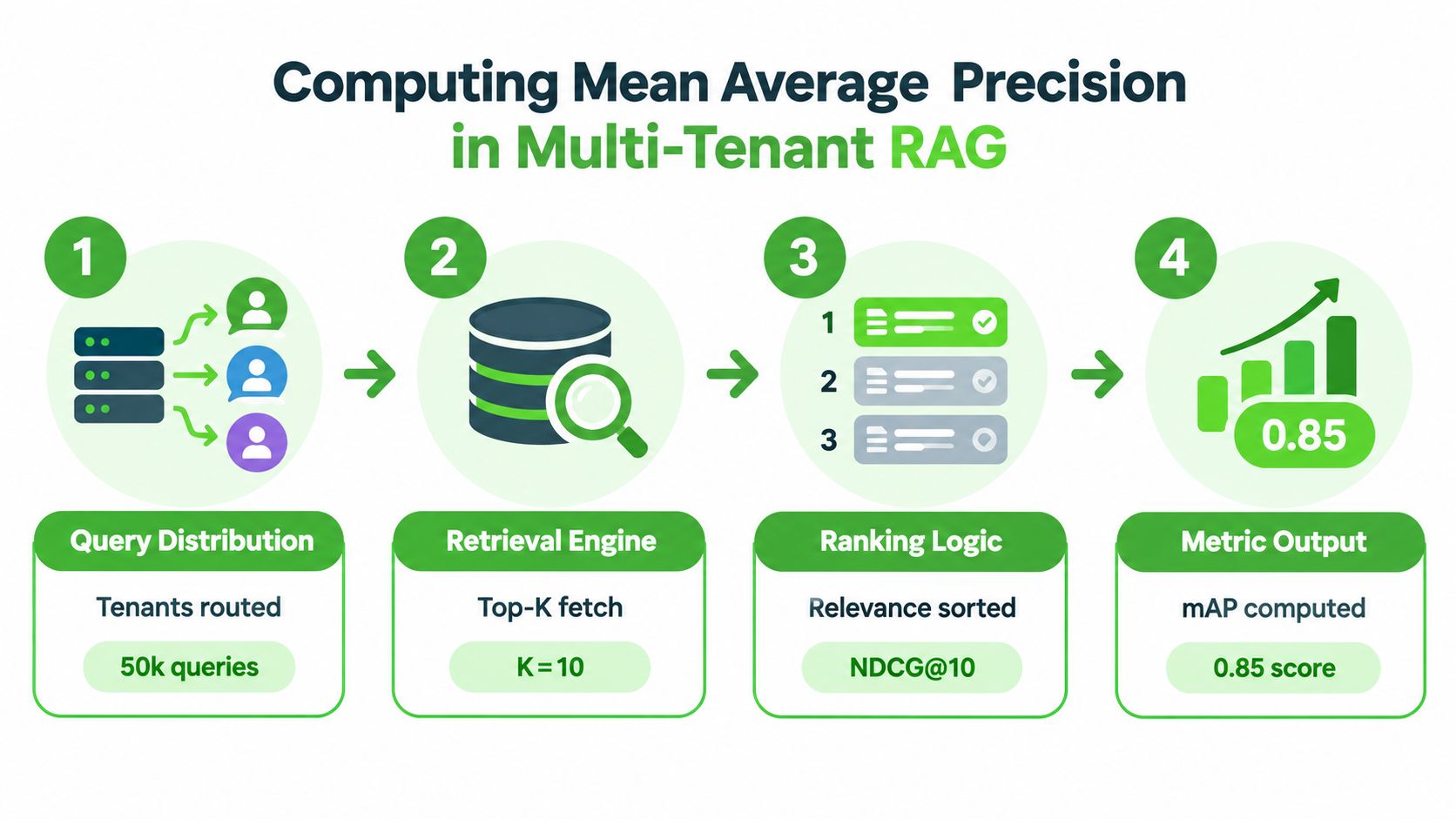
For a single query, Average Precision evaluates the positions at which relevant documents appear. At each relevant position, calculate precision at that rank, then average those precision values over the relevant documents for the query. Mean Average Precision is the arithmetic mean of those AP values across the evaluation queries.
A compact formulation is:
AP(q) = average of precision@k for every rank k where the result is relevant
MAP = average of AP(q) across the evaluation set
The formula is simple. The difficult production decision is defining “relevant.”
Label relevance after authorization
Suppose a support agent asks about a contract renewal. The corpus contains an authoritative contract passage for Tenant A, a nearly identical passage for Tenant B, an outdated version for Tenant A, and a general policy document available to both tenants.
A semantic evaluator might label the Tenant B passage as relevant because it answers the question. A secure evaluator must label it as unauthorized and non-relevant, even if its wording is perfect. The outdated Tenant A passage may be semantically relevant but operationally invalid if a newer authoritative version exists.
Build each judgment record with more than a query and document ID. Store:
- Tenant and principal context, including the identity and entitlements used at retrieval time.
- Document authorization, including tenant scope, role requirements, and trust zone.
- Authority status, such as canonical, supporting, superseded, or revoked.
- Relevance label, with separate treatment for direct support, partial support, and irrelevant content.
- Version and evaluation timestamp, so later changes don't alter the meaning of the score.
The MAP calculation should run on the authorized candidate set, not on a global corpus followed by post-retrieval filtering. OWASP identifies cross-tenant leakage as a vector-store risk and recommends permission-aware retrieval with logical or physical partitioning. Application-layer filtering after similarity search isn't enough, because unauthorized records may already have influenced ranking, logs, caches, or model context. See this guide for journalists on precision recall for a broader explanation of why precision and recall must be interpreted together rather than treated as interchangeable targets.
Choose the cutoff that reaches the model
Evaluate MAP at the number of passages that enter the prompt, rather than at an arbitrary depth. If a reranker produces a long candidate list but delivery controls pass only the leading evidence, a score calculated below that boundary can hide a poor user-facing ranking.
Use different cutoffs when the product has different modes. A concise support answer, a research agent, and a workflow that needs several independent sources have different evidence demands. Report the cutoff, label policy, corpus version, and authorization policy beside the score. Without those fields, two MAP values may not describe comparable systems.
The following video can help teams align basic precision and recall terminology before they define their own relevance protocol.
The Trade-Off Between Retrieval Confidence and Abstention
A retriever can become more confident without becoming more correct. Similarity scores, reranker scores, and classifier probabilities describe model behavior, but they don't prove that the retrieved passage supports the claim an agent wants to make.
The REASONS benchmark illustrates the problem. It contains 12,723 sentence-level citation instances across 12 arXiv subject categories. In its reported comparison, advanced RAG reduced hallucination rate from 87.6% to 65.4% relative to naive RAG, while attribution recall fell from 5.0% to 0%. Under adversarial metadata, some systems exceeded 85% hallucination rate, and retrieval-augmented variants often maintained near-zero abstention. These results come from a defined benchmark and comparison, not a universal prediction for every RAG deployment, so teams should reproduce the protocol before generalizing. REASONS benchmark
Why MAP can't measure refusal quality
MAP can tell you that relevant passages moved upward. It can't tell you whether the generator used them faithfully, whether the passages were current, or whether the agent should have answered at all. A system may retrieve a plausible document for every query and still fabricate a conclusion when the evidence is incomplete.
Here threshold tuning creates an uncomfortable trade-off. A stricter evidence threshold usually reduces coverage and increases abstentions. A permissive threshold may give users more answers while allowing weakly supported claims through. The correct operating point depends on the consequence of an unsupported answer, not on a universal score target.
Do not turn abstention into a simple failure label. In a tenant-scoped system, an empty authorized result is often the correct result. Falling back to unrestricted search converts uncertainty into a confidentiality incident. The evaluator should distinguish:
- Supported answer, where every material claim has authorized evidence.
- Qualified answer, where the agent clearly marks an evidence limitation.
- Abstention, where no authorized evidence supports a safe answer.
- Unsupported answer, where the agent asserts a claim beyond the retrieved record.
- Leakage, where the answer uses data outside the principal's authority.
For a deeper treatment of uncertainty as an engineering concern, see uncertainty in artificial intelligence.
Evaluate the full behavior surface
Run MAP beside attribution recall, citation entailment, unsupported-claim rate, and abstention rate. Break results down by query type, tenant, authorization complexity, document freshness, and adversarial metadata. Aggregate scores can conceal a failure concentrated in one customer segment or one permission path.
A retrieval system that never abstains may look convenient in a demo. In production, that behavior can mean the system has no effective evidence boundary.
The most useful dashboard doesn't ask only whether retrieval improved. It asks whether the change moved the system toward authorized, attributable, and appropriately cautious answers. If MAP rises while abstention collapses and unsupported claims increase, the change isn't an improvement. It's a ranking gain purchased with weaker control.
Defining Error Budgets for AI Grounding Accuracy
Mapmaking offers a useful warning for AI engineers. A scale ratio describes the relationship between map distance and ground distance, but it doesn't guarantee positional accuracy. At scale 1:10,000, one map unit represents 10,000 identical ground units, yet the ratio says nothing by itself about whether a mapped utility line is positioned accurately enough for construction.
The same distinction applies to retrieval. A high MAP value describes ranking behavior under a particular label and cutoff policy. It doesn't establish that the resulting answer is safe for compliance, financial operations, medical support, or access-controlled customer service.
ISO 19111 treats coordinate reference metadata as essential for reproducible measurement, and geospatial workflows must record the coordinate reference system, datum, projection, and measurement method. For AI evidence, the equivalent metadata includes source identity, authority scope, version, transformation history, retrieval method, and the exact passage used for the claim. ISO 19111 guidance
Translate spatial tolerance into grounding tolerance
Geospatial accuracy is managed as an error budget. The U.S. National Standard for Spatial Data Accuracy guidance recommends reporting positional accuracy in ground distances and using RMSE-based testing. Its publication-scale guidance, as summarized by ASPRS, uses different point-error thresholds for maps larger than 1:20,000 and maps at 1:20,000 or smaller. At 1:20,000, the corresponding examples are approximately 16.9 metres and 10.2 metres, depending on the applicable scale category and test protocol. FGDC spatial data accuracy guidance
An AI grounding budget needs the same discipline, translated into system-specific terms. Define the maximum permitted error for each workflow:
- A support answer may require every policy assertion to cite an authorized, current source.
- A compliance workflow may reject any answer when provenance is incomplete.
- A research assistant may provide a qualified synthesis if it exposes uncertainty and source disagreement.
- An action-taking agent may require a canonical record and explicit authorization before execution.
Measure the budget against independently reviewed claims, not against model confidence. Record the denominator, test-set version, source state, evaluator agreement, and measurement method. If a source is superseded during the test, preserve the earlier index state so the result remains reproducible.
Precision can create false confidence
Digital maps can be resized without changing the source data. Likewise, a retrieval interface can display a precise similarity value while the underlying chunk is stale, truncated, incorrectly attributed, or outside the user's scope. More decimal places don't reduce those uncertainties.
A practical grounding report should therefore include:
| Field | Production question |
|---|---|
| Evidence identity | Which exact source and passage supported the claim? |
| Authority scope | Was the source permitted for this principal and tenant? |
| Version state | Was the record current, superseded, deleted, or corrected? |
| Measurement method | Which retriever, reranker, filters, and cutoff produced the result? |
| Error outcome | Was the claim supported, qualified, abstained, unsupported, or leaked? |
This is the operational meaning of accuracy of artificial intelligence. The objective isn't a more impressive score. It's a bounded statement about what the system can support under specified conditions.

Architecting Evidence-Bounded Retrieval Pipelines
Naive RAG usually follows a convenient path: embed the query, search a shared index, retrieve the top results, and ask the language model to answer. That design can work for low-risk, single-tenant content. It becomes fragile when authorization, record lifecycle, and auditability matter.
An evidence-bounded pipeline inserts authority controls before similarity search and delivery controls before generation. The flow is:
Authenticated request → structured intent → authorized candidate query → ranking and evidence validation → provenance-preserving context → generation or abstention
This isn't a replacement for an LLM, vector database, or memory system. It's a control layer around them. The language model can still interpret, summarize, and propose. It shouldn't decide which tenant's records it is allowed to see.
Enforce isolation inside retrieval
OWASP's guidance on vector and embedding weaknesses identifies cross-tenant leakage when embeddings from one group are returned to another group's query. Fine-grained permission-aware retrieval and strict logical or physical partitioning reduce that risk. For high-sensitivity workloads, physically separate indexes can reduce the blast radius of query-filtering errors. OWASP vector and embedding guidance
The critical implementation rule is simple: authenticate the tenant and entitlements before the similarity operation, then include those constraints in the query itself. Don't retrieve broadly and filter in application code afterward. An empty authorized result must remain empty. It must not trigger an unrestricted fallback.
Preserve provenance through change
NIST's Generative AI Risk Management Profile recommends tracking dataset modifications, including deletions and rectification requests, because those changes can affect the verifiability of content origins. It also recommends documenting provenance limitations. NIST Generative AI Risk Management Profile
A production record should carry the source identifier, version or timestamp, ingestion event, tenant scope, transformation history, and retrieved passage or record identifier. When a source is revoked or corrected, the system needs an invalidation or revalidation path for indexes, caches, memory entries, and generated claims.
MAP fits here as a validation signal. Run it on authorized, versioned judgments to see whether important evidence reaches the delivery boundary. Pair that result with leakage tests and provenance checks. A ranking improvement that depends on stale or overbroad evidence isn't a valid improvement.
Testing Protocols for Verifiable AI Infrastructure
A useful MAP score begins with a frozen evaluation protocol. Freeze the query set, corpus snapshot, authorization policy, relevance judgments, embedding and reranking versions, cutoff, and denominator before comparing pipeline changes. Otherwise, a score movement may reflect changed labels or data rather than a better retriever.
Start with a test matrix that makes failure modes visible:
- Tenant separation tests: Issue equivalent queries under different tenant identities and verify that authorized results differ where policy requires it.
- Role boundary tests: Remove a user's entitlement and confirm that restricted evidence disappears from the retrieval operation, not just from the final response.
- Staleness tests: Mark a source superseded or corrected and verify that retrieval, caches, memory, and citations no longer treat it as current.
- Adversarial metadata tests: Add misleading titles, source fields, or instructions and measure whether ranking and generation follow content authority rather than metadata alone.
- Insufficient-evidence tests: Ask questions with no authorized answer and require a qualified response or abstention.
Report more than one retrieval score
For each run, publish MAP with its cutoff and relevance policy, then report authorized precision, recall, attribution correctness, unsupported claims, abstentions, and leakage separately. Include per-tenant and per-risk-class breakdowns. A single aggregate can hide a serious failure when most queries are easy and only a small group exercises sensitive permissions.
The REASONS results show why this matters. Retrieval augmentation can reduce one kind of hallucination while attribution recall worsens and abstention remains too low under adversarial conditions. That benchmark doesn't prescribe a universal target, but it does justify testing these dimensions independently rather than treating retrieval success as answer verification.
Teams comparing dashboards may also benefit from AI citation intelligence for firms, provided they verify the underlying definitions and don't confuse an observability label with an evaluation protocol.
Make abstention a passing outcome
A test should pass when the system refuses an unsupported claim for the right reason. Store the authorized result set, the evidence presented to the generator, the final answer, citations, and the policy decision. If no permitted record supports the request, an empty result plus a clear limitation is better than a plausible answer drawn from a neighboring tenant.
Use LLM evaluation guidance as a starting point for broader test design, then adapt the protocol to your data authority and action risk. CI should block changes that increase leakage or unsupported assertions, even when MAP improves.
Building Inspectable and Testable AI Systems
The map metric system is valuable when it helps engineers locate a failure, not when it decorates a dashboard. Use it to inspect ranking order at the evidence boundary, with relevance labels that account for authorization, authority, and freshness. Then connect it to claim validation, abstention, provenance, and leakage tests.
A dependable architecture keeps responsibilities separate. Credentials determine who may retrieve. Canonical state determines which records are authoritative. Retrieval ranks only permitted evidence. The generator proposes language, while policy and delivery controls decide what may be stated or acted upon.
That separation supports composable AI infrastructure. It lets teams change an embedding model, vector database, memory mechanism, or language model without losing the ability to reproduce why a claim was made. It also makes limitations visible, which is more useful than promising that a score eliminates hallucinations.
Final engineering test: Can your team reproduce the evidence, authorization decision, ranking result, and abstention choice for a disputed answer?
AletheionAGI provides grounding and memory infrastructure for production AI, including persistent memory, authorized retrieval, and fail-closed grounding that works with existing LLMs, RAG pipelines, vector databases, and memory systems. Visit AletheionAGI to explore evidence-bounded, inspectable infrastructure for agents that need verifiable retrieval and explicit operational limits.