Accuracy in artificial intelligence is not a single number. Even advanced systems produce incorrect information in more than 17% to more than 34% of high-stakes legal research cases, depending on the tool and evaluation.
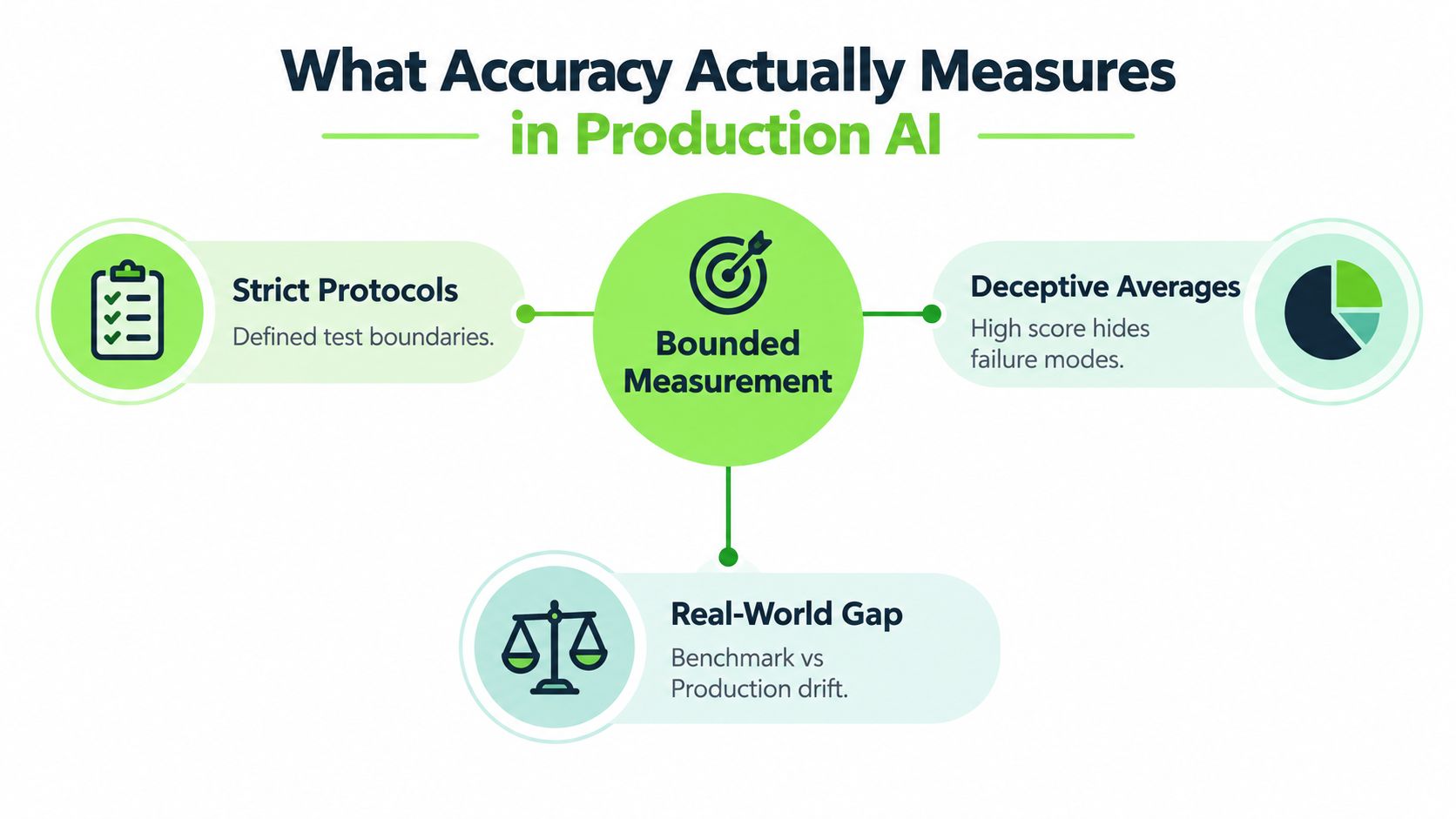
That counterintuitive result exposes the central problem: a model can perform well on general benchmarks and still fail when the task requires open-ended factual generation, authorized retrieval, or evidence-backed explanation. The accuracy of artificial intelligence is a bounded measurement defined by its protocol, denominator, domain, evidence source, and tolerance for uncertainty.
What Accuracy Actually Measures in Production AI
Production accuracy isn't a permanent property of a model. It's a measurement of a model-and-system combination under specified conditions. Change the benchmark version, retrieval corpus, user population, prompt, permission policy, or definition of an error, and you may be measuring something materially different.
A raw accuracy score usually answers a narrow question: how often did the system produce the expected result for the evaluated items? That number becomes useful only after engineers define what counts as an item, which outcomes count as correct, and which failures are included in the denominator. A customer-support agent that retrieves the wrong policy document has a different failure from one that retrieves the right document but invents a warranty exception.
Measurement rule: Never publish an AI accuracy score without naming the task, benchmark version, denominator, evaluation protocol, and error categories.
Stanford HAI observed in 2023 that many widely used AI benchmarks were already reaching roughly 80% to 90% accuracy as benchmarks approached saturation. At that point, incremental gains become harder to interpret. A higher score may reflect progress on familiar items while saying little about rare, multilingual, adversarial, or long-tail cases.
From model score to system behavior
For a RAG pipeline, the measured object includes more than the language model. It includes document parsing, chunking, embedding, indexing, permission filtering, retrieval ranking, context assembly, generation, citation handling, and abstention. An evaluation that tests only the final answer can hide which component failed.
A useful production protocol therefore separates at least four questions:
- Retrieval accuracy: Did the system return the authoritative evidence?
- Grounding accuracy: Did the answer stay within that evidence?
- Claim accuracy: Is each material claim supported?
- Decision reliability: Did the system answer, escalate, or abstain appropriately?
Teams designing an agent can use a resource such as Production AI agent with Captapi to think through the broader agent workflow, but the evaluation still needs a task-specific protocol. A helpful companion is LLM evaluation methodology, especially when a team must turn qualitative concerns into frozen test cases and reproducible scoring.
Two models can share an accuracy score while having opposite operational profiles. One may make occasional, obvious refusals. Another may answer nearly every question, including questions outside its evidence boundary. For a sensitive enterprise application, the second system may be less reliable even if its raw answer rate looks stronger.
Accuracy Versus Precision and Recall
Accuracy combines correct positives and correct negatives across the evaluated population. That's useful when classes are balanced and the cost of errors is similar. Production retrieval and safety systems rarely satisfy either condition.
Precision asks how many returned results were relevant. Recall asks how much of the relevant material the system found. A legal retrieval system with high precision may return only a small set of highly relevant clauses, while a high-recall system may return a broader evidence set that includes more noise. Neither metric alone describes whether the final answer is safe.
| Metric Focus | System Behavior | Primary Risk |
|---|---|---|
| Accuracy | Optimizes aggregate correctness across all evaluated outcomes | Dominant classes can hide minority or edge-case failures |
| Precision | Returns fewer results, aiming for a high share of relevant evidence | The system may omit material evidence |
| Recall | Retrieves broadly to reduce missed evidence | The model may receive distracting or conflicting context |
Consider a multi-tenant support agent. If most test questions have straightforward answers, the system can achieve strong aggregate accuracy while failing on permission-sensitive questions. A single unauthorized retrieval isn't merely a false negative or false positive in the conventional sense. It's a boundary violation that requires its own security metric and a fail-closed response.
The trade-off becomes clearer in different workflows:
- Security filtering: Precision may matter when false alarms overwhelm analysts, but recall remains important when missing a prohibited item creates material exposure.
- Legal retrieval: Recall often deserves priority because omitted authority can distort the answer. The generation layer must still distinguish retrieved evidence from unsupported inference.
- Customer support: Precision and grounded claim accuracy may matter more than broad recall when a wrong policy answer creates customer or compliance risk.
- Agent action selection: The critical measure may be the rate of correctly authorized actions, not the percentage of all text responses judged acceptable.
Optimizing one metric can worsen another. Increasing retrieval breadth may improve recall while making grounding harder. Tightening a confidence threshold may improve precision while increasing abstentions and unresolved tickets. The correct choice depends on the error profile the business can tolerate, not on a universal ranking of metrics.
Engineering teams can also separate build-time comparison from operational quality practice. A practical build vs phase quality comparison can help frame evaluation as an activity embedded across development and release phases, rather than a final inspection after the system has already accumulated hidden failure modes.
Why High Benchmark Scores Hide Failure
A benchmark score is evidence about a defined test, not a certificate of general reliability. Stanford's 2023 discussion of benchmark saturation shows why this distinction matters. When many evaluations cluster near 80% to 90% accuracy on widely used benchmarks, the remaining errors may carry more information than the aggregate score.
Closed-form questions also differ from open-ended generation. A model can select a correct answer from constrained options yet fabricate a citation, merge two sources, omit a qualification, or state an unsupported conclusion when asked to produce a narrative response.

The domain changes the denominator
A 2025 survey of hallucinations reported substantially lower factual and intrinsic hallucination rates for GPT-4 than for earlier systems in some evaluations, including a QAFactEval value around 4.7%. The same summary reported LLaMA 2 values of 31.2 on TruthfulQA, 27.6 on HallucinationEval, and 24.8 on QAFactEval, compared with GPT-4 values of 14.3, 9.8, and 4.7, respectively in the surveyed model-specific results. These figures come from particular tasks and protocols. They shouldn't be treated as universal model properties.
High-stakes legal research makes the production gap concrete. Stanford HAI reported that Lexis+ AI and Ask Practical Law AI produced incorrect information more than 17% of the time, while Westlaw's AI-Assisted Research hallucinated more than 34% of the time in the reported evaluations. The result isn't that benchmarks are useless. It's that benchmark performance and domain-specific factual reliability answer different questions.
Stanford's technical performance reporting also highlights reliability problems in common evaluations, including error rates of up to 42% on some evaluations, alongside missing statistical significance reporting, replication scripts, or valid questions in a substantial share of items in its 2026 technical chapter. Benchmark contamination and memorization can further inflate apparent generalization.
A better question is not “Which model is most accurate?” It's “Accurate on which benchmark, under which protocol, with which denominator, and for which failure class?” That question forces teams to test the evidence path rather than celebrate a leaderboard position. Guidance on AI hallucination prevention is most useful when translated into those concrete test boundaries.
Measuring Accuracy with Explicit Protocols
A defensible evaluation starts by freezing the conditions before looking at results. Otherwise, teams can unconsciously change the task, remove difficult examples, or reward answers that sound plausible rather than answers supported by evidence.
Define the evaluation boundary
Write the protocol as an executable specification:
- Name the population. State whether the test covers support tickets, policy questions, retrieved documents, agent actions, or generated claims.
- Freeze the version. Record the model, prompt, retrieval index, corpus snapshot, parser, reranker, and policy configuration.
- Declare the denominator. Decide whether the denominator is questions, retrieved chunks, answerable claims, citations, actions, or tenant-boundary queries.
- Set the adjudication rule. Specify who or what determines correctness and how disagreements are handled.
- Preserve difficult cases. Don't remove ambiguous or unanswerable items because the system struggled with them.
A 2026 benchmark used 6,000 questions and a bounded index that penalized hallucinations while rewarding abstention in its evaluation design. The index defines 0 as a state where the model answers correctly as often as incorrectly. Its important contribution is conceptual: it treats accuracy as calibrated reliability, not as a contest to answer the largest share of questions.
Classify the failure, not just the outcome
A binary correct-or-incorrect label is too coarse for RAG and agent systems. At minimum, classify:
- Omission: The answer leaves out material evidence or a required constraint.
- Fabrication: The system introduces a fact, citation, or action not supported by the available evidence.
- Unsupported claim: The statement may be plausible, but the system provides no authorized evidence for it.
- Wrong retrieval: The system selected irrelevant or unauthorized context.
- Unwarranted answer: The system responded when it should have abstained or escalated.
These categories tell engineers where to intervene. Chunking may influence omission. Retrieval filters may determine authorization failures. Prompting may affect unsupported synthesis. Confidence calibration may control unwarranted answers.
Measure claims and evidence paths
For generated answers, evaluate individual material claims and trace each claim to its source passage. A response-level score can hide one dangerous assertion inside otherwise correct prose. Also test unanswerable questions, conflicting documents, stale records, and permission changes. A system that returns “I don't have authorized evidence” has produced a valid result when the protocol requires abstention.
Calibration and Abstention in High-Stakes Tasks
A system that answers every question can look productive while making uncertainty invisible. In high-stakes workflows, abstention is an accuracy outcome when the available evidence cannot support a reliable answer.
Calibration measures whether confidence corresponds to observed correctness. A confidence score that says “high certainty” should identify outputs that are usually correct under the same task distribution. Ranking correct answers above incorrect ones isn't enough if the scores encourage unsafe acceptance.

An independent hallucination-detection study evaluated 64,507 labeled examples across question answering, dialogue, summarization, and general user-query domains. Its test split reported AUROC 0.835, F1 0.751, and expected calibration error of 0.009 for hallucination confidence under that study's protocol. A simple sigmoid calibration produced similar discrimination, with AUROC 0.822, but substantially worse calibration, with ECE 0.080. The practical implication is specific: a detector can preserve its ranking ability while becoming much less trustworthy for threshold-based rejection.
Compare answer-first and evidence-first behavior
An answer-first system tries to maximize response coverage. It may be appropriate for low-risk brainstorming, where users expect exploration and can verify results. It becomes dangerous when the interface presents unsupported claims as settled facts.
An evidence-first system checks whether authorized support exists before generation. If the support is missing, stale, contradictory, or outside the user's scope, the system abstains, asks for clarification, or routes the case to a human. This reduces apparent answer coverage, but it can improve operational reliability by preventing confident fabrication.
For sensitive multi-tenant applications, log at least the confidence signal, evidence set, policy result, final answer, and abstention decision under a shared request identifier. Review calibration by tenant, language, domain, and question type. A single global confidence curve can conceal a subgroup where the model is systematically overconfident.
Infrastructure Requirements for Verifiable Accuracy
Accuracy becomes operationally meaningful only when the system can show why an answer was produced and which evidence the user was allowed to see. This makes provenance and authorization part of accuracy engineering, not separate compliance features.
A secure RAG request should look like this in words:
User request → authenticated identity → policy constraint → authorized retrieval query → evidence validation → claim generation → provenance record → answer or abstention
Permission metadata should be attached to every chunk at ingestion. The retrieval query must enforce that metadata as a mandatory filter, rather than retrieving broadly and checking permissions afterward as recommended in RAG security guidance. Post-retrieval filtering is too late if the model or an intermediate component has already received unauthorized context.
Treat tenant boundaries as retrieval boundaries
Per-tenant namespaces or collections provide hard trust boundaries. OWASP guidance recommends storing access-control metadata alongside vector chunks, enforcing checks at retrieval time, using separate namespaces or indices where appropriate, and running cross-tenant test queries with a target of zero cross-boundary results in its operational controls.
Authorization should constrain the database query itself. Research on authorized RAG describes a pattern in which policy evaluation produces a resource constraint, then compiles that constraint into a database-native filter so the model receives only authorized context in the proposed architecture.
The audit record should preserve the query, user identity, retrieved chunk IDs, permission result, generated answer, and correlation ID. Without that chain, a team can observe that an answer was wrong but can't determine whether the failure began in ingestion, policy evaluation, retrieval, generation, or delivery.
Make claims traceable
Microsoft's VeriTrail work separates provenance from hallucination detection. Provenance traces the final output through intermediate outputs back to source text, while hallucination detection classifies claims as supported, unsupported, or inconclusive in its workflow design.
A grounding and evidence-control layer such as AletheionAGI's GQueries can work with existing LLMs, RAG pipelines, vector databases, and memory systems to support authorized retrieval, persistent memory, evidence-backed outputs, provenance, and fail-closed handling. It doesn't replace the model. It changes the conditions under which the model can receive evidence and deliver an answer.
For an enterprise knowledge base, AI knowledge-base architecture should be assessed by the same standard as the model: can the system reproduce the evidence path, enforce current permissions, and expose an abstention when support is insufficient?
Building a Rigorous Accuracy Strategy
A reliable strategy begins with a narrow operational claim. Don't state that an AI system is “accurate” in general. State that it answers a defined class of questions, against a specified corpus and policy configuration, under a documented protocol, with measured behavior across supported, unsupported, inconclusive, and abstained outcomes.
A support team might start with a frozen set of real question types, then separate answerable requests from requests requiring escalation. An ML platform team can evaluate retrieval and generation independently. A security team can add cross-tenant probes, revoked-permission tests, and attempts to induce the system to reveal hidden context.
A practical sequence
- Freeze the baseline. Record the model, corpus, index, prompt, policies, and evaluation set.
- Measure the evidence path. Score retrieval relevance, authorization, claim support, citation validity, and abstention separately.
- Inspect the tail. Review rare languages, long documents, conflicting policies, ambiguous requests, and unanswerable questions.
- Calibrate decisions. Tune acceptance, escalation, and abstention thresholds against observed reliability, not model confidence alone.
- Re-run after every material change. A new parser, embedding model, policy rule, or memory behavior can alter the measured system.
The engineering objective isn't the highest leaderboard percentage. It's a reproducible boundary around what the application can safely claim and do. Teams building the evaluation harness should also make the surrounding data-collection and service layer observable. Guidance on Python HTTP clients can help when selecting the transport components used to collect evaluation inputs and record repeatable test runs, though the client itself doesn't establish model accuracy.
The most useful accuracy report ends with limitations. It says where the system performs reliably, where it abstains, which errors remain, which tenants or domains were evaluated, and which conditions weren't tested. That level of precision gives product, security, and compliance teams something stronger than confidence. It gives them a claim they can inspect.
AletheionAGI offers grounding and memory infrastructure for authorized retrieval, persistent state, provenance, and fail-closed evidence delivery across existing LLM and RAG systems. If your team needs to replace broad accuracy claims with reproducible, auditable behavior, visit AletheionAGI to explore its research and composable infrastructure products.