The most popular advice about AI infrastructure starts with the wrong question. Teams ask how many GPUs they need, which cloud instance to select, or whether a larger model will lower latency. Those questions matter, but they don't explain why production agents expose private records, lose conversational state, cite irrelevant documents, or take actions that no policy approved.
AI infrastructure is the complete system that builds, deploys, and operates AI workloads in production. That includes compute, storage, networking, orchestration, models, data access, memory, intent handling, authorization, observability, and policy enforcement. A model host can generate tokens. Production infrastructure must also establish which evidence the model may use, what state it may retain, and which actions it may take.
Redefining AI Infrastructure Beyond Compute
The hardware-first definition is useful for procurement, but incomplete for engineering. AI infrastructure is an end-to-end stack, not just a pool of accelerators behind an inference endpoint. IBM describes it as the systems required to develop, deploy, and maintain AI models, including compute, storage, networking, and the software that coordinates them in operation. That lifecycle view is the right starting point for enterprise agents and RAG applications.
A support agent can have abundant compute and still fail in ordinary ways. It may retrieve a document from the wrong tenant, rely on stale memory, misunderstand the user's intent, or produce an answer that no authorized source supports. These are infrastructure failures because the surrounding system failed to manage state, evidence, authority, or traceability. More compute may improve response capacity, but it won't repair a broken permission boundary or an unversioned memory store.
Practical rule: Treat every model output as the final step of a governed workflow, not as the whole workflow.
The production stack has two planes
The data plane moves workloads through hardware and software. It includes accelerators, storage, network fabrics, model serving, vector search, queues, and caches. The control plane determines what should happen. It parses intent, selects an eligible workflow, retrieves authorized evidence, applies policy, records decisions, and manages state across interactions.
This distinction helps explain why scaling only the data plane creates brittle systems. A larger cluster can serve more requests, but it doesn't tell an agent whether a user is allowed to access a particular account record. A faster vector database can return more documents, but it doesn't establish whether those documents belong in the model context. A longer context window can hold more text, but it doesn't make that text authoritative.
Teams choosing a platform should therefore evaluate more than model access and deployment options. A practical guide on how to pick an AI development platform is useful context, but the evaluation should also cover memory lifecycle, evidence boundaries, policy hooks, and post-response auditability. Those capabilities often determine whether a prototype can become a dependable service.
Why DevOps patterns aren't enough
Traditional DevOps gives teams valuable practices for infrastructure provisioning, release automation, service health, and incident response. AI systems add a second set of changing assets, including prompts, model versions, retrieval indexes, evaluation sets, memory records, tool permissions, and policy decisions. The operational boundary is broader, which is why the distinction between DevOps and MLOps matters.
A production definition of AI infrastructure must answer concrete questions:
- Grounding: Which sources can support this answer?
- Authorization: Which tenant, user, or workflow may access those sources?
- Memory: Which prior facts remain valid, and who can correct or delete them?
- Intent: What does the user want, and which parts of the request remain unresolved?
- Policy: Which actions are permitted, denied, or subject to human approval?
- Evidence: Can another engineer reconstruct why the system responded this way?
If the architecture can't answer those questions, it isn't merely missing documentation. It has an ungoverned control plane.
The Hardware and Networking Foundation
The physical layer still sets hard limits. Training and inference depend on accelerated compute, high-throughput storage, and interconnects that move data between nodes without starving the processors. A useful definition of AI infrastructure includes this foundation, but it also recognizes that nominal accelerator capacity isn't the same as delivered workload performance.
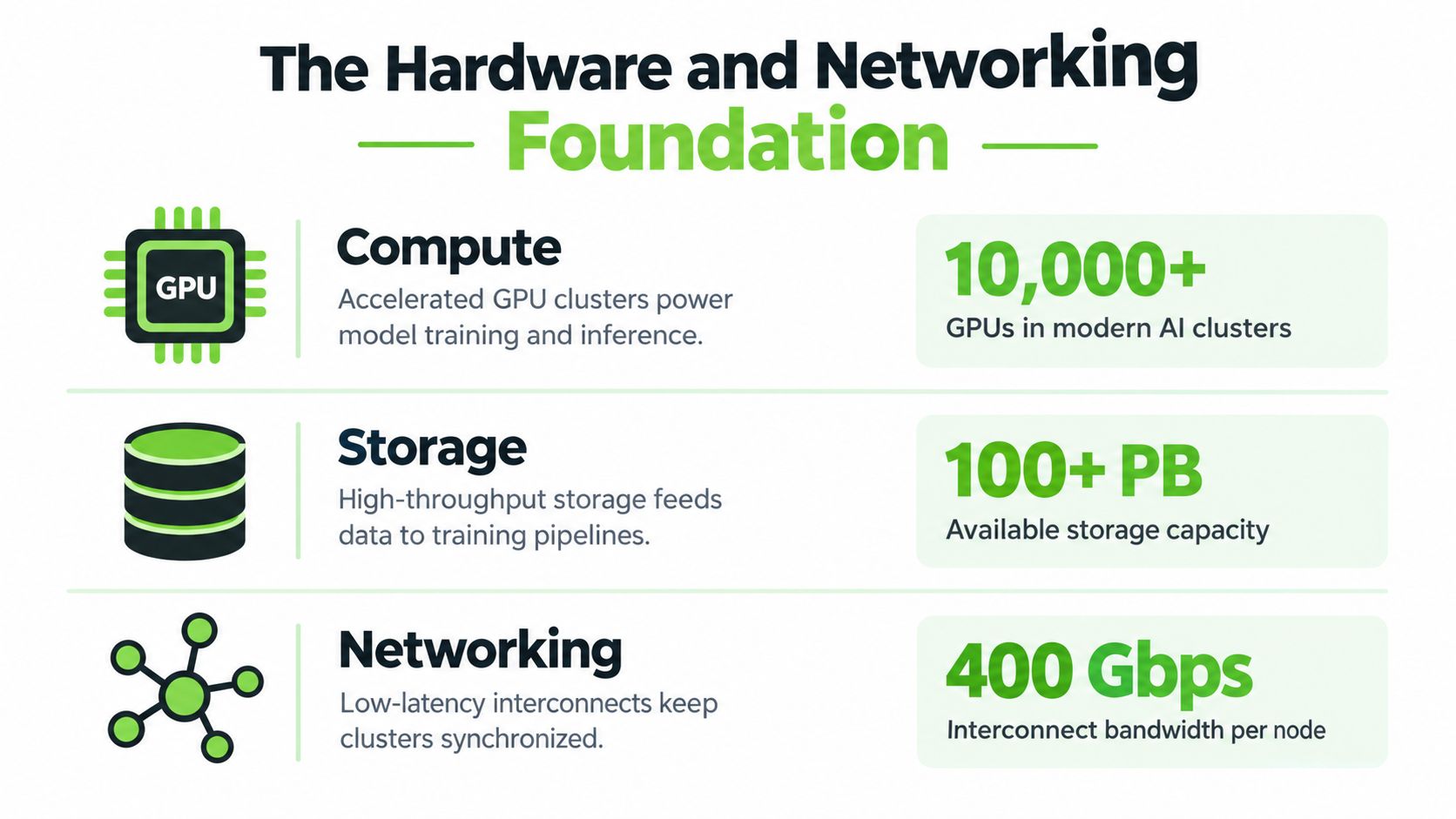
IDC reported that worldwide spending on AI infrastructure for compute and storage hardware reached $82.0 billion in Q2 2025, up 166% year over year, and projected total AI infrastructure spending would reach $758 billion by 2029. The same IDC figures show cloud and shared environments accounted for 84.1% of spending in that quarter, while servers represented 98% of AI-centric spending. These figures point to a market still dominated by deployment hardware and server capacity, even as the software control plane becomes more important operationally. IDC market data
Compute capacity can hide communication limits
Distributed training is a communication problem as much as a computation problem. GPUs exchange activations, gradients, and synchronization data, and model parallelism increases the amount of coordination required. If the network introduces congestion or latency, the accelerators wait instead of computing.
One published AMD analysis cites targets below 5 microseconds for intra-rack communication and below 20 microseconds for inter-rack communication in high-scale AI workloads. The same analysis reports historical benchmark efficiency around 95% for InfiniBand in HPC and about 90% for tuned RoCE in AI workloads, while reported model FLOP utilization across several deployments ranged from 38% to 50% of theoretical peak. Those results have scope and implementation limitations, so they shouldn't be treated as a universal promise. They do demonstrate why a cluster's advertised FLOPS won't predict application throughput by itself. AMD's comparative infrastructure analysis
A platform team should test the complete path rather than benchmark the accelerator in isolation:
- Measure collective communication. Test the operations your training framework uses, not only point-to-point bandwidth.
- Inspect topology-aware placement. Rank placement should reflect rack and fabric boundaries so communication-heavy workers aren't distributed inefficiently.
- Watch storage feeding behavior. A fast accelerator attached to a slow or contended data path will spend time waiting for batches.
- Separate training and serving objectives. Training favors sustained distributed throughput, while serving emphasizes predictable latency, concurrency, batching, and isolation.
Choose the deployment boundary deliberately
Cloud and shared environments can provide elastic capacity and reduce the need to operate physical clusters. Dedicated or on-premises environments can offer tighter control over data locality, workload placement, and network design. A hybrid architecture may fit organizations that need both operational flexibility and stricter control for selected workloads.
The trade-off is not just cloud versus on-premises. It includes the cost of idle capacity, the complexity of moving sensitive data, the maturity of scheduling, the quality of observability, and the team's ability to operate the stack. Procurement decisions should follow workload shape and governance requirements, not accelerator specifications alone.
The Control Plane for Memory and Intent
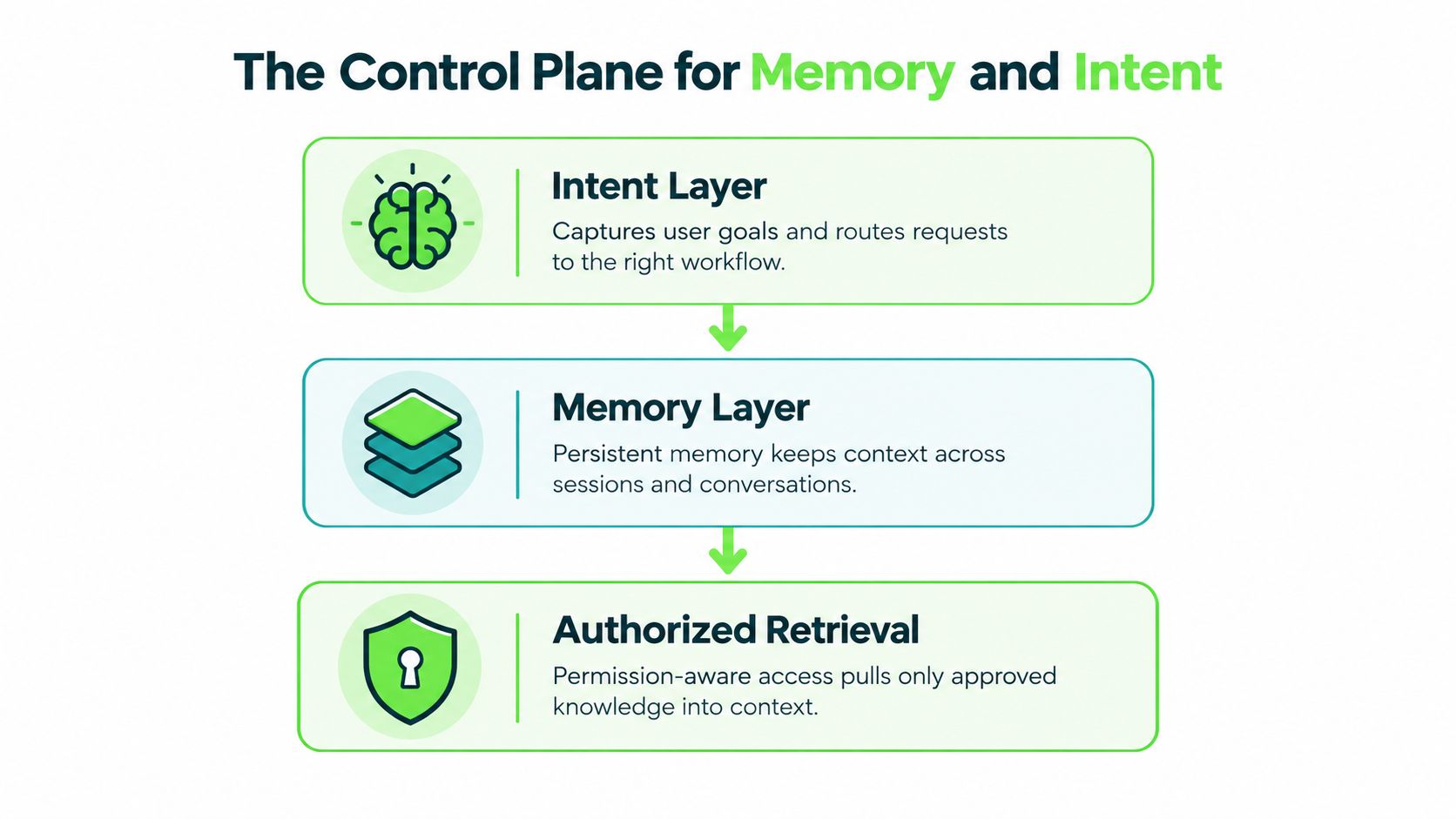
Compute does not determine whether an AI system can act safely. A stateless model sees only the prompt it receives, while a production application must relate that prompt to prior interactions, current permissions, business rules, and the user's actual objective. Memory, intent parsing, and authorized retrieval form a control plane that converts an open-ended language interface into a bounded workflow.
Intent parsing should produce more than a category label. It should record known facts, constraints, preferences, unresolved questions, and provenance. For example, “change the billing contact for my account” may leave the target account, required verification, or effective date unclear. A structured intent state can route the request to clarification or authentication instead of allowing the model to fill those gaps by inference.
Memory should preserve state without becoming an authority leak
Persistent memory is useful when it stores compact, relevant state instead of repeatedly exposing an entire conversation history. A memory record should have an owner, scope, source, version, and lifecycle. A guide to AI context management explains how these records can be scoped and expired in practice. Memory also needs correction and expiry because a remembered preference or account fact can become invalid.
The key design question is which system is allowed to write memory, which system can read it, and how the application proves that the record was eligible for this request. Memory reads should pass through policy enforcement. Memory writes should preserve provenance and prevent an unverified model assertion from becoming a canonical business fact.
Authorized retrieval completes the boundary. The retriever should return evidence that the requesting principal may use, applying filters before content enters the model context. This keeps data authority separate from inference. The model can summarize approved evidence, but it should not decide whether that evidence is approved.
Make the control plane composable
Teams can add this architecture without replacing their existing LLM, RAG pipeline, vector database, or memory system. A composable grounding and evidence-control layer can sit between application services and model inference. It can expose validated intent, eligible memory, authorized evidence, and policy outcomes through explicit interfaces.
The separation also improves testing. Engineers can evaluate retrieval authorization independently from generation, compare intent parsing against fixed examples, and inspect memory mutations without treating the model as an opaque application. Teams measuring how AI systems are represented and discovered can use MyMentions for AI visibility, but visibility does not replace controlled evidence or traceable state.
A practical reference model is:
User request → intent state → authorization decision → memory and retrieval query → filtered evidence → model response or action proposal → policy decision → audit record
The model remains useful for language understanding and generation. Application services retain authority, while the control plane makes each decision, read, write, and evidence path inspectable.
Architecting Secure Multi-Tenant RAG Systems
A multi-tenant RAG system should never ask the model to enforce tenant access. The model can recognize a tenant name, but recognition isn't authorization. Access must be resolved by an API or policy layer that knows the authenticated principal, tenant boundary, resource scope, and applicable rules.
Microsoft's multitenant RAG guidance recommends an API layer that encapsulates tenant data access and filtering logic rather than allowing the model to decide access. The user should receive common data or tenant-specific data filtered to what that user is authorized to access. Microsoft's multitenant retrieval guidance
Put authorization before retrieval delivery
A reliable request path can follow these steps:
- Authenticate the caller. Establish the user, service identity, tenant, and relevant session context outside the model.
- Resolve policy. Determine which collections, records, memory namespaces, and tools the caller may use.
- Construct the query server-side. Apply tenant and resource filters in the retrieval API, not in a prompt instruction.
- Retrieve only eligible evidence. The vector or search layer should receive the constrained query and return documents that satisfy the policy boundary.
- Attach provenance. Preserve source identity, version, scope, and retrieval metadata with each evidence item.
- Generate within the evidence boundary. The model should receive approved context and explicit instructions to distinguish supported answers from uncertainty.
- Authorize actions separately. A retrieved document can inform an action, but it shouldn't grant permission to perform that action.
The ordering matters. Filtering after generation is too late because unauthorized text may already have influenced the answer. Filtering only in the UI is also too late because downstream tools or logs may retain the response.
Fail closed when evidence is unavailable
If a user asks about a record outside their scope, the retriever should return no usable evidence. If the source is unavailable, stale, or contradictory, the system should expose that condition or route to review. It shouldn't fill the gap with a plausible answer.
This design can feel less fluent than a permissive chatbot, especially during early demos. That's the correct trade-off for systems handling customer records, financial details, internal knowledge, or regulated workflows. A clear refusal or clarification gives the organization a controllable failure mode. A confident answer based on inaccessible or unsupported material creates a security and reliability incident.
The same boundary applies to memory and tools. Tenant filters belong in the access layer for each resource, not only in the initial retrieval call. Application teams building these systems can use RAG for enterprise applications as a design reference, then validate the exact policy behavior against their own tenancy model and threat scenarios.
Provenance and Observability in AI Workflows
Basic logging tells you that a request occurred. Provenance tells you why the system produced a particular result. That difference becomes critical when a customer disputes an answer, a security team investigates a data boundary violation, or an operator needs to reproduce an agent action.
A conventional application log might contain a request ID, latency, status code, and model response. Those fields help with service operations, but they don't establish which source supported the response or which policy allowed the system to use it. Token throughput and latency are useful signals, not a complete audit trail.
Compare operational logs with evidence records
| Basic operational logging | Comprehensive AI provenance |
|---|---|
| Request and response timestamps | Source identity and source version |
| Model endpoint and status | Retrieval query and ranking behavior |
| Token and latency metrics | Transformations, prompts, and model identity |
| Error codes | Policy decisions, memory reads, and memory writes |
| Tool name | Tool parameters, human approvals, and final output |
Enterprise model inventories should catalog model names and versions, source repositories, known upstream base models, deployment locations, and the business functions each model supports. Splunk's guidance presents this inventory as a foundation for managing AI supply-chain risk and identifying lineage relationships that ordinary model documentation may miss. Splunk's model provenance guidance
Reconstruct the decision path
For an agent or RAG response, the evidence record should connect the request to the final output:
- Request context: authenticated identity, tenant, session, and intent state.
- Evidence path: source identity, source version, query, ranking behavior, and transformations.
- Decision path: policy checks, memory reads and writes, tool calls, and human approvals.
- Generation context: prompt assembly, model identity, and output.
- Outcome: final response, action result, abstention, or escalation.
Research on governance for agents argues that provenance should span these layers and that authorization must apply to retrieval, memory, tools, and agent actions, not only to the user interface. It also describes enterprise memory as attributable, versioned, expirable, correctable, and auditable. Research on governance for agentic systems
Don't record sensitive payloads indiscriminately. Define retention, redaction, access, and deletion policies for traces themselves. The goal is reconstructability with controlled exposure, not a second uncontrolled copy of every customer record.
Designing for Fail-Closed Behavior and Abstention
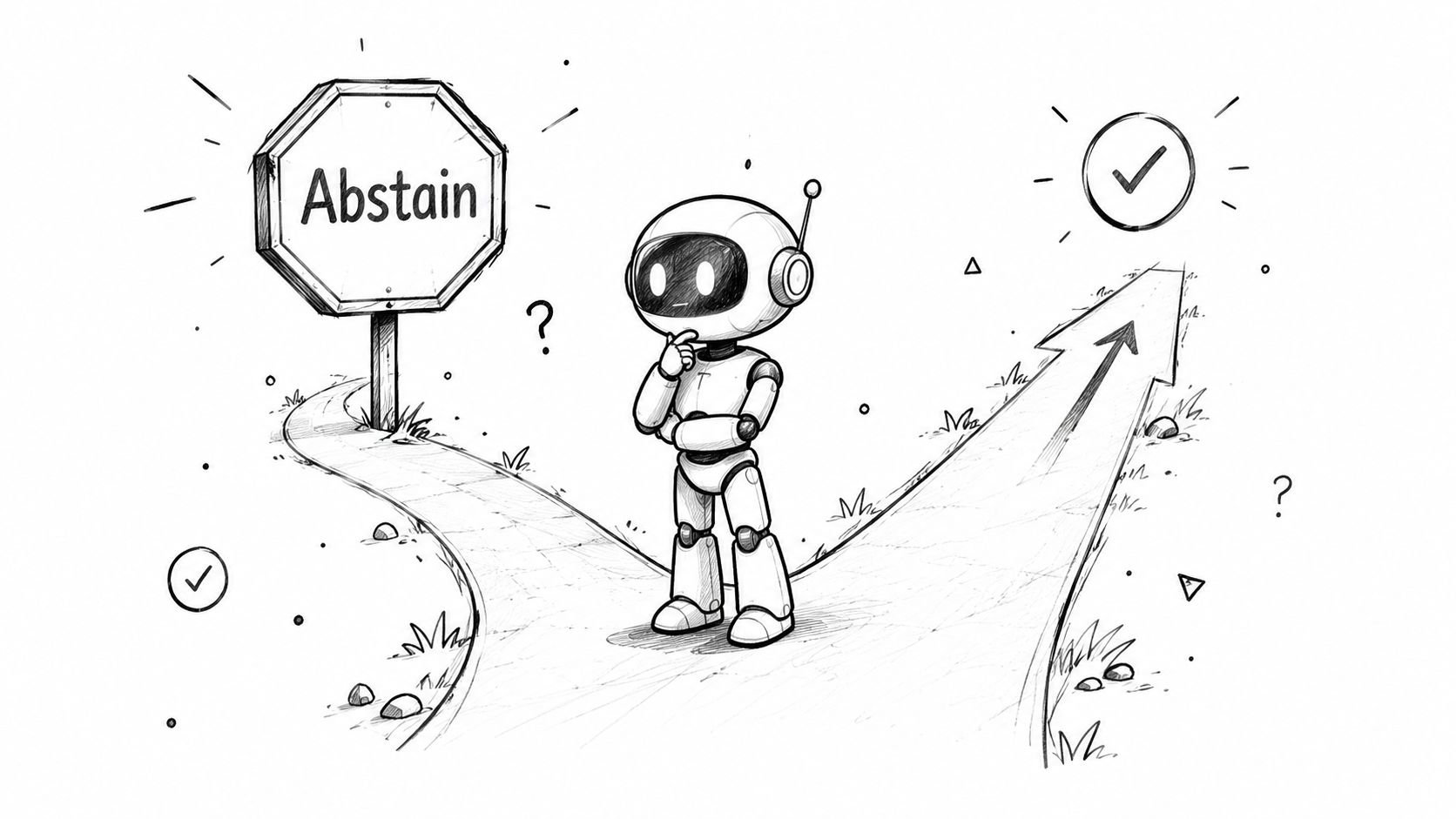
Many AI teams treat abstention as a defect because they optimize for response completion. That incentive produces the wrong behavior in systems where unsupported certainty is more damaging than an explicit limitation. Abstention is a valid infrastructure outcome when the system lacks authorized, current, or sufficiently relevant evidence.
Fail-closed grounding means the system doesn't deliver evidence unless retrieval authorization succeeds and the evidence meets the application's requirements. The model then operates inside a bounded context. If that context is empty or inadequate, the application can ask a clarifying question, state that it lacks the required information, or send the case to a human.
Authority before autonomy: Let the model propose an answer or action, but let authenticated policy and canonical state make the deciding move.
This principle changes how teams design customer support automation. The model may summarize an eligible refund policy and propose a response. It shouldn't infer a refund entitlement from a loosely related article, modify an account because the user sounded confident, or treat its own previous answer as authoritative state.
Engineer uncertainty instead of hiding it
A useful response policy distinguishes among several conditions:
- Supported: Evidence is authorized, relevant, and sufficient for the requested claim.
- Incomplete: Evidence exists, but a required fact or constraint remains unresolved.
- Conflicting: Eligible sources disagree or have incompatible versions.
- Unauthorized: Relevant material may exist, but the caller can't use it.
- Unavailable: The required retrieval, memory, or policy service failed.
Each condition can map to a controlled outcome. Incomplete requests can trigger clarification. Conflicting sources can trigger escalation. Unauthorized requests can receive a bounded refusal. Service failures can produce a retry or human handoff rather than a fabricated answer.
A fail-closed system still needs evaluation. Test denied retrieval, stale memory, prompt injection in documents, tool authorization failures, tenant switching, and contradictory evidence. Measure whether the application chooses the intended safe outcome, not only whether the generated prose sounds natural.
Evaluating Your AI Infrastructure Readiness
A readiness review should reveal whether the system is a model host or a verifiable production platform. Start with the request path, then inspect each authority boundary.
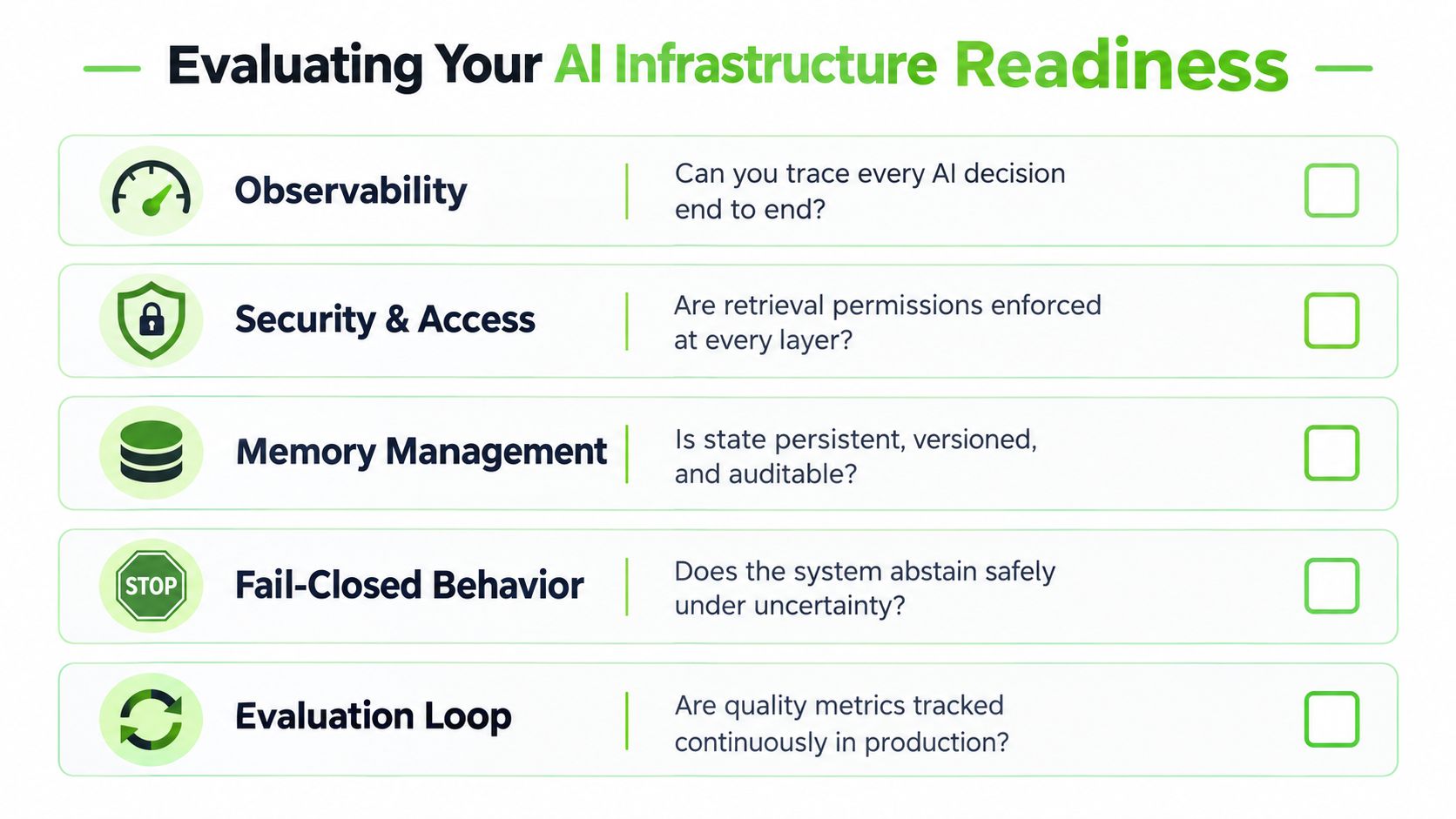
Ask these questions:
- Observability: Can engineers reconstruct the evidence, prompt assembly, policy decisions, tool calls, and final output for an individual response?
- Security and access: Are permissions enforced independently at retrieval, memory, tool, and agent-action layers?
- Memory management: Does every persistent fact have scope, attribution, versioning, correction, and expiry behavior?
- Fail-closed behavior: Does the application abstain or escalate when evidence is missing, contradictory, stale, or unauthorized?
- Evaluation loop: Do frozen tests cover grounding, intent resolution, cross-tenant isolation, policy enforcement, and action safety?
A useful review also checks the physical layer. Confirm that storage can feed workloads, network topology matches distributed communication patterns, and serving capacity is separated from control-plane dependencies. A fast model endpoint won't compensate for a policy service that fails open or a memory store that can't explain its writes.
Finally, document ownership. Someone should be accountable for model lineage, retrieval indexes, memory lifecycle, policy changes, evaluation results, and incident reconstruction. If those responsibilities are scattered across teams with no shared evidence model, the organization will struggle to determine whether a failure came from the model, the data, the authorization layer, or the orchestration path.
A production-ready AI stack makes its boundaries testable. It doesn't promise that models will never be wrong. It ensures that unsupported claims, unauthorized evidence, state drift, and unapproved actions have explicit controls and observable failure modes.
AletheionAGI offers GQueries for persistent memory, authorized retrieval, and fail-closed grounding, and IntentParse for converting user language into validated intent state with provenance. Visit AletheionAGI to evaluate how these composable layers can fit alongside your existing LLM, RAG pipeline, vector database, and memory systems.