Adding agents isn't a production strategy. It's a topology decision with consequences for latency, state consistency, authorization, observability, and failure containment.
The popular advice says to decompose a difficult task into specialized agents and let them collaborate. That works when the subtasks are independent. It breaks down when agents must preserve a strict sequence, share hidden assumptions, or retrieve data across tenant boundaries. In those systems, the difficult engineering problem isn't getting agents to communicate. It's deciding what they're allowed to know, which state is authoritative, and when the workflow must stop.
The Reality of Multi Agent Coordination in Production
The strongest argument against “more agents is better” comes from controlled evaluation rather than architectural taste. Google evaluated 180 agent configurations and found that coordination improved performance on parallelizable tasks but degraded it on sequential tasks. Their predictive model selected the optimal architecture for 87% of unseen tasks, which points to a practical conclusion: task structure should determine the architecture, not enthusiasm for agent swarms. The evaluation details include important limitations, including the controlled nature of the tasks and the fact that results don't automatically transfer to every production workload.
A parallelizable task has work that can proceed without waiting for another agent's intermediate reasoning. A support system might independently classify an issue, retrieve an order record, and check a documented policy before a final response agent synthesizes the authorized results. A sequential task is different. If step two depends on a validated result from step one, splitting the workflow introduces message passing, duplicated context, and more opportunities for state drift.
Practical rule: Add an agent only when it creates a meaningful boundary, such as independent execution, specialized tools, separate context, or an explicit approval stage.
Start with the dependency graph
Before choosing a framework, draw the workflow as a dependency graph. Mark each operation as one of three types:
- Independent work: Tasks can run concurrently and return typed results.
- State transition: The next operation requires a validated output from the previous one.
- Authority decision: A policy, permission, or canonical record determines what may happen.
The first category can benefit from multi agent coordination. The second usually needs a stateful handoff or a single controlled executor. The third shouldn't be delegated to an untrusted model, regardless of how many agents participate.
Coordination also adds operational overhead. Every message needs a schema, a recipient, a timeout policy, provenance, and a decision about whether failure is retried, ignored, or escalated. An orchestrator that merely forwards natural-language messages creates a distributed system with weak contracts. It may look flexible in a demo, but debugging becomes difficult when the final answer depends on several opaque intermediate decisions.
The practical target is not maximum autonomy. It's a bounded system whose useful work can be parallelized, whose state transitions are inspectable, and whose unsupported result is an explicit stop condition.
Foundations of Distributed Agent Systems
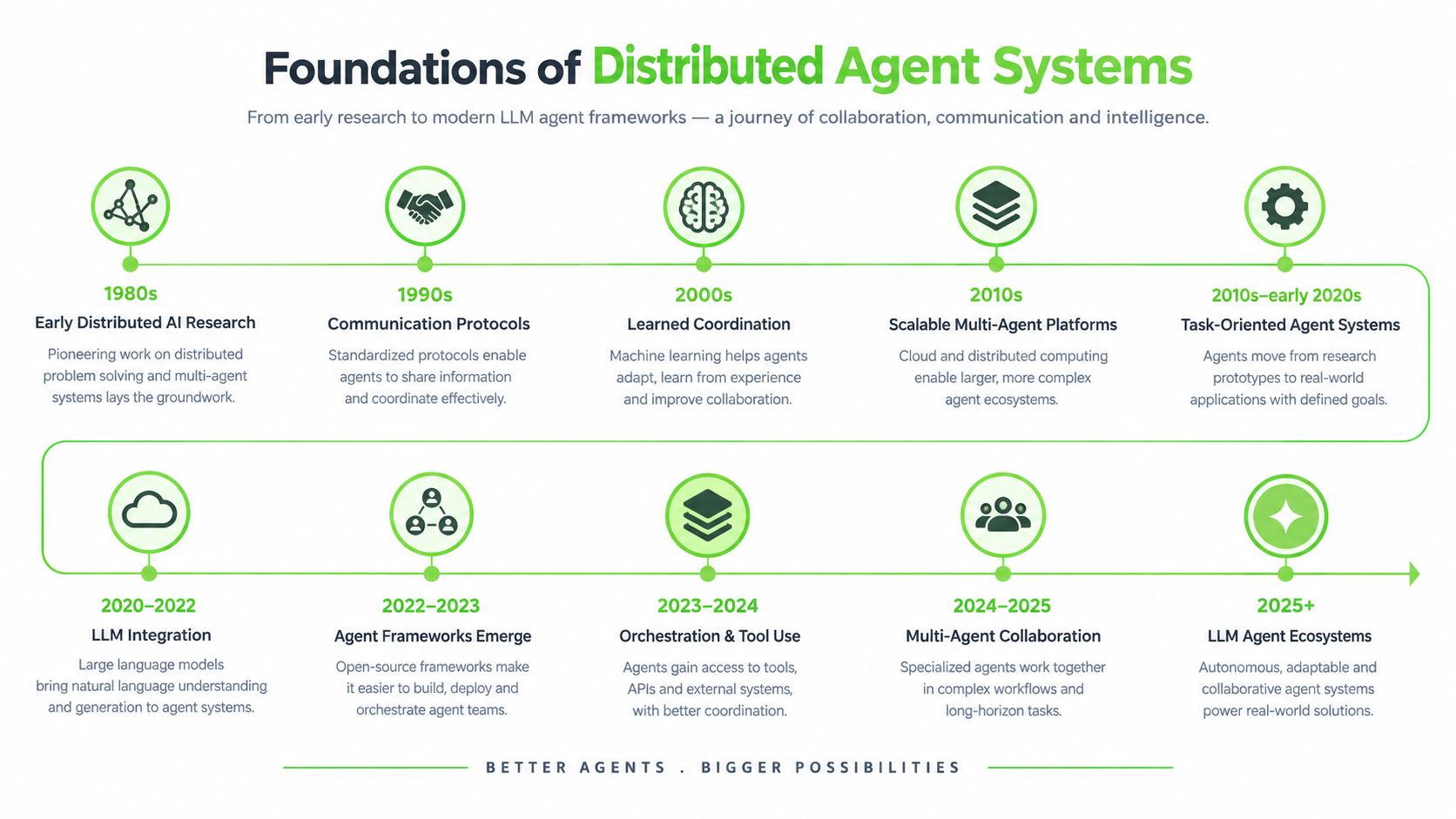
Contemporary LLM frameworks often present multi-agent coordination as a new application pattern. The underlying engineering problems are older. Distributed AI research developed foundational coordination mechanisms in the 1980s, including Contract Net in 1980 for hierarchical decentralized control, DVMT in 1984 for distributed interpretation, and MACE in 1987 for multi-agent platforms. The first international conference on multi-agent systems followed in 1995, and the Autonomous Agents + Multi-Agent Systems venue appeared in 2002. These milestones show how coordination moved from experimental concepts into a dedicated research community over roughly two decades. This historical overview of distributed AI and multi-agent systems provides the broader lineage.
The old questions still apply
A modern agent may use an LLM instead of a rule-based planner, but it still has to answer the same systems questions:
- What should be coordinated? Tasks, tools, memory reads, approvals, or state transitions?
- Why coordinate it? To reduce latency, isolate context, distribute ownership, or improve coverage?
- With whom? A supervisor, a peer agent, a human reviewer, or a policy service?
- How should coordination happen? Shared state, typed messages, event streams, or explicit handoffs?
A 2025 survey places multi-agent coordination across search and rescue, warehouse automation and logistics, transportation, humanoid and anthropomorphic robots, satellite systems, and large language models. Its four-question framing, what, why, with whom, and how, reflects the shift from simple task allocation toward broader system design across varied environments. The survey on multi-agent coordination is useful for mapping current application areas without assuming that one topology fits all of them.
The distributed-systems analogy is especially useful for memory. An agent that writes shared state is similar to a service writing to a shared datastore. An agent that consumes another agent's message is a downstream service accepting an event. If the system lacks ownership, versioning, access controls, and conflict rules, a more capable model won't remove the consistency problem.
Teams can also use curated multi-agent test results to compare how different coordination approaches are being evaluated. The valuable lesson isn't a single leaderboard result. It's the habit of asking what was measured, what the agents could observe, how state was shared, and where the evaluation stops representing the target production environment.
Designing Communication and State Sharing Protocols
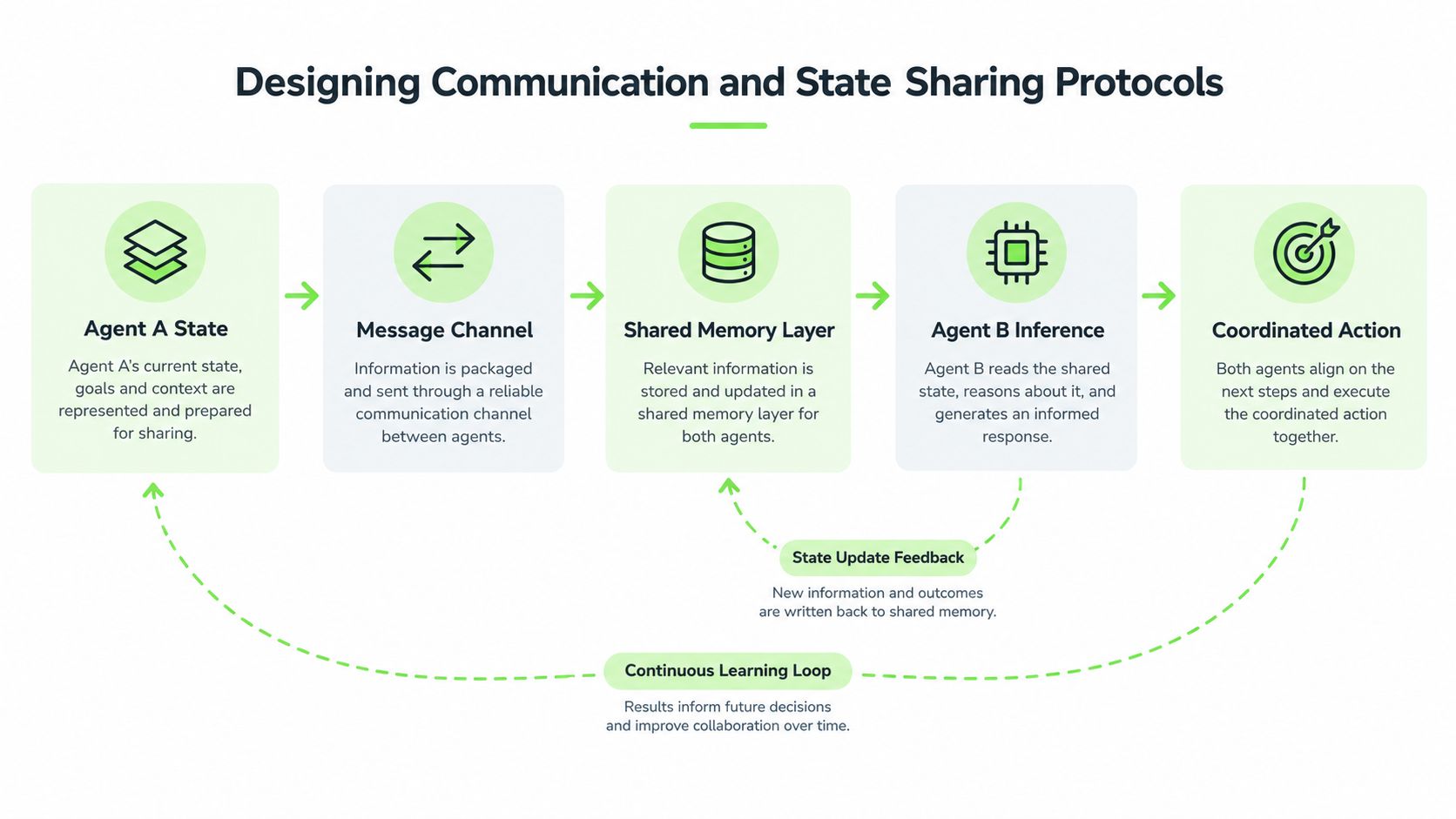
Long-horizon collaboration becomes fragile when agents can't observe one another's internal state. The AgentWorld benchmark evaluates 100 human-annotated tasks plus 100 augmented variants, with 3–20 agents coordinating over 25–55 rounds in a black-box setting where agents can't inspect one another's internal states. Its setup highlights a production problem: without shared state visibility, explicit roles, communication protocols, and intermediate-state constraints, coordination weakens as workflows become longer and more distributed. The AgentWorld study is a benchmark result, not a guarantee about every deployment. Its value is in exposing the conditions under which coordination becomes difficult.
Treat messages as contracts
A useful inter-agent message should contain more than a prompt and a response. Define a contract that includes:
- Role and recipient: Identify which agent produced the message and which agent may consume it.
- Intent reference: Tie the message to a structured request or workflow identifier.
- Claim set: Separate observed facts from interpretations and proposed actions.
- Evidence references: Include document identifiers, retrieval scope, timestamps, and provenance.
- State version: Make it possible to detect stale or conflicting updates.
- Action status: Distinguish proposed, authorized, executed, rejected, and escalated states.
This structure prevents an agent from treating a plausible paragraph as authoritative state. The downstream agent receives a bounded object that can be validated before it changes the workflow.
Use compact persistent state rather than repeatedly copying the entire conversation into every context window. Store the current objective, completed actions, unresolved questions, authorized evidence references, and the next permitted transition. Keep raw conversation history available for audit or targeted retrieval, but don't make every agent reconstruct the workflow from an unbounded transcript. Practical context design guidance is available in this article on AI context management.
Make transitions explicit
A state machine is often more reliable than a free-form conversation between agents. For a support workflow, states might include received, classified, evidence_pending, evidence_validated, response_proposed, policy_checked, and human_review. Each transition should specify its preconditions and failure behavior.
A message that fails schema validation should be rejected. A stale update should be quarantined or re-read against canonical state. A missing evidence reference should prevent the response agent from presenting a claim as verified. These controls may feel restrictive, but they turn hidden reasoning into observable system behavior.
The video below provides a visual treatment of communication and state-sharing mechanics:
Don't expose internal chain-of-thought to achieve state visibility. Expose structured intermediate state instead. A downstream agent needs to know what was established, what remains uncertain, which evidence supports the result, and what action is permitted. It doesn't need an unrestricted dump of another model's private reasoning.
Orchestration Strategies and Topology Trade-offs
Topology determines who can act, who can veto, and where failures become visible. A centralized orchestrator offers a clear control point, but it can become a bottleneck. A peer-to-peer mesh distributes responsibility, but conflict resolution and auditability become harder. A hierarchy can separate planning from execution, though each additional layer creates another boundary that must be authenticated and monitored.
| Topology | Control Level | Latency | Best Use Case |
|---|---|---|---|
| Centralized orchestrator | High | Predictable, with coordinator overhead | Parallel subtask execution, synthesis, approval gates |
| Decentralized peer-to-peer | Low to shared | Variable, depending on coordination traffic | Loosely coupled agents with explicit consensus rules |
| Hierarchical | High at policy layers, delegated at execution layers | Moderate to variable | Enterprise workflows with supervisors, specialists, and controlled escalation |
Centralized control
A centralized design places routing, aggregation, and often policy checks in one orchestrator. It's easier to trace because the orchestrator can assign correlation identifiers, enforce timeouts, reject malformed outputs, and maintain the workflow state. The trade-off is concentration of responsibility. If the orchestrator is overloaded or poorly designed, every agent inherits its latency and failure modes.
This topology works well when specialized workers can execute independently and return typed results. It works less well when the orchestrator becomes a second model that rewrites every message, makes undocumented policy decisions, and has no canonical state outside its context.
Peer networks
Peer-to-peer coordination can reduce dependence on a central router and may fit systems where agents own separate domains. It introduces difficult questions, though. Which agent resolves contradictory claims? How does an agent know that a peer is authorized to make a recommendation? What happens when two agents update the same state version?
Without deterministic conflict rules, peer autonomy becomes accidental authority. A peer should propose a result, not establish a business fact. Systems that use this topology need authenticated identities, message schemas, version checks, bounded retries, and a clear escalation path.
Hierarchical designs
Hierarchies separate responsibilities. A planner can define the work, domain agents can gather evidence, and a policy or approval layer can decide whether an action is allowed. This structure supports an authority-before-autonomy rule: models may propose actions, while authenticated policy and canonical state make the deciding move.
For teams designing event-driven workflows and data movement around agents, digna for data engineers offers relevant orchestration context. The same principle applies here: operational ownership must remain explicit even when the workflow contains autonomous components. A broader treatment of the surrounding platform concerns appears in this guide to AI infrastructure.
Memory Isolation and Authorization-First Retrieval
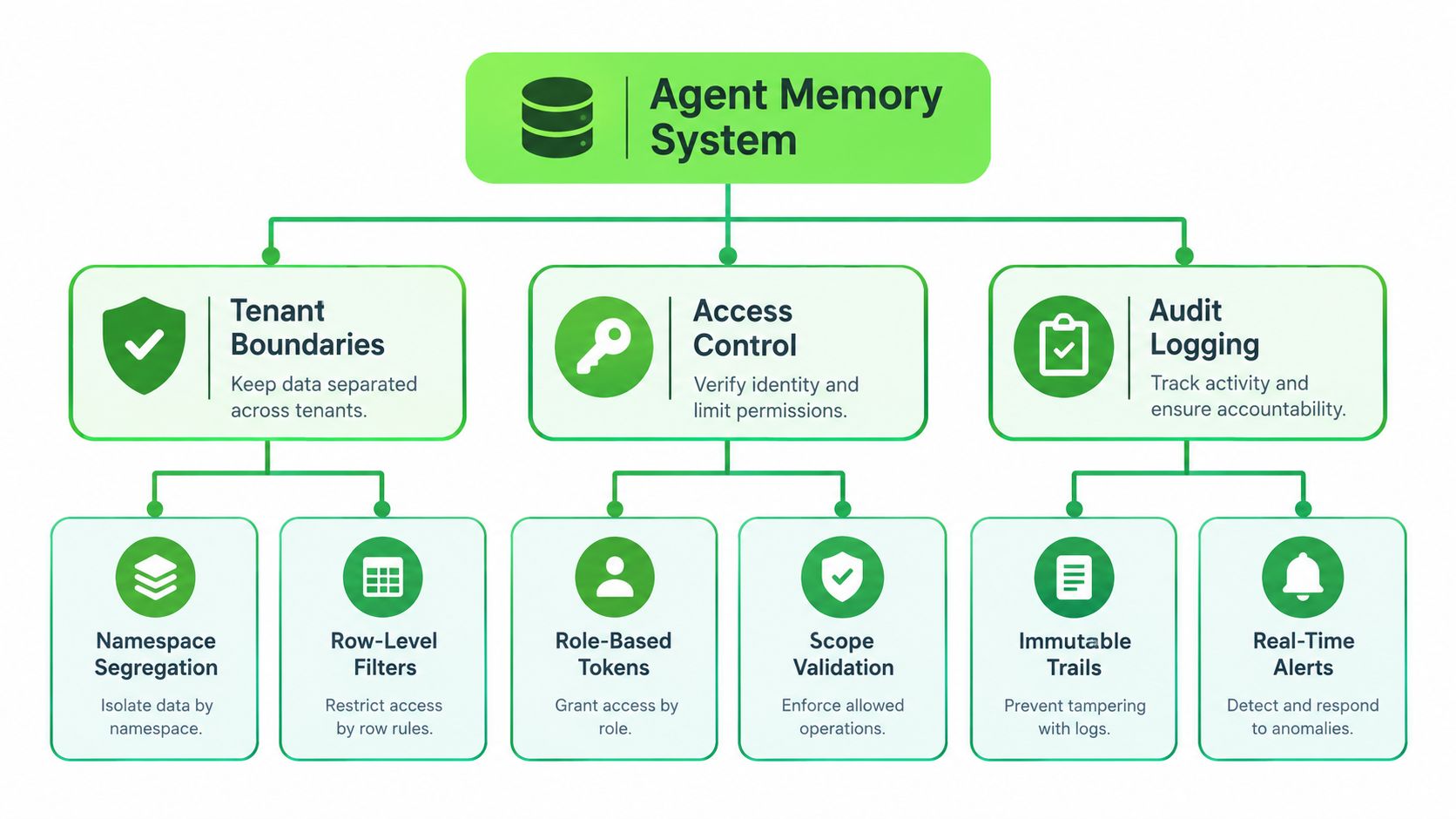
Shared memory is not automatically shared permission. In a multi-tenant system, a vector database, conversation store, cache, or agent scratchpad can become a cross-boundary leak if retrieval filters are applied too late. The model shouldn't receive unauthorized candidates and then be asked to ignore them. The system must prevent those candidates from entering the model's evidence set.
Amazon's Agentic AI Lens recommends partitioning memory by workload boundaries such as session, user, tenant, agent, or group. It also recommends namespace-scoped retrieval so cross-tenant data is blocked at both the application and authorization layers. The AWS memory guidance treats memory scope as an architectural control, not a prompt instruction.
Apply authorization before semantic retrieval
The retrieval order matters:
- Authenticate the principal and identify the tenant, user, agent, and workflow.
- Resolve the namespaces and records that principal may access.
- Apply authorization filters before vector similarity or other learned ranking.
- Retrieve candidates only from the permitted set.
- Preserve authorization metadata and provenance with each result.
- Fail closed when scope cannot be resolved or evidence is insufficient.
The ACL Anthology paper on authorization-first retrieval defines this as a pipeline property. For every user and query, the semantic retrieval candidate set must be authorization-constrained before any learned component consumes it. That is the least-privilege rule a RAG system needs when evidence may contain sensitive tenant data.
Isolate memory at every layer
Microsoft's guidance recommends isolating memory by user, agent, and tenant with deterministic controls such as ACLs, scoped tokens, and encryption in transit and at rest. It also says shared-memory architectures should enforce isolation down to the agent and user, with explicit tenant allowances. Microsoft's agentic memory safety guidance is especially relevant when multiple agents use one memory service.
Namespace labels alone aren't enough. Enforce scope in the API, datastore query, authorization service, cache key, and audit record. A response generator should receive evidence that has already passed permission checks. If the system can't prove that a candidate belongs in the context, it should return no evidence and route the request to clarification or review.
For enterprise retrieval architecture, this guide to RAG for enterprise provides useful context on treating retrieval as a governed system rather than a similarity-search feature.
Structured Intent and Evidence-Bounded Grounding
A vague request creates coordination problems before the first agent runs. “Fix my billing issue” could mean explaining a charge, cancelling a subscription, requesting a refund, or investigating unauthorized use. If a router forwards that sentence directly to several agents, each may infer a different objective and retrieve evidence for a different task.
Structured intent gives every handoff a stable contract. Capture the user's facts, constraints, preferences, unresolved questions, requested action, and provenance. Preserve uncertainty instead of forcing every field into a confident value. Downstream agents can then ask a targeted question or select a permitted workflow without filling gaps through inference.
Separate facts from proposals
A useful intent object distinguishes:
- Facts: Information the user stated or an authorized system record confirms.
- Constraints: Requirements such as account scope, product, date range, or approval status.
- Preferences: Tone, channel, urgency, or desired resolution.
- Unknowns: Missing identifiers, ambiguous ownership, or unresolved policy conditions.
- Proposals: Actions an agent suggests but has not authorized.
- Provenance: The source and processing step associated with each field.
This separation keeps a model-generated inference from becoming indistinguishable from a customer-provided fact. It also lets the orchestrator route only work supported by the current state. Store these distinctions in a versioned object, so later agents can identify which values changed and which evidence supports them.
Grounding must remain bounded by authorized evidence. If a customer asks whether a refund is allowed, the response agent should receive the relevant policy, account state, and authorization result. Evidence from another tenant, an unverified memory entry, or an expired workflow state cannot support the answer. If inputs conflict or are missing, the system should abstain or escalate. Treat that outcome as a controlled result that exposes an unresolved condition rather than a system failure.
Validate before consolidation
AWS guidance recommends layered validation for outputs, inter-agent messages, and consolidation. The layers include schema checks, policy enforcement, PII filtering, and grounding checks for high-stakes outputs before data reaches downstream agents. The AWS agent security guidance supports a practical implementation pattern: validate at every boundary, not only before the final response.
A validator can check whether:
- The message conforms to its declared schema.
- The sender is authorized for the requested operation.
- Claims have retrievable, in-scope evidence.
- PII is permitted for the recipient and task.
- Proposed actions match the current workflow state.
- The final wording exceeds the evidence or introduces unsupported certainty.
The model may draft the answer, but deterministic controls should decide whether it can be delivered. Grounding therefore operates as a control plane, not merely as a prompt enhancement. A response with no authorized evidence should be blocked, qualified, or escalated according to policy. Fail-closed behavior prevents an incomplete retrieval result from becoming a confident claim.
Implementing Secure Multi-Tenant Agent Workflows
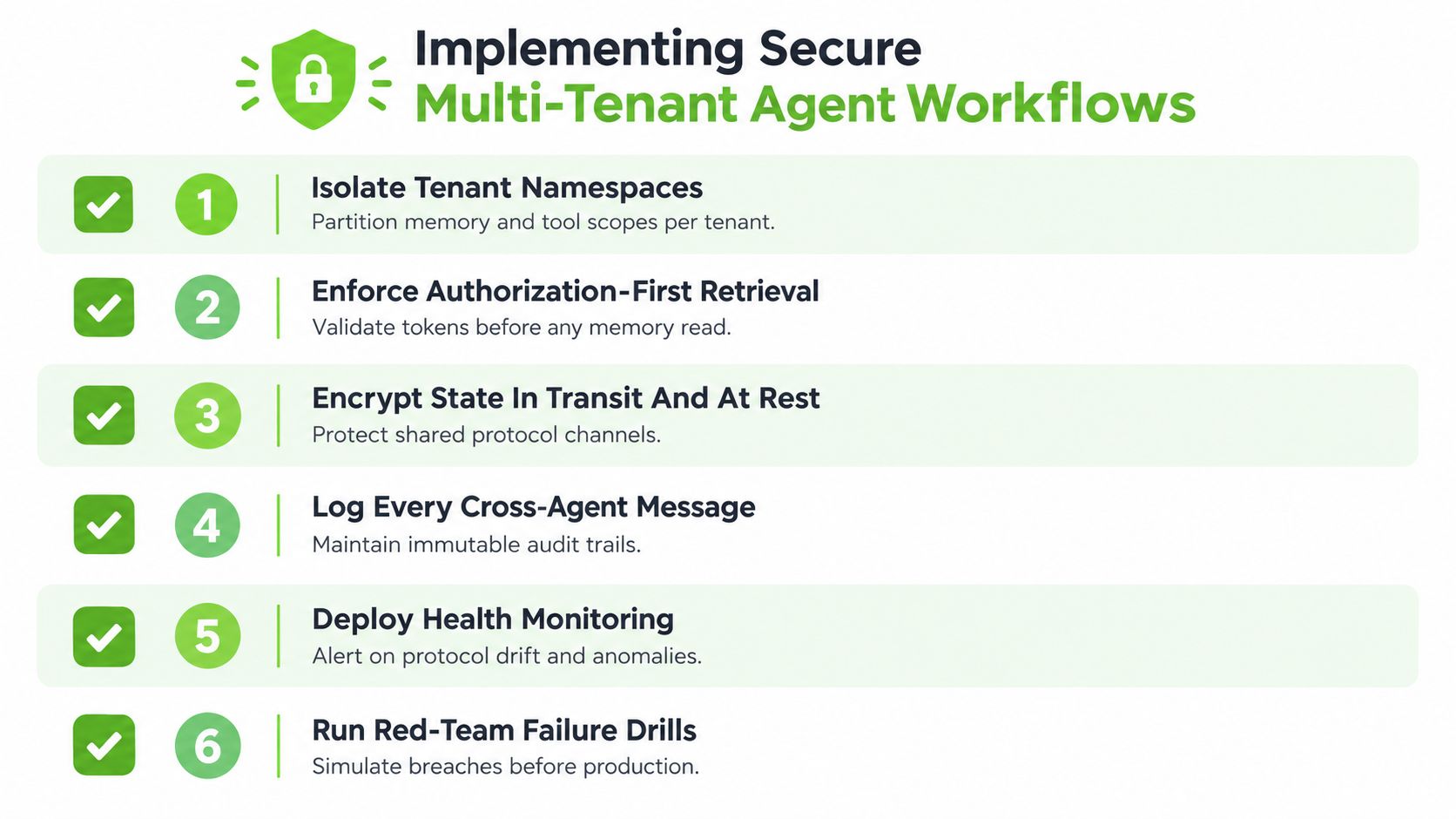
Consider a customer support assistant serving multiple SaaS tenants. A customer reports a duplicate charge and asks for a refund. The intake component first converts the message into structured intent, identifying the account context, billing issue, requested action, and unresolved need for transaction confirmation.
The router then assigns bounded work. One agent checks the authorized billing record, another retrieves the applicable refund policy, and a third prepares a response proposal. These agents don't receive the entire customer database or an unrestricted shared memory namespace. Each receives the minimum context and tool scope needed for its task.
A controlled execution path
The workflow can operate as follows:
- Resolve identity: Bind the request to an authenticated user, tenant, account, and session.
- Create intent state: Store facts, constraints, unknowns, and provenance in a versioned workflow record.
- Retrieve authorized evidence: Apply tenant and user permissions before semantic retrieval.
- Run independent checks: Fetch billing evidence and policy evidence in parallel where their dependencies allow it.
- Validate messages: Check schemas, sender permissions, evidence references, PII scope, and state versions.
- Apply policy: Let the model propose a refund, while policy and canonical billing state determine whether the action is allowed.
- Respond or escalate: Deliver an evidence-backed explanation, request missing information, or send the case to human review.
Test the boundaries, not just the happy path
Frozen evaluations should include attempts to retrieve another tenant's record, use an expired scope, reuse stale state, inject instructions into retrieved content, and force a response when the evidence is incomplete. Record the protocol version, model version, retrieval configuration, authorization decision, and final disposition so the result can be reproduced.
A production review should ask whether every cross-agent message is logged, whether failed authorization blocks retrieval rather than merely suppressing output, and whether an agent can trigger a side effect without an authenticated policy decision. Monitoring should surface protocol drift, repeated validation failures, unexpected namespace access, and unexplained escalation patterns.
The right architecture is inspectable by design. It makes memory boundaries explicit, keeps evidence provenance attached to claims, and treats abstention as a valid result. Multi agent coordination becomes useful when it distributes bounded work without distributing authority by accident.
AletheionAGI provides grounding and memory infrastructure for production AI, including authorized retrieval, structured intent handling, and fail-closed controls that work with existing LLMs, RAG pipelines, vector databases, and memory systems. If you're designing a multi-tenant agent workflow that needs evidence-bounded outputs and inspectable state transitions, visit AletheionAGI to evaluate how its infrastructure fits your architecture.