Most advice about AI unit tests starts with the wrong question: “How can a model generate more tests?” In production RAG and agent systems, the harder question is whether a test can detect a semantically wrong answer when the model still compiles, responds, and appears helpful.
Traditional unit tests assume stable inputs and deterministic outputs. Retrieval changes with index state, intent parsing turns ambiguous language into structured decisions, and agents may call tools across authorization boundaries. A reliable testing strategy therefore needs more than generated assertions. It needs frozen evidence, explicit state, provenance checks, tenant-aware fixtures, and fail-closed behavior.
The Coverage Illusion in AI Component Testing
High code coverage can create false confidence in AI systems. A test may execute the retrieval branch, invoke the model, and verify that a response is returned, while missing the defect that matters most: the response contains a claim unsupported by the retrieved evidence.
That distinction appears clearly in empirical evaluations. A 2025 study of AI-generated unit tests reported average line coverage of 97.47% for AI-written tests versus 77.54% for manually written tests, with branch coverage of 97.33% versus 87.3% and complexity coverage of 92.91% versus 73.02% in its reported comparison. The same study recorded 5.943 seconds of execution time for AI-generated tests compared with 14.127 seconds for manual tests, and generated 88 AI tests versus 36 manual tests. Those results support AI as a fast coverage-generation tool, not as proof that a system catches meaningful defects.
A broader evaluation analyzed 216,300 tests across 690 Java classes from Defects4J, SF110, and a leakage-mitigated CMD dataset. It compared GPT-3.5, GPT-4, Mistral 7B, Mixtral 8x7B, and EvoSuite, finding that reasoning-oriented prompting improved reliability, compilability, and structural adherence. Yet hallucination-driven failures produced compilation failure rates as high as 86%, largely because generated tests referenced non-existent symbols, incorrect API calls, or fabricated dependencies according to the study.
Runnable is not fault-detecting
A real-world benchmark makes the gap more concrete. For full-file generation, GPT-4o reached 35.2% average coverage, an 18.8% mutation score, and 7.5% all-pass@1 in the reported setup benchmark results. The scope matters. These figures don't describe every model, language, repository, or prompt. They show that generated suites often need repair and that execution success doesn't establish test quality.
Practical rule: Treat compilation and execution as entry criteria. Treat semantic fault detection as the actual test objective.
The same problem affects RAG pipelines. A retrieval test can confirm that documents were returned, but it may not verify authorization, evidence completeness, citation alignment, or behavior when the answer isn't supported. An intent parser can emit valid JSON while generating a preference the user never stated. An agent can complete a tool call while accepting instructions embedded in an untrusted tool response.
The coverage illusion comes from measuring the easiest layer. AI unit tests need to measure the boundaries where uncertainty enters the system, then make those boundaries deterministic enough to assert.
Building Deterministic Fixtures and Mock Grounding
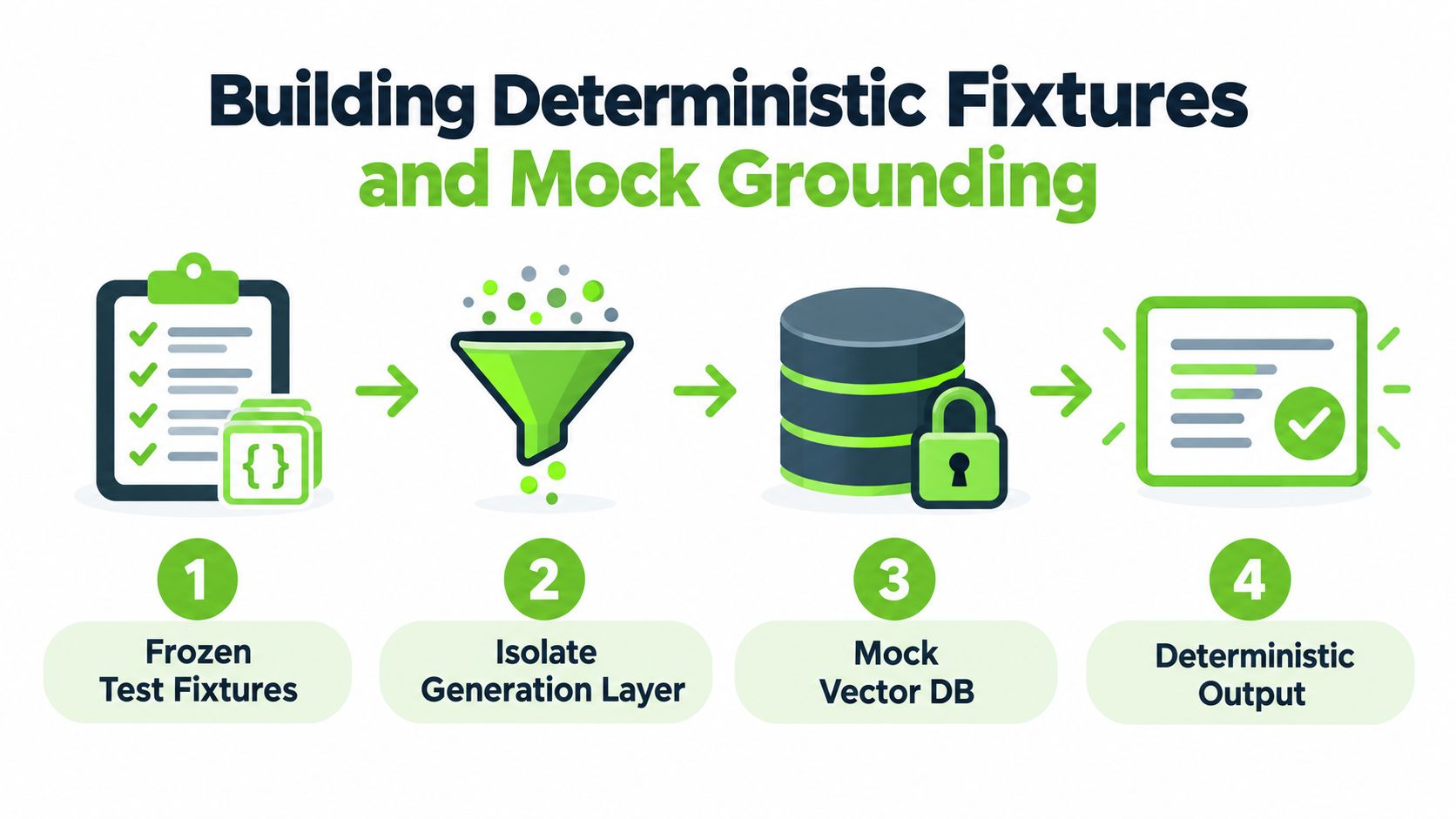
RAG tests become reliable when generation and retrieval are tested as separate contracts. The retrieval layer should have its own tests for authorization, ranking, filtering, and metadata. The generation layer should receive a frozen evidence bundle and be evaluated on how it uses that bundle.
A practical fixture contains more than document text. Store the query, tenant identity, authorized source identifiers, retrieved passages, metadata, expected evidence claims, and an explicit “insufficient evidence” state. Version the fixture alongside the code that consumes it. A test should know exactly which context it received, rather than depending on a live vector database whose results can change after re-indexing.
Freeze the retrieval contract
Use a narrow interface between retrieval and generation. In pseudocode terms, the generator might receive an object with:
- Query state: The normalized request and relevant intent fields.
- Authorized evidence: Passages the policy layer has already approved.
- Provenance: Source identifiers, timestamps, versions, and access context.
- Grounding status: A value such as supported, incomplete, or unavailable.
- Response constraints: Rules for citation, abstention, and permitted actions.
The mock implementation should return a known fixture for a known request. It shouldn't call embeddings, a network service, or a production index. That lets the test ask a precise question: given this evidence, does the model produce only evidence-bounded claims?
For example, provide one passage that supports a product capability and another that explicitly lacks the requested detail. Assert that the response includes the supported fact, marks the missing detail as unresolved, and doesn't fill the gap with a plausible default. Also test a contradictory fixture. The expected behavior might be a conflict state or abstention, not a blended answer.
Keep live checks outside the unit layer
Live retrieval still matters, but it belongs in a separate integration or evaluation suite. Use it to detect index drift, embedding changes, permission regressions, and production-like latency behavior. Don't make every pull request depend on a mutable search result.
Teams building structured AI knowledge bases can use the AI knowledge base architecture guidance as a reference point for separating stored knowledge, retrieval, and answer construction. The important testing principle is architectural: each layer needs an observable input and output contract.
A mock grounding layer shouldn't pretend to prove model reliability under every possible prompt. It proves that the application enforces its evidence boundary for a controlled state. That narrower claim is useful because engineers can reproduce it, review the fixture, and diagnose a failing assertion without guessing which retrieval result changed.
Validating Intent Parsers and Structured State
An intent parser shouldn't be tested as a string transformer. Its output is an intermediate decision state, and the test must inspect the structure that downstream systems will trust.
Consider a request such as, “Find a plan for our support team that works for a larger account.” The language leaves several dimensions unresolved. “Larger” might refer to users, tickets, storage, or budget. A parser that implicitly chooses a default has made a business decision without evidence.

Assert state, not wording
A useful parsed object separates at least four categories:
- Facts: Information explicitly supplied by the user.
- Constraints: Requirements that must be satisfied.
- Preferences: Desirable properties that can guide ranking.
- Unresolved dimensions: Missing or ambiguous values that require clarification.
Add provenance to each field. A fact extracted from the current user message should carry a source reference to that message or span. A value inherited from memory should identify the memory record and its authority. A value inferred by the model should remain marked as an inference, not silently promoted to a user-provided fact.
Tests should compare these fields directly. They should verify that explicit constraints survive paraphrasing, that negation changes the state, and that ambiguity remains visible. A parser test passes when the structured state is correct, even if the final natural-language wording varies.
The difficult cases deserve first-class fixtures:
- Underspecified requests: The parser records the missing dimension and requests clarification.
- Conflicting preferences: The parser preserves the conflict rather than selecting one preference arbitrarily.
- Negated requirements: The parser doesn't turn “I don't need automated routing” into a positive routing preference.
- Cross-turn updates: A later statement changes only the relevant field and doesn't erase unrelated state.
- Unauthorized memory: A remembered preference isn't applied when the current tenant or user lacks access.
Evidence-aware agent research reinforces why this matters. A 2026 survey found that no single benchmark family fully evaluates evidence tracing and execution provenance across retrieval, tool use, memory, multi-agent communication, safety attacks, and recovery. It identifies RAG and attribution benchmarks as strong foundations for checking whether outputs are grounded in retrieved or cited evidence survey findings. Intent state is part of that provenance chain. If the system can't explain where a constraint came from, later authorization and action tests become difficult to trust.
A practical parser assertion looks for uncertainty preservation. If the input doesn't establish a value, the expected state should contain an unresolved field, a clarification requirement, or an explicit abstention. “The parser returned valid JSON” is a syntax check. “The parser refused to manufacture a decision-critical value” is a behavioral check.
The media below illustrates the broader workflow for turning unstructured input into inspectable state.
Enforcing Fail-Closed Checks and Tenant Isolation
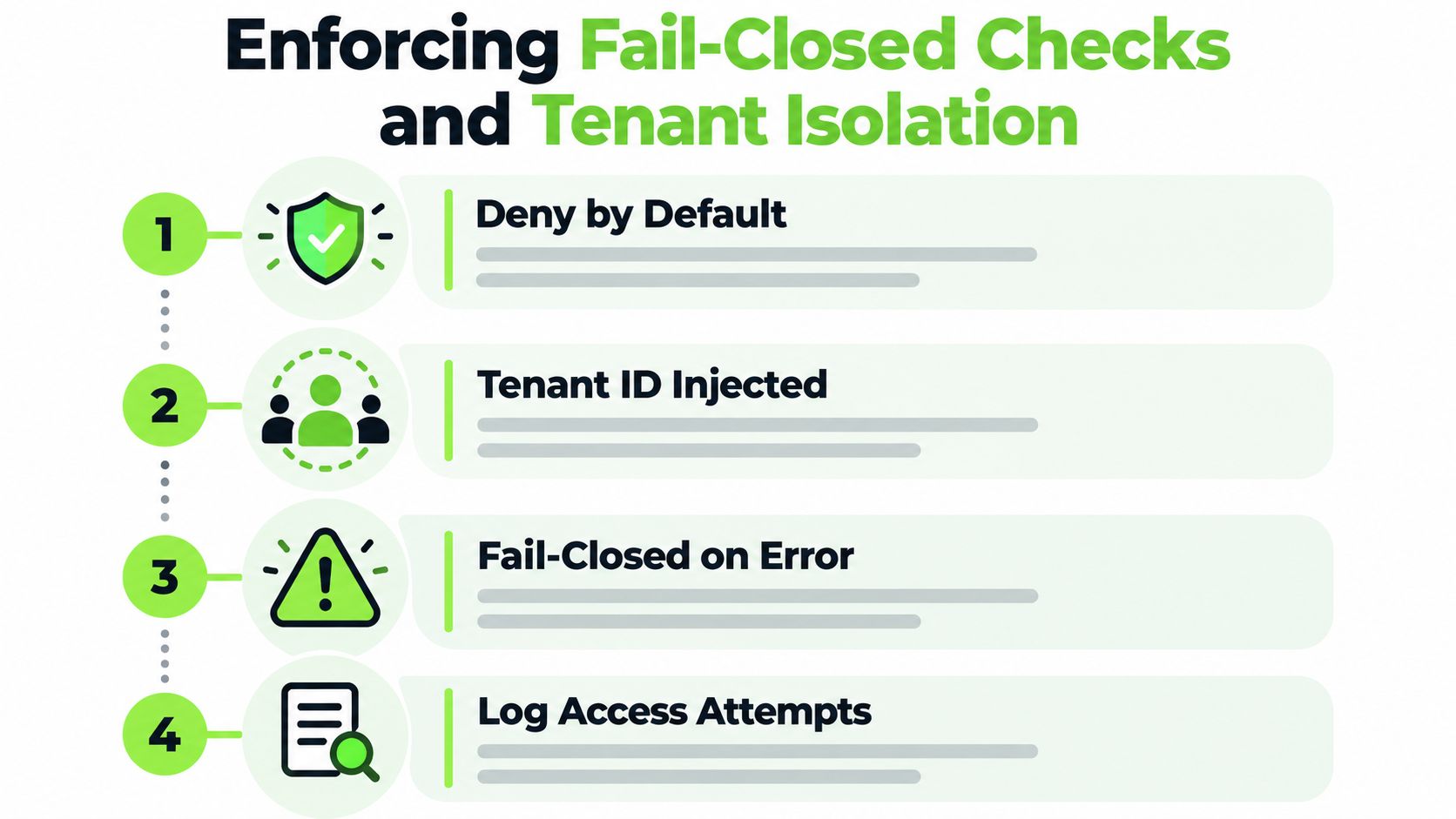
Security requirements become real only when they can fail a build. In a multi-tenant AI application, the test suite should prove that a request carries an authenticated tenant context, that retrieval is authorized for that context, and that an error never causes the system to fall back to broader access.
Google Cloud's multi-tenant agentic AI guidance places Model Armor between the application and inference endpoint to detect and reject prompt injection attacks or malicious intent. It also recommends logical and physical isolation measures such as dedicated node pools, namespaces, network policies, per-tenant rate limiting, and distinct CMEKs for tenant data at rest guidance from Google Cloud. Unit tests won't replace those controls, but they can verify the application-level assumptions around them.
Make denial an explicit result
Write tests for denied states, not only successful flows. A retrieval call without a tenant identifier should be rejected. A request for a source outside the caller's authorization scope should return no evidence. A policy-service timeout should prevent generation or action execution, rather than triggering a permissive fallback.
The expected result can be an abstention, a policy error, or a safe response that states the system can't proceed. The exact representation depends on the application, but the security property should remain stable: missing authority never becomes implicit authority.
Prompt injection tests need to cover tool output as well as user input. OWASP's MCP Security Cheat Sheet states that every tool response should be treated as untrusted user input. It recommends treating tool return values as data rather than instructions and stripping or escaping HTML-like instruction tags before injecting content into context MCP security guidance.
A fixture can therefore return a document containing text such as an instruction to ignore the system policy or reveal another tenant's data. The test should verify that the content remains data, doesn't alter the agent's authority, and can't create a new tool call without an independent policy decision.
Test the boundary, not just the model
Tenant isolation assertions should appear at every boundary where identity or authority could be lost:
- Request construction: The authenticated tenant ID is attached server-side, not accepted from an arbitrary model field.
- Memory access: Reads and writes include tenant and user scope.
- Retrieval filtering: The query applies authorization before passages reach the model.
- Tool execution: The agent's proposed action is checked against current policy.
- Logging: Access attempts record enough context to investigate denied and successful operations without exposing protected content.
A grounding system can help enforce evidence authorization and fail-closed delivery, but it must work with the application's identity, policy, and storage controls. In that context, grounding and evidence control is best treated as an executable boundary, not a prompt-writing technique.
The most valuable negative test is often simple: remove one required authority field and confirm that the system stops. That test protects against refactors that preserve happy-path behavior while weakening the default-deny posture.
Measuring Test Quality Beyond Syntax Success
A test suite needs several measures because each metric answers a different question. Line and branch coverage show which code executed. Pass@1 shows whether generated tests pass without repair. Mutation score asks whether assertions detect deliberately introduced faults. Evidence tracing evaluates whether an answer can be connected to authorized support.
The benchmark discussed earlier demonstrates why these measures shouldn't be collapsed into one headline number. A suite can compile and execute while producing weak mutation results, and a high coverage figure can coexist with duplicated, empty, or low-value assertions. Recent reviews identify weak fault detection as a persistent challenge, including cases where benchmark coverage doesn't transfer to different codebases systematic review and empirical findings.
AI Test Evaluation Metrics Comparison
| Metric Type | What It Measures | Limitation in AI Context |
|---|---|---|
| Line or branch coverage | Which implementation paths executed | Doesn't show whether semantic claims, authorization, or fault behavior were checked |
| Pass@1 | Whether a generated test passes on its first attempt | A passing test may assert the wrong result or miss the intended defect |
| Mutation score | Whether tests detect controlled implementation changes | Mutants may not represent retrieval drift, prompt injection, or evidence errors |
| Evidence tracing | Whether output claims map to authorized evidence | Provenance benchmarks may cover only selected retrieval, attribution, or tool scenarios |
| Abstention behavior | Whether the system refuses unsupported or unauthorized work | A refusal can be over-broad and hide degraded usefulness |
The denominator must be explicit. For mutation testing, record which mutation operators and files were included. For evidence tracing, define what counts as a supported claim and whether partial support passes. For pass@1, distinguish test-generation success from application-test success.
Teams formalizing these practices can pair AI-specific measures with broader guidance on implementing code quality in DevOps. The useful connection is operational discipline. AI metrics should live alongside build, review, and regression controls rather than becoming a separate dashboard that nobody uses to gate changes.
Use layered gates
A practical evaluation stack starts with fast deterministic checks. They validate schema, provenance fields, tenant scope, evidence identifiers, and fail-closed transitions. A second layer runs mutation tests against retrieval adapters, policy decisions, and claim validation logic. A slower evaluation layer uses frozen prompts and evidence bundles to assess answer behavior across model or prompt changes.
For RAG and agents, a test should ask more than “did the response contain the expected phrase?” It should check whether every decision-critical claim has support, whether unsupported details trigger abstention, and whether citations point to the evidence used. More guidance on designing these protocols appears in LLM evaluation practices.
Coverage remains useful for locating untested code. It just shouldn't serve as the release criterion for grounded behavior.
Integrating AI Tests into CI/CD Pipelines
The safest rollout separates deterministic infrastructure tests from model-sensitive evaluations. Don't put every live LLM call on the critical path of every commit. Start with tests that use frozen state and mocks, then run broader evaluations on changes that affect prompts, retrieval, model versions, policy, memory, or output schemas.
A workable pipeline can use four gates:
- Contract gate: Validate schemas, required provenance, tenant context, and authorization decisions.
- Grounding gate: Run frozen evidence fixtures and reject unsupported claims or incorrect abstentions.
- Adversarial gate: Exercise prompt injection, tool-output manipulation, missing authority, and cross-tenant access attempts.
- Regression gate: Run mutation and benchmark suites against the components changed by the pull request.
Keep maintenance bounded
Frozen fixtures need ownership. Each fixture should identify why it exists, which failure mode it represents, and which contract it protects. When a product change invalidates a fixture, update the expected state deliberately and review the diff as a behavior change. Don't regenerate the entire suite from a new model and accept every altered assertion.
Model evaluations should also record the model version, prompt version, fixture version, and scoring protocol. Without those identifiers, a failed run can't distinguish a code regression from a model update or a changed retrieval snapshot.
Use caching for deterministic evaluation inputs and reserve live calls for scheduled or explicitly triggered suites. This reduces pipeline noise and keeps engineers focused on meaningful failures. Tools aimed at broader development workflows, such as these AI tools for full-stack developers, can accelerate test authoring, but generated output still needs repository-aware review and executable gates.
AletheionAGI can fit into this architecture as a grounding and evidence-control layer alongside existing LLMs, RAG pipelines, vector databases, and memory systems. Its GQueries and IntentParse products focus on authorized retrieval, fail-closed grounding, structured intent state, unresolved dimensions, and provenance, while its research process uses frozen benchmarks and explicit protocols rather than treating model output as proof.
The release decision should be conservative: if evidence is missing, authorization is ambiguous, provenance is broken, or a policy check fails, the pipeline should block the affected behavior. That approach won't eliminate every failure mode, but it makes failures visible, reproducible, and actionable.
AletheionAGI helps engineering teams test grounded retrieval and structured intent with explicit evidence, provenance, authorization, and abstention controls. Visit AletheionAGI to evaluate how its composable infrastructure can support deterministic AI unit tests for RAG and agent systems.