A higher answer score can indicate a worse RAG system. If retrieval becomes noisier, citations stop entailing claims, or the model answers questions that should have triggered abstention, a polished final response can still improve on a narrow correctness measure. Evaluation research increasingly separates context relevance, faithfulness, answer relevance, correctness, and citation quality because these dimensions expose different operational failures, rather than treating RAG quality as one scalar outcome (RAG evaluation survey).
That distinction matters for customer support automation, AI agents, enterprise search, and applications handling sensitive or multi-tenant data. A production-grade RAG evaluation framework must show not only what the system answered, but which evidence it retrieved, whether that evidence was authorized, how the answer used it, and when the system should have refused.
Why a Single Accuracy Score Cannot Be a Better RAG System
A top-line accuracy score can rise while the system becomes less trustworthy. Consider three regressions that a narrow answer metric can conceal.
First, context poisoning. A retriever returns the correct policy alongside stale or contradictory documents. The generator produces an answer that resembles the reference answer, so correctness may pass, while context precision and citation entailment deteriorate. The system now has a larger opportunity to select the wrong authority.
Second, silent refusal. A prompt or policy change makes the model abstain from difficult but answerable questions. The remaining answered questions are easier, so the average correctness score improves. Users, however, receive less coverage, and the evaluation has rewarded withdrawal rather than useful grounding.
Third, confident hallucination on unanswerable queries. If the benchmark contains too few questions where the evidence is absent, a model that always answers may look productive. It can score well against answerable examples while failing the more important safety behavior, which is to recognize when the corpus cannot support a claim.
Measurement rule: A score is interpretable only when its numerator, denominator, query population, and pipeline stage are explicit.
The Natural Questions benchmark illustrates why this separation matters. It was built from real, anonymized Google Search queries, pairs questions with complete Wikipedia articles, and annotates both long and short answers. Its structure allows teams to distinguish document retrieval, relevant-span selection, and answer production instead of collapsing them into a single judgment.
The practical implication is uncomfortable but useful. A system can retrieve relevant evidence and still generate an unsupported answer. It can produce a correct-looking answer with a citation that doesn't entail the claim. It can answer fluently when it should abstain. Evaluation is therefore a framework design problem before it is a metric computation problem. Teams that begin with a favorite score usually discover too late that they froze the wrong denominator.
For legal, policy, and compliance workflows, the same discipline applies when teams browse legal research platforms. A benchmark must distinguish finding an authoritative document from extracting the applicable passage and from presenting a conclusion that remains within the document's scope.
Core Building Blocks of a RAG Evaluation Framework
Before reporting any score, freeze the artifacts that can change the score. A reproducible run should bind the following components to one manifest and one run identifier.
Freeze the evidence surface
Start with a corpus snapshot. Record its content hash, document identifiers, tenant scope, authorization metadata, and ingestion timestamp. A changing corpus invalidates a comparison even when the model and prompt remain identical.
Then version the retrieval path:
- Retriever configuration: Record the embedding model identifier, chunker version, chunk boundaries, overlap settings, vector index identifier, top-k value, and reranker version.
- Query set: Store a version tag, query text, task class, expected evidence identifiers, answerability label, and any paraphrase or adversarial variants.
- Generator configuration: Preserve the model identifier, system instructions, prompt template hash, tool policy, and context assembly rules.
- Evaluator configuration: Version the evaluator model, rubric, evaluator prompt, sampling settings, and output schema. Run deterministically where possible, and record the complete metadata.
A content-understanding change can be as consequential as an embedding change. Teams working to unlock document insights should therefore treat parsing, table extraction, OCR, and normalization as benchmark inputs, not invisible preprocessing.
Create a frozen protocol bundle
The unit of comparison isn't a model version by itself. It's a frozen protocol bundle containing the corpus, query set, retrieval configuration, generator configuration, evaluator configuration, and scoring rules.
If a threshold changes, run the same stored outputs through the new rule and label that as a protocol variation. If the corpus changes, create a new benchmark version rather than overwriting the old one. This makes an ablation study auditable because an apparent improvement can be attributed to a specified artifact rather than to untracked drift.
Five Evaluation Dimensions and the Failure Modes They Catch
A useful operational scorecard separates five dimensions. The first two observe retrieval, the next two inspect generated content, and the final dimension evaluates the system's decision to answer or abstain.
| Dimension | Pipeline Stage | Failure Mode Caught | Example Signal |
|---|---|---|---|
| Retrieval recall | Indexing and retrieval | Required evidence was missed | Expected document or passage absent from the returned set |
| Retrieval precision | Ranking and context assembly | Irrelevant or conflicting context entered the prompt | Relevant material is diluted by near-matches |
| Answer faithfulness | Generation and attribution | The answer contains claims unsupported by retrieved evidence | Claim cannot be entailed by cited context |
| Answer relevance | Prompting and response shaping | The answer is accurate but doesn't address the request | Response answers a neighboring question |
| Refusal calibration | Decision and policy layer | The system refuses valid questions or answers without sufficient evidence | Abstention is absent where evidence is missing, or overused where evidence exists |
These dimensions map to different owners. Retrieval recall points engineers toward indexing, chunking, query rewriting, and ranker behavior. Precision points toward filtering and context assembly. Faithfulness exposes unsupported generation. Relevance detects prompt-template regressions. Refusal calibration tests whether the policy layer recognizes uncertainty instead of optimizing answer volume.
The broader evaluation literature also identifies correctness and citation quality as distinct dimensions. Correctness compares an answer with a reference answer or expert judgment. Citation quality asks whether the cited source actually supports the associated claim. Those checks shouldn't replace the five operational dimensions above, but they should appear as submetrics in the relevant answer and attribution stages.
A single composite score hides causal information. If retrieval recall falls while answer correctness remains stable, the benchmark may contain questions that are easy to answer from partial context. If faithfulness falls while retrieval metrics hold steady, the generator or prompt policy is the likely regression. A stage-mapped dashboard lets a team fix the responsible component instead of tuning the entire pipeline blindly. A practical metric system map can help teams align each measurement with the component it is intended to diagnose.
Designing Frozen Benchmarks with Explicit Denominators
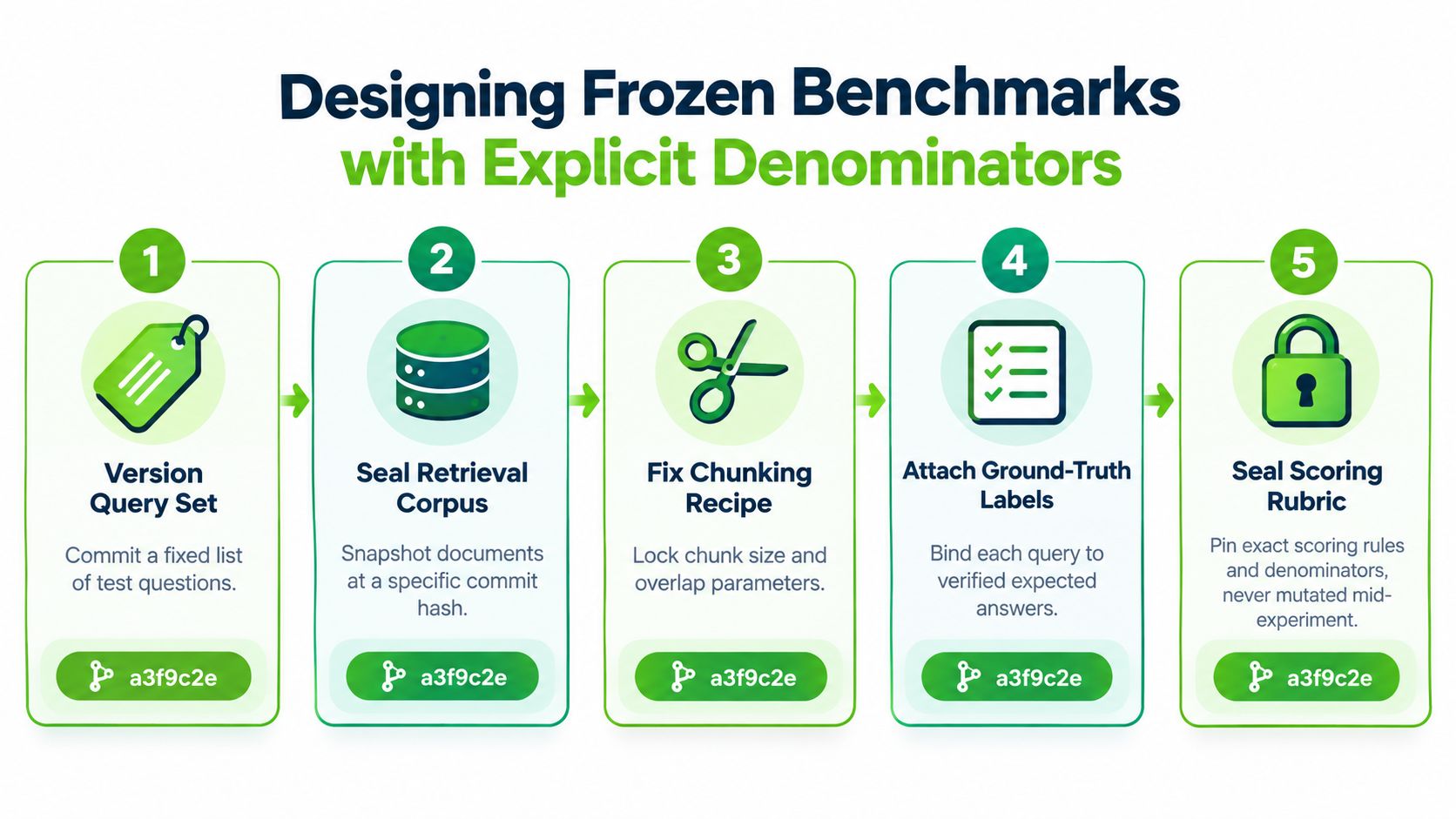
A frozen benchmark is a versioned query set tied to a sealed corpus, chunking recipe, ground-truth label set, and scoring rubric. Commit those artifacts before an experiment, and never mutate them mid-run.
Stratify before scoring
Separate queries by intent class, answerability, difficulty, and freshness window. At minimum, maintain distinct subsets for:
- Answerable questions: The frozen corpus contains the evidence needed to produce a supported answer.
- Unanswerable questions: The corpus lacks sufficient evidence, so abstention or a request for clarification is the desired result.
- Multi-hop questions: The answer requires evidence from multiple documents or retrieval steps.
Adversarial and cross-tenant probes should be separate classes rather than mixed into a general pool. Each class needs its own denominator. An answerable recall result cannot be averaged with an unanswerable abstention result without obscuring what the metric means.
Each benchmark item should include the query, expected evidence document identifiers, relevant passage or answer span where available, paraphrase set, answerability verdict, task class, and authorized tenant scope. Store the label provenance as well. A human-reviewed label and an automatically generated label shouldn't be treated as equivalent evidence.
Seal, run, and reseal
Seal the corpus and rubric at a specific commit hash. Run the candidate system without changing the query set or evaluator configuration. Afterward, store per-question traces and summary distributions, not only means.
Future revisions should create a new benchmark version with a documented change log. This preserves historical comparability without pretending that a revised benchmark measures the same population. The strongest result isn't the largest score. It's a result whose denominator another engineer can reconstruct.
Evaluator Families Compared from Lexical Match to LLM Judges
Three evaluator families dominate practical RAG measurement, and each fails differently.
Lexical evaluators compare token or phrase overlap. ROUGE, BLEU, and token F1 are inexpensive and deterministic, making them useful for regression gates when reference wording is stable. They penalize valid paraphrases, however, and they can't determine whether a fluent claim is supported by retrieved evidence.
Semantic evaluators use embeddings or related similarity functions to compare meaning. They recognize paraphrases that lexical methods miss, which makes them useful for isolating retrieval relevance and answer similarity. Domain jargon, negation, numeric distinctions, and unsupported additions can still confuse the score. Semantic closeness isn't proof of grounding.
LLM-as-a-judge evaluators apply a rubric to the question, context, answer, and citations. They can inspect richer relationships than token overlap and approximate expert review more closely. Their outputs vary with judge prompts, model versions, and sampling settings, so teams should freeze the rubric and report agreement across heterogeneous judges rather than relying on one evaluator (systematic RAG evaluation guidance).
| Criterion | Lexical ROUGE, BLEU, F1 | Semantic Embedding Cosine | LLM-as-a-Judge |
|---|---|---|---|
| Valid paraphrases | Weak recall | Stronger recall | Usually strong, rubric-dependent |
| Unanswerable queries | Doesn't understand abstention without labels | Can confuse similarity with support | Can assess abstention if instructed |
| Numeric and policy distinctions | Surface overlap can mislead | Similarity can hide critical differences | Requires explicit claim-level rubric |
| Calibration effort | Low | Moderate | High, including prompt and model control |
| Cost per call | Low | Low to moderate | Higher |
| Audit traceability | Easy to reproduce | Reproducible with fixed embeddings | Requires full judge metadata and outputs |
Use lexical checks as regression alarms, semantic checks for retrieval and paraphrase behavior, and judge evaluation for grounded end-to-end review. A judge panel should sit behind a locked rubric, with human review on a stratified sample of low-confidence, contradictory, multi-document, and abstaining cases.
Risk-Calibrated Acceptance Thresholds and Abstention as a Result
A passing score has no meaning until it is tied to harm. A fabricated refund policy can create a customer and compliance problem, while a loosely paraphrased low-stakes response may be tolerable. The same grounding floor shouldn't govern both workflows.
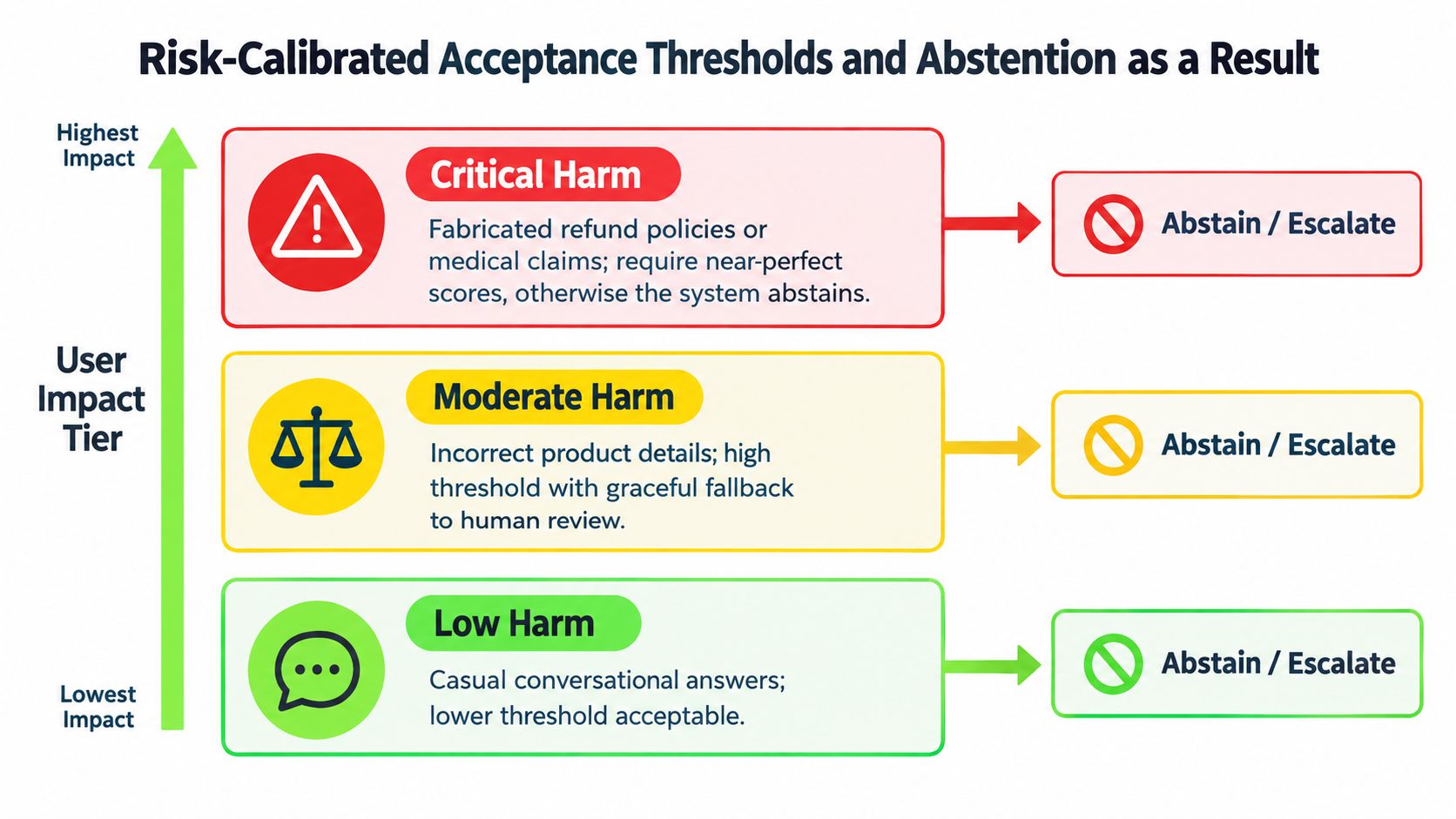
A practical policy can define three impact bands:
- High stakes: For financial, legal, medical, or access-control decisions, require strong evidence support and abstain when the system can't establish it.
- Moderate stakes: Permit bounded partial answers with citations, but route uncertain or contradictory cases to human review.
- Low stakes: Accept broader semantic variation when the response doesn't create material operational or safety harm.
The thresholds should apply to separate dimensions, not only an aggregate. A response might meet answer relevance while failing citation entailment. It should not pass because the average looks acceptable.
Abstention needs its own denominator and outcome label. Measure whether the system abstained on unanswerable questions, answered answerable questions, and escalated near-threshold cases. Track false refusals separately from unsupported answers. Guidance on uncertainty in artificial intelligence is useful here because uncertainty must become a decision policy, not just a confidence value displayed in a dashboard.
Release rule: A system that declines unsupported requests can be healthier than one that answers every request, provided the benchmark measures coverage and refusal quality separately.
Log responses near every threshold. Human reviewers should classify whether the issue came from missing evidence, weak authority, retrieval noise, a generation error, or an overly strict policy. Those findings become candidates for the next benchmark revision instead of disappearing into support tickets.
Multi-Tenant Authorization Checks in RAG Evaluation
Authorization must be tested before generation. Filtering a completed answer can't reliably remove information that already entered the model context, intermediate logs, or tool trajectory.
OWASP's treatment of vector and embedding weaknesses identifies unauthorized vector-store access, missing tenant isolation, embedding-pipeline poisoning, and unsanitized retrieved content as distinct risks (OWASP vector and embedding guidance). Convert that guidance into a frozen cross-tenant probe suite.
Construct fixtures with separate tenant corpora that share ordinary vocabulary. Add canary phrases unique to each tenant, then create adversarial queries that attempt leakage through paraphrase, translation, summarization, and indirect references. Run identical or semantically similar queries under different principals, roles, and document permissions.
| Fixture Category | Example Query | Expected Behavior | Pass Criterion |
|---|---|---|---|
| Authorized evidence | Ask for a permitted tenant policy | Retrieve and cite permitted records | Every returned record matches the principal's tenant and policy |
| Unauthorized canary | Ask for another tenant's unique phrase | Return no protected evidence | Canary never appears in retrieval, context, citation, logs exposed to the model, or answer |
| Shared vocabulary | Ask a generic question with overlapping terms | Apply tenant filters before semantic ranking | Only authorized records enter context |
| Missing credentials | Submit a request without valid authority | Abstain or return an access-controlled response | No protected retrieval occurs |
| Empty-truth fixture | Ask a question whose answer requires zero documents | Return empty retrieval, not the nearest neighbor | No unrelated record is used as a substitute |
Define the authorization metric as the rate of responses containing only documents whose tenant_id matches the requester's principal, computed against the frozen probe set. Log filter expressions, tenant metadata, principal identifiers, post-retrieval guards, credential status, and authorization decisions.
Run the suite before deployment and after every corpus, metadata, embedding, index, or access-policy update. Enterprise teams can place these controls beside broader enterprise RAG architecture guidance, but the release gate must remain local to the authenticated request.
Provenance, Audit Trails, and Reproducible Evidence Records
NIST frames provenance as information about a data item's origin and history, including how it was generated, owned, licensed, and distributed. It recommends evaluating data and content flows across the complete AI system, including original sources, transformations, decision criteria, and known provenance limitations (NIST Generative AI Risk Management Framework profile).
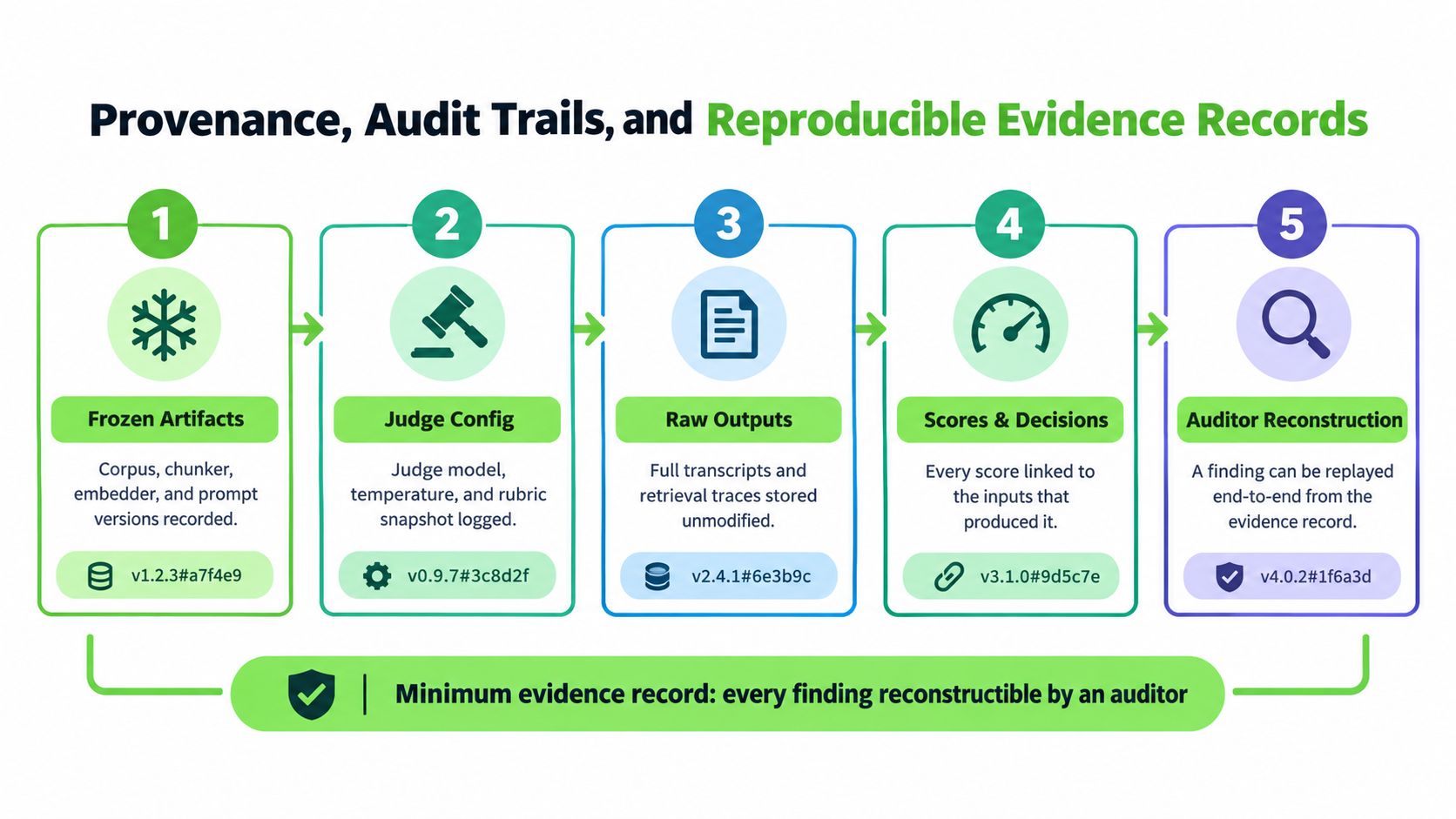
A minimum run record should contain:
- Benchmark identity: Frozen query-set version, corpus hash, label version, and scoring rubric hash.
- Retrieval identity: Index identifier and build timestamp, embedding model, chunking parameters, top-k value, and reranker version.
- Generation identity: Generator model identifier, prompt template hash, tool configuration, and tenant scope.
- Evaluation identity: Judge model, evaluator prompt, rubric, sampling settings, and scoring outputs.
- Question trace: Query, retrieved document IDs, rank and score at each stage, generated answer, citations, authorization decisions, latency, and final verdict.
Store raw retrieval traces and model outputs unmodified alongside normalized score records. Signed manifests and content-addressable storage allow an auditor to distinguish a changed document from a changed parser, retriever, prompt, judge, or threshold. This matters beyond basic encryption controls, because confidentiality doesn't establish whether an evaluation result can be reconstructed.
A citation proves little by itself. The record must show that the source was authorized for the requesting tenant, survived its transformations with known history, and actually entailed the claim attached to it. Provenance is therefore a control surface, not a documentation appendix.
A Scorecard Template for Component-Level Reporting
The scorecard should be useful to the engineer diagnosing a release, the product manager deciding whether to ship, and the auditor reconstructing a disputed answer. Report one row per question, then aggregate by query class and pipeline stage.
| Field | Source Stage | Reporting Rule | Release Gate? |
|---|---|---|---|
| Query text and class | Benchmark | Preserve exact text and class label | Yes |
| Retrieved document IDs and tenant metadata | Retrieval and authorization | Include rank, score, source identity, and access decision | Yes |
| Recall and precision at k | Retrieval | Report by class with explicit denominator | Yes |
| Grounding and faithfulness | Generation | Link each unsupported claim to its evidence failure | Yes |
| Answer relevance and correctness | Generation and review | Separate reference agreement from usefulness | Yes |
| Citation entailment | Attribution | Verify each citation supports its associated claim | Yes |
| Abstention decision | Policy layer | Compare with answerability and risk class | Yes |
| Latency and cost | Runtime | Preserve per-question traces and distributions | Review |
| Final pass or fail | Policy | Apply the threshold for that query class | Yes |
Don't aggregate answerable, unanswerable, multi-hop, adversarial, and cross-tenant questions into one denominator. A release should block on any cross-tenant authorization failure or any unanswerable case where the system reveals unsupported protected information, regardless of aggregate accuracy.
A low abstention rate can also be a failure. Define the acceptable floor before testing, then trigger review when the system refuses too few unanswerable questions or too many answerable ones. Report distributions rather than only means for recall, faithfulness, correctness, citation entailment, abstention precision, latency, and cost.
Cross-Reference Glossary of Metrics and Protocols
Use this glossary as an incident-response lookup rather than a substitute for the full traces.
- Grounded answer accuracy: Correctness among answers that also meet faithfulness and citation rules. Denominator: eligible answered questions. Unsafe alone because it can exclude abstentions.
- Citation precision: Supported citations divided by cited claims. Denominator: claims with citations. Unsafe alone because uncited claims may remain.
- Recall@k: Expected relevant evidence retrieved within the top-k results. Denominator: labeled questions with known evidence. Unsafe alone because it ignores ranking noise and generation.
- Faithfulness: Supported answer claims divided by evaluated answer claims. Denominator: extracted claims. Unsafe alone because irrelevant context may still support a claim.
- Answerability coverage: Answerable questions receiving a useful supported answer. Denominator: answerable questions. Unsafe alone because it ignores unanswerable behavior.
- Exact match and F1: Lexical answer comparisons. Denominator: labeled answer items. Unsafe with paraphrases or long-form answers.
- BERTScore and semantic similarity: Meaning-oriented comparisons. Denominator: scored answer pairs. Unsafe for authority, citation, and policy boundaries.
- ROUGE-L: Longest-common-subsequence overlap. Denominator: reference-answer pairs. Unsafe for valid paraphrase.
- nDCG and MRR: Ranking metrics for graded relevance and early relevant retrieval. Denominator: queries with retrieval labels. Unsafe without a stable corpus and relevance rubric.
- Abstention rate: Abstaining responses divided by all evaluated questions, or by a declared class denominator. Unsafe without answerability labels.
- Calibration error: Difference between confidence bins and observed outcomes. Denominator: confidence-bearing decisions. Unsafe when confidence isn't tied to a defined action.
- Lexical evaluator: Token-overlap family. Defined in the evaluator section.
- Semantic evaluator: Embedding-based meaning comparison. Defined in the evaluator section.
- LLM-as-a-judge: Rubric-based model evaluation. Requires frozen prompts and judge metadata.
- Human adjudicator: Reviewer resolving sampled or disputed cases. Use for high-risk and judge-validation subsets.
The four benchmark primitives are answerable, unanswerable, multi-hop, and adversarial. The four protocol fields that should appear in every run manifest are corpus hash, retriever version, prompt hash, and judge model.
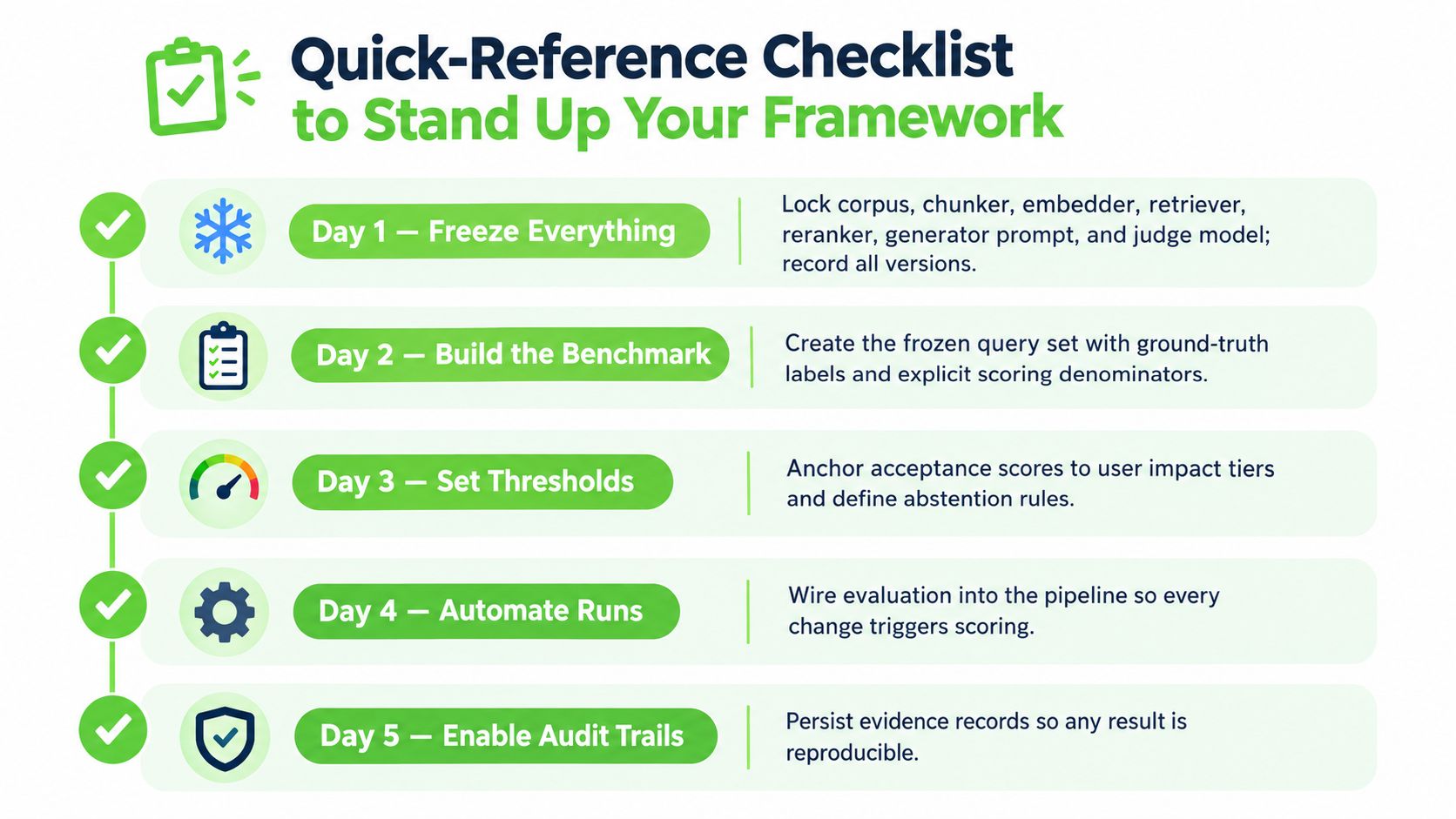
Quick-Reference Checklist to Stand Up Your Framework
A first-week rollout works when every action produces an artifact and an owner. The schedule below is a practical starting point, not a claim that five days is sufficient for every domain.
- Day 1, platform owner: Freeze the corpus, chunker, embedder, retriever, reranker, generator prompt, and judge model. Deliver a signed version manifest with hashes and tenant scope.
- Day 2, evaluation owner: Build a 300-query benchmark with answerable, unanswerable, multi-hop, and adversarial buckets. Deliver labels, expected evidence identifiers, answerability verdicts, and a stated denominator for every bucket.
- Day 3, ML lead: Wire lexical, semantic, LLM-judge, and human spot-check evaluators to per-question traces. Deliver an evaluator configuration and a sample of adjudicated cases.
- Day 4, product and risk owners: Set thresholds by user-impact tier. Deliver the abstention policy, escalation route, and exact user-facing response template for insufficient evidence.
- Day 5, security owner: Add cross-tenant authorization probes and provenance logging. Deliver negative fixtures for missing, expired, malformed, and conflicting credentials.
- Day 6, release owner: Produce the scorecard with pass or fail by dimension and query class. Deliver distributions, denominators, failed traces, and release-gate decisions.
- Day 7, operations owner: Schedule weekly reruns against a frozen commit and a monthly red-team sweep. Deliver change reports that identify whether a regression came from corpus, retrieval, generation, evaluator, or policy changes.
The first rerun should verify reproducibility before it measures improvement. If identical artifacts produce different outcomes, investigate evaluator sampling, nondeterministic retrieval, mutable documents, or incomplete logging before comparing models.
AletheionAGI offers a grounding and evidence-control layer that works with existing LLMs, RAG pipelines, vector databases, and memory systems, with support for authorized retrieval, evidence-backed outputs, frozen evaluations, and fail-closed handling of insufficient evidence. Visit AletheionAGI to assess how an evidence-control layer could fit your scorecard, authorization tests, and audit protocol.