Most advice about llm performance benchmarks starts in the wrong place. It treats leaderboard position as if it were a proxy for operational reliability, then acts surprised when a model that aces general knowledge still fails on access control, evidence grounding, or refusal behavior in production.
That gap is not a footnote. It is the core problem for teams building RAG systems, customer support automation, and multi-tenant agents that have to behave correctly under policy, not just look smart on a public test.
| Benchmark family | What it is good at | What it misses | Production risk if overtrusted |
|---|---|---|---|
| General knowledge suites | Breadth of knowledge and pattern matching | Grounding, state, authorization, abstention | Confident wrong answers |
| Specialized task suites | Domain-specific reasoning or coding behavior | Workflow context, policy, data scope | False confidence from narrow wins |
| RAG evaluation | Retrieval and answer support | Cross-tenant isolation unless explicitly tested | Leakage, unsupported claims |
| Frozen private protocols | Deployment-like behavior | Public comparability | More setup work, less leaderboard glamour |
A useful ranking guide for model selection is still helpful when you need a fast survey, and AI benchmarks ranking guide is a practical starting point. But once the system touches real users, the question changes from “Which model scored higher?” to “Which model fails less often, under my access rules, with my data, in my workflow?”
The Gap Between Leaderboards and Production Reality
Public benchmarks reward generality, but production systems get judged on specificity. A model can answer a broad set of exam-style questions and still miss the one billing-policy sentence a tenant is allowed to see, or answer when the right behavior is to abstain.
That is why aggregate scores mislead so easily. In enterprise settings, the failure mode is rarely “the model knows nothing.” It is more often “the model knows something plausible, but not the right thing, not from the right source, and not for this user.”
Practical rule: if a benchmark score doesn't encode authorization, source scope, and refusal behavior, it's not measuring the risk your production system actually carries.
The temptation is to compare models the same way you'd compare CPUs, but LLMs don't behave like fixed hardware. They respond to prompting, tool access, retrieval quality, and hidden data exposure. Even the best public score can only tell you that a model is broad, not that it is safe.
For teams evaluating enterprise assistants, LLM performance benchmarks need a second layer. Public suites can narrow the candidate pool. They can't certify that a model will respect tenant boundaries, preserve state across turns, or avoid unsupported claims when evidence is missing. A high score is a starting signal, not a deployment verdict.
If you build support flows, compliance workflows, or agentic tools, treat leaderboard results as a baseline and nothing more. The true test is whether the system stays correct when the prompt changes, the retrieval set is incomplete, or the user's permissions remove part of the context.
Deconstructing General Knowledge Evaluation Suites
What MMLU actually tells you
MMLU became one of the most cited broad-knowledge baselines because it spans 57 subjects, including mathematics, history, law, medicine, and computer science, and uses a four-option multiple-choice format with a 25% random-guess baseline aiwiki.ai/wiki/llm_benchmarks_timeline. That structure is useful because it forces breadth, not just a narrow skill.
The historical curve is informative too. GPT-3's 175-billion-parameter version scored 43.9% in the reported five-shot evaluation, Chinchilla 70B reached 67.6% in 2022, PaLM 540B reached 69.3%, and GPT-4 reached 86.4% in 2023, while the reported human-expert reference was about 89.8% BIG-bench paper. That progression shows scaling and instruction tuning clearly. It does not prove grounding, safe action selection, or reliable state tracking.
Why aggregate scores hide real weaknesses
MMLU is a breadth-and-knowledge measure. It is not a proxy for calibrated uncertainty, production abstention, or whether the model can safely act on a user's behalf. Protocol details matter too. Scores shift with model version, subject mix, number of demonstrations, contamination controls, and whether the published value is an average or a selected subset aiwiki.ai/wiki/llm_benchmarks_timeline.
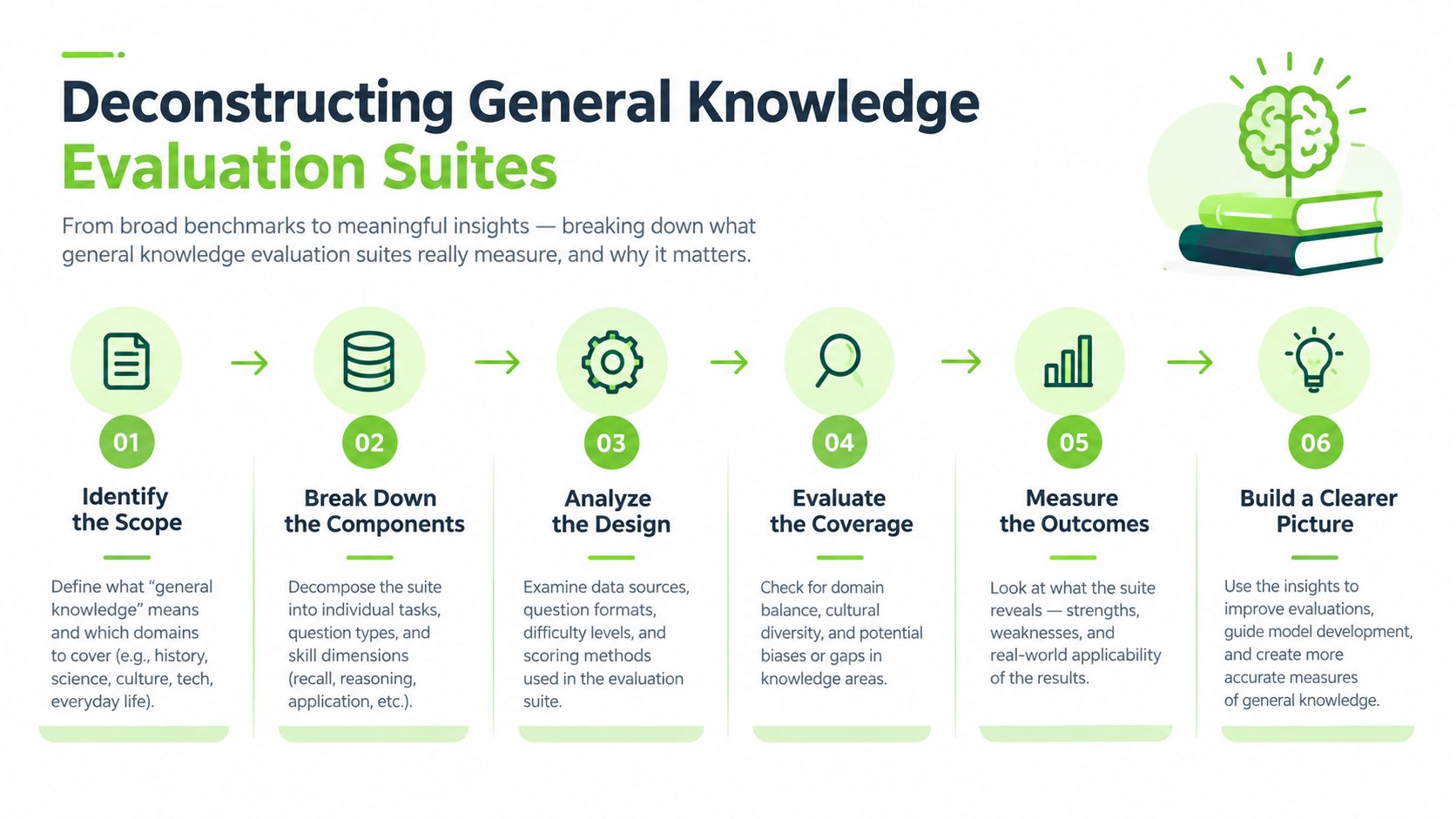
BIG-bench widened the frame further by assembling 204 tasks from 450 authors across 132 institutions, with tasks that probe reasoning, multilingual behavior, social and ethical judgments, algorithmic tasks, and compositional problem solving BIG-bench paper. Its value is methodological. It showed that averages can conceal discontinuities, metric artifacts, and capability-specific failures.
The practical takeaway for platform teams is simple. General suites mostly test whether a model has absorbed broad patterns and knowledge. They do not tell you whether the model can handle a denied-document distractor, an empty retrieval result, or a policy exception without making something up. For that, you need task-level evaluation, not just a leaderboard.
Comparing Specialized Tasks and Cross-Benchmark Progress
Specialized benchmarks expose what general suites often hide, progress is uneven. Stanford's 2025 AI Index shows that between 2023 and 2024, performance rose sharply on MMMU, GPQA, and SWE-bench. The same report also records OpenAI o1-preview at 92.3% on MMLU, versus 86.4% for GPT-4 Stanford AI Index 2025. Those gains do not move together because the tasks probe different failure modes.
MMMU targets multimodal university-level reasoning. GPQA focuses on difficult graduate-level questions. SWE-bench measures software-engineering agents on real repository issues. A model can improve fast on one benchmark and still miss badly on another, which is normal.
Match the benchmark to the product risk
A support assistant needs grounded retrieval, abstention, and instruction-following checks. A coding agent needs repository-level patch success and regression testing. A multimodal assistant needs image-text reasoning, not just chat fluency. The benchmark should map to the failure that matters in production.
A good evaluation suite is not the one with the most metrics, it's the one that makes the wrong behavior expensive to miss.
Protocol details matter just as much as the task choice. Model version, prompting regime, tool access, number of attempts, and whether the result is pass@1 or best-of-N can change the apparent score materially. If a vendor changes those settings and gives only a headline number, the comparison is not like for like.
| Benchmark Suite | Primary Focus | Evaluation Methodology | Ideal Production Use Case |
|---|---|---|---|
| MMMU | Multimodal reasoning | Mixed visual and textual problem solving | Document understanding with images or charts |
| GPQA | Hard academic questions | Graduate-level question answering | Research assistants and expert routing |
| SWE-bench | Software engineering | Real repository issue resolution | Coding agents and patch generation |
For teams comparing vendors, compare leading language models can help frame the market. The real work still happens inside your own environment, because your users, permissions, and data model will not match a public benchmark's assumptions.
Top-end general benchmarks still move. The same Stanford report shows that current models can post materially different scores on mature academic tests, but that lift still does not prove correct behavior inside your workflow. A higher leaderboard number can coexist with weak abstention, poor provenance, or unsafe action-taking.
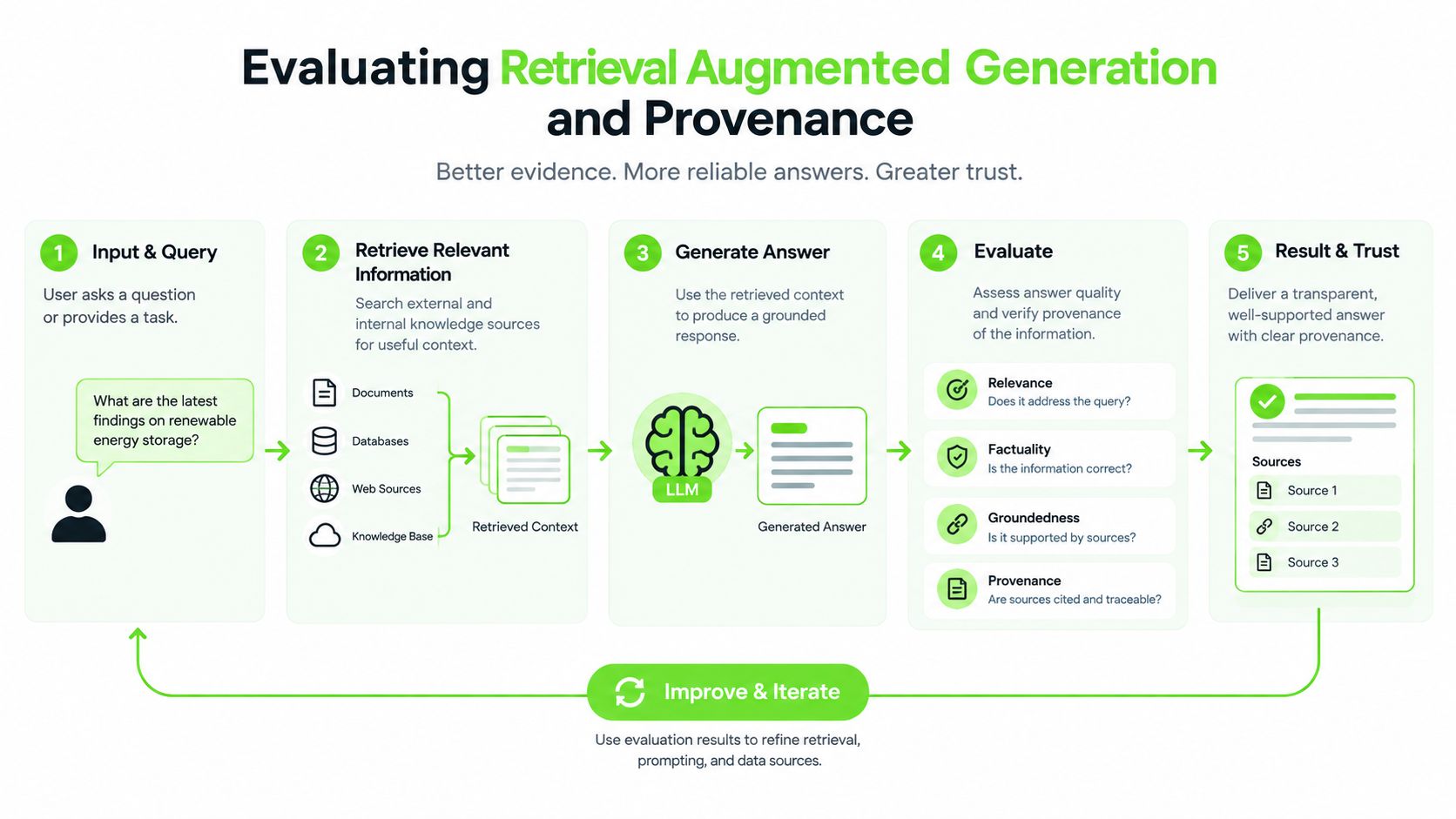
Evaluating Retrieval Augmented Generation and Provenance
RAG changes the evaluation question. The issue is no longer whether the model “knows” an answer, but whether it used the right evidence and stayed within what that evidence supports. That split matters because retrieval and generation fail in different ways, and production systems have to catch both.
Separate retrieval quality from answer grounding
RAGBench's TRACe framework evaluates utilization, relevance, adherence, and completeness RAGBench TRACe. The framework is useful because it separates whether the system found useful context from whether the final answer stayed faithful to that context and covered the needed ground.
That distinction is operational, not academic. A system can retrieve the right document and still invent a policy exception. It can also produce a polished answer that omits the one clause a support agent needs before taking action.
The benchmark mix also matters. RAGBench spans PubMedQA, CovidQA, HotpotQA, MS MARCO, CUAD, DelucionQA, EManual, TechQA, FinQA, and TAT-QA, which makes it better suited for comparing retrieval-plus-generation behavior than for treating any single score as a universal proxy. For practical evaluation, use it as a signal, not as proof that a model will behave correctly across your own workflows.
Hallucination detection is part of the same problem. The reported DeBERTa AUROC values vary materially by task, which shows that automated claim-quality checks are uneven and should not be treated as a stand-alone safety gate.
Build provenance into the evaluation itself
NIST defines data provenance as information about a datum's origin and history, including generation, ownership, licensing, distribution, and lineage, and recommends capturing source information, legal rights, privacy considerations, method, intended use, restrictions, and lineage NIST provenance draft. In a RAG system, that means every retrieved passage should carry source identity, version, and usage scope before generation ever sees it.
That lines up with the internal design pattern described in AletheionAGI's retrieval-augmented generation notes. It also matches practical AEO strategies that work, where answer quality depends on evidence control, not just fluent output.
For evaluation, keep these measures separate:
- Retrieval recall, so you know whether the right evidence arrived.
- Sentence-level support, so unsupported claims do not hide inside a mostly correct answer.
- Citation correctness, so the cited passage entails the claim.
- Abstention behavior, so missing evidence leads to refusal or clarification instead of invention.
The Hidden Risks of Contamination and Environmental Shift
Public benchmark scores can reflect exposure to the test set, not real reasoning on unseen work. That is the core contamination problem, and it makes leaderboard movement a measurement issue as much as a modeling one.
A 2025 study found that exposing DeepSeek-R1-Distill-Llama-8B to benchmark membership data seven times produced performance inflation of up to 11.76% across six benchmarks, and the contaminated model exceeded a clean baseline by an average of 10.80% contamination study. For guidance on handling uncertainty when evidence is incomplete, see our notes on uncertainty in artificial intelligence. That kind of lift can make a model look materially stronger than it is.
Why paraphrase defenses do not solve this cleanly
Static paraphrasing and small syntactic edits do not close the gap. The same study notes that many lightweight mitigation strategies fail across benchmarks, while stronger transformations only work for subsets of tests. So “we paraphrased the test set” is not a serious defense.
The production response has to be stricter. Keep frozen private holdouts, rotate task instances, track training-data cutoffs, and report separate results for public, private, and freshly generated items. Pair those with process metrics such as citation correctness, evidence coverage, abstention precision, policy violations, latency, and cost per successful task.
Environmental shift is the other half of the risk. A model can score well on academic tasks and still fail when schemas, permissions, ambiguity, or multi-step context change. A benchmark pass does not tell you whether a support workflow will stay safe when the retrieved document is stale or when cross-tenant access is blocked.
If the test environment does not resemble production, the score mainly reflects performance under the test environment.
For customer support or marketplace workflows, the evaluation has to include hard cases, unauthorized distractors, empty retrieval, contradictory sources, and prompt-injection content. Without those, you are measuring familiarity, not resilience.
Designing Frozen Protocols for Verifiable Production Systems
Leaderboard scores are easy to publish and hard to trust. Production evaluation has to answer a narrower question: will the system stay inside policy, preserve provenance, and fail closed when evidence is missing or access is blocked?
Build the test set around production failure modes
The NIST AI Risk Management Framework says AI performance or assurance criteria should be measured qualitatively or quantitatively under conditions similar to the intended deployment setting NIST AI RMF. For a multi-tenant support assistant, that means preserving tenant, user role, document version, authorization state, retrieval result, generated claim, and final disposition.
A useful suite should cover the full decision path, not just the final answer. Include authorized retrieval for the happy path, unauthorized-document distractors to test cross-tenant isolation, stale documents to catch version drift, contradictory sources to measure conflict handling, empty retrieval results to force abstention, prompt-injection content to test fail-closed behavior, and cross-tenant identifiers to expose leakage risks.
That setup produces metrics that matter in production, such as supported-claim rate, unauthorized-evidence exposure rate, citation precision, retrieval recall, refusal correctness, and latency. It also keeps dangerous cases visible instead of averaging them into a single score.
Treat abstention as a valid outcome
A high aggregate answer score can hide serious failures if unauthorized answers are rare in the test set or if unsupported claims are only counted at the response level. A production system should be allowed to say, “I can't support that with the evidence I have.” That is control, not weakness.
The internal guidance in AletheionAGI's evaluation notes lines up with this approach, because it treats frozen protocols, explicit denominators, and fail-closed outcomes as the basis for measurement. That is the right frame for teams that need auditability, not just a benchmark graph.
If you only remember one rule, make it this. A system is not production-ready because it can answer. It is production-ready when it can answer, refuse, and cite correctly under the same policy constraints your users live under.
Implementing Evidence-Bounded Infrastructure and Grounding
Benchmarks can tell you whether a model has promise. They can't give you reliable production behavior without infrastructure that controls evidence, state, and intent before generation begins.
That is why the practical stack should include a grounding layer, persistent memory with authorization checks, and structured intent parsing. These are not replacements for LLMs, they are control planes around them. The model proposes text, the infrastructure decides what evidence it may see and what actions it may take.
AletheionAGI fits that pattern as one option for teams that need evidence-bound retrieval and structured intent handling alongside existing LLMs, vector databases, and memory systems. The point is not to chase a brand name. The point is to separate authority before autonomy, so policy and canonical state make the deciding move.
This architecture changes evaluation too. Once evidence is bounded, the benchmark can test whether the system stayed inside scope, preserved provenance, and abstained when evidence was missing. That is a much better fit for enterprise risk than a single aggregate accuracy number.
The bottom line: leaderboard scores are useful, but only inside a stricter evaluation frame. If you're building AI agents, customer support automation, or multi-tenant RAG, you need systems that are measurable, auditable, and fail-closed.
If you're evaluating production AI and want a grounding layer that works with existing LLMs, RAG pipelines, vector databases, and memory systems, visit AletheionAGI. It's built around evidence-bounded claims, authorized retrieval, and structured intent so you can measure what the system does, not just what a benchmark suggests it might do.