Your support agent remembers a customer's old organization, retrieves a preference from a previous role, and confidently recommends a workflow the customer no longer has permission to use. Nothing crashed. The vector search returned a semantically similar memory, the prompt was assembled correctly, and the model produced a fluent answer. The failure happened earlier, when the system treated persistence as retrieval instead of governed state.
That's the practical problem behind A-MEM, agentic memory for LLM agents. Persistent memory can help an agent connect events across sessions, reduce unnecessary context, and continue long-running work. It can also preserve mistakes, expose data across tenants, and turn stale information into authoritative-sounding instructions. Production teams need both capabilities and controls.
What Agentic Memory Requires in Production
An agent stores a user preference on Monday, sees a related request on Thursday, and applies that memory without checking whether the user still belongs to the same tenant, still has the same permissions, or even confirmed the original fact. The retrieval can look correct while the behavior is wrong. Production memory fails less often at search time than at write time, authorization time, and abstention time.
A memory store by itself does not solve that problem. A vector database can index representations and return nearby records. The production requirement is broader. The system has to decide whether an observation should persist, whether a newer fact should replace or narrow an older one, and whether the current actor is allowed to use the result.
In practice, memory is persistent state with boundaries. Those boundaries include identity, tenant, task, time, authority, provenance, and confidence. A support agent can remember a customer's preferred communication channel, but that preference should not override a current account policy. A coding agent can retain a deployment failure pattern, but it still needs to separate a verified failure from an untested guess.
The operational consequence is straightforward. Memory does more than help answer the current prompt. It can shape the next plan, tool selection, escalation path, or action. Once memory affects behavior, the write path becomes a policy decision with audit implications.
From summaries to evolving state
The A-MEM research paper describes a memory architecture that organizes long-term experience dynamically instead of relying only on fixed memory operations. Each interaction becomes a structured note with content, timestamp, keywords, tags, contextual description, and an embedding. The system retrieves related notes, then an LLM controller decides whether to revise notes, create links, or change the surrounding memory structure. The paper connects that design to the Zettelkasten method, where individually addressable notes accumulate into a growing knowledge network.
That shift matters because the system is no longer storing only summaries. It is maintaining state that can be revised and reused later. The upside is continuity across sessions and tasks. The risk is that unsupported inferences can become durable artifacts, stale memories can survive past their valid window, and links between similar records can bypass cross-tenant isolation if authorization is treated as a retrieval concern instead of a memory concern.
Teams building serverless agentic apps should set the memory contract before choosing storage. Ask:
- What may be written: facts, preferences, decisions, outcomes, or only evaluator-approved observations?
- Who owns the record: user, account, tenant, workflow, or system?
- What proves it: source message, tool response, document version, or human confirmation?
- When does it expire: immediately, after a task, after a policy change, or only through explicit deletion?
- What happens under uncertainty: retrieve with a warning, request confirmation, or abstain?
- Can operators reconstruct the decision: including the memory version, authorization result, and evidence delivered to the model?
A system that cannot answer those questions may still score well on a clean recall benchmark. It is not ready to influence sensitive production decisions.
Building a Controlled Memory Lifecycle
Treat memory as a lifecycle with separate controls for observation, writing, retrieval, change, and removal. The architecture can use a vector database, graph store, relational database, or hybrid backend. The control plane matters more than the storage label.
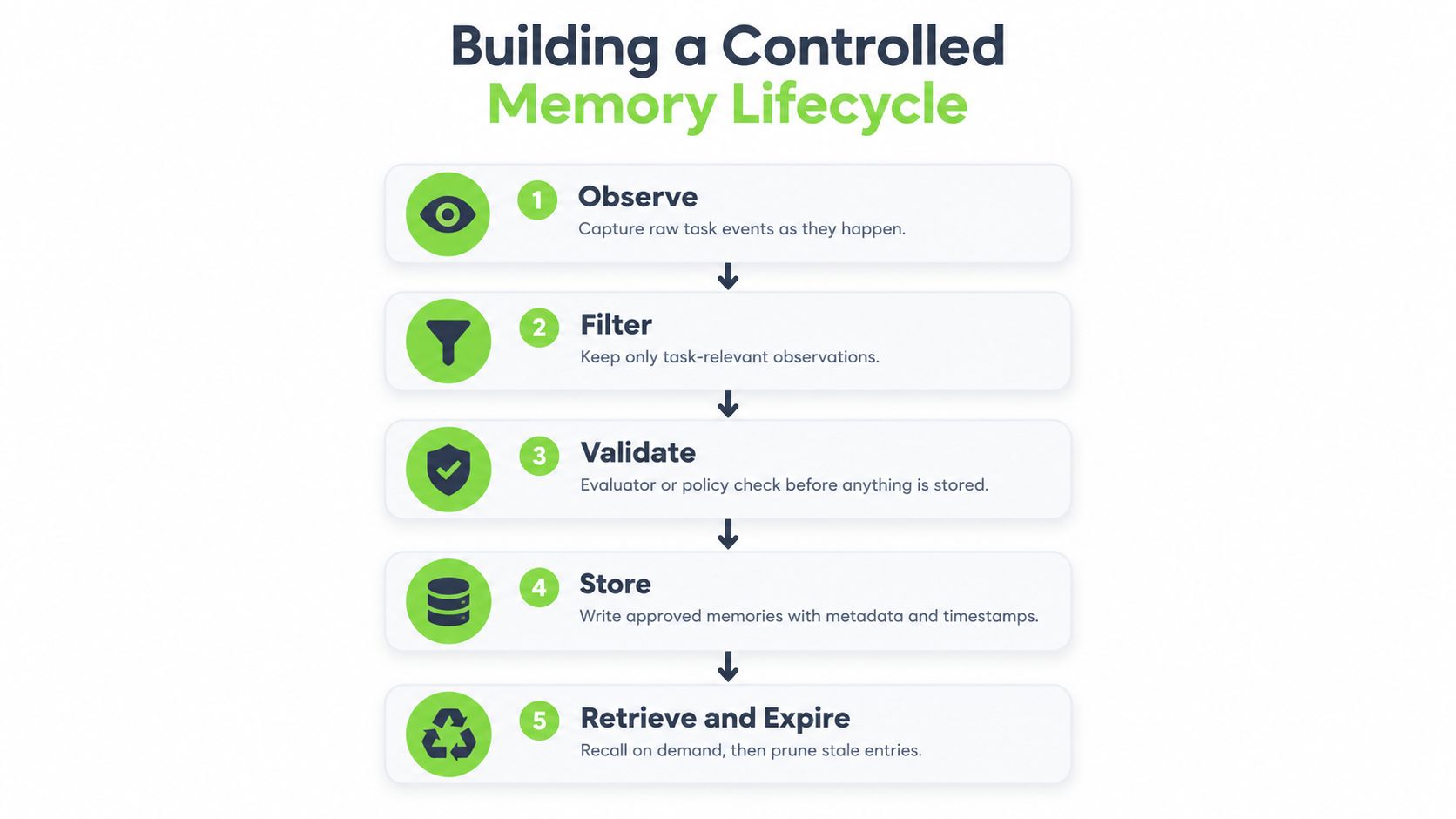
1. Observe without committing
Capture raw task events, but don't treat every event as a candidate memory. A conversation contains scaffolding, temporary statements, speculation, and sensitive information that the agent may need in the moment but shouldn't persist.
The observation layer should preserve the original event separately from any extracted memory. That separation gives you immutable source evidence and makes later review possible. For a support workflow, the raw event might include the user's message, authenticated account context, tool results, and the agent's proposed action. The candidate memory might be much narrower, such as an explicitly confirmed preference or a verified resolution.
2. Filter for task relevance
The write path should ask whether an observation will predictably improve a future task. Relevance isn't enough by itself. A statement can be highly relevant and still be unauthorized, temporary, or too ambiguous to store.
Use explicit filters for:
- Identity and tenant: bind the observation to the authenticated subject and organization.
- Task scope: distinguish a project decision from a general user preference.
- Sensitivity: route personal, financial, or credential-related content through stricter policy.
- Durability: separate temporary working context from long-term state.
- Conflict status: flag observations that contradict an existing memory instead of overwriting it without notification.
3. Validate before storage
A policy engine or evaluator should validate candidate memories before they enter durable state. Validation can check whether the source supports the extracted claim, whether the writer has permission to persist it, and whether the record should be stored as a fact, hypothesis, event, or unresolved conflict.
Store metadata with the memory, not in a separate operational log that retrieval can't see. Useful fields include provenance, timestamp, scope, confidence, version, subject identity, tenant, retention rule, and deletion status.
Practical rule: If a future agent can't tell who supplied a memory, when it was true, and what scope it applies to, the record isn't ready for autonomous retrieval.
4. Store relationships, not just embeddings
A structured note can carry semantic content, but production retrieval often needs more than similarity. A current preference may supersede an older preference. A deployment decision may depend on a particular repository, environment, and incident. A customer's entitlement may change when the account changes organizations.
A hybrid design can keep exact identifiers and authorization fields in structured storage, use embeddings for semantic discovery, and maintain explicit links for temporal or causal relationships. The LLM can propose a relationship, but the system should validate the relationship before treating it as authoritative state.
The AI context management guidance from AletheionAGI is useful background for separating active context from durable state. That distinction prevents teams from storing every transient prompt detail because it was available during inference.
5. Retrieve bounded evidence, then revise or expire
Retrieval should combine semantic similarity with task, recency, scope, and authorization filters. Similarity can identify candidates. It can't establish permission or current truth.
Expose retrieved memories to the agent as bounded evidence with identifiers and provenance. Don't flatten them into an unmarked block of text. The model should be able to distinguish a confirmed fact from an inferred preference, a historical event from a current policy, and a low-confidence note from a canonical record.
The write and read paths also need correction handling. When later evidence contradicts an earlier memory, the system should support revision, deletion, supersession, or rollback. Keep prior versions auditable where policy permits, but prevent superseded content from returning as current evidence.
An empirical study describes an experience-following effect, where an agent tends to reproduce behavior associated with a retrieved memory when the current task resembles the memory's original input. The same work identifies error propagation, in which an incorrect memory reinforces an incorrect action, and misaligned experience replay, in which superficial similarity leads the agent to apply a memory to the wrong situation. The study on memory lifecycle failure modes reports that deletion combined with selective addition, guided by a strong evaluator, mitigates these problems more effectively than indiscriminate accumulation.
Log write precision separately from retrieval recall. A system can retrieve the right records from a polluted store, or retrieve the wrong records from a carefully curated store. Those are different failures and require different fixes.
Grounding Memory Decisions in Benchmark Evidence
A-MEM provides useful evidence for structured, evolving memory, but it doesn't establish a universal production guarantee. The reported experiments covered six foundation models and used the LoCoMo and DialSim long-term conversational benchmarks. The results support the claim that structured memory can help multi-hop reasoning under those evaluation conditions. They don't prove factuality, privacy compliance, authorization integrity, or safe behavior in every domain.
On LoCoMo, A-MEM with GPT-4o-mini reportedly reached a multi-hop F1 score of 27.02, compared with 9.15 for ReadAgent. Another comparison reported a temporal-question F1 of 45.85 for A-MEM, versus 25.52 for MemGPT. These figures come from the benchmark evaluation summarized at AlphaXiv's A-MEM record, and they should be read as scoped comparisons, not deployment forecasts.
The token result is also relevant to architecture. A-MEM reportedly used approximately 2,520 tokens per memory operation, compared with about 16,910 tokens for the LoCoMo full-context baseline, a reduction of roughly 85%. That supports a practical hypothesis: compact, linked notes can reduce the need to resend complete histories when the task requires combining information from multiple memories. It doesn't show that the same reduction will hold for every workload, model, memory policy, or retrieval budget.
Isolate memory from the rest of the agent
A useful evaluation sequence starts with a no-memory baseline. Then compare:
- No memory: the agent receives only the current task and permitted external evidence.
- Append-only memory: records accumulate without revision or deletion policy.
- Retrieval-only memory: the system retrieves prior records but doesn't allow agentic updates.
- Policy-controlled memory: writes, retrieval, updates, and deletion pass through explicit controls.
Keep the model version, tool conditions, memory budget, and task distribution fixed. Otherwise, a stronger retriever or better tool execution may receive credit for an improvement attributed to memory.
MemGym's isolated evaluation approach reinforces this point. In its tool-use dialogue setting, adding memory increased Claude Haiku 4.5 success by 8.7 percentage points. In a coding question-answering track under a 500,000-token context-pressure condition, A-MEM reached 0.75 accuracy versus 0.20 without memory, an absolute improvement of 55 percentage points. The MemGym evaluation record describes these as task-specific results, so teams should reproduce the comparison under their own context, tools, and memory policies.
The DialSim result adds another bounded comparison. A-MEM was reported at 3.45 F1, compared with 2.55 for the LoCoMo baseline and 1.18 for MemGPT. That pattern is encouraging for long-horizon interaction, but it remains benchmark evidence rather than a reliability certificate.
Measure the whole action boundary
Security evaluation must cover more than retrieval. Test the complete chain:
- write
- store
- retrieve
- execute
- share
- propagate
- forget
- roll back
A memory can be accurate and still unsafe if the agent retrieves it for the wrong tenant or uses it to authorize an action. A memory can be useful and still operationally unsuitable if construction becomes too slow under concurrent traffic. For teams evaluating RAG and memory together, the RAG evaluation framework from AletheionAGI offers a useful way to keep evidence quality, retrieval behavior, and final outputs distinct.
Why Higher Recall Can Increase Risk in Multi-Tenant Systems
Higher recall sounds unambiguously positive until the retrieved item is obsolete, unauthorized, or attached to the wrong identity. In a multi-tenant support platform, a memory about one organization must never become available merely because another organization used similar language. Semantic similarity is a discovery signal, not an access decision.
Common benchmark narratives leave a gap. Public discussions often measure retrieval quality and token efficiency more thoroughly than memory writing, forgetting, per-user isolation, and concurrent multi-user load. A separate MemoryBench result reported that advanced memory systems, including Mem0, didn't consistently outperform simple RAG across diverse tasks, and that procedural memory derived from user feedback remained weak. The benchmark discussion on agent memory evaluation frames the unresolved issue clearly: retrieval performance doesn't answer whether the system stores the right facts, removes corrected facts, or respects authorization boundaries.
Similarity can conceal a policy mismatch
Consider four records that all mention a refund:
- a public refund policy,
- a customer-specific contract,
- an internal support note,
- a former employee's historical case.
A vector search may rank several of them highly for the same question. Only the authorized, current record should influence the answer. If the system gives the model all four without labels, the model must infer authority from prose, which is a weak substitute for policy enforcement.
The safer sequence is authorize first, retrieve within the permitted boundary, then ground the response in the returned evidence. If the system can't establish identity, scope, or freshness, it should abstain or ask for clarification. An empty result is safer than a confident result from the wrong tenant.
The operational problem also appears at scale. Recent coverage notes that clean benchmarks often underrepresent typos, mixed languages, sarcasm, partial updates, multi-topic turns, long-term drift, schema migrations, and distribution shifts. MemoryBench reported pathological slowdowns for some systems on large corpora, with memory-construction time rising from seconds to more than 20 minutes on certain datasets. The production-focused memory benchmark discussion makes the implication practical: teams need p95 and p99 latency, cost, correctness, and abstention measurements under their actual write and concurrency patterns.
Security principle: A memory is useful only if the system is authorized to retain it, authorized to retrieve it, and able to establish that it still applies.
Use safety-conditioned utility
Raw recall rewards delivery. Production systems need to reward authorized usefulness and penalize harmful delivery.
Track at least these categories separately:
- Useful memories retained: records that improve an authorized decision.
- Stale memories delivered: records that were once valid but should no longer influence behavior.
- Unauthorized memories delivered: records exposed outside their permitted identity or tenant boundary.
- Unsupported memories written: records whose source evidence doesn't justify the extracted claim.
- Correct abstentions: cases where the system withheld a memory or answer because authority, freshness, or provenance was inadequate.
This framing changes the optimization target. A system with higher recall can be worse if it also delivers more stale or cross-tenant records. Memory quality must be evaluated across write, retrieve, update, and rollback, not inferred from final answer accuracy alone.
Designing Production Tests for Memory Safety and Utility
An agent passes a demo, then fails in production because one preference update did not propagate, one deleted record still appeared in retrieval, or one tenant boundary leaked under concurrency. That is the level to test. A useful protocol fixes the conditions that otherwise hide regressions: corpus boundary, language mix, write-to-read ratio, concurrency, update frequency, model version, memory budget, and tool access.
Keep the denominator stable. Benchmark results like those discussed earlier are a starting point; your production protocol still needs its own denominator, model version, data boundary, and failure definitions.
Report metrics separately: recall, stale-memory rate, write latency, retrieval latency, token spend, and failure-abstention rate. A blended score hides the operational trade-off. Higher recall can come from writing too much, retrieving outdated state, or avoiding hard cases through over-abstention. Those are different failure modes and need different fixes.
Build the test matrix around lifecycle events
Center the matrix on lifecycle events where memory systems break:
- Authorized write: the source supports the claim and the identity is allowed to store it.
- Rejected write: the content is speculative, sensitive without permission, or outside task scope.
- Correction propagation: a user changes a preference and the prior value stops affecting retrieval.
- Deletion completeness: a deletion request removes the allowed memory from every retrieval path.
- Tenant isolation: similar requests across organizations never cross the authorization boundary.
- Temporal conflict: an older fact and a newer fact coexist, but only the applicable version is returned.
- Insufficient evidence: the system abstains instead of inventing a plausible memory.
- Rollback: an incorrect update is reversed without corrupting unrelated records.
These tests should be adversarial, not ceremonial.
For every stored claim, keep immutable source evidence and enough metadata to reconstruct the decision path. An evaluator should be able to trace a response to the memory ID, source event, policy decision, version, and authorization result. That record is more useful than a benchmark summary when security, legal, or compliance asks why the agent acted.
This also changes how utility is measured. A memory is not useful because it was retrieved. It is useful only when it was authorized to exist, still current at read time, scoped to the right tenant, and strong enough to support the action taken.
Teams building customer-facing systems can use workflow examples from this AI-powered marketing agent guide and apply the same controls to campaign preferences, approval history, audience rules, and brand constraints. The domain changes. The production test stays the same: did the agent use authorized, current evidence, or did it answer when it should have abstained?
Rolling Out Grounded Memory Infrastructure Safely
Start with read-only retrieval and a no-memory baseline. Enable writes only for narrowly defined, evaluator-approved record types, then monitor stale results, authorization failures, latency, and abstention behavior. Keep credentials, billing, data authority, and operational responsibility separate, and define rollback triggers before enabling tool actions.
A grounding and evidence-control layer such as AletheionAGI can sit alongside existing LLMs, RAG pipelines, vector databases, and memory systems rather than replacing them. Its AI knowledge base approach is relevant when teams need authorized evidence, provenance, and fail-closed behavior around retrieved state.
Stop automation when evidence is missing, scope is ambiguous, or a memory conflicts with canonical data. Resume only after the policy, source, and test case are clear.
AletheionAGI provides grounding, persistent memory, authorized retrieval, intent state, provenance, and fail-closed evidence controls for production AI systems. If you're building an agent that handles sensitive or multi-tenant data, visit AletheionAGI to evaluate how governed memory can fit alongside your existing LLM and RAG stack.