Your support assistant retrieves the right policy, attaches a citation, and tells a customer they qualify for an exception that nobody authorized. Your retrieval dashboard looks healthy, but the support team now has to retract a promise. If you're building an agent, the next question is more uncomfortable: could that unsupported answer also trigger a refund?
Reducing hallucinations in production requires more than a better prompt. You need an evidence path that engineers can inspect, security teams can challenge, and operators can stop before an unsupported claim becomes an answer or action.
Why Fluent LLM Answers Still Fail
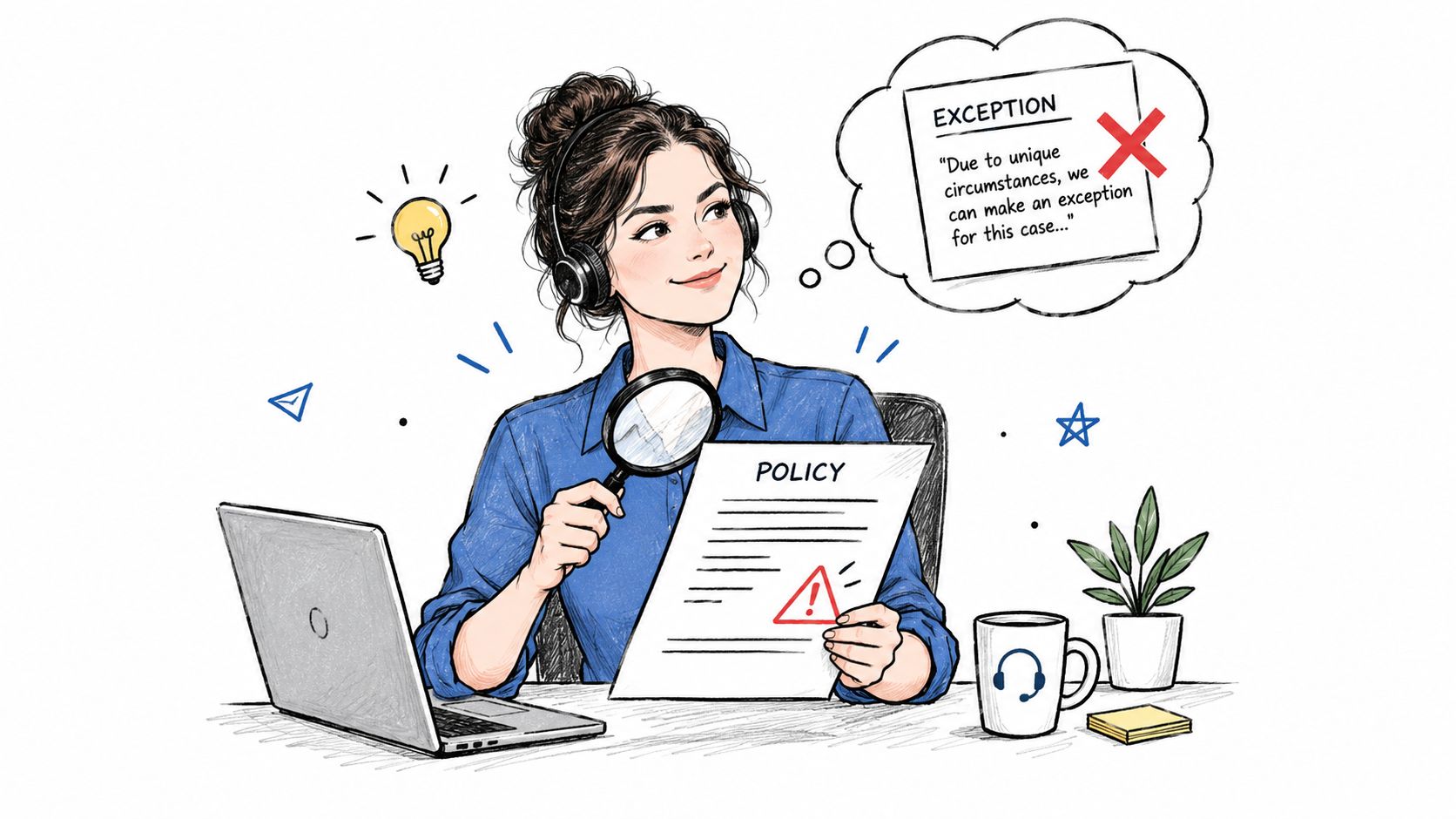
Consider a hypothetical marketplace assistant handling a refund request. It retrieves the merchant's current policy, correctly summarizes the eligibility conditions, then invents a discretionary exception. The citation is real. The exception isn't.
The distinction matters because the failure happened after relevant retrieval. Adding another document or demanding citations wouldn't necessarily address it. Research summarized in the RAGTruth discussion of end-to-end grounding failures describes unsupported and contradictory content persisting despite retrieved evidence. It also discusses a SemEval result in which removing RAG improved a participating system's performance, a warning against treating retrieval as an automatic improvement.
The operational problem is visible in an ordinary policy review.
Define the failure beyond invented facts
NIST's generative AI risk profile defines confabulation as confidently presented erroneous or false content, including outputs that diverge from the prompt or contradict earlier statements. That gives production teams a broader diagnostic scope than factual question answering alone.
A support assistant might misread a request for an explanation as permission to act. It might contradict a previously validated account status. An agent might select a tool that isn't available. These failures need different tests, even when users describe all of them as hallucinations.
Practical rule: A fluent answer is a candidate output, not proof that the request was understood, the evidence was sufficient, or the action was authorized.
Treat the whole request path as testable
Use this mental model: request → identity and policy → authorized evidence → generation → claim verification → delivery or execution decision. Record what crossed each boundary.
The engineering questions are distinct:
- Retrieval: Did the system locate evidence that addresses the request?
- Grounding: Does that evidence support the actual claims?
- Control: May this caller receive the answer or execute the proposed action?
- Recovery: What happens when support is missing or contradictory?
These controls are defensible engineering mechanisms, not a universal reduction guarantee. Their effectiveness, thresholds, and deployment costs remain hypotheses until your team tests them against representative workloads.
Separate Every Failure Mode
A larger context window doesn't establish that an answer is supported. Neither does a confident citation.
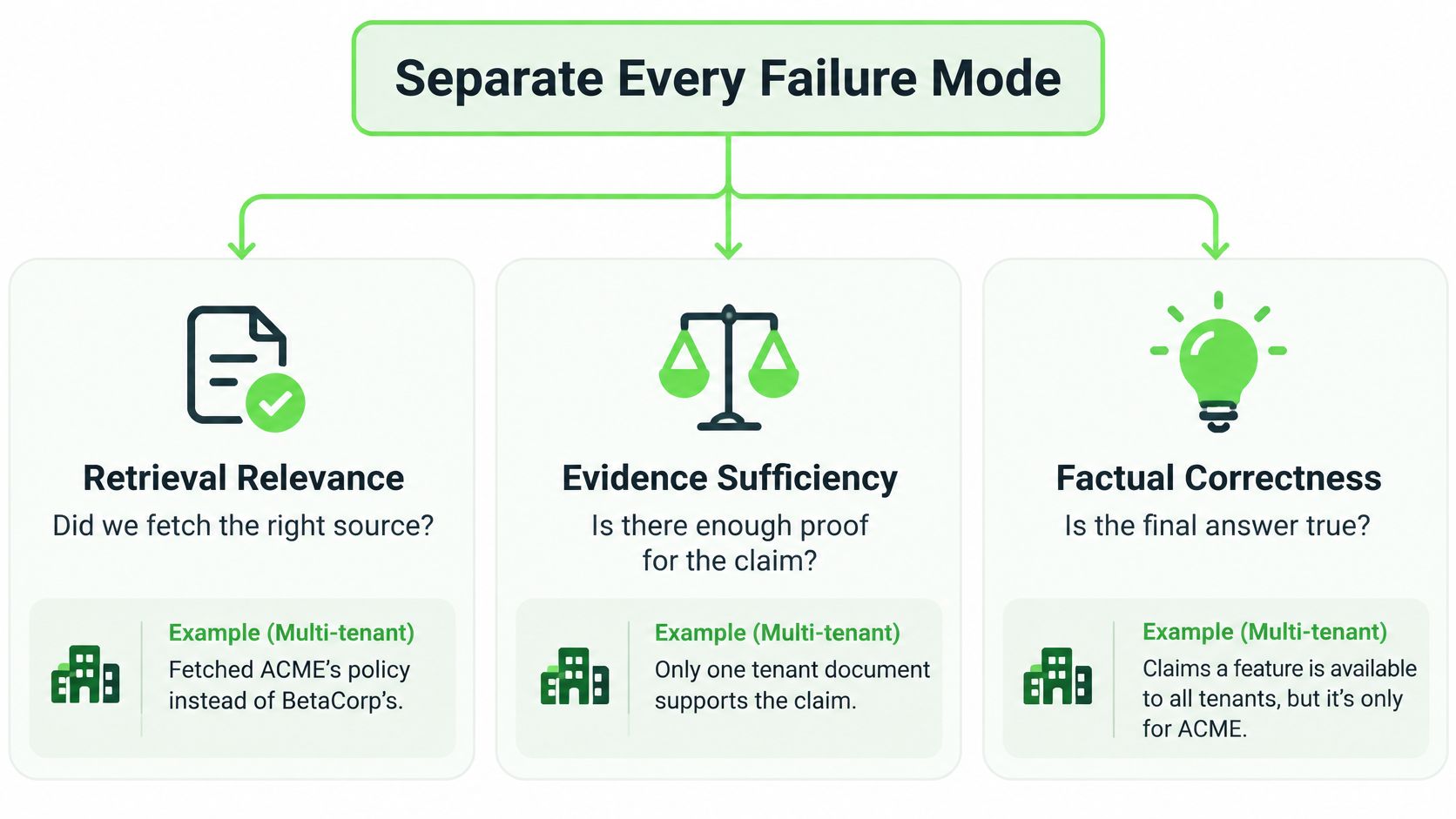
In a hypothetical multi-tenant support system, an assistant could retrieve a policy about refunds from the wrong merchant. The passage is relevant to the topic and may accurately support the sentence, but the caller isn't authorized to use it. Alternatively, the assistant could retrieve the correct merchant's policy and infer an exception that the text never grants.
Keep these distinctions visible during diagnosis.
Measure boundaries, not impressions
Recent work on retrieval, generation, and tool-augmented failure modes describes why relevant evidence can still be incomplete or misapplied, and why invalid tool selection belongs in the failure taxonomy. For implementation, maintain separate labels rather than forcing every defect into answer accuracy.
| Boundary | Diagnostic question |
|---|---|
| Retrieval recall | Did retrieval recover the required authorized passages? |
| Evidence sufficiency | Do those passages establish the conditions needed to answer? |
| Claim-level entailment | Does each factual assertion follow from its evidence? |
| Contradiction | Does the answer conflict with evidence or validated state? |
| Citation correctness | Does the cited passage support the attached claim? |
| Instruction adherence | Did the assistant perform the requested task within constraints? |
| State consistency | Did it preserve previously validated facts? |
| Tool validity | Is the selected operation available with valid arguments? |
| Harmful refusal | Did the system withhold an answer it could safely provide? |
A fluent refusal can fail the product requirement too. If the evidence establishes eligibility and the assistant refuses anyway, the customer still needs help. Counting that refusal as non-hallucinated hides a service failure.
The accompanying video offers another way to examine the topic.
Inspect the earliest broken boundary
Start with the caller's identity and intended task. Inspect the permitted source set, retrieved passages, temporal scope, generated claims, verifier decisions, and proposed tool call in that order.
If retrieval missed the governing policy, fix retrieval. If the policy was present but the answer exceeded it, inspect claim construction and verification. If the answer was supported but the action violated permissions, changing the generation prompt targets the wrong component.
Keep prose quality outside this diagnostic chain. Clear writing is useful, but it doesn't establish correctness or authority.
Build a Gated Evidence Pipeline
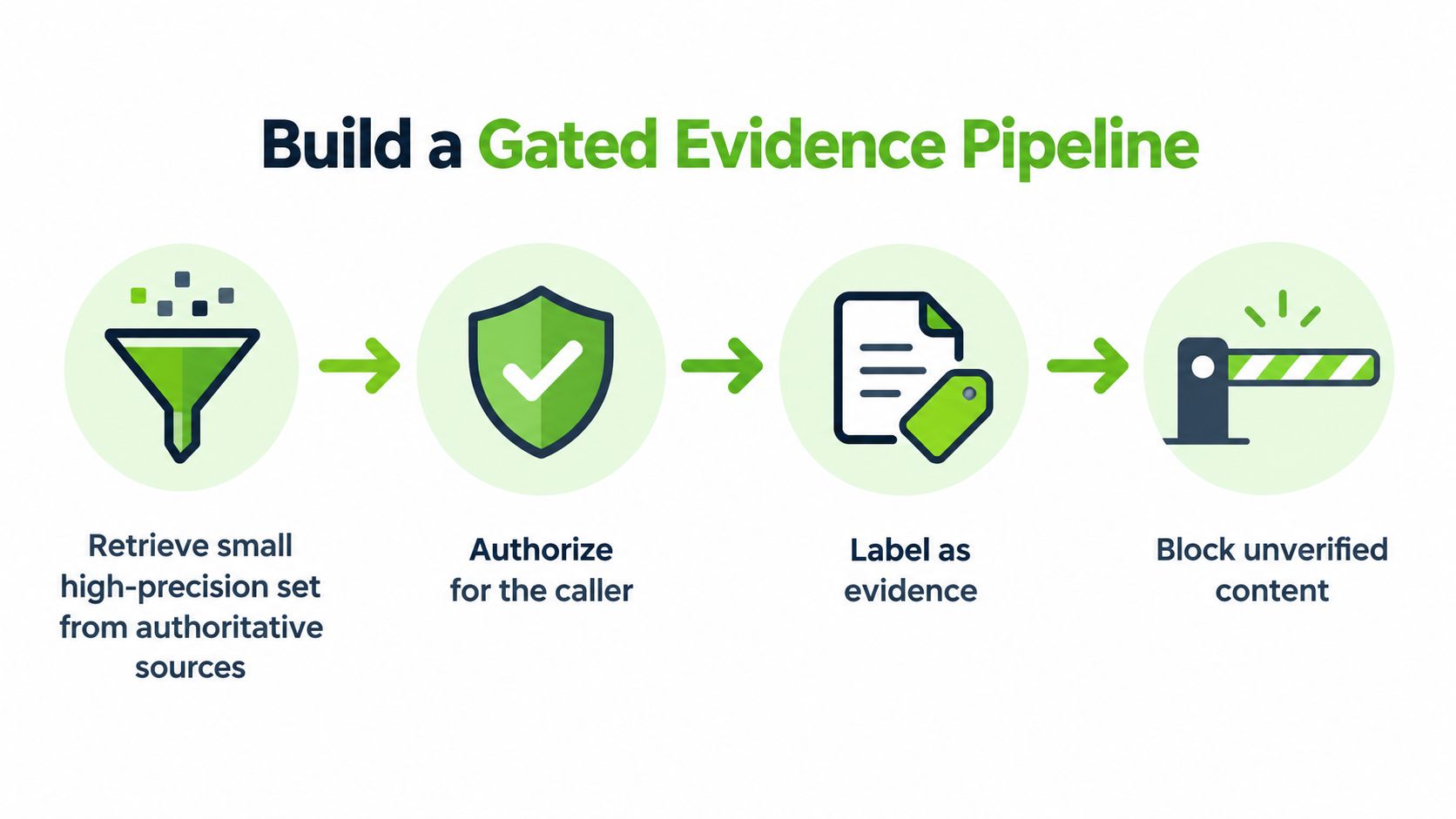
Build the pipeline so unsupported material can be stopped before delivery. The architecture should expose a policy gate, retrieval gate, generator, claim map, verifier, delivery gate, and audit log as explicit responsibilities, even if some initially share a service.
The evidence boundary begins before generation.
Prepare evidence with a defined scope
Resolve the caller and request purpose at the policy gate. Retrieve a small, high-precision evidence set from approved sources, then validate that every selected passage is authorized and applicable before constructing context.
Represent passages as labeled evidence objects, not anonymous text. Useful fields include source identity, document version, passage location, tenant scope, effective status, and retrieval decision. Pass only the material needed for the current task.
A practical introduction to grounding and why it matters helps distinguish evidence-conditioned generation from merely placing documents beside a prompt.
Require atomic claims and provenance
Ask the generator to produce an answer alongside an inspectable claim map. Break compound assertions apart so an unsupported conclusion can't hide behind a supported clause.
For a hypothetical refund response, separate:
- Policy fact: The policy permits refunds when its stated eligibility conditions hold.
- Account fact: The authorized account record establishes whether those conditions hold.
- Recommendation: A human review may be appropriate when a required fact is unresolved.
- Action status: A refund hasn't occurred unless the execution system confirms it.
Bind each externally verifiable claim to supporting passages or canonical records. Label recommendations as recommendations. Don't let an inferred suggestion appear as a cited entitlement.
A citation should identify the evidence for a claim, not decorate the paragraph containing it.
Verify independently and control delivery
The survey of hallucination mitigation and verification methods supports combining pre-generation retrieval with post-generation checking. It also describes Chain-of-Verification, which separates verification questions from the original generation before revising the answer.
Implement that separation deliberately. Give the verifier the claim, relevant evidence, and acceptance criteria rather than asking whether the whole draft sounds correct. Check unsupported additions, contradictions, missing prerequisites, and scope.
Then apply an explicit delivery decision:
- Revise when an overbroad claim can be narrowed to the evidence.
- Retrieve again when an identifiable evidence gap can be resolved.
- Suppress or abstain when support remains missing, stale, contradictory, or out of scope.
- Escalate when the unresolved issue requires business judgment.
Preserve the original draft, revisions, evidence IDs, and decisions in the audit record. For organizing investigations into repeatable documentation, the Verbex guide to lab root cause docs is a useful companion resource.
Verification adds work and latency, and the verifier can still miss errors. The defensible claim is that the pipeline makes acceptance criteria explicit and failures inspectable, not that another model pass guarantees truth.
Choose Verification and Abstention Controls
Grounded generation, verification, abstention, escalation, and self-consistency address different problems. Deploying all of them indiscriminately can create an expensive system that still refuses the wrong requests.
Grounded generation supplies evidence. Verification tests whether claims follow from it. Calibrated abstention decides when the system should withhold an answer. Human escalation handles unresolved stakes, while self-consistency supplies a behavioral warning signal.
Choosing Hallucination Controls by Failure Risk
| Situation | Primary control | Required evidence | Operational trade-off |
|---|---|---|---|
| Answerable factual request | Grounded generation | Applicable, authorized passages | Retrieval and source-maintenance work |
| Draft includes unsupported assertions | Independent verification | Atomic claims and supporting passages | Additional latency and verifier errors |
| Evidence is insufficient | Calibrated abstention | Held-out answerability labels and decision features | Missed answers versus unsupported responses |
| Request is ambiguous | Targeted clarification | Known facts and unresolved dimensions | Another interaction before resolution |
| High-stakes uncertainty | Human escalation | Evidence package and unresolved decision | Reviewer capacity and response delay |
| Answers vary across samples | Self-consistency triage | Independently sampled responses | Sampling cost without factual proof |
A generic instruction to admit uncertainty isn't a calibrated decision policy. AbstentionBench evaluated 20 frontier models across 20 datasets covering different abstention conditions and found that abstention remained unresolved; reasoning fine-tuning reduced performance by 24% on average, while scaling offered little benefit. Those findings concern that evaluation protocol, not every production deployment.
Match the response to the uncertainty
For an answerable request, return the supported answer. For an unanswerable request, state the evidence limitation without inventing a completion.
An ambiguous request usually needs clarification, not a blanket refusal. A false-premise request needs a supported correction. Stale evidence requires a current source or a clear temporal limitation. A subjective request can receive a labeled judgment without pretending that preference is an objective fact.
Treat uncertainty in artificial intelligence as an input to product behavior, not just wording.
Self-consistency has a narrower role. SelfCheckGPT uses disagreement across sampled responses to detect potentially non-factual content without an external database. Agreement still isn't proof: repeated samples can repeat the same falsehood.
Choose thresholds against evidence sufficiency and business risk. Refusing too little permits unsupported claims; refusing too much creates harmful refusals and reviewer workload. Neither failure disappears merely because the answer sounds cautious.
Protect Evidence and Action Boundaries
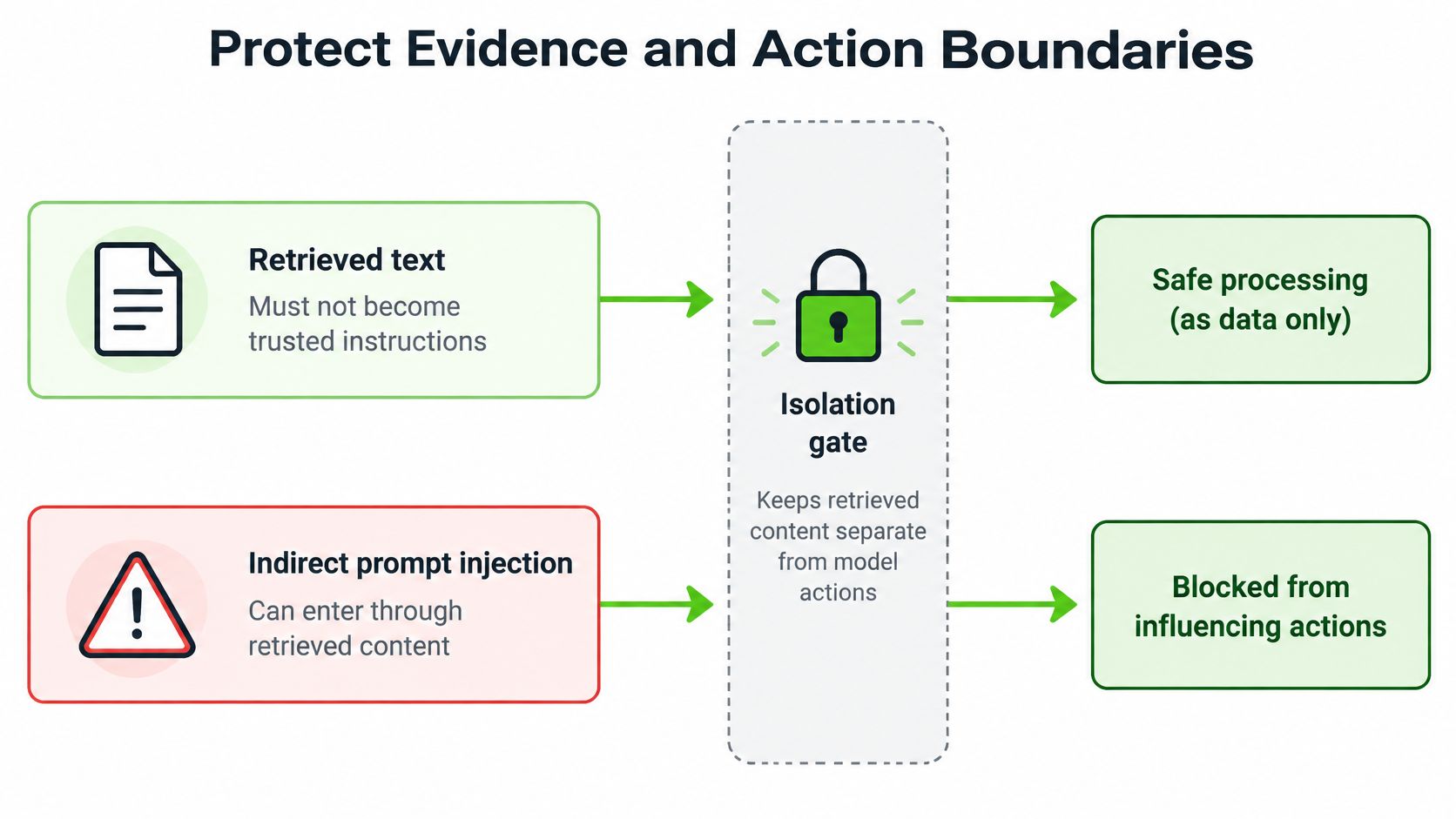
Retrieved content is data, not application policy. An attacker-controlled document can contain relevant support information alongside instructions to disclose private material or invoke an unauthorized function.
The OWASP prompt injection prevention guidance explicitly covers poisoned vector-database documents and manipulated retrieval results. It also states that RAG and fine-tuning don't fully mitigate prompt injection.
The security boundary must remain visible even when the retrieved document looks ordinary.
Enforce isolation before context construction
Separate authenticated application instructions from labeled evidence objects. Filter retrieval by tenant, user, document permissions, and purpose of use before assembling model context.
Don't place another tenant's secret in context and expect an instruction to protect it afterward. The application should prevent unauthorized exposure at the retrieval boundary, including any subsequent evidence fetched through tools.
Test indirect injections in retrieved files, poisoned documents, and tool responses, alongside direct user attacks. Preserve provenance so investigators can identify which object introduced the malicious content.
Security boundary: The model may interpret evidence, but evidence must not redefine the model's authority.
Keep execution outside model authority
For an agent, a supported statement and an authorized operation are separate decisions. A refund recommendation doesn't grant permission to issue the refund.
OWASP's documented prompt injection consequences include sensitive-information disclosure, unauthorized access to connected functions, and arbitrary command execution. Protect the action path with an independently authenticated policy service.
Before execution, require that service to verify identity, tenant scope, permissions, required approvals, and current canonical state. Validate the tool name and argument schema, use narrowly scoped credentials, and allowlist operations.
- Reject unavailable tools: Don't interpret invented operation names as executable intent.
- Check arguments independently: A valid schema doesn't establish business permission.
- Record the decision: Log the requester, evidence references, policy result, and resulting state change.
- Fail closed: If authorization or canonical state can't be established, withhold execution.
Among implementation options, AletheionAGI's GQueries serves as a grounding and evidence-control layer alongside existing LLMs, RAG pipelines, vector databases, and memory systems. Its stated scope includes authorized retrieval, claim-level validation, provenance, and fail-closed grounding rather than replacing those components.
That layer doesn't remove the application owner's responsibility for credentials, tenant policy, or action authorization. Keep those responsibilities explicit in service interfaces and operational ownership.
Evaluate Claims Instead of Final Answers
A reproducible evaluation must explain what was tested, what counted as failure, and which system produced the result. A headline accuracy score can't show whether an improvement came from better evidence use or refusing more requests.
Freeze a domain-stratified test set containing answerable, unanswerable, ambiguous, false-premise, stale, multi-tenant, and adversarial cases. Preserve expected evidence and permitted behavior, not just a reference paragraph.
Define the denominators before running tests
Use the RAG evaluation framework as a starting point for separating retrieval, generation, and operational decisions. Then make each metric's unit explicit.
| Metric | Denominator or evaluation unit |
|---|---|
| Retrieval recall | Required authorized passages in the labeled reference set |
| Evidence sufficiency | Requests requiring evidence |
| Claim entailment | Externally verifiable generated claims |
| Citation correctness | Claim-to-citation associations |
| Contradiction and unsupported-claim rates | Evaluated factual claims |
| Instruction adherence and state consistency | Applicable requests or turns |
| Tool validity | Proposed tool calls |
| Hallucination rate | Responses, reported separately by answerability |
| False-abstention rate | Answerable requests |
| Latency and escalation burden | Requests and routed cases, with aggregation disclosed |
Report both claim-level and response-level outcomes. A response containing several correct statements and an unsupported eligibility claim shouldn't disappear inside an average.
Interpret benchmark results within their scope
A public RAG hallucination benchmark reported that a naïve configuration hallucinated on 100% of 12 unanswerable questions; a calibrated similarity-threshold abstention check reduced that rate to 8.3%, with 8.7% false abstention across 23 answerable questions. The denominators are small, and the result belongs to that configuration and test set, not RAG systems generally.
The operational lesson is to evaluate the refusal trade-off explicitly. Don't copy the threshold and assume it transfers to a different corpus, domain, or risk level.
- Calibrate separately: Use held-out data for thresholds, not the final test set.
- Version dependencies: Record the model, prompt, index, source snapshots, tool schemas, verifier, and abstention configuration.
- Test distribution shifts: Include changed terminology, expired policies, unfamiliar request types, and adversarial evidence.
- Disclose limitations: Publish the protocol, denominator, versions, and excluded cases alongside any production claim.
Turn failures into regression artifacts
For each failed case, preserve the request, authorized source set, retrieved passages, claim map, expected behavior, observed decision, and earliest broken boundary. Assign an owner and add the smallest reproducible case to the regression suite.
Track unauthorized retrieval separately from unauthorized delivery and unauthorized execution. Otherwise, a final-output filter can conceal an earlier isolation failure without repairing it.
Operationalize Controls with Runbooks
Before launch, require evidence that the gates work, not merely that the services are deployed. Release reviewers should see authorized retrieval tests, captured claim provenance, calibrated verifier and abstention decisions, tenant-isolation results, validated tool schemas, external action authorization, populated dashboards, and replayable traces.
Assign an owner to each boundary and a responder to each failure class. For organizing trigger-to-action procedures, CapyScout's explanation of how playbooks work provides a useful operational reference.
Contain first, then reproduce
Use runbooks that specify the immediate action, evidence to preserve, and recovery condition.
| Observable signal | Containment and investigation |
|---|---|
| Low retrieval relevance | Stop unsupported answering; preserve query transformations and ranked results; replay against the frozen index |
| Unsupported claims | Suppress affected claims; retain drafts and claim maps; reproduce the support-check failure |
| Contradictory evidence | Abstain on the disputed conclusion; preserve source versions; route authority resolution to the source owner |
| Unexpected tool calls | Block execution; retain proposed names, arguments, and policy decisions; inspect schema and permission handling |
| Cross-tenant exposure | Isolate the affected path; restrict sensitive traces; involve security and reproduce with synthetic tenant fixtures |
| Rising false abstention | Preserve decisions and thresholds; inspect answerable-case slices before changing policy |
| Verifier disagreement | Withhold high-stakes delivery; retain verifier inputs; escalate unresolved evidence judgments |
Don't fall back to ungrounded answers during retrieval outages in sensitive workflows. Offer a bounded failure message, clarification path, or human handoff instead.
Make recovery an owned decision
Reproduce incidents with recorded versions and appropriately protected evidence. Revise when the answer can be narrowed, suppress unsupported additions, abstain when evidence remains insufficient, and escalate when policy ownership or business judgment is required.
Keep a compact release checklist across functions:
- Product: Define acceptable answer, clarification, abstention, and escalation behavior.
- Engineering: Demonstrate replayability, regression coverage, and controlled delivery.
- Security: Verify isolation, injection handling, credentials, and action-policy enforcement.
- Compliance: Review evidence retention, access, provenance, and decision records.
Knowing how to reduce hallucinations in LLM systems means maintaining these controls as sources, models, and policies change. Monitoring and incident ownership matter as much as the initial architecture. Treat every release as another test of an ongoing control system, not proof that a prompt or model setting finished the job.
AletheionAGI offers grounding and memory infrastructure through GQueries, with authorized retrieval, claim-level validation, provenance, and fail-closed delivery controls that complement existing AI stacks. Visit AletheionAGI to explore how an evidence-control layer could fit your RAG or agent architecture, and bring a concrete failure case, authorization boundary, and evaluation protocol to the discussion.