
The most popular advice on instruction following is to compare models on a leaderboard and choose the highest score. That advice is incomplete. A score without its verifier, denominator, prompt distribution, evaluator version, and failure cases is not evidence of general reliability. It is evidence that a model performed under one measurement protocol.
For teams building agents, RAG systems, customer support automation, and applications handling sensitive or multi-tenant data, that distinction is operational. A model can satisfy a formatting rule while citing unauthorized evidence, preserve a requested tone while violating a tenant boundary, or answer the latest turn while forgetting a policy established earlier. Instruction-following evaluation for large language models is therefore a reproducibility and limits-disclosure problem before it becomes a leaderboard problem.
Why Instruction-Following Evaluation Is a Measurement Problem
A benchmark score answers a narrow question: how often did a particular system satisfy the conditions defined by this particular test? It doesn't automatically answer whether the model will follow unseen instructions, preserve constraints across a conversation, use only authorized evidence, or fail safely when a request is underspecified.
The distinction resembles laboratory measurement. A result is only interpretable alongside the instrument, calibration, sample, and procedure. In instruction-following evaluation, the instrument is the verifier or judge, the sample is the prompt distribution, and the procedure includes decoding settings, preprocessing, retries, and denominator rules.
IFEval helped establish this measurement discipline in 2023. Its design used 25 types of verifiable instructions and roughly 500 prompts, including objectively checkable requirements such as minimum word counts and keyword inclusion. That emphasis reduced dependence on subjective human judgment and made comparisons easier to reproduce across systems. The benchmark's historical contribution was not that it settled instruction following. It made the unit of analysis more explicit, moving evaluation toward reproducible constraint-level checks (the IFEval benchmark documentation).
Demonstrated behavior is narrower than claimed capability
Suppose two models receive the same aggregate score. That result may conceal different profiles. One model may pass simple lexical constraints but fail when constraints interact. Another may miss exact formatting while preserving policy and evidence boundaries. An aggregate score treats those failures as interchangeable unless the report separates them.
A defensible report should state:
- What was scored: prompt, instruction, constraint, turn, tool action, or final answer.
- What counted as success: exact predicate, rubric threshold, judge decision, or human adjudication.
- What entered the denominator: all cases, only parseable outputs, or only evaluated items.
- What was excluded: missing responses, judge failures, malformed JSON, retries, and ambiguous cases.
- What the test does not establish: generalization to unseen constraints, production safety, or multi-turn retention.
Practical rule: Never write “the model follows instructions reliably” when the evidence only supports “the model passed this defined test slice under this protocol.”
This is especially important for grounded systems. Instruction compliance must be evaluated together with claim validation, provenance, retrieval authorization, cross-tenant isolation, and fail-closed behavior. A response that follows the requested format but introduces unsupported claims is not a successful production action. Its surface compliance is real, but its operational compliance has failed.
What Counts as a Verifiable Instruction
A verifiable instruction has a satisfaction condition that an evaluator can express as a finite, inspectable check. The check may be exact or approximate, but its rule must be stated before scoring. “Write a useful answer” is not directly verifiable without a rubric. “Return valid JSON with a status field” is much easier to test.
The central design principle is decomposition. Convert a compound prompt into atomic requirements, then define a predicate for each requirement. The evaluator should be able to say which constraint passed, which failed, and which could not be scored.
Format constraints
Format rules govern the shape of the response rather than its meaning.
Example instruction: “Return valid JSON with exactly two top-level fields, answer and evidence.”
Possible predicates include:
- The response parses as JSON.
- The top-level value is an object.
- The key set equals the required key set.
evidenceis an array.- No prose appears outside the JSON object.
A length rule can be equally concrete: “Use at least one paragraph and no more than the permitted response length.” The evaluator must define whether it counts characters, tokens, words, or visible lines. Otherwise, two implementations may report different results for the same output.
Lexical constraints
Lexical rules test required or prohibited strings, casing, language, or punctuation.
Example instruction: “Include the term retention policy, avoid the word guaranteed, and write the answer in English.”
Checks can test:
- Required-term presence after normalization.
- Prohibited-term absence.
- Case-sensitive or case-insensitive matching.
- Language identification.
- Whether the response contains an unintended translation or script switch.
These checks are transparent, but they don't prove semantic correctness. A model can include a required term in an irrelevant sentence. The lexical predicate should therefore remain separate from any content or grounding judgment.
Structural constraints
Structural requirements define ordering and organization.
Example instruction: “Use the headings Decision, Risks, and Next steps, in that order, with bullets under Next steps.”
The evaluator can verify heading presence, heading order, section boundaries, and bullet structure. A parser should distinguish a genuine heading from text that merely contains the same word. Tests also check whether the response wraps content in an unexpected preamble that breaks downstream ingestion.
Content constraints
Content rules concern entities, references, exclusions, or claims.
Example instruction: “Mention the approved policy identifier, don't name any customer, and cite only evidence returned for the current tenant.”
The first condition may be machine-checkable if the identifier is known. The second requires entity detection or a reviewed list of prohibited identifiers. The third is not a simple string test. It requires provenance-aware evaluation that compares cited evidence with the authorized retrieval set.
| Constraint Family | Example Instruction | Check Type |
|---|---|---|
| Format | Return valid JSON with the required fields | Parser and schema predicate |
| Lexical | Include retention policy and avoid guaranteed |
Required and prohibited token checks |
| Structural | Use named headings in a specified order | Ordered section and nesting checks |
| Content | Include an approved identifier and exclude customer names | Entity and reference validation |
| Evidence boundary | Use only authorized tenant evidence | Retrieval-set and provenance comparison |
Grounding adds an important distinction. A response can satisfy the visible instruction while violating the evidence boundary behind it. Teams evaluating grounding and why it matters for AI systems should therefore score instruction predicates and evidence predicates separately. Combining them into one opaque pass rate makes remediation harder.
Major Benchmark Families and How They Differ
Instruction-following benchmarks differ along verifiability, granularity, and interaction depth. Those axes are more useful than a single leaderboard because they identify what the evaluator can observe and what it leaves outside the test.
IFEval represents a narrow, single-turn verifiable family. Its checks are deterministic and well suited to format, lexical, and other explicit constraints. FollowBench, introduced in 2023, contains 820 curated instructions spanning over 50 NLP tasks and uses multi-level constraint difficulty. InFoBench uses 500 diverse instructions decomposed into 2,250 questions, which reflects a move toward scoring requirement satisfaction at a finer level (the InFoBench findings).
AgentIF moves toward agentic realism. Its 2025 benchmark contains 707 instructions across 50 real-world agentic applications, and its authors report that even the best-performing model follows fewer than 30% of instructions perfectly. The denominator matters here. “Fewer than 30% perfectly” is an instruction-level result, not a claim that fewer than 30% of individual constraints were satisfied. A model may partially comply with many instructions while failing the complete set (the AgentIF benchmark report).
| Benchmark Family | What It Measures | Scoring Method | Key Limitation |
|---|---|---|---|
| Verifiable single-turn | Explicit format, lexical, and structural constraints | Deterministic predicates per response | Can overrepresent simple, visible rules |
| Decomposed | Satisfaction of atomic requirements within compound prompts | Constraint-level or question-level scoring | Partial success can look stronger than full-task success |
| Multi-level | Performance across increasing constraint difficulty | Tiered checks or rubric levels | Difficulty bands may not match production complexity |
| Rubric-based | Semantic quality, policy alignment, and complex behavior | Human or LLM judge against a reference rubric | Judge variance and rubric interpretation |
| Agentic | Instruction adherence across applications, tools, and action sequences | Task, step, or process-level evaluation | Tool state, environment, and recovery behavior complicate attribution |
The families also carry different denominator choices. A single-turn suite may report the share of prompts whose predicates pass. A decomposed suite may report the share of atomic questions satisfied. An agentic evaluation may score a complete workflow, individual tool calls, or the final state. These numbers shouldn't be compared as though they measure the same event.
A benchmark family is a measurement instrument, not a universal scale. Choose it according to the failure you need to expose.
For model selection, evaluation teams can use this map alongside a broader resource to find the right AI model for your workload. The model decision still needs a workload-specific protocol. A comparison tool can narrow candidates, but it can't define whether your application values evidence authorization, cross-turn retention, refusal behavior, or exact schema compliance.
Metrics for Instruction Compliance
Metric choice determines what the organization learns from a run. Rule-based verification is appropriate when the requirement has a stable predicate. A JSON parser can establish whether output is syntactically valid. It can't determine whether a support explanation is faithful to an approved policy unless the system supplies a semantic rubric or structured evidence comparison.
LLM-as-judge methods handle nuance, but they introduce another model, another prompt, and another source of variance. The judge may reward fluent explanations, overlook subtle policy violations, or react to formatting rather than substance. A credible report names the judge model and version, provides the rubric, and tests judge decisions against masked human labels.
| Metric Family | Mechanism | Strength | Failure Mode |
|---|---|---|---|
| Rule-based compliance | Parser, matcher, schema validator, or deterministic predicate | Auditable and repeatable | Blind to meaning and pragmatic intent |
| LLM-as-judge | Judge model evaluates an answer against criteria | Handles nuanced semantic behavior | Judge bias, prompt sensitivity, and version drift |
| Constraint-level satisfaction | Scores each atomic requirement | Reveals partial compliance and failure locations | Can inflate results when easy constraints dominate |
| Prompt-level pass rate | Requires the whole prompt to pass | Matches strict task completion | Hides which constraint caused failure |
| Decomposed multi-aspect score | Aggregates several categories such as policy, evidence, and style | Separates operational dimensions | Aggregation choices can obscure serious failures |
The denominator problem is easiest to see with a compound instruction containing many requirements. A system may pass most low-risk formatting checks and fail one authorization constraint. A constraint average can remain high even though the failed condition should block the action. Prompt-level pass or fail exposes that operational failure, but it can be too harsh for diagnostic analysis.
Use reporting tiers rather than choosing one metric:
- Constraint level: Which requirements passed?
- Prompt level: Did the complete instruction pass?
- Task or workflow level: Did the application reach an acceptable state without violating policy?
- Risk level: Did any critical failure trigger abstention or a fail-closed path?
Negative controls and paired perturbations improve interpretation. Remove a required condition, change a tenant identifier, reorder constraints, or insert irrelevant content. The evaluator should detect the intended difference. If the score stays unchanged, the benchmark may not be testing the control it claims to test.
For semantic accuracy, teams need a protocol that distinguishes factual correctness from persuasive fluency. A useful companion is this discussion of how artificial intelligence accuracy should be evaluated, provided that its concepts are translated into explicit predicates and disclosed limitations.
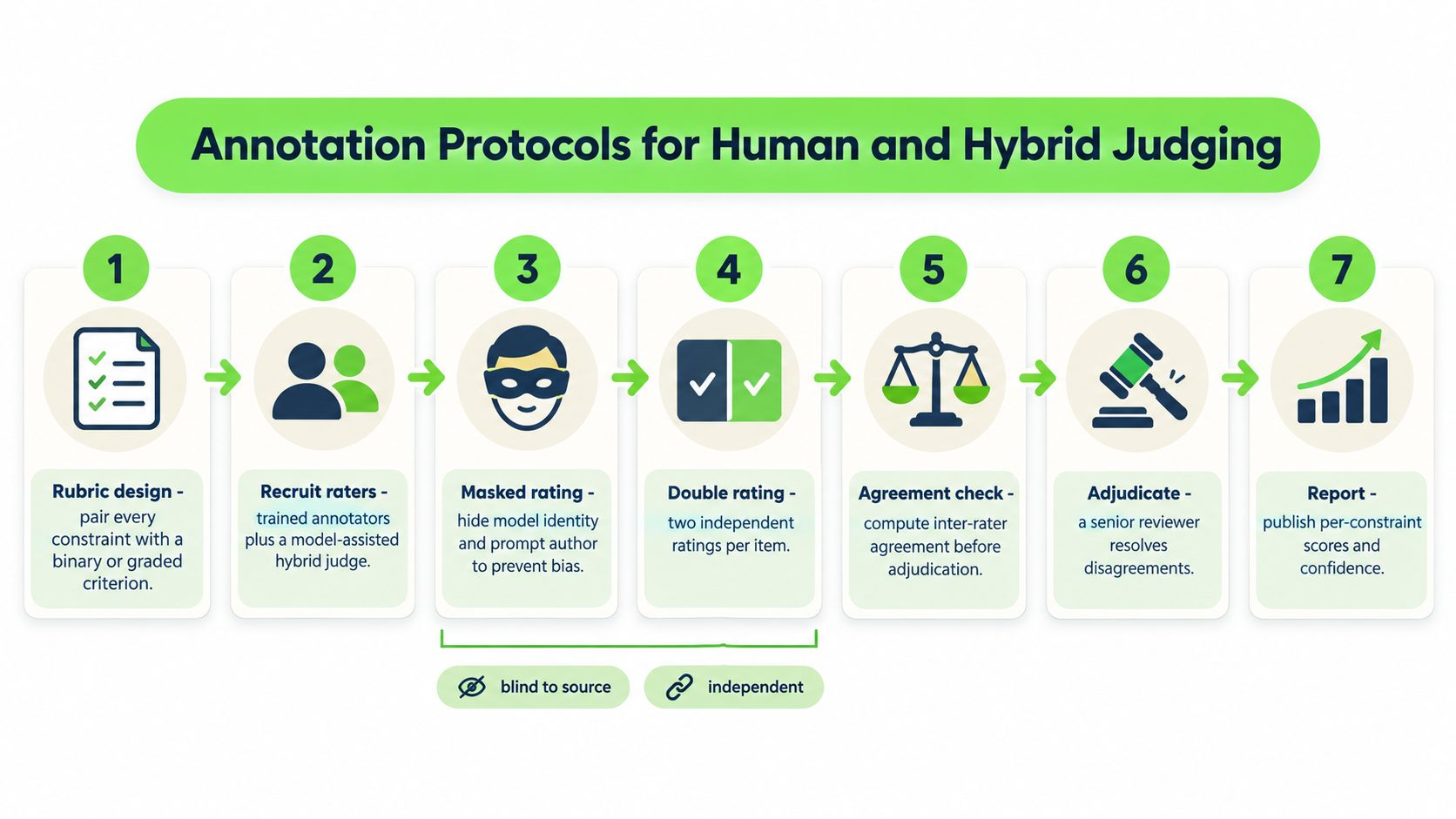
Annotation Protocols for Human and Hybrid Judging
Human annotation becomes necessary when a response can satisfy the literal wording while violating the intended meaning. The solution isn't to replace rules with an unexamined model judge. It is to define a controlled handoff between deterministic checks and semantic review.
Start by pairing every constraint with a criterion. A binary criterion might ask whether the answer contains an unauthorized customer identifier. A graded criterion might assess whether a refusal explains the limitation without revealing restricted information. The rubric should define what counts as pass, borderline, fail, and unscored.
Build the labeling record before collecting labels
A useful record stores the prompt, applicable constraints, model output, evaluator result, evidence references, rater decisions, disagreement reason, adjudication outcome, and protocol version. Provenance matters because later reviewers need to know whether a label came from a parser, a human, or a judge model.
Use independent ratings with masked model identity and prompt authorship. Masking reduces the risk that a rater's expectations about a vendor, model family, or experiment influence the decision. Calibration should occur on a shared gold set before live labeling, with examples that include clear passes, clear failures, and ambiguous cases.
A practical hybrid pipeline looks like this:
- Deterministic stage: Parse JSON, check required fields, inspect lexical rules, and validate references against an allowed set.
- Semantic stage: Review policy alignment, factual support, intent preservation, and whether the response should abstain.
- Escalation stage: Send disagreements or high-impact failures to a senior adjudicator under a documented tie-breaking rule.
- Reporting stage: Publish agreement, unresolved ambiguity, per-constraint outcomes, and the provenance of each label.
The evaluator should preserve disagreement rather than erase it through forced consensus. If two raters disagree because the rubric is underspecified, that is a protocol defect. If they disagree because the output sits near a meaningful boundary, the report should expose that uncertainty.
The required workflow can be summarized as:
- Design the rubric.
- Recruit and train raters.
- Mask source identity.
- Collect independent ratings.
- Check agreement.
- Adjudicate disagreements.
- Report scores and confidence.
A model-assisted judge can accelerate semantic review, but it shouldn't silently become the ground truth. Record its prompt, model version, output, and escalation rules. For sensitive applications, retain the original evidence context so a reviewer can determine whether a decision was grounded in authorized material or merely sounded plausible.
Overfitting, Generalization, and Hidden Limits
A high score on a frozen benchmark is weak evidence of general instruction control unless the protocol tests whether the behavior survives changed wording, constraint combinations, and task conditions. The score may reflect genuine capability, familiarity with the benchmark's constraint vocabulary, or both. A model can learn how a suite expresses requirements without reliably controlling unseen instructions.
IFBENCH targets this limitation with 58 out-of-domain constraints and reports overfitting to a small set of established constraints. Existing scores remain useful, but their scope must be stated precisely: in-distribution performance demonstrates behavior on that distribution, not general control of instructions. The same analysis reports that IFScale's best frontier models reach only 68% accuracy at 500 instructions in a business-report task. That result supports caution about dense workloads, while its denominator and task definition limit how far the finding can be generalized (the IFBENCH discussion of out-of-domain constraints).
Stress the protocol, not just the model
A generalization suite should preserve the underlying task while varying how constraints are expressed and combined. Useful perturbations include:
- Paraphrasing an instruction without changing its requirement.
- Reordering constraints.
- Adding irrelevant or distracting context.
- Combining positive and negative constraints.
- Introducing conditional requirements.
- Testing an unseen output format.
- Moving a critical policy rule into an earlier turn or system message.
The evaluator must separate model failure from harness failure. If a paraphrase defeats a brittle checker, the result measures evaluator stability rather than instruction following. Maintain a versioned test harness and manually audit a sample of modified cases, especially where a parser determines pass or fail.
Instruction density exposes another boundary. Compliance can decline as requirements accumulate, but a result from one business-report workload does not establish a universal accuracy rate for production prompts. It does establish a testable concern: sparse benchmark prompts can conceal failures that appear when operational workflows combine many constraints.
Cross-suite rank changes provide another diagnostic. A model may rank differently on a lexical suite, an unseen-constraint suite, and a multi-turn task because those suites measure different properties. Such divergence should remain visible in the report. It indicates that “instruction following” is a collection of capabilities, not a single scalar trait, and that grounded evidence from several protocol layers is more informative than one leaderboard position.
Reproducible Benchmark Runs and Honest Reporting
A reproducible run begins before the model generates an answer. Freeze the prompt strings, constraint definitions, dataset version, retrieval state, evaluator code, and model revision. Lock serving parameters and decoding controls. Pin library dependencies, record the execution environment, and capture a random seed where the stack supports meaningful seed control.
The protocol should make every denominator visible. Report results per constraint type, per prompt, and per task or workflow. Keep separate counts for missing responses, malformed outputs, evaluator errors, timeouts, and items that could not be scored. Dropping difficult or unparseable cases changes the population under measurement.
Minimum release envelope
A useful benchmark package should contain:
- Dataset and prompt hashes.
- Versioned constraint definitions.
- Evaluation code and environment files.
- Model revision and serving configuration.
- Judge prompts and judge version.
- Parser behavior for malformed outputs.
- Retry and timeout policy.
- Per-item results, not only the aggregate.
- Failure taxonomy and known metric limitations.
- Variance or uncertainty reporting appropriate to the sampling design.
Prompt contamination deserves explicit treatment. State whether prompts were checked against known training or evaluation corpora, and describe what that check can and can't establish. A contamination check is evidence about test exposure, not proof that no related examples influenced a model.
For LLM-as-judge runs, report the judge identity and version, rubric text, scoring scale, and any calibration or human comparison. A judge update can change results without any change in the evaluated model. The same applies to retrieval. If the system uses RAG, freeze the corpus snapshot, chunking, ranking configuration, authorization policy, and evidence presented to the generator.
A score is reproducible only when another team can reconstruct the conditions that produced it, including the cases you didn't score.
Teams designing a broader LLM evaluation protocol should treat the limitations paragraph as a first-class artifact. State whether the run supports claims about exact compliance, semantic quality, evidence grounding, multi-turn retention, or production reliability. It rarely supports all of them at once.
Multi-Turn, Sequential, and System-Level Instructions
Single-turn evaluation checks a local relationship between one prompt and one response. Production systems maintain state. A user may establish a preference, add a restriction, change an authorized scope, or ask the assistant to act through a tool. The failure can occur when the model answers correctly now but forgets a requirement established earlier.
A multi-turn protocol should score at least three distinct properties:
- Per-turn adherence: Did the response satisfy the active requirements for that turn?
- Cross-turn consistency: Did the model preserve earlier instructions that remained in force?
- Cumulative satisfaction: Did the complete session maintain all applicable constraints?
Order matters when a protocol claims sequential reasoning. Reorder independent instructions as a control. For dependent instructions, test whether the model applies the earlier result to the later step. A final-answer-only check can miss an intermediate tool call that exposed restricted data or applied the wrong tenant context.
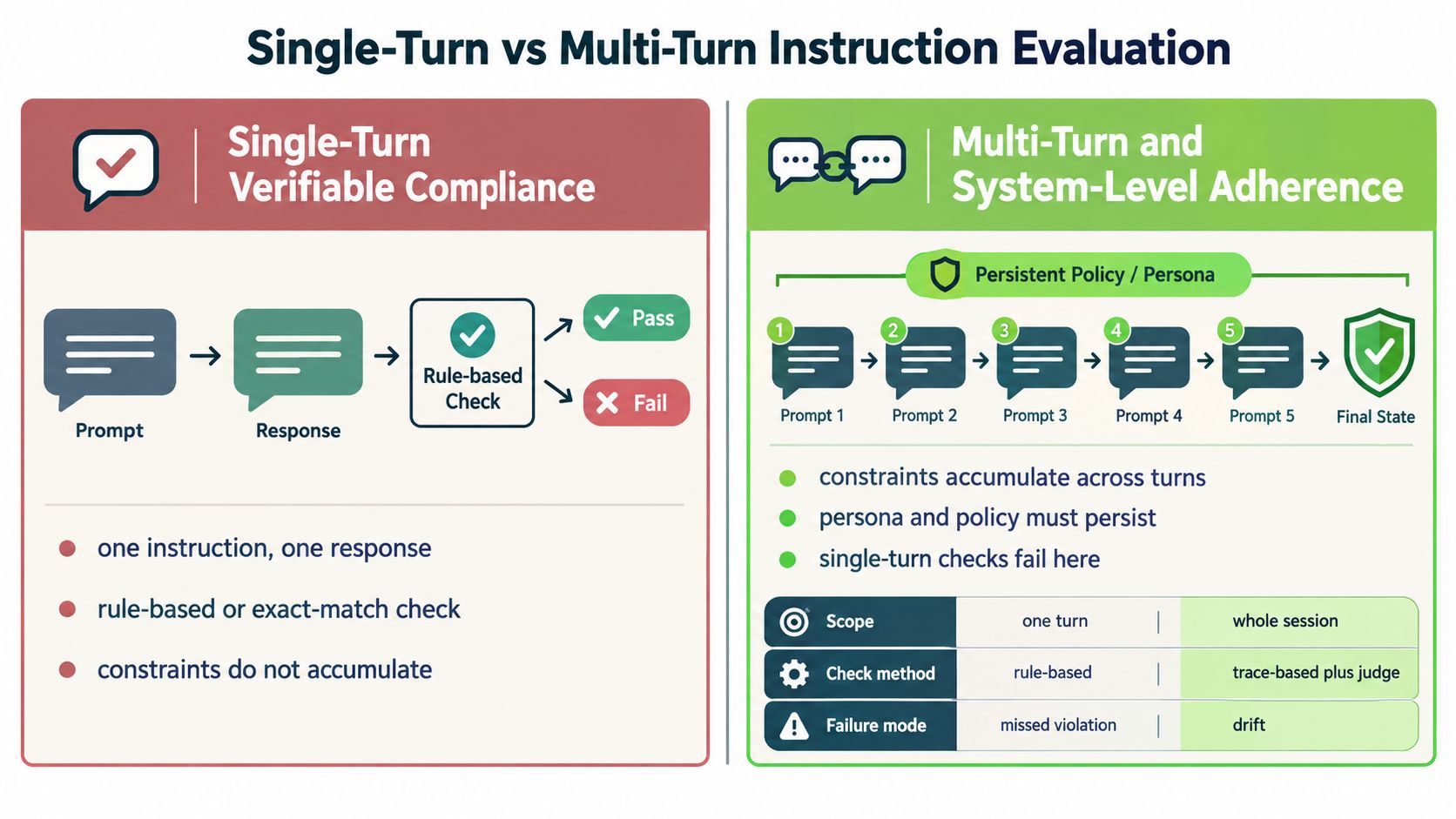
System-level instructions require different evidence. Persona persistence, refusal behavior, policy alignment, and authority boundaries are rarely captured by exact lexical checks. Rubric-based judgment can assess them, but the rubric must specify whether the model should refuse, ask for clarification, use authorized evidence, or abstain.
Recent work illustrates the move toward richer protocols. Meta's AdvancedIF reports more than 1,600 prompts with expert-curated rubrics for complex, multi-turn, and system-level instructions, and reports a 6.7% absolute gain from rubric-based instruction-following learning. Those results describe that benchmark and training method. They don't establish a universal production improvement or resolve judge dependence (the AdvancedIF research).
Many decomposed benchmarks still assume a cooperative session with clean text inputs. Agentic systems add tool errors, stale state, authorization changes, retries, and competing policies. Evaluation should capture the trace, not only the final response. A system that reaches the correct final wording after an unauthorized intermediate action has not demonstrated safe instruction following.
From Evaluation to Production Decisions
A production decision should connect benchmark evidence to a defined risk. Start with out-of-distribution constraints, prompt-injection probes, distraction cases, and abstention tests. For RAG and agentic applications, add unauthorized retrieval attempts, tenant-identifier substitutions, stale evidence, conflicting policy layers, and tool actions that should be blocked.
Treat evaluation as a feedback loop:
- Classify failures by constraint, risk, and stage.
- Add representative failures to the red-team set.
- Clarify ambiguous rubrics.
- Re-run the frozen baseline and the changed system.
- Promote only through a gated decision with an explicit limits statement.
A pass should authorize the next experiment, not certify universal reliability. Claims need scope: the constraint class, prompt distribution, evaluator, denominator, and evidence boundary. A model may be suitable for drafting grounded support summaries while remaining unsuitable for autonomous account changes.
Grounding layers fit into this evaluation pipeline without replacing the language model, RAG stack, vector database, or memory system. The layer can be evaluated for whether it retrieves authorized evidence, preserves provenance, blocks unsupported assertions, and returns an abstention when the evidence is insufficient. That gives the production team separate measurements for language behavior and evidence control.
The most useful deployment record is therefore not a rank. It is a decision log showing which failures remain, which controls contain them, and what behavior triggers a fail-closed response.
Quick Reference of Benchmarks and Terminology
Use the following table as a lookup artifact rather than a ranking.
| Benchmark Family | What It Measures | Scoring | Disclosed Limits |
|---|---|---|---|
| Verifiable single-turn | Explicit, machine-checkable constraints | Predicate pass or fail | May favor visible templates and narrow formats |
| Decomposed | Atomic requirements within a compound instruction | Per-question or per-constraint satisfaction | Partial compliance may obscure complete-task failure |
| Multi-level | Constraint difficulty and layered requirements | Tiered or level-based scoring | Difficulty may not represent production context |
| Rubric-based | Semantic, behavioral, and policy-sensitive adherence | Human or LLM judge against criteria | Judge variance and rubric interpretation |
| Agentic | Instructions across tools, applications, and workflows | Step, task, or trace-level scoring | Environment and tool-state effects complicate attribution |
Glossary
Instruction following: Observable adherence to a stated requirement under a defined protocol. Test it by identifying the requirement and the pass condition before generation.
Verifiable constraint: A requirement whose satisfaction can be checked by a finite rule, parser, comparison, or explicit rubric. Test it by writing the predicate independently of the model output.
Constraint-level satisfaction: The proportion of atomic requirements that pass. Test it by scoring each decomposed requirement separately.
Prompt-level satisfaction: Whether the complete instruction passes all required checks. Test it by applying a strict all-required-conditions rule.
Decomposition: Splitting a compound instruction into atomic requirements. Test it by checking whether each item has a distinct outcome and failure reason.
Adjudication: A documented procedure for resolving disagreement between independent raters or evaluators. Test it by reviewing the disagreement record and final decision authority.
Fail-closed grounding: A behavior in which the system declines, blocks, or routes an action when authorized evidence is missing or insufficient. Test it with unsupported claims, unauthorized tenant evidence, and ambiguous retrieval results.
Reproducibility artifact: The versioned data, code, prompts, model settings, evaluator configuration, and environment needed to reconstruct a run. Test it by having an independent team execute the package.
Selecting an Evaluation Protocol and Open Limits
Choose the protocol from the failure you need to detect.
- Single-turn compliance: Use deterministic rule-based checks for format, lexical, schema, and structural requirements.
- Layered or conflicting prompts: Use decomposition plus rubric-based review, with explicit precedence and conflict rules.
- Agentic and tool-use workflows: Track constraints across the trace, tool calls, intermediate state, and final outcome.
- Sensitive multi-tenant production: Add authorization checks, provenance validation, abstention tests, prompt-injection probes, and a frozen reproducibility artifact.
No current protocol removes every limitation. Judge-model drift, template exposure, English-language bias, single-turn ceilings, and the gap between benchmark compliance and deployed reliability remain material. The field still lacks a consensus protocol for system-level instructions, especially when policies persist across sessions, partially conflict, or control tool-mediated actions.
An honest methods section should name which limits apply to the run. That disclosure is more valuable than a headline score that suggests broader capability than the protocol demonstrates.
AletheionAGI offers grounding and memory infrastructure for production AI, including authorized retrieval, persistent state, provenance, and fail-closed behavior that can be evaluated alongside existing LLMs and RAG pipelines. Visit AletheionAGI to connect evidence control and reproducible evaluation with the systems you're building.