On QAGS-C, the reported hallucination rate was 51.9%, compared with 18.4% on SummEval. That gap isn't a leaderboard result; it's a warning that an AI hallucination detector's performance depends on what it's tested against, how claims are labeled, and what counts as evidence (benchmark re-evaluation).
For teams building AI agents, retrieval-augmented generation (RAG), and customer support automation, the production question isn't whether a model can be flagged as wrong. It's what the system does when a claim can't be verified, when retrieved evidence isn't authorized for the caller, or when the detector itself is uncertain. A reliable design treats claim validation, provenance, calibration, and access control as parts of one decision path.
Why AI Hallucination Detection Is a Production Problem
A fluent answer can contain one unsupported policy detail, invented financial fact, or incorrect summary of a retrieved document. The rest of the response may be useful, which makes a single response-level “good” or “bad” label inadequate for deciding what to show a customer or let an agent do.
For a support leader, that can mean an assistant states a refund rule that isn't in the approved policy. For a platform engineer, it can mean a RAG system retrieves a relevant document that the current tenant isn't permitted to access. In both cases, the risk isn't only that the model generated an error. It's that the pipeline delivered a claim without checking whether its evidence was both sufficient and authorized.
Detection and grounding answer different questions
Detection estimates whether output may be wrong or unsupported. Grounding supplies evidence for claims, while authorization determines whether the system is allowed to use that evidence for this caller. A detector can flag a contradiction with a retrieved source, but it can't make an unauthorized source acceptable. Nor can a confidence score establish that an uncited claim is true.
That's why “the model is confident” and “the answer is grounded” must remain separate signals. The first describes a model's output behavior. The second requires a traceable relationship between a claim and evidence the application is allowed to rely on.
Two questions for production teams
The first is which claim-level evidence supports each statement? The second is what action follows when evidence is absent, conflicting, or outside the caller's access boundary? These questions put the operating policy ahead of the detector leaderboard.
A practical flow is straightforward: the model proposes an answer, a validation layer checks its claims against authorized evidence, and application policy decides whether to deliver, qualify, route for review, or block the response. The model doesn't grant itself permission to use evidence or trigger an action.
Production rule: If the system can't show why a claim is supported and permitted, don't treat a detector score as proof that it's safe to deliver.
This is the useful frame for B2B teams: AI hallucination detection isn't just a model-quality metric. It's a production control that must fit the application's evidence rules, user permissions, and consequences of an unsupported answer.
The Family of Hallucination Failure Modes
“Hallucination” covers errors that need different tests, different evidence, and different remedies. A benchmark spanning medical, legal, and financial use cases separates factual inconsistency, factual fabrication, logical inconsistency, instruction inconsistency, and context inconsistency; in that synthetic question-answer evaluation, off-the-shelf Llama 2 and Llama 3 failed on approximately 30–35% of instances across the evaluated domains, while domain-specific fine-tuning improved reported detection accuracy by 15.8 percentage points in medicine, 11.4 in law, and 11.6 in finance (domain benchmark). Those denominators matter: synthetic instances can define detector tasks, but they do not prove transfer to live conversations, private policy corpora, or a caller-specific authorization boundary.
| Subtype | Typical context | Best-suited check |
|---|---|---|
| Factual inconsistency | A support agent states a return window that conflicts with the approved policy document. | Claim-level entailment or contradiction checks against the authorized policy. |
| Factual fabrication | A financial assistant invents a fee that doesn't appear in the retrieved account records. | Evidence-span checks, plus an unsupported or abstain outcome when no source establishes the claim. |
| Logical inconsistency | A medical answer recommends avoiding an ingredient, then later recommends a treatment containing it. | Cross-claim checks inside the same response, with evidence verification for the underlying facts. |
| Instruction inconsistency | An agent follows a directive embedded in a retrieved document instead of the application's trusted instructions. | Instruction-policy validation and controls that keep retrieved content separate from trusted instructions. |
| Context inconsistency | A customer-support assistant answers for the wrong account or ignores the user's stated constraint. | Conversation-state, caller-context, and authorization validation. |
Why the subtype changes the test
A source comparison can catch a policy claim contradicted by an approved document. It can miss an instruction violation when the system never compares model behavior with the applicable policy hierarchy. A response can also be factually plausible yet wrong for the current customer because the assistant used another account's context, so context checks must run against caller identity and permissions, not only the retrieved document.
That makes the detector output part of an evaluation protocol, not a verdict by itself. An operator needs claim-level provenance, a calibrated confidence value with a known denominator, and an authorization result before delivery. “Contradicted,” “unsupported,” “internally inconsistent,” and “outside policy” point to different actions: refresh evidence, adjust retrieval, correct state, enforce instruction priority, or abstain. The failure label should describe the error the system needs to act on, not collapse every problem into “hallucinated.”
Signal Types Detectors Actually Use
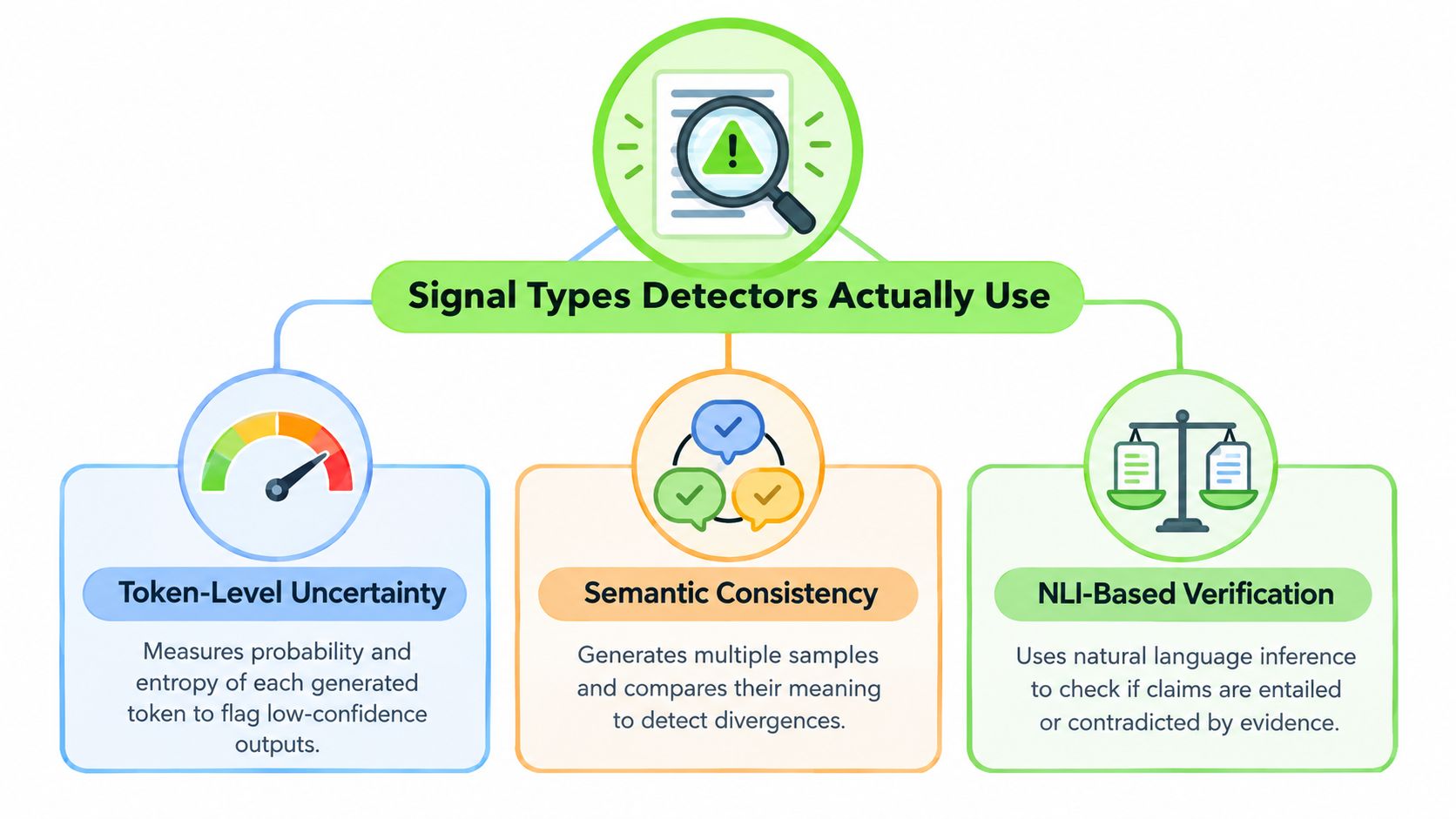
A detector can use several signals, but each measures something different. The engineering mistake is to combine them into one opaque score and assume that a higher score means the claim is supported.
Uncertainty and consistency
Token-level uncertainty aggregates model probabilities or entropy across generated text. Low average probability or high entropy can flag content the model is less certain about. But fluency and high token confidence don't prove factual correctness, so this signal can miss a confident falsehood.
Semantic consistency compares multiple answers or decomposed claims for meaning-level disagreement. If independently sampled answers give incompatible dates or amounts, variation can be a warning. The trade-off is that repeated answers can repeat the same confident mistake, and sampling adds computation.
The word “detection” also gets used for adjacent tasks such as identifying AI-generated text. Those aren't the same as checking whether a particular claim is supported by authorized evidence. For a related overview of text detection methods and their scope, see Humantext.pro's detector guide.
Evidence comparison and judge models
Natural-language inference (NLI) tests whether evidence entails or contradicts a claim, or leaves it unresolved. Comparative evaluations report that NLI methods generally outperform simpler unigram-overlap approaches, but the result depends on the evaluation protocol and doesn't make NLI a substitute for authorized evidence (NLI and consistency methods review).
Retrieval mismatch checks ask whether an answer is supported by the spans returned for the query. They're useful when an answer drifts beyond retrieved content, but a retrieval system can return irrelevant or unauthorized documents. Similarity alone doesn't establish either factual support or permission to use the source.
LLM-as-judge asks another model to review an answer against context. It can reason over paraphrases, but it can also share the generator's blind spots. The reported 30–35% failure rate for Llama 2 and Llama 3 in the synthetic multi-domain benchmark is a reminder that an advanced model used as a detector still needs validation for its task and domain (domain benchmark).
The useful design principle is to make signals explain different evidence about a claim, then preserve uncertainty when they disagree. For an overview of the grounding concept behind evidence-based responses, see grounding in AI systems.
Building a Layered Detector Architecture
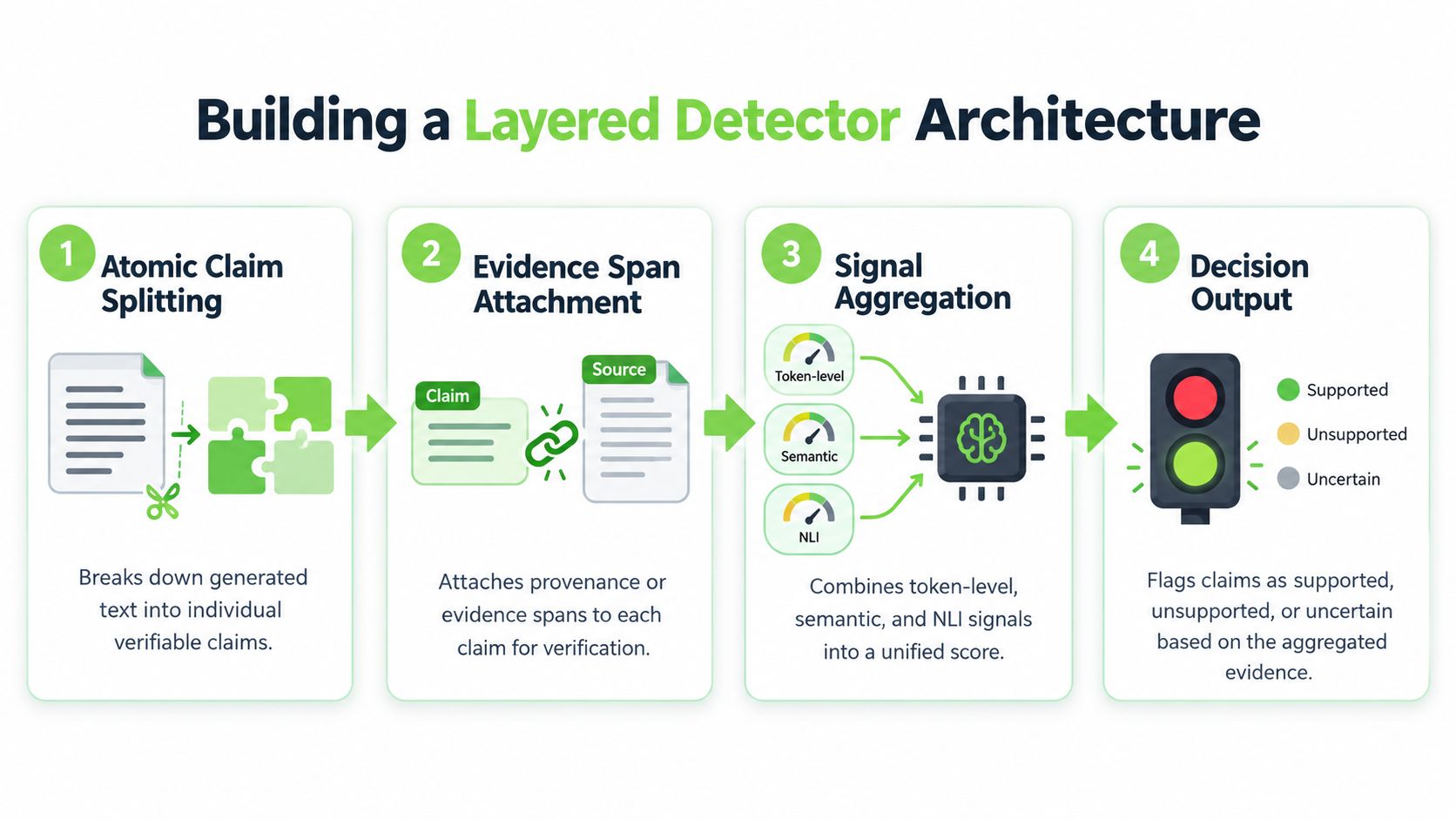
A production detector should evaluate atomic claims and keep the evidence trail for each one. A paragraph can contain several assertions with different support status, different source permissions, and different delivery risk.
From answer to evidence record
Start by splitting the response into claims that can be checked. “Your plan includes international support and costs a monthly fee” contains separate assertions. Attach a provenance record to each one: the source document or tool result, the relevant evidence span, the source version where available, and the authorization decision that permits use.
Then run claim-level checks against that record. Entailment, contradiction, retrieval coverage, and sampling disagreement should be stored as separate observations, as described in the NLI and consistency methods review above. If no authorized source exists, agreement across regenerated answers remains only a weak signal. It can expose instability, but it cannot create provenance.
The layer is useful when each signal explains a different failure mode: missing evidence, conflicting evidence, stale evidence, unauthorized evidence, or ambiguous evidence. A single confidence score collapses those cases and makes review harder. For upstream prompt and retrieval hygiene, teams can pair this record with practical tips for stopping AI hallucinations, while keeping enforcement inside the detector path.
Make the decision explicit
A claim-level result should distinguish at least three operational states:
- Supported: Authorized evidence entails the claim, and no required policy check fails.
- Contradicted or unsupported: Evidence conflicts with the claim, or the required evidence is absent.
- Uncertain: Available checks disagree, the evidence is ambiguous, or the detector cannot resolve support.
The application can then deliver a supported claim, remove or qualify an unsupported one, or abstain and route an uncertain response for review. A response-level summary may still help monitoring, but it should preserve the claim-level record that explains the decision.
Decision boundary: The model proposes content. Authenticated policy decides whether the application may deliver it.
Treat the detector as a control layer around existing components rather than a replacement for the LLM, vector database, RAG pipeline, or memory store. AletheionAGI's grounding and evidence-control approach fits this category: it is described as validating generated claims against authorized evidence and enforcing a fail-closed delivery decision. That design still depends on correctly defined claims, trusted evidence, calibrated thresholds, and application-specific policy.
Evaluation Protocols Worth Trusting
On SummEval's 1,600 samples the reported hallucination rate is 18.4%; on QAGS-C's 235 samples it is 51.9% (benchmark re-evaluation). A detector scored on one distribution and deployed against another will produce a different number. Benchmark identity and denominator belong in the evaluation record itself, alongside the score.
Labels are part of the measurement too. In the same re-evaluation, iterative adjudication raised triple agreement among human, GPT, and Gemini assessments by 6.38 percentage points on QAGS-C and approximately 7.62 points on SummEval. After adjudication, GPT's accuracy rose by 4.25 points on QAGS-C and 2.34 on SummEval, while Gemini's rose by 8.51 and 3.80 points. The score moved because the protocol moved. Any quoted accuracy needs its annotation method attached.
Calibrate for the decision cost
A reproducible study on HaluEval examples reported expected calibration error of 0.009 for temperature-scaled predictions, compared with 0.080 for a sigmoid applied to raw SVM scores. In its general-query subset, 18.1% of examples were labeled hallucinated (calibration study). Two detectors with identical ranking quality can justify very different thresholds, and as domain prevalence shifts a fixed threshold changes its false-positive and false-negative mix without the underlying model changing at all.
For a customer-support workflow, the threshold depends on the cost of sending a wrong policy answer versus routing the response for human review. In a regulated workflow, a refusal may be safer than an unsupported assertion. That trade-off should be measured as an operating outcome, with abstentions counted separately from detector errors.
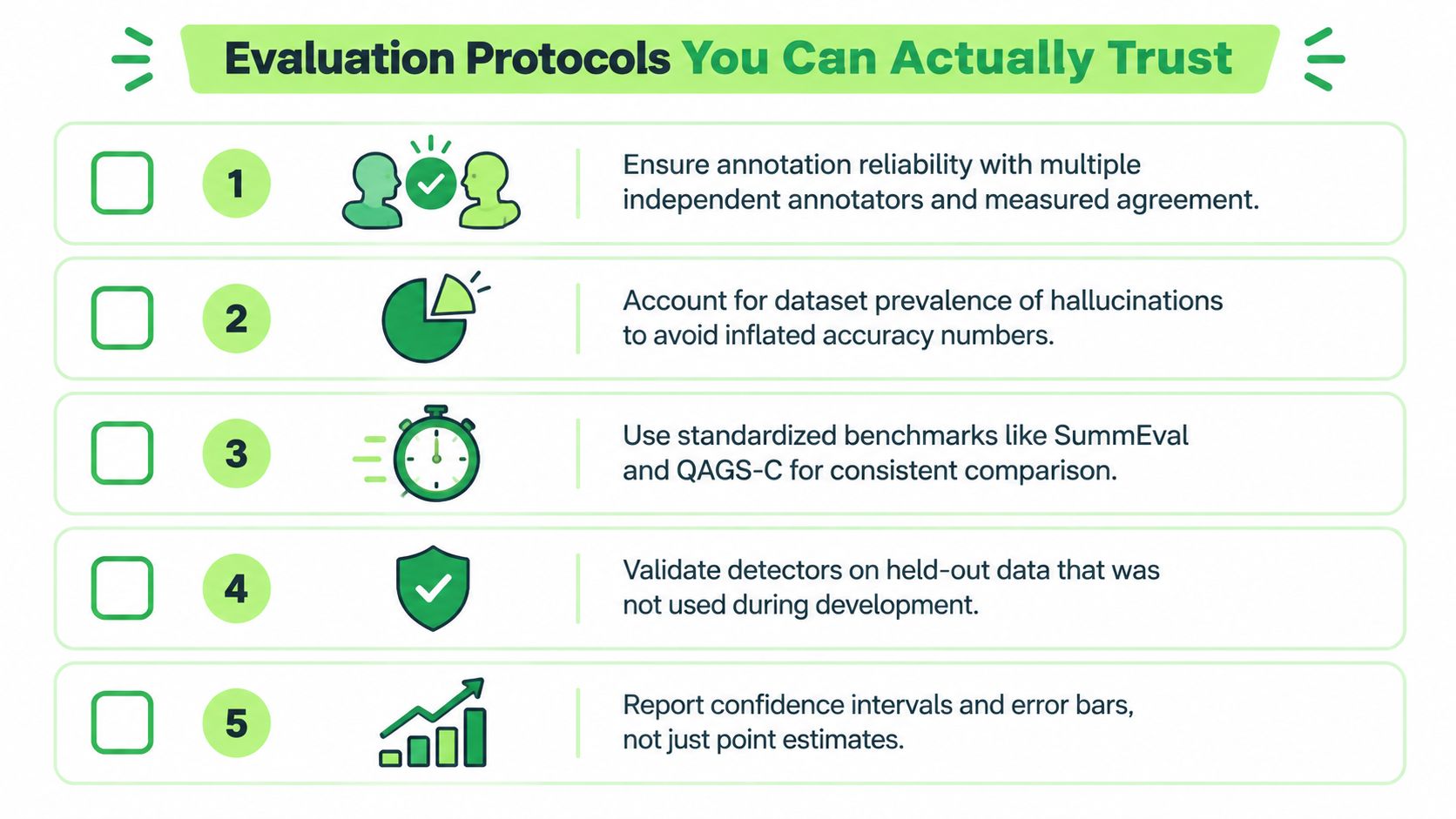
An evaluation protocol worth trusting fixes five things:
- Benchmark identity and denominator: Record the dataset version, sample count, task, and class distribution.
- Label policy and adjudication: Define what counts as contradiction, fabrication, or unsupported content, and document how disagreements get resolved.
- Calibration and abstention: Report calibration error, coverage, and error costs at thresholds chosen for the application.
- Domain-separated results: Report results per use case, since averaging materially different tasks hides the failures that matter.
- Repeatability: Freeze evaluation inputs and detector versions so successive runs are comparable.
For a broader treatment of versioned test design, see LLM evaluation practices. A detector score earns trust when the protocol states what was measured, on how many examples, and which delivery decision the score is allowed to support.
Integration Points for Production Monitoring
A hallucination detector that runs only in a post-hoc dashboard arrives after the damage. Claim validation belongs inside the application's security and observability path, and the first integration point is identity and authorization, because a detector cannot make improperly retrieved evidence safe.
Enforce access before retrieval
The OWASP RAG Security Cheat Sheet requires access-control metadata, including classification, owner, permitted roles, and permitted tenants, to travel with every vector chunk, and requires query-time filtering to enforce the caller's access boundary before similarity-search results are returned. Provenance and authorization are separate checks, and conflating them is a frequent design error: a source can be fully traceable yet still be unauthorized for the current caller.
Multi-tenant systems need the boundary tested directly. Chunks belonging to tenant A must never be retrievable for tenant B, and recurring cross-tenant test queries should verify zero boundary violations (the same OWASP RAG Security Cheat Sheet). Where the application cannot establish the caller's authority, retrieval and delivery should fail closed rather than degrade to a permissive default.
Keep model output outside trusted control
OWASP's prompt-injection guidance treats retrieved documents, tool results, and conversation history as untrusted content. Labeling those materials as separate from trusted instructions is necessary; labels alone enforce nothing. Enforcement lives in execution code: validate tool arguments there, check caller permissions outside the model, restrict tools to the data and operations required, and require action-specific approval for high-risk operations (OWASP prompt-injection guidance).
The same boundary applies after generation. Treat model output as untrusted input to any downstream system and apply destination-specific controls rather than keyword filters. For shared AI environments, the OWASP Secure AI Model Ops Cheat Sheet calls for authentication and authorization, per-tenant limits on tokens, requests, concurrency, and spending, and workload separation by trust boundary; it also warns against sharing accelerator devices across mutually untrusted tenants without strong hardware-backed partitioning and memory isolation.
Operational test: Authorization must be enforced by the services that retrieve evidence, execute tools, and deliver responses, not by asking the model to respect a boundary.
Telemetry closes the loop. Log the model version, retrieved evidence identifiers, claim-level decisions, abstentions, and delivery outcomes so reviewers can reconstruct how each answer was produced and why it was delivered or withheld. Those records feed the metrics pipeline described in what is AI observability, and the trace-level view for multi-step agents is covered in agentic AI observability. When a claim is later disputed, the difference between a defensible system and an anecdote is whether that trace exists.
An Evidence-Bounded Operating Protocol
A practical protocol starts by defining what counts as a claim and what sources are authorized to support it. Attach provenance and an evidence span to each claim, then keep factual verification separate from instruction and context consistency checks. If evidence is missing, conflicting, or unauthorized, preserve an explicit abstention state instead of converting uncertainty into a confident answer.
Set thresholds for the risk and cost of each decision, then measure calibration and abstention quality on representative data. Freeze evaluation versions and denominators, document label policy and adjudication, and re-test after changes to models, prompts, retrieval, or application policy. The evidence should let an operator trace a delivered claim to its source and decision, or understand why the system withheld it.
Grounding and evidence-control infrastructure can work with existing LLMs, RAG pipelines, vector databases, and memory systems. It doesn't replace those components or eliminate all unsupported output. The aim is bounded, auditable behavior under explicit limits, with authority and evidence checked outside the model.
Before deployment, ask: Can every material claim be traced? Was its evidence authorized for this caller? Are uncertainty and abstention visible? Can the team reproduce the evaluation that supports the delivery policy? If not, a single accuracy score won't fill the gap.
AletheionAGI offers grounding and evidence-control infrastructure, including GQueries, for validating claims against authorized evidence and supporting fail-closed behavior alongside existing AI systems. Review how that approach fits your RAG or agent architecture at AletheionAGI.