Your support agent can find the right invoice, explain the charge accurately, and still expose customer information to someone who shouldn't see it. If you're connecting an LLM to billing tools, a vector database, or a shared support workspace, the difficult question isn't just whether the agent can retrieve evidence. It's whether every subsequent use of that evidence remains authorized.
Why a Customer Support Agent Failed Its Own Access Check
Consider a hypothetical support workflow. An account manager asks an agent to investigate a disputed charge, and the agent retrieves the customer's invoice through a privileged service identity. The billing API accepts the request.
The agent then posts its explanation, including invoice details, into a shared support channel. Another teammate can read that channel but doesn't have permission to view invoices. The retrieval succeeded, the explanation was grounded, and the disclosure was still wrong.
The missing decision was at delivery
The billing service answered whether the service identity could read the invoice. It didn't answer whether the agent could disclose its contents to everyone in the destination channel.
Okta's analysis of the AI-agent authorization gap describes this broader failure pattern: privileged retrieval followed by disclosure through a surface with different permissions. Permission to access evidence isn't permission to publish it.
Practical rule: Treat every destination as an authorization boundary, including shared channels, notifications, generated files, and externally fetched URLs.
For this example, a safe implementation would distinguish:
- Retrieval authority: Whether the requesting principal and agent may access the invoice.
- Context authority: Whether that evidence belongs in the current task's reasoning context.
- Delivery authority: Whether the proposed recipients may receive the resulting facts in that channel.
Control must remain available during execution
This isn't just a question of configuring permissions at deployment. An agent may choose a different tool, change its plan, or prepare an answer for a different audience while executing a task.
Article 14 of the EU AI Act requires effective human oversight for covered high-risk systems, proportionate to risk, autonomy, and deployment context. Its controls include monitoring, interpreting, overriding, and interrupting behavior where appropriate.
That requirement doesn't make every support agent a high-risk system. It does provide a useful architectural principle: control must remain operational, rather than existing only as an initial approval. Production AI agent authorization should apply that principle to both actions and disclosures.
Authorization Is Not Authentication and Not Capability
A hotel concierge can call a restaurant, authenticate as a hotel employee, and make reservations. None of those facts establishes that a particular guest authorized a particular booking.
The guest may have approved only certain restaurants and a spending limit. If the concierge asks another employee to complete the booking, that handoff shouldn't erase the original restrictions.
Separate the questions
The same distinction applies to an agent:
- Authentication asks who is acting. Identify the agent workload and, when applicable, the user or service that delegated the task.
- Capability asks what it can attempt. A registered refund tool makes a refund technically possible.
- Authorization asks what may proceed. Evaluate the operation against the tenant, resource, purpose, delegation, and current policy.
The conceptual separation is straightforward, even when implementations blur it.
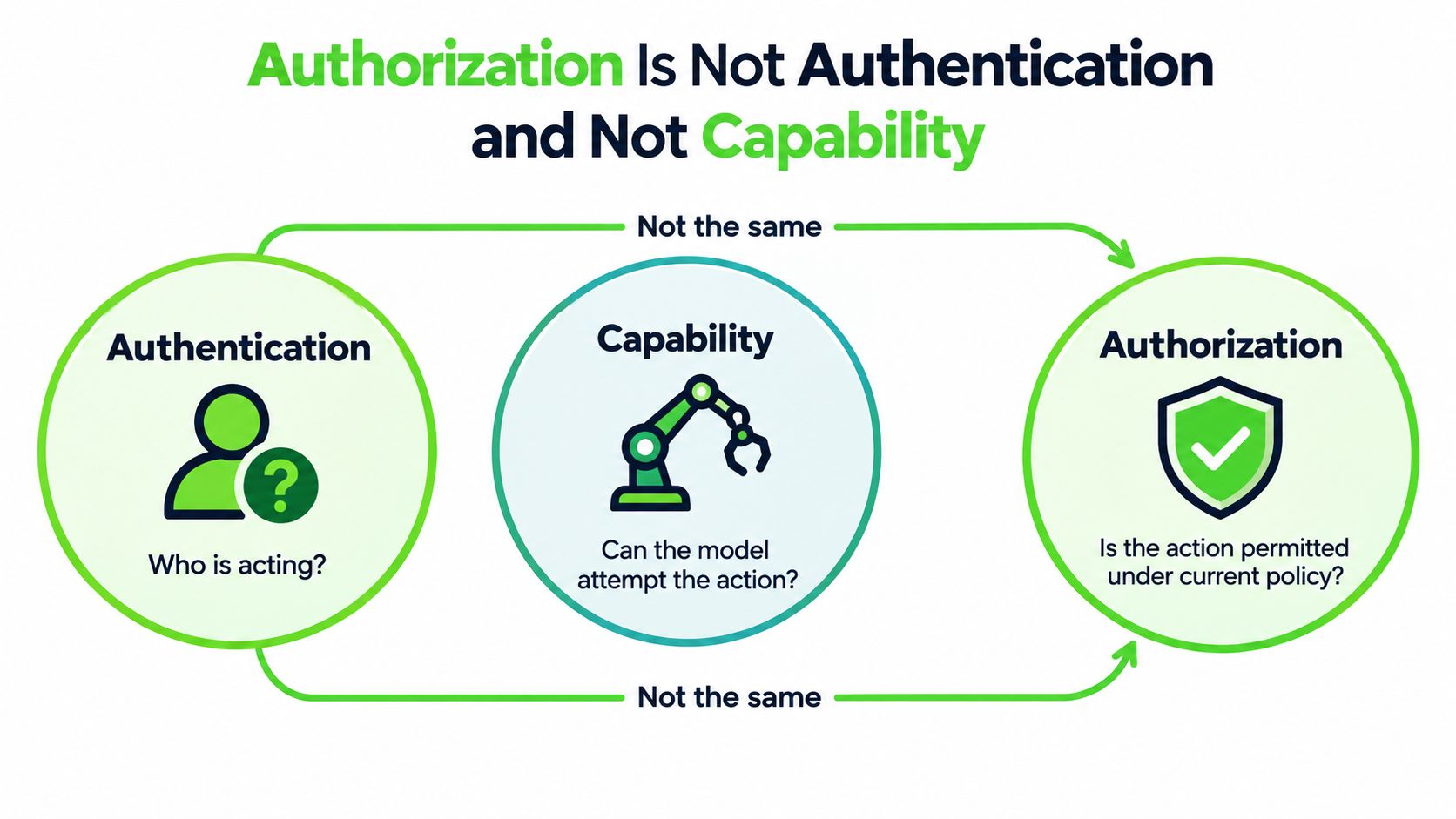
A user being logged in doesn't authorize every action an agent might infer from their request. Similarly, exposing a tool to the model isn't equivalent to approving its invocation.
Keep the agent and delegator distinct
The NIST concept paper on software and AI-agent identity and authorization identifies least privilege as an unresolved implementation challenge when required actions aren't predictable at deployment. It discusses OAuth extensions and policy mechanisms as building blocks, not as proof that agent authorization is solved.
A practical model separates agent identity, delegating principal, and authorization decision. OAuth can carry scoped authority and delegation information; OpenID Connect supports identity assertions. Neither replaces application policy about the specific resource and operation.
For a user-delegated task, require the action to fit both the agent's permitted operations and the user's delegated authority. For an autonomous task, require an explicit service principal and task policy instead of inventing an implied user.
Preserve that distinction through handoffs and asynchronous work. Otherwise, a downstream service sees only a powerful account and loses the information needed to determine whose authority applies.
The Four-Part Authorization Gate
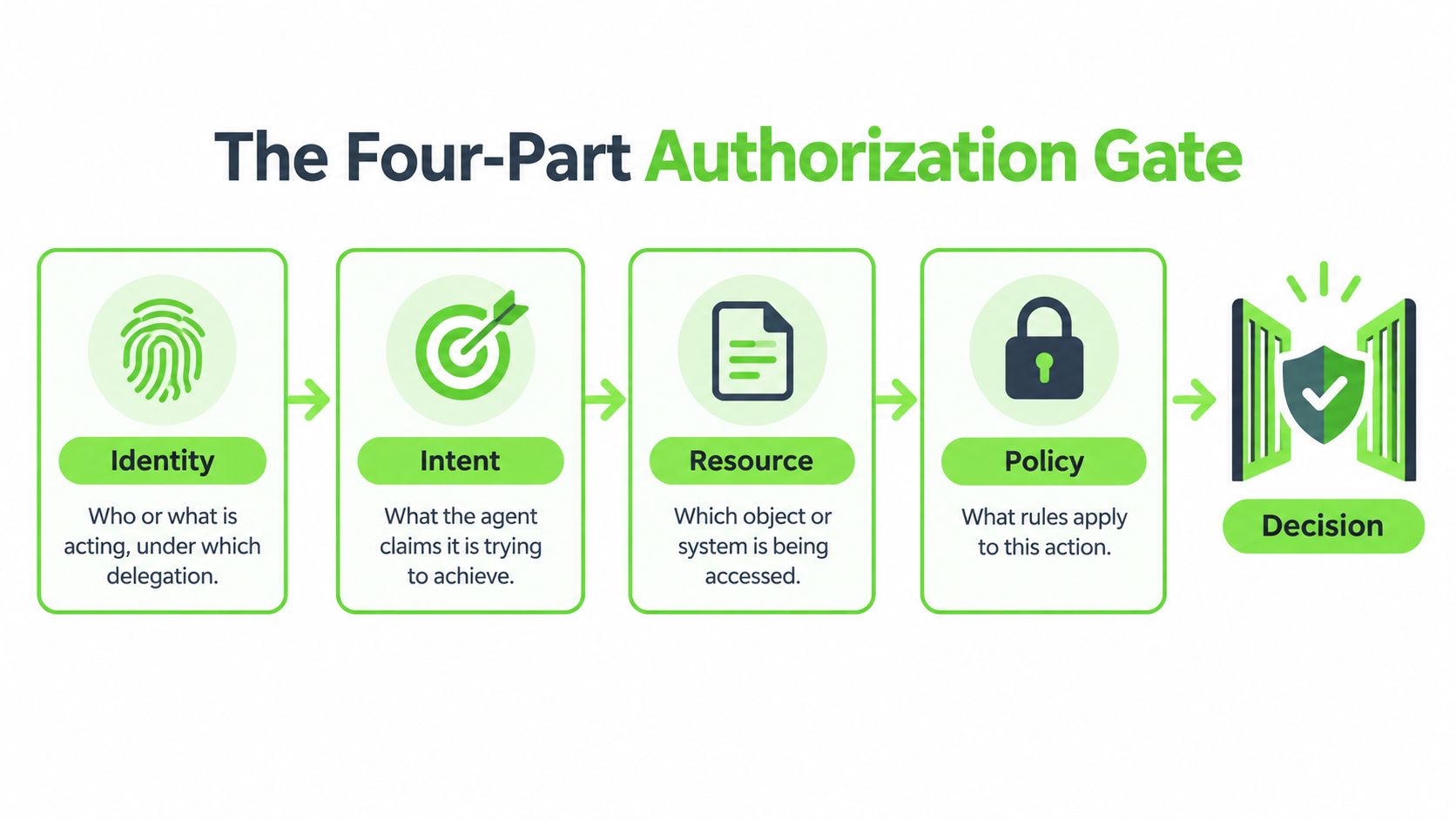
Put a deterministic gate between the model's proposal and the operation that changes external state. A useful engineering model evaluates identity, intent, scope, and action. Resource and policy checks make those dimensions enforceable.
The diagram shows the decision inputs, rather than suggesting that the model itself should approve execution.
Apply the gate to a refund
Suppose a customer asks a support agent to refund a disputed purchase. The agent proposes a refund tool call. Before execution, evaluate the proposal against trusted application state.
| Gate dimension | What the refund workflow must establish |
|---|---|
| Identity | The authenticated agent, delegating principal, and valid delegation chain |
| Intent | The approved support task and whether a refund fits that task |
| Scope | The tenant, customer, purchase, and permitted refund operation |
| Action | The exact tool, target, amount, destination, and other execution parameters |
Intent is a claim to validate, not a source of authority. The model saying that a refund resolves the case doesn't establish that the customer owns the purchase or that the requested refund satisfies policy.
Resolve ownership and eligibility from canonical records. Obtain human approval when policy requires it, and bind that approval to the specific proposed operation rather than to the conversation generally.
Bind approval to what will execute
The OWASP AI Agent Security Cheat Sheet recommends checking the authenticated actor, exact tool and parameters, approval validity, and single-use status immediately before execution. Approval validation and consumption should occur atomically, preventing competing requests from replaying the same authorization.
If the agent changes the purchase, amount, recipient, or another material argument, invalidate the earlier approval. A conversational flag saying the user approved isn't sufficient evidence that they approved the revised action.
A useful authorization record binds:
- Authority: Agent identity, user or service principal, and tenant.
- Operation: Resource, tool, permitted action, and parameter hash.
- Validity: Expiry, approval reference, single-use state, and policy version.
The model may revise its proposal. It must not revise the authority attached to an already approved operation.
For implementation discussion alongside the gate, use this accompanying video.
This design doesn't require predictable planning. It requires predictable enforcement: an altered plan becomes another proposal that must pass authorization before producing a side effect.
Architecture for Delegated Credentials and Fail-Closed Controls
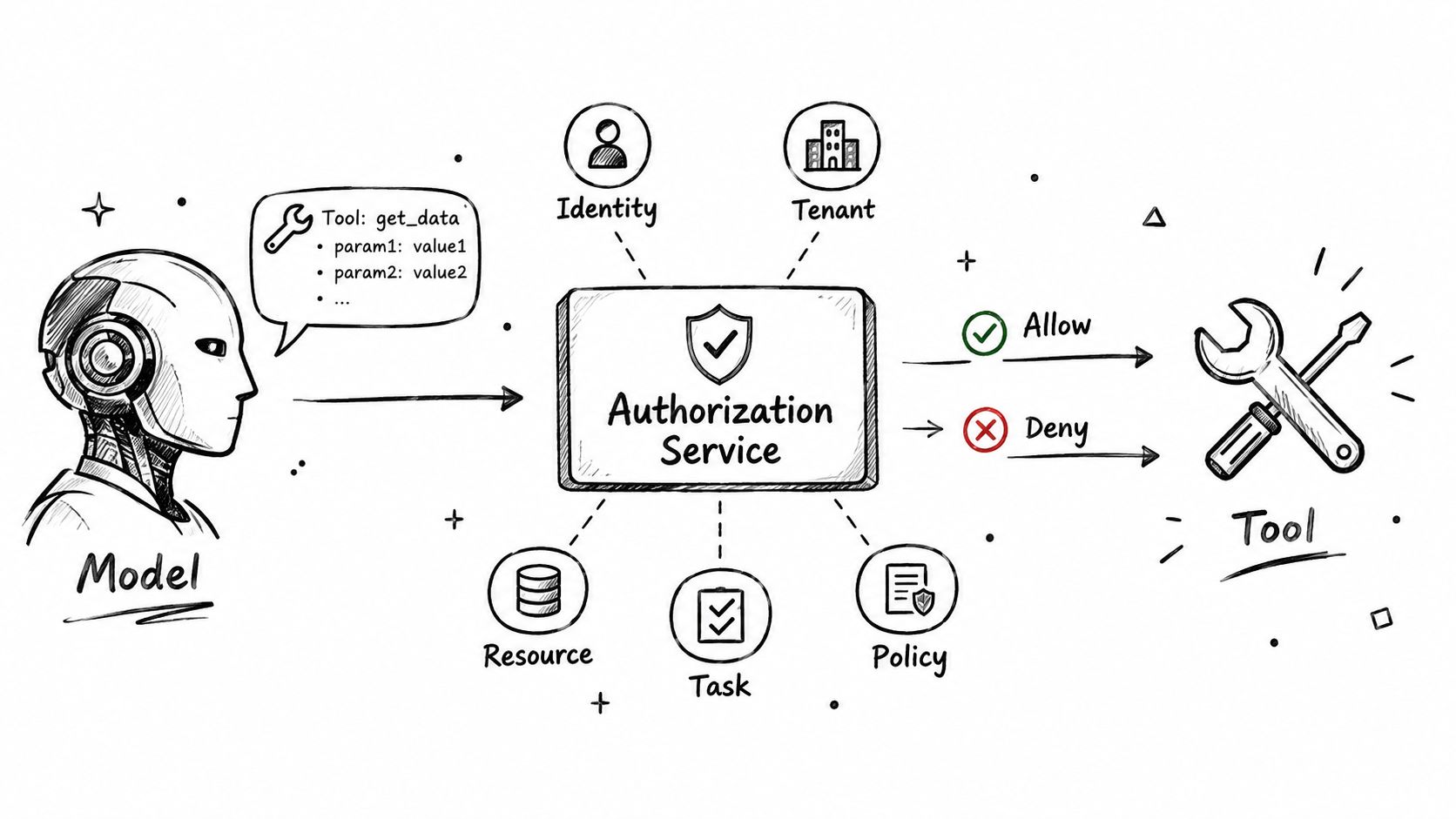
Describe the reference architecture as a sequence of trust boundaries:
Model proposal → authorization service → constrained executor → downstream service → controlled delivery.
The model produces a requested tool and arguments. The authorization service evaluates trusted identity, tenant, resource, task, and policy state. Only an approved request reaches the executor.
Keep credentials outside model context
Issue short-lived, audience-restricted credentials through trusted infrastructure. Bind the execution grant to the approved operation and parameter hash, using a separate authorization record when the downstream token format can't express those constraints.
Don't pass an end-user bearer token into model context. The model needs enough information to propose work, not possession of credentials that let it bypass the executor.
Downstream services should independently verify tenant, resource, purpose, and operation. A gateway approval shouldn't turn the receiving API into an unchecked deputy. This separation belongs in the broader AI agent architecture, alongside orchestration, retrieval, and memory boundaries.
Use distinct tool permission classes:
- Read-only access: Retrieve approved records without granting modification rights.
- Resource-specific writes: Update the authorized case or account, not an entire tenant's records.
- Irreversible operations: Require the stronger approval path for deletion, credits, or other high-impact changes.
Stop when authority can't be established
OWASP's agentic-AI threat-modeling controls include least-privilege agency, confirmation for irreversible or high-blast-radius actions, authenticated inter-agent communication, signed workflows, and hard resource limits. They are mitigation practices, not a measured guarantee of security.
Implement call budgets, API-usage budgets, session deadlines, and circuit breakers outside the model. Missing approval, invalid identity, unverifiable message integrity, or an exhausted budget should terminate execution or return a controlled denial.
An emergency path should revoke agent credentials and prevent pending execution grants from being used. Test that path with queued work as well as active sessions.
The trade-off is additional policy evaluation, credential handling, and failure recovery. Keep low-risk reads convenient through narrowly defined policies, but don't recover from authorization outages by falling back to a broad service account. A dependency failure must not become a privilege escalation.
Three Failure Modes That Prove the Architecture Matters
A useful security review names the missing control, not just the unwanted outcome. The following examples are hypothetical failure cases, not reported customer incidents.
Identity and privilege abuse
A support agent receives a generic billing credential because it needs invoice access. During a case investigation, it proposes reading records belonging to another tenant, and the API accepts the shared credential.
The missing control is task-scoped authority. The executor and downstream API should require the specific tenant and resource authorized for that case, rather than treating possession of the billing credential as sufficient.
The OWASP agentic application risk framework explicitly distinguishes identity and privilege abuse from tool misuse and cascading failures. That distinction matters operationally: correctly identifying an agent doesn't establish that its inherited privileges are appropriate.
Tool misuse
An agent has a legitimate export tool for investigating individual customer requests. Retrieved content persuades it to export a much broader collection of records.
An allowlist that permits the export tool won't contain this failure by itself. The authorization service must evaluate the requested operation and parameters against the approved task, and the executor must enforce the resulting decision.
| Naive implementation | Missing enforcement |
|---|---|
| The tool is registered, so invocation is allowed | Resource and operation constraints |
| The conversation contains an approval | Approval bound to current parameters |
| A previous attempt was authorized | Fresh validity and single-use checks |
These checks address authorization at execution time. Input validation remains useful, but it shouldn't bear the entire burden of preventing unauthorized side effects.
Audience mismatch
The agent retrieves an invoice correctly and prepares an accurate explanation. It then sends the explanation to a shared channel whose membership includes people without invoice access.
The missing control is delivery authorization. Evaluate the recipient set, channel, artifact visibility, and disclosed facts before release. If recipient permissions can't be established, withhold the sensitive content or offer an authorized private route.
A grounded answer can still be an unauthorized answer.
For RAG systems, preserve source permissions through summaries and memory so the delivery check can trace sensitive claims back to their evidence. This belongs within large language model security, not merely presentation-layer sanitization.
The earlier NIST framing supplies an important limitation: dynamic least privilege remains an engineering problem. These controls define a defensible implementation approach, not evidence that any deployment has eliminated the failure modes.
Least Privilege, Least Purpose, Least Duration, Least Audience
A credential can be narrowly scoped and still be used for the wrong task. An agent allowed to read a customer's invoices shouldn't infer permission to reuse those details in an unrelated account summary.
Least privilege is necessary, but insufficient as the entire authorization model. I recommend narrowing authority along scope, purpose, duration, and audience, with explicit restrictions on further delegation.
Compare the constraints
Single-Constraint vs Multi-Constraint Agent Authorization
| Axis | Single Constraint (least privilege only) | Four-Constraint Authorization |
|---|---|---|
| Scope | Permits an operation on a resource | Binds the tenant, resource, and operation to the task |
| Purpose | May leave task relevance implicit | Requires consistency with the authorized purpose |
| Duration | Relies on credential expiry | Ends authority at expiry or task completion |
| Audience | May stop checking after retrieval | Separately authorizes recipients and delivery surface |
| Delegation | May allow credentials to be forwarded | Narrows authority and preserves provenance at each handoff |
The position paper on authenticated delegation for AI agents argues for auditable delegation and explicit accountability chains extending existing identity concepts. Its contribution is a design argument, not a benchmark demonstrating that a particular implementation prevents compromise.
For product teams, the practical implication is to make delegation explicit. A request to investigate billing doesn't automatically permit changing billing, approving a refund, or assigning the same authority to another agent.
Narrow authority through handoffs
The research note discussing the OpenID Foundation's response to NIST describes preserving provenance while attenuating privileges during token exchange or delegation. Downstream agents shouldn't receive broader authority than the principal upstream.
For example, an orchestrator investigating a marketplace dispute might delegate evidence retrieval to a specialist. That specialist needs access to the relevant purchase records, not permission to settle the dispute or export the seller's history.
- Least purpose: Bind the delegated work to the dispute investigation.
- Least duration: End the grant when the delegated operation completes or expires.
- Least audience: Keep the resulting evidence within the authorized case audience.
- Restricted transfer: Don't permit another handoff unless policy explicitly allows it.
This increases policy complexity and can interrupt underspecified workflows. That's a useful interruption when the alternative is allowing the agent to invent the missing authority.
Auditable Trails and Reproducible Decisions
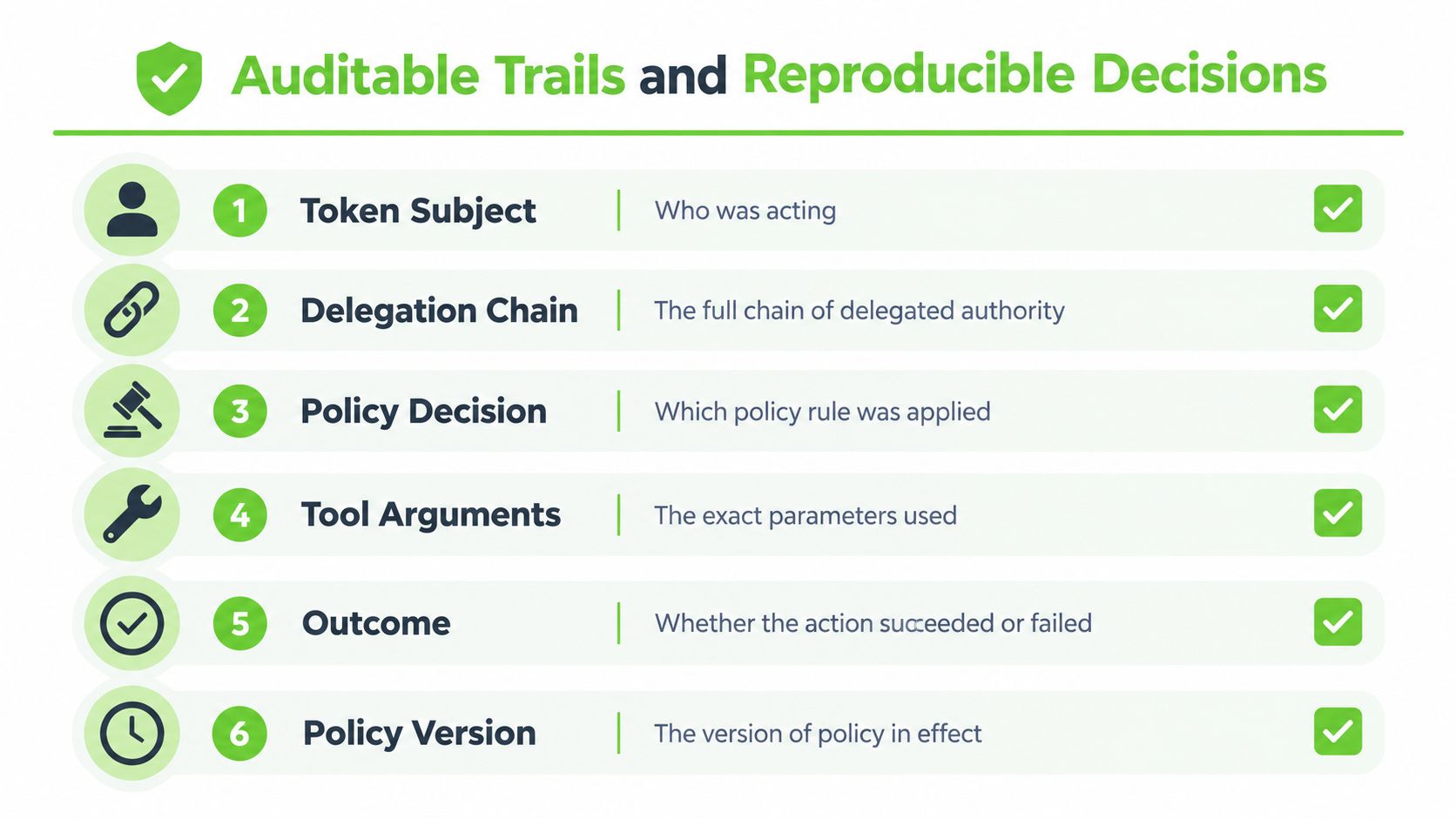
An API success log tells you what happened. An authorization trail should also establish why it was permitted at that moment.
Record enough trusted state to reconstruct the decision without relying on the agent's retrospective explanation.
Make decisions inspectable
- Token subject and delegation chain: Identify the executor and originating authority.
- Decision and policy version: Preserve the rule applied and relevant policy inputs.
- Tool arguments: Retain the exact approved parameters or a protected reference with an integrity hash.
- Outcome: Distinguish denial, abstention, execution failure, and successful execution.
- Evidence and delivery context: Record source references, intended recipients, and the disclosure decision.
Apply the earlier execution-boundary controls to logging: no irreversible action should proceed without a durable pre-execution authorization event, followed by an immutable outcome event. If outcome recording fails after execution, preserve the pending event for reconciliation rather than treating it as complete.
Denied requests and abstentions deserve attention in agentic AI observability. They can expose attempted escalation, scope creep, and legitimate workflows that policy accidentally blocks.
Audit standard: Preserve the decision inputs and versions, not just the final allow or deny.
Version the tool schema, policy, evidence references, and evaluation protocol. Reproducing a policy decision doesn't require claiming that the model will regenerate identical prose.
When reporting evaluation results, disclose the tested action set, denominator, versions, and limitations. A successful test supports a claim about that protocol, not a universal security claim.
Designing for Delivery Authorization From Day One
The invoice example changes when the agent must authorize disclosure independently. It may retrieve evidence for the investigation while withholding invoice details from the shared channel and offering a permitted private response instead.
Start with consequential operations and sensitive disclosures. Instrument separate agent identity, the authorization gate, fail-closed execution, and audience-aware delivery before expanding the permitted action space.
Questions to ask before shipping
- Whose authority applies? Identify the principal and allowed delegation.
- What exactly is approved? Specify the operation, resource, parameters, and validity conditions.
- Who may receive the result? Establish recipients and channel permissions independently of retrieval.
Grounding validates whether evidence supports an answer. Delivery authorization determines whether that supported answer may reach this audience. Production systems need both, with abstention available whenever either decision can't be established.
AletheionAGI offers grounding and evidence-control infrastructure designed to work with existing LLMs, RAG pipelines, vector databases, and memory systems rather than replace them. Visit AletheionAGI to explore authorized retrieval and delivery controls, and use a sensitive support workflow as the starting point for evaluating integration boundaries and limitations.