Your support agent resolved the ticket, but the answer was wrong. The retrieval query returned a document from the wrong tenant, a memory record supplied outdated account context, and the agent called a billing tool before the authorization service rejected the request. The final log shows only a prompt, a completion, and a successful HTTP response. It doesn't show which state influenced the decision, which evidence was authorized, or whether the control blocked the action.
That failure is the operational reality behind agentic AI observability. Production teams need more than traces that reconstruct a run. They need evidence about memory provenance, retrieval authorization, authority boundaries, and fail-closed behavior, without turning telemetry into a second sensitive-data store.
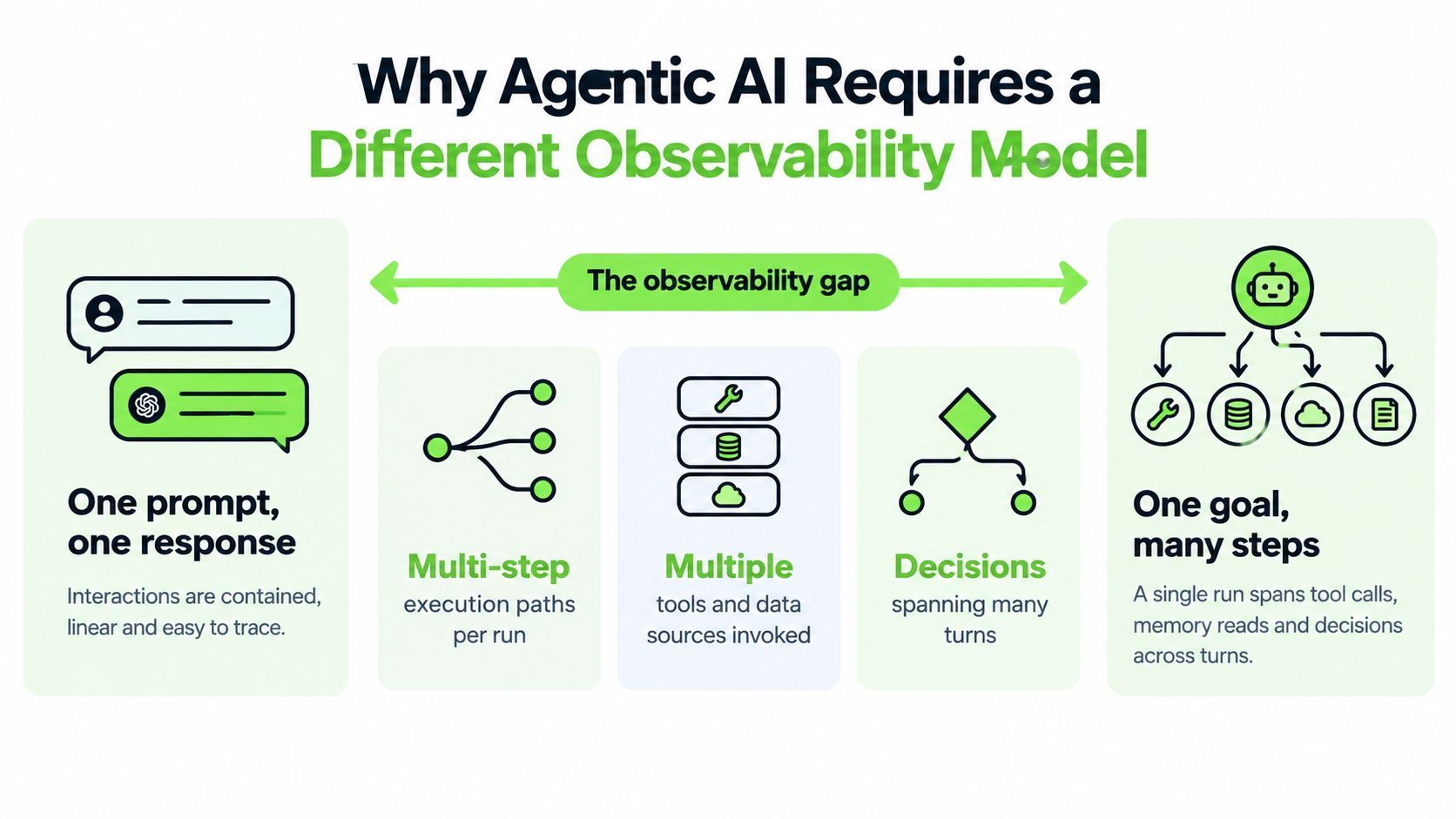
Why Agentic AI Requires a Different Observability Model
A conventional application often has a relatively contained interaction. A request enters, a service performs known operations, and a response leaves. A single agent request can instead create a plan, read memory, retrieve documents, call several tools, delegate work to another agent, invoke an external system, replan after an exception, and produce a final answer. A prompt and completion log can't reconstruct that causal chain.
The visibility gap is measurable. Only 38% of organizations monitor AI traffic end-to-end across prompts, tool calls, and outputs, while just 17% continuously monitor agent-to-agent interactions, according to a 2026 Cloud Security Alliance analysis of AI agent observability. The same assessment reports that only 21% have complete visibility into their agent inventory, 41% have runtime guardrails deployed, and approximately 20% have no security controls over agentic systems.
Why standard model metrics fall short
Token usage, latency, response quality, and model error rates remain useful. They don't tell you whether the agent retrieved a document outside the requesting tenant, whether a memory entry was poisoned, or whether a tool call exceeded the user's authority. A fluent answer can conceal a failed retrieval, an unauthorized context read, or a policy decision made from stale state.
Operational indicators must therefore include the execution path, not just the endpoint result. Useful signals include action velocity, delegation depth, permission-escalation attempts, cross-boundary invocations, exception rates, and replanning behavior. A support agent that suddenly calls more tools, delegates more, or retries authorization failures is behaving differently even if its final responses still look acceptable.
NIST's governance direction supports this model. NIST AI RMF 1.0 was issued on January 26, 2023 as NIST AI 100-1 and organized risk work around GOVERN, MAP, MEASURE, and MANAGE. NIST later published the Generative AI Profile, NIST AI 600-1, in July 2024. For agents, those functions need operational evidence about attempted actions, invoked tools, delegated tasks, used authority, and policy compliance.
Practical rule: Treat observability as continuous governance and incident evidence, not as a dashboard added after debugging is complete.
Teams working on agentic AI implementation patterns should also examine scripted abuse studies, because normal traffic rarely exposes the authority and boundary failures that adversarial workflows reveal.
Designing a Trace Schema for Agent Execution Paths
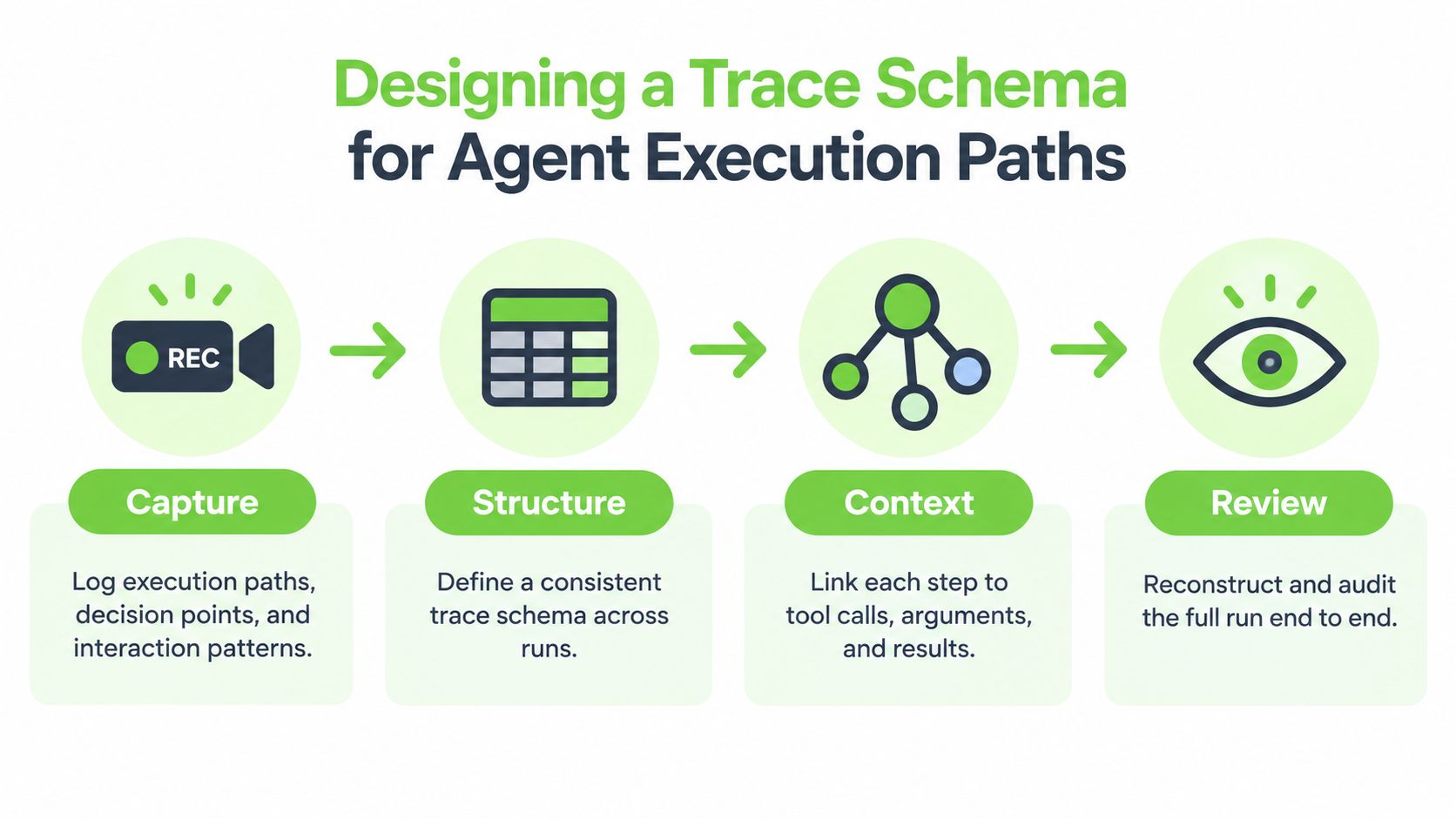
A useful trace begins with a question an investigator must answer: what happened between the user's request and the side effect? The schema should make that answer reconstructable without forcing analysts to infer causality from unrelated application logs.
Microsoft's secure-agent guidance recommends traces containing execution paths, decision points, and interaction patterns, alongside baselines for latency, cost per interaction, and success rates, with alerts when those measures move outside expected ranges. A production trace can represent the run as timestamped spans with a shared trace identifier:
- Request span: authenticated principal, tenant, session, request identifier, and normalized intent.
- Authorization span: policy version, requested scope, decision, credential or token reference, and reason for denial.
- Retrieval span: query representation, index or data source, tenant scope, returned document identifiers, and filtering result.
- Decision span: model or policy version, selected route, proposed tool, and relevant state references.
- Tool span: tool name, argument hash or redacted arguments, authorization result, execution result, latency, and error class.
- Delivery span: evidence references, response status, abstention decision, and downstream side effects.
Use spans to isolate failure classes
Suppose a RAG assistant answers with unsupported account information. If the retrieval span shows no authorized result, the problem is retrieval or access control. If it shows valid documents but the decision span references unrelated memory, the problem is context selection. If the evidence is valid and the response still invents a claim, the failure belongs to synthesis or claim validation. If the tool span shows a denied action followed by a side effect, the enforcement path is defective.
That distinction matters for remediation. Changing a prompt won't repair a tenant-filtering defect, and increasing retrieval depth won't repair a tool policy failure.
The trace should also preserve version metadata for the agent, prompt, tools, policies, retrieval configuration, and memory subsystem. Store evaluations centrally and connect them to CI/CD so a change can be assessed against quality, safety, and reliability criteria before release. A trace exposes behavior, but it doesn't prove that every document was authorized or that every claim is supported. Those properties need explicit checks in the request path.
For teams formalizing state across interactions, AI context management is a useful adjacent design concern. Context should be represented as versioned, attributable state, not an opaque text blob appended to every prompt.
Instrumenting Provenance Capture for Memory and Evidence
Most tracing systems record tool calls, arguments, results, latency, cost, and step counts. That helps explain execution, but persistent memory creates a harder question: which stored fact influenced the decision, who created it, and was its use authorized at that moment?
A benchmark study constructed MPBench to evaluate memory-poisoning attacks against two agent systems, showing that long-lived memory introduces a distinct attack surface requiring dedicated measurement rather than ordinary prompt or tool monitoring. The result doesn't establish that every memory system is vulnerable in the same way. It does establish that memory poisoning deserves its own evaluation dimension.
Make memory entries auditable
A memory record should carry provenance and lifecycle metadata, not just content. At minimum, retain:
- Origin: the user, tool, document, or process that created the entry.
- Subject: the tenant, user, account, or entity to which it belongs.
- Version: the state revision and the parent revision that preceded it.
- Authority: the policy permitting creation, retrieval, or mutation.
- Validity: confidence, expiry semantics, correction status, and deletion state.
- Influence: the trace and decision spans in which the entry was retrieved or cited.
An append-only or versioned history lets investigators distinguish legitimate state drift from unauthorized mutation. Retrieval authorization events should record the requested scope, the evaluated policy, the decision, and a reference to the state returned. They shouldn't require storing the full memory value in every trace.
Prove the boundary, not just the read
A useful incident review asks whether the agent acted on the correct user's state under the correct policy, using evidence authorized at that time. Replay tests after policy changes, memory correction, or data deletion can test whether revoked state still influences behavior. A successful deletion workflow should produce evidence that the entry wasn't retrieved, rather than merely showing that a deletion endpoint returned success.
Detailed traces can increase risk. Raw memory, hidden reasoning artifacts, and complete retrieval contexts may create a second sensitive data store with broader access than the original system. Redaction, retention limits, role-based access, and references to protected evidence are safer than maximizing log volume.
Teams designing an AI knowledge base should treat provenance as part of the retrieval contract. A result without tenant scope, authority, version, and lifecycle status is difficult to defend during an investigation.
Building a Three-Channel Architecture for Trusted Inputs
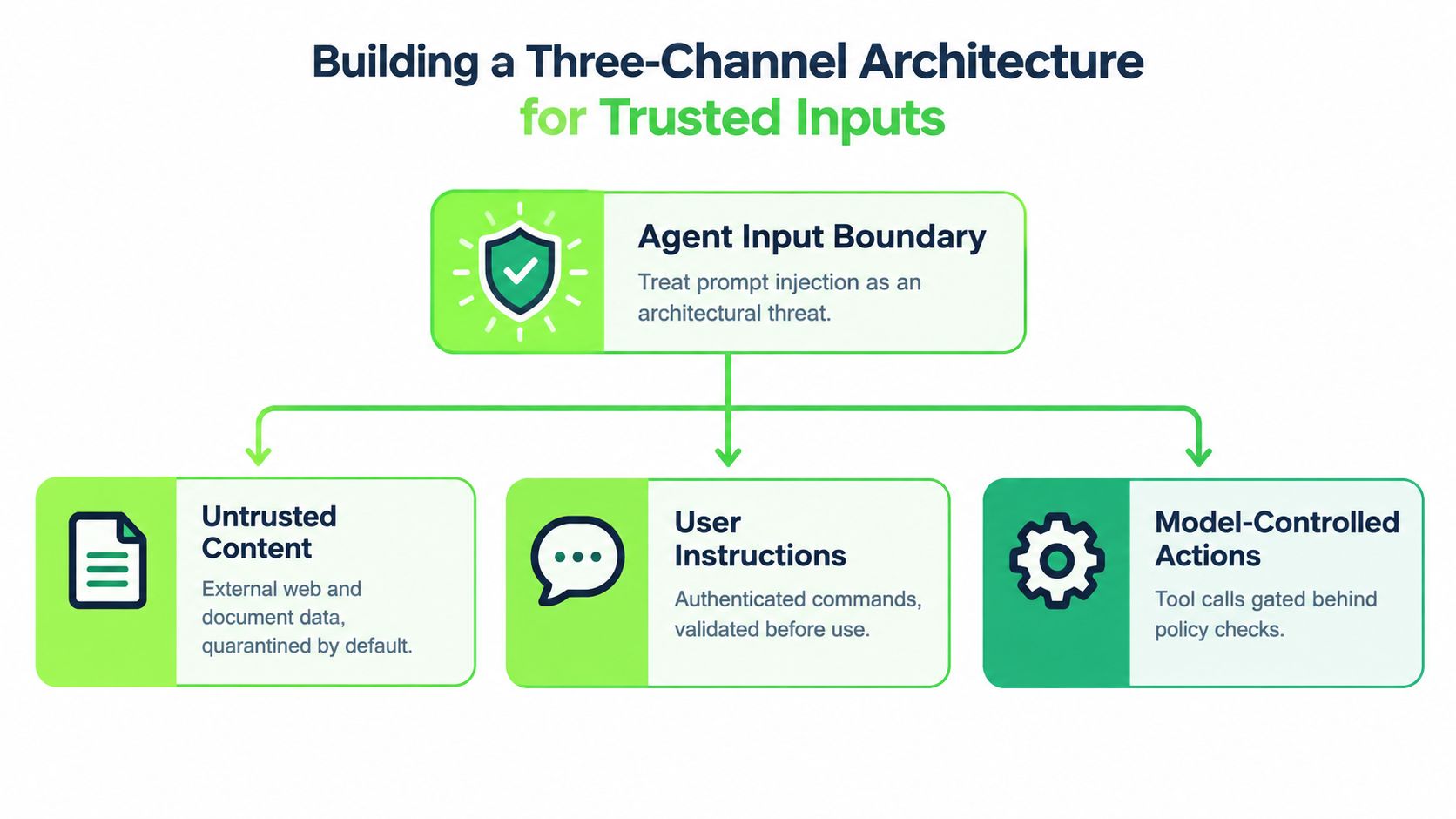
Prompt injection is an architectural boundary problem. External documents, email bodies, web pages, and tool outputs can contain text that looks like instructions, but the model must not automatically treat that text as authorized control input.
AWS guidance recommends treating prompts as version-controlled code artifacts, verifying every access attempt, logging injection attempts with metrics, and applying multilayer input sanitization. It also separates retrieved content into an untrusted data channel rather than mixing it with instructions and authorization decisions.
Separate content from control
A practical architecture has three logical channels:
- Untrusted content: retrieved documents, web pages, emails, uploaded files, and tool results. The system can quote or analyze this material, but it shouldn't grant it authority.
- User instructions: authenticated commands associated with a known principal and validated against the permitted task scope.
- Model-controlled actions: proposed tool calls and plans that remain subject to independent policy checks.
The model can propose a billing action. It shouldn't be the component that authorizes the action. A policy service should evaluate the principal, tenant, resource, requested operation, current state, and tool risk before issuing credentials or allowing execution.
Log enough to reconstruct injection
For each attempted action, retain a reference to the input that influenced it, the selected tool, the authorization result, and the resulting action. Record whether the content was classified as untrusted, whether sanitization or validation ran, and which policy version made the decision. Preserve hashes, identifiers, or redacted excerpts where full payloads would expose sensitive data.
Testing should include direct attacks in user prompts, indirect attacks embedded in retrieved content, and multi-step attacks that attempt to influence later decisions. Sanitization reduces exposure, but it can't eliminate the interpretation risk created when a model reads adversarial text. Least-privilege tools, independent policy checks, and explicit channel separation reduce the consequences when interpretation fails.
The key design trade-off is reconstructability versus data minimization. A log that omits the relevant input can't support an investigation. A log that stores every document and memory value may become the next breach target. Store protected evidence references and controlled excerpts where possible, then make access to the underlying material deliberate and auditable.
Running Post-Execution Evaluations on Agent Traces
Live dashboards answer “what is happening now?” They don't reliably answer “did the run satisfy the evidence and policy requirements?” Post-execution evaluation adds a second inspection point. It replays a stored trace and checks the run against explicit criteria.
Microsoft Foundry documents evaluating interactions that already occurred through traces, with end-to-end tracing across tools and agent systems through OpenTelemetry. That creates a practical workflow: store span-level identifiers, replay the trace, and score each material property separately instead of assigning one vague quality label.
Evaluate the chain, not only the answer
For a customer-support or RAG agent, an evaluator can ask:
- Did retrieval occur when the task required it?
- Was every returned source authorized for the requesting tenant?
- Can each material claim map to an evidence reference?
- Did the response abstain when evidence was insufficient?
- Did every tool action pass policy validation?
- Did the final response accurately reflect the permitted state?
A final sentence should link to the retrieval result that supported it, then to the authorization decision that permitted delivery. That chain is stronger than a prompt-completion record because it exposes where support was gained or lost.
Turn findings into release controls
Store evaluation results with the agent, prompt, policy, retrieval, and tool versions. Use representative traces and adversarial traces in CI/CD, then require review when a change causes evidence mapping, tenant authorization, abstention, or tool-policy results to regress.
A replay can demonstrate that a run violated policy. It can't retroactively prevent the unauthorized action.
Telemetry may be incomplete, sensitive fields may need redaction, and an evaluator can miss a failure when the trace omitted the decisive event. Fail-closed enforcement must remain in the request path. Observability supplies detection, diagnosis, and reproducible evaluation, not the sole security barrier.
This separation also clarifies the role of LLM-based judges. They can help classify response quality or policy relevance, but their verdict is another model output. Deterministic checks, authorization records, evidence identifiers, and tool-policy results should carry the strongest weight for security-sensitive conclusions.
Avoiding the Logging Trap and Enforcing Fail-Closed Behavior
More telemetry isn't automatically safer. Raw memory, full retrieval contexts, reasoning artifacts, and unredacted tool arguments can expose tenant data to operators, vendors, or compromised observability systems. They can also make retention and access-control obligations harder to manage.
The safer model treats logs as evidence about control execution, not as a replica of application state. Record that a retrieval request was scoped to tenant A, that policy P allowed or denied it, and that protected evidence was delivered or withheld. Don't copy the entire tenant dataset into the trace merely to make a future investigation convenient.
Keep prevention in the request path
Fail-closed behavior requires authenticated policy and canonical state to gate actions. The agent may propose an operation, but an independent enforcement layer should decide whether the operation can proceed and issue explicit per-call credentials only after approval.
Monitoring should verify enforcement with fields such as:
| Event evidence | What it helps establish |
|---|---|
| Requested scope and tenant reference | Which boundary the caller requested |
| Policy version and decision | Which rule evaluated the request |
| Tool and operation identifier | What the agent attempted |
| Block or allow result | Whether enforcement intervened |
| Evidence reference or non-access marker | What was delivered or withheld |
| Side-effect confirmation | Whether an external change occurred |
Make non-access observable
Cross-tenant isolation is difficult to prove by logging only successful reads. A denied retrieval, filtered result, withheld document, or missing credential should produce a controlled event that confirms the system refused access without exposing the protected content. This is verifiable evidence of non-access, not a claim that telemetry alone proves the entire boundary is secure.
Retention and access controls belong in the observability design from the start. Separate operational metrics from sensitive event details, restrict investigator access, redact arguments and content, and version the redaction policy. A system that prevents leakage but stores unrestricted copies of the same data in logs has only moved the risk.
The practical test is simple: if the telemetry backend were compromised, would it reveal more than the systems it monitors? If the answer is yes, reduce payloads, use stable references, and require controlled lookup for protected evidence.
Implementing an Auditable Observability Workflow
A deployable workflow needs a stable schema, explicit authority events, provenance-aware state, and repeatable evaluation. Start with one critical agent path, such as a support workflow that retrieves account information and can create a ticket or issue a refund. Instrument the complete path before adding more dashboards.
A practical implementation checklist
Define the trace contract. Include request, identity, tenant, authorization, retrieval, memory, model decision, tool, delivery, and side-effect spans. Give every span a stable identifier and parent relationship.
Version the moving parts. Record agent, prompt, model, tool, policy, index, memory, and evaluation versions. Without these references, comparing two runs becomes guesswork.
Capture provenance selectively. Store source identifiers, memory versions, creator references, expiry state, retrieval authorization, and influence links. Keep sensitive values behind controlled access rather than duplicating them in every event.
Separate channels. Mark external content as untrusted, validate user instructions, and route model-proposed actions through independent authorization. Record attempted input, selected tool, authorization result, and resulting action.
Enforce fail-closed decisions. Require authenticated policy and canonical state before issuing per-call authority. A denied action must not reach the downstream system through a retry, fallback, or alternate agent.
Replay stored traces. Score retrieval occurrence, tenant authorization, claim-to-evidence mapping, abstention, and tool-policy validation. Keep these checks distinct so a good answer can't mask an unauthorized read.
Connect evaluation to delivery. Store results centrally and use CI/CD review gates for changes to prompts, tools, retrieval, memory, and policies. Production alerts should identify unusual action velocity, delegation, cross-boundary calls, or policy failures.
Write an audit policy. Specify retention, redaction, investigator roles, protected evidence access, deletion behavior, and the evidence required to demonstrate non-access. Logging best practices for sellers offers useful operational context for making these controls consistent rather than ad hoc.
What readiness looks like
An investigator should be able to answer five questions from the trace and its controlled evidence references:
- Who initiated the run?
- Which tenant and authority scope applied?
- Which memory and sources influenced the decision?
- Which tool actions were proposed, allowed, blocked, or executed?
- Which claims and side effects can be tied to authorized evidence?
If the answer depends on manually correlating incomplete logs, the system is observable only in fragments. If the answer requires exposing every sensitive payload, the design has created a new security problem. The target is evidence-grade observability, where the execution path is reproducible, authority is explicit, and missing access is visible without copying protected state.
AletheionAGI develops grounding, intent, memory, and authorized-retrieval infrastructure for AI systems that need inspectable evidence and fail-closed behavior. Explore how AletheionAGI can help connect agent traces to provenance, tenant boundaries, and evidence-controlled delivery.