Most advice about AI agent architecture starts with the wrong question: which model or orchestration framework should you choose? Production incidents rarely begin with an insufficiently clever model. They begin with an agent that can't distinguish current state from narrative history, treats similarity as permission, accepts tenant identity from an untrusted request, or keeps acting after evidence has become insufficient.
A production agent is a controlled decision system. The model proposes an action, but deterministic infrastructure decides whether the action is authorized, grounded, valid for the current state, and safe to execute. That shift, from model capability to control surfaces, is the difference between an impressive demo and an inspectable system.
The Reality of Production Control Loops
An agent isn't a text generator with a few tools attached. It's a loop connecting inference, action execution, observation handling, and termination. The model reads inputs and state, proposes a next action, receives the result, and revises its next decision. The surrounding system must decide which tools are available, which arguments are valid, what evidence can enter context, and when the loop must stop.
That pattern predates modern large language models. Multi-agent systems were already treated as an emerging AI subdiscipline in an Association for Computing Machinery survey published in 1995, followed by a major machine-learning-oriented survey in 2000. A 2008 encyclopedia treatment described multi-agent systems as an approach for analyzing, designing, and implementing large-scale complex systems, with shared mental models, coordination, communication, and helping behavior as central concerns. Contemporary agent infrastructure extends those ideas with memory, retrieval, tools, policy gates, and model-based decisions.
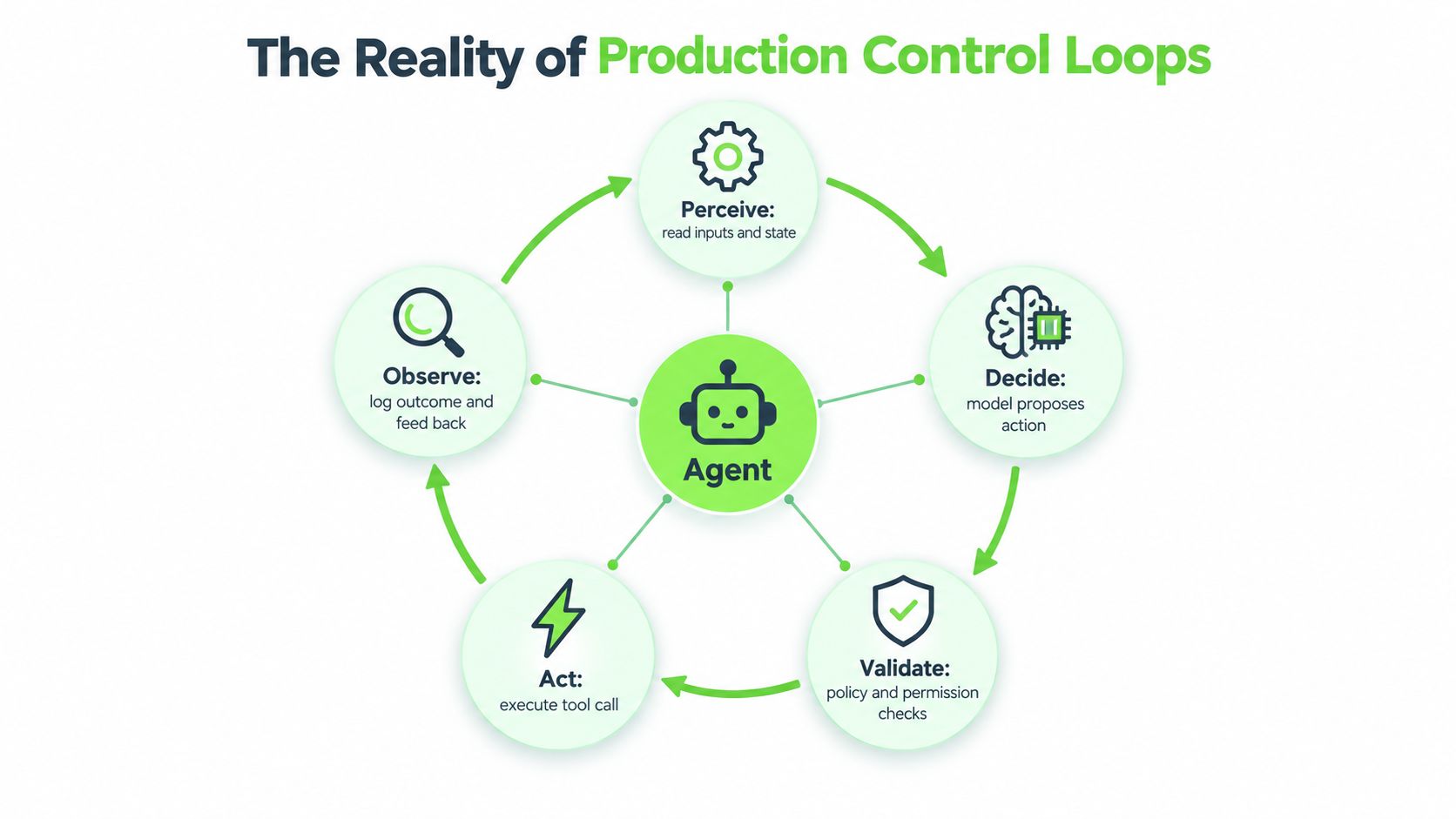
The model proposes, infrastructure disposes
The ReAct architecture made this loop explicit by interleaving language-model reasoning with external actions and observations. Introduced in an October 2022 paper and published at ICLR 2023, ReAct evaluated the approach across HotpotQA, FEVER, ALFWorld, and WebShop. Its important contribution wasn't a claim that models should reason longer. It showed how tool calls and observations can become part of a feedback loop that changes subsequent decisions. The ReAct paper provides the architectural foundation.
In a support workflow, the loop might look like this:
- Perceive: read the authenticated request, canonical account state, and permitted evidence.
- Decide: ask the model to propose a response or tool action.
- Validate: check intent, authorization, schema, tenant scope, and preconditions.
- Act: execute the approved tool call with scoped credentials.
- Observe: record the result, update state, and determine whether to continue, escalate, or stop.
Frameworks can help coordinate these steps, but they don't remove the need to define them. Teams building an application can also benefit from practical implementation perspectives such as how AppLighter handles AI app builds, provided they preserve an explicit boundary between model output and executable authority.
Practical rule: Treat every model response as an untrusted proposal until deterministic controls validate it.
The key architectural question is therefore not “How autonomous is the model?” It is “Which decisions remain outside the model?” Communication protocols, role boundaries, shared state, authorization, validation, provenance, retries, and termination rules create the conditions under which autonomy is acceptable. A deeper treatment of these coordination patterns is available in multi-agent coordination.
Designing Schema-Constrained Agent State
A transcript records what people and agents said. It does not reliably establish what is true now, which transitions are legal, or which authority remains valid. Production agents need a state model that can be inspected and tested independently of the conversation.
Persistent memory works better when it stores explicit variables and permitted transitions. In the SciBORG evaluation, agents with initial state information achieved 85% path-based success, compared with 65% without it. Finite-state-automaton memory reached 90% on state-dependent tasks, while action-summary memory reached 50%. These findings apply to a specific evaluation, not every production workflow, but they show why operational state can preserve information that narrative summaries omit.
Narrative history versus operational state
An action summary might say that an agent contacted a customer and requested verification. A state record should identify whether identity verification is pending, which method was authorized, which workflow stage is active, and which transition is permitted next.
A useful schema can include:
- Authentication status: whether the principal was verified and which session or credential established that result.
- Workflow stage: the current stage, permitted transitions, and the version of the state definition.
- Validated constraints: shipping limits, account restrictions, product requirements, or user-confirmed conditions.
- Pending obligations: approvals, documents, callbacks, or tool results still required.
- Provenance: where each important value came from, when it was observed, and whether it remains authoritative.
Keep this state outside the model context. Expose only the fields allowed by the current request and policy. The model may interpret state, but it must not become the system of record for authentication, permissions, balances, workflow status, or irreversible commitments.
Make every transition testable
Each tool call should declare preconditions and expected postconditions. A refund tool might require an authenticated account, an eligible transaction, matching tenant scope, and a policy-approved amount. After execution, the system should validate the returned transaction status and update canonical state only when the result matches the expected transition.
Version state transitions and treat interruptions as normal. If a process resumes after a timeout, reconstruct state from the store rather than infer progress from the final paragraph of a conversation. Contradictory or missing state should trigger clarification or abstention.
The same discipline applies to memory retrieval. Guidance on agentic memory for LLM agents can inform implementation, while production systems still need explicit authority, expiry, access scope, and invalidation rules for their own data.
State should answer “what is true and what may happen next?” A summary usually answers only “what happened before?”
Implementing Fail-Closed Grounding and Retrieval
A similarity score tells you that two representations are close. It does not tell you that the caller may read the retrieved document, that the document is current, or that the text supports the proposed claim.
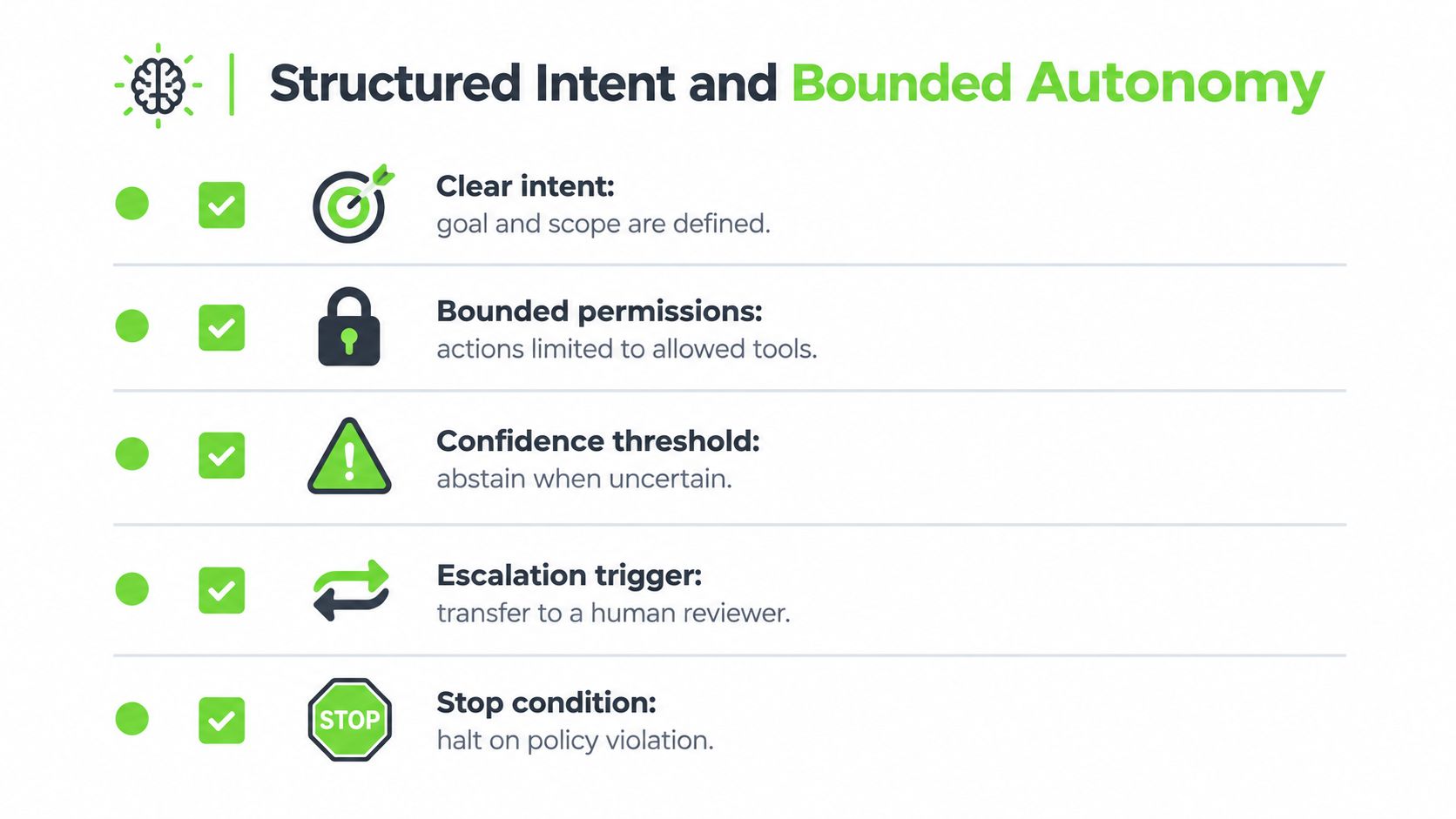
A secure RAG pipeline should follow a strict sequence:
- Authenticate the request. Establish the server-verified principal and tenant context.
- Evaluate policy. Determine the user, tenant, purpose, document classes, and actions permitted.
- Retrieve with permissions applied. Pass policy constraints into the vector or hybrid search layer.
- Validate evidence. Check provenance, freshness, source status, access scope, and contradictions.
- Assemble model context. Deliver only evidence that passed the previous gates.
- Validate the output. Check claims against authorized evidence before returning or acting on the response.
OWASP identifies vector and embedding weaknesses as a security boundary because malicious content injection, output manipulation, and sensitive-data disclosure can enter through generation, storage, or retrieval. Its guidance on vector and embedding weaknesses supports permission-aware vector stores, logical dataset partitioning, knowledge-source validation, and data classification.
Carry provenance through the whole pipeline
Attach provenance before indexing, not after generation. Each evidence item should retain source identity, version or timestamp, tenant scope, access policy, transformation history, and the retrieval or tool call that supplied it. Chunking and embedding must preserve those fields.
NIST's Generative AI risk guidance treats provenance as an operational risk-management concern and recommends tracking the provenance of training data and metadata while documenting limitations in that provenance. Provenance improves auditability, but it doesn't prove that a generated claim is correct. The output still needs evidence validation.
If provenance is missing, stale, contradictory, or outside the caller's scope, the safe result is no evidence. The system should abstain, ask for clarification, or route the request to a reviewer rather than broadening retrieval until it finds something plausible.
A grounding layer should therefore control evidence delivery, not merely generate citations after the model has already seen unrestricted content. This is the central distinction described in what grounding is and why it matters. The model can still make an unsupported inference, so production systems should retain claim-level checks and explicit abstention paths.
Multi-Tenant Isolation Models for AI Systems
Tenant isolation affects more than application tables. In an AI product, the boundary must cover vector indexes, embeddings, conversation memory, caches, tool credentials, prompts, logs, evaluation datasets, and output delivery.
OWASP recommends establishing tenant identity from a server-verified principal early in the request lifecycle. A client-supplied tenant identifier may select a tenant, but it cannot establish authority. The authenticated principal must be checked against that selection, and the verified context must flow through every tenant-sensitive component.
Compare isolation models before choosing one
| Isolation Model | Architecture Pattern | Security Profile | Operational Cost |
|---|---|---|---|
| Silo | Dedicated infrastructure, commonly including a separate database, for each tenant | Strongest isolation profile and clearest blast-radius boundary | Highest operational cost and provisioning burden |
| Pool | Shared infrastructure with tenant-aware filtering, commonly including row-level controls | Efficient, but dependent on consistent authorization and query enforcement | Lowest relative infrastructure cost, with significant control complexity |
| Bridge | Shared infrastructure with separate schemas for tenants | Intermediate boundary between dedicated and pooled designs | Intermediate operational cost and migration complexity |
For pooled AI infrastructure, tenant scope must be part of every lookup, retrieval filter, memory read, write operation, and credential decision. A model must never receive cross-tenant records and then be asked to filter them through prompting. Filtering after retrieval is already too late.
AWS describes these multi-tenant SaaS security practices and the silo, pool, and bridge trade-offs. Apply the same decision to vector stores and memory as to relational data. Row-level security can provide defense in depth, but it doesn't replace authorization at the service boundary.
Tenant context should be resolved before query planning, retrieval, tool execution, and response generation.
Bind tool credentials to explicit tenant and permission scopes. Make absent or invalid tenant context a hard denial. Then test every read and write path with adversarial tenant substitutions, including background jobs, retries, cache hits, asynchronous tool callbacks, and evaluation pipelines.
Measuring Reliability Beyond Task Success
A clean demonstration can hide a fragile agent. Reliability includes whether the system repeats a valid decision, tolerates changed wording, survives tool failures, recovers from interrupted work, refuses unauthorized actions, and escalates appropriately.
ReliabilityBench evaluated agents across repeated-execution consistency, input and task perturbations, and infrastructure-failure tolerance. Its workload covered 1,280 episodes across scheduling, travel, customer support, and e-commerce. Under no perturbation, agents reached 96.9% pass@1, while performance fell to 88.1% at perturbation level ε=0.2, an 8.8 percentage-point decline, according to the ReliabilityBench results. Those figures belong to that benchmark and shouldn't be treated as a universal production forecast.
Define the denominator before the score
A useful evaluation layer reports more than nominal success:
- Pass@1: whether one execution completes the task correctly.
- K-trial pass rate: whether repeated runs remain consistent.
- Perturbation sensitivity: how results change when wording, tool responses, or environmental conditions vary.
- Failure-recovery rate: whether the system recovers safely after timeouts, malformed responses, or interrupted execution.
- Unsafe-action rate: whether the agent attempts unauthorized or destructive operations.
- Escalation quality: whether human handoffs contain the right state, evidence, and unresolved questions.
Freeze the task set, denominator, perturbation distribution, tool versions, model configuration, and treatment of abstentions before comparing architectures. A system that abstains safely may have a lower task-completion score while being more suitable for a sensitive workflow.
Separate the policy from deterministic controls. Schema validation, authorization, canonical state updates, bounded retries, compensating actions, and termination rules should be independently testable. A high nominal score doesn't tell you whether reliability comes from the model, orchestration, retrieval, or favorable environment assumptions.
A 2025 study of 306 practitioners across 26 application domains found reliability was the leading development challenge. The study reported that 68% of production agents executed at most 10 steps before requiring human intervention, while 74% relied primarily on human evaluation and 25% used formal benchmarks. These findings appear in the practitioner study, and they support a practical conclusion: bounded autonomy and well-designed checkpoints are not signs of failure. They are how many production systems currently manage risk.
Structured Intent and Bounded Autonomy
Raw language is too ambiguous to serve as an execution policy. “Cancel my order and send it to the other address” may contain multiple objects, conflicting actions, an unspecified order, and a destination that requires verification.
Structured intent converts the request into explicit fields:
- Goal: what the user wants to accomplish.
- Facts: entities and values extracted from the request.
- Constraints: conditions the system must preserve.
- Preferences: choices that guide selection but don't create authority.
- Unresolved dimensions: missing order IDs, ambiguous recipients, or unclear timing.
- Authorization status: what the authenticated principal is permitted to request.
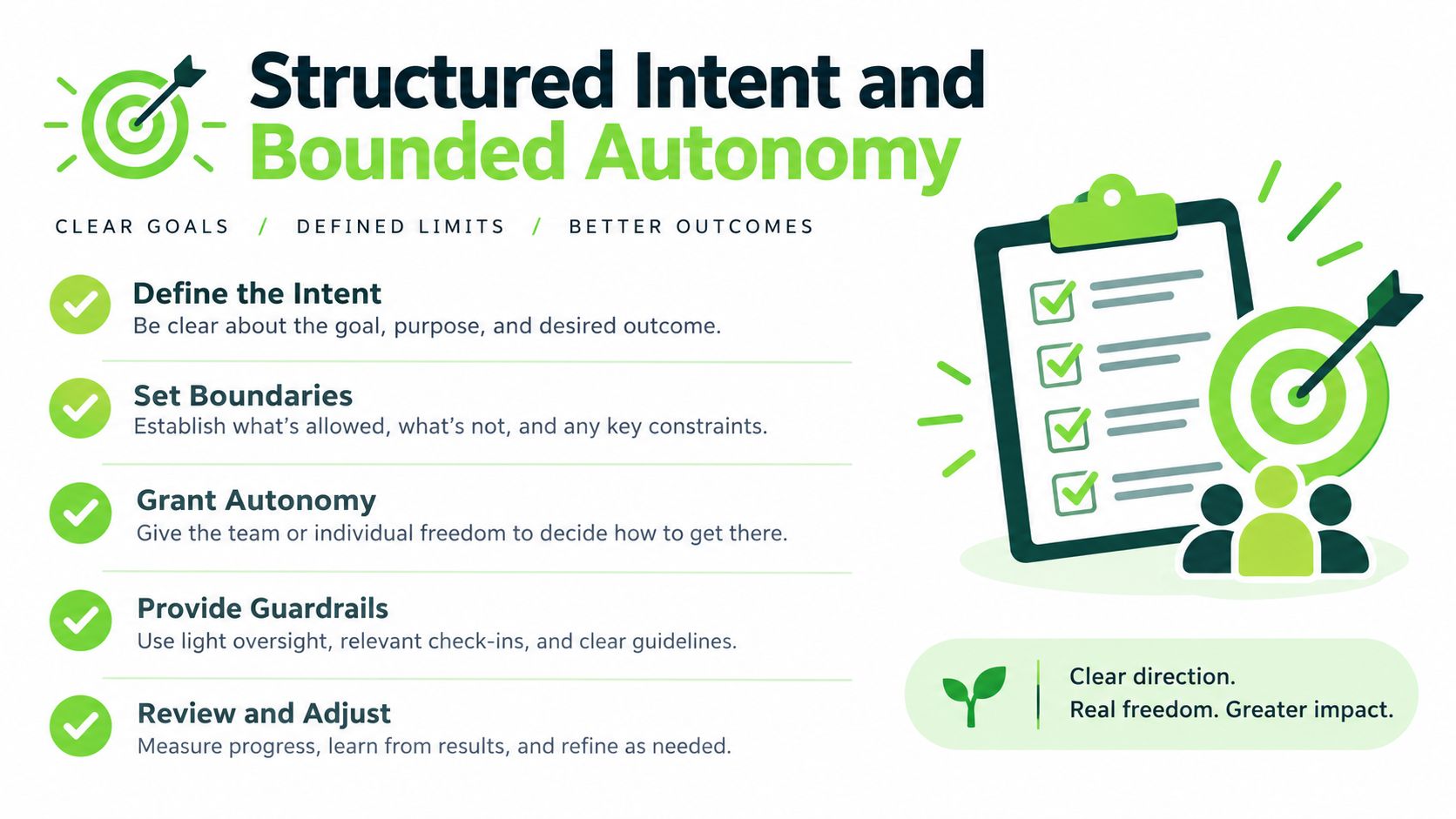
The agent can propose this structure, but a validator should identify missing fields, conflicts, and unsupported assumptions. A policy gate should then determine whether the request can proceed, needs clarification, requires human review, or must be denied.
Make stopping a successful outcome
An agent should stop when evidence is insufficient, authorization is unclear, a precondition fails, or a tool returns a result that cannot be reconciled with canonical state. Continuing to generate text may feel helpful, but it turns uncertainty into an unsupported claim or an unauthorized action.
This matters especially when agents handle payments, account changes, or marketplace transactions. Teams designing these flows can consult a practical guide to agent payment wallets, then apply the same controls used elsewhere: scoped credentials, explicit user intent, transaction limits, confirmation rules, and auditable state transitions.
Abstention is a valid result when the system cannot establish authority or evidence.
Human escalation should preserve the structured intent, relevant state, authorized evidence, failed preconditions, and recommended next question. A reviewer shouldn't have to reconstruct the workflow from a long transcript. This design makes the handoff useful without granting the agent permission to continue acting in the background.
Building Verifiable Agent Infrastructure
Production readiness comes from replacing implicit trust with explicit, testable boundaries. The model remains valuable as a reasoning and proposal engine, but the system must determine what it may see, what it may do, and what the application can claim.
A practical audit should ask:
- State: Is operational state stored in a versioned schema outside the model context? Are transitions and postconditions validated?
- Grounding: Does retrieval apply authorization before evidence reaches the model? Can the system abstain when provenance is missing or contradictory?
- Tenant scope: Is tenant identity derived from a verified principal? Does scope reach memory, vectors, caches, tools, logs, and writes?
- Authority: Are tool credentials narrow, explicit, and bound to tenant and permission context?
- Evaluation: Are repeated runs, perturbations, infrastructure failures, unsafe actions, and escalation quality measured?
- Observability: Can engineers reconstruct the state, evidence, policy decision, tool call, and resulting transition?
- Termination: Are stop conditions enforced outside the model?
AletheionAGI offers infrastructure for persistent memory, authorized evidence retrieval, structured intent, policy controls, and fail-closed grounding. Its GQueries and IntentParse products are designed to work with existing LLMs, RAG pipelines, vector databases, and memory systems rather than replace them. Teams should still evaluate any such layer with versioned protocols, defined denominators, and explicit limitations.
The strongest AI agent architecture is not the one that maximizes uninterrupted autonomy. It is the one that makes decisions inspectable, state transitions verifiable, evidence authorized, and uncertainty visible. That architecture can support customer support automation, SaaS workflows, marketplaces, and sensitive enterprise applications without asking the model to serve simultaneously as planner, database, policy engine, and security boundary.
If your AI agent handles sensitive data or multi-step actions, audit it against the state, grounding, tenant isolation, authorization, evaluation, and termination checks above. Visit AletheionAGI to explore infrastructure for persistent memory, structured intent, authorized retrieval, and fail-closed grounding that can integrate with your existing AI stack.