Most AI memory management advice starts with the wrong optimization target. It tells teams to increase context windows, improve embeddings, summarize more aggressively, or retain more history. Those techniques can reduce repetition, but they don't answer the production question that causes the most damage: who is allowed to write, change, delete, retrieve, and rely on a memory?
A persistent memory can turn an isolated mistake into a recurring decision. It can preserve a stale preference, expose another tenant's data, or make an unsupported claim appear authoritative because a summary sounds plausible. In sensitive AI applications, memory is therefore not just a retrieval feature. It's a governed subsystem with policies for authority, provenance, retention, access, contradiction, and refusal.
Why Memory Is a Governance Problem Before It Is an Engineering Problem
Teams often treat memory as a ranking problem. Store an interaction, create an embedding, retrieve similar records, and place the results in the prompt. That pipeline is useful for prototypes, but it leaves the most important controls implicit. A production agent also needs to know whether a memory is current, whether its source is authoritative, whether the requesting user may access it, and whether the system should act when evidence conflicts.
Memory is mutable. Agents increasingly add, update, consolidate, and delete records through autonomous or learned policies. That creates failure modes that ordinary retrieval benchmarks underrepresent, including stale preferences, incorrectly generalized episodes, lost provenance, contradictory records, and self-reinforcing errors. The practical meaning of a memory isn't determined only by similarity score. It depends on authority and permitted use.
Practical rule: A memory should never become more authoritative merely because the system retrieved it successfully.
This is why guardrails in business contexts belong in the same conversation as vector search and context compression. A guardrail isn't only a response filter. It can determine whether a record may enter memory, which version wins when facts conflict, and whether the agent must abstain when the evidence is incomplete.
Memory creates a control surface
A useful mental model treats each memory operation as a controlled state transition:
- Admission: What evidence qualifies for persistence?
- Mutation: Who can revise a stored claim, and under what conditions?
- Retrieval: Which identity, tenant, role, and purpose authorize access?
- Consolidation: Can several observations become a generalized rule?
- Deletion: How quickly must a record disappear from active and derived stores?
- Execution: May the agent rely on the memory for an external action?
This model changes the order of implementation. Start with the authority model and data boundaries, then choose storage and retrieval mechanisms. Measure answer quality only after the system can explain which evidence influenced an output and why that evidence was permitted.
The progression is straightforward. Define the difference between working context and persistent state. Choose patterns for compaction, retention, and provenance. Enforce tenant authorization before retrieval, not only in the final prompt. Then evaluate memory with metrics that capture harmful recall, stale state, unauthorized access, and appropriate refusal.
Defining AI Memory Management in Production Systems
AI memory management is the controlled process of selecting, storing, transforming, retrieving, revising, and deleting information that an AI system may use across a task or across sessions. That definition is deliberately broader than “put conversation history in a vector database.” It includes the rules that determine whether information should persist and whether the model may rely on it.
The first distinction is between ephemeral working memory and persistent structured memory.
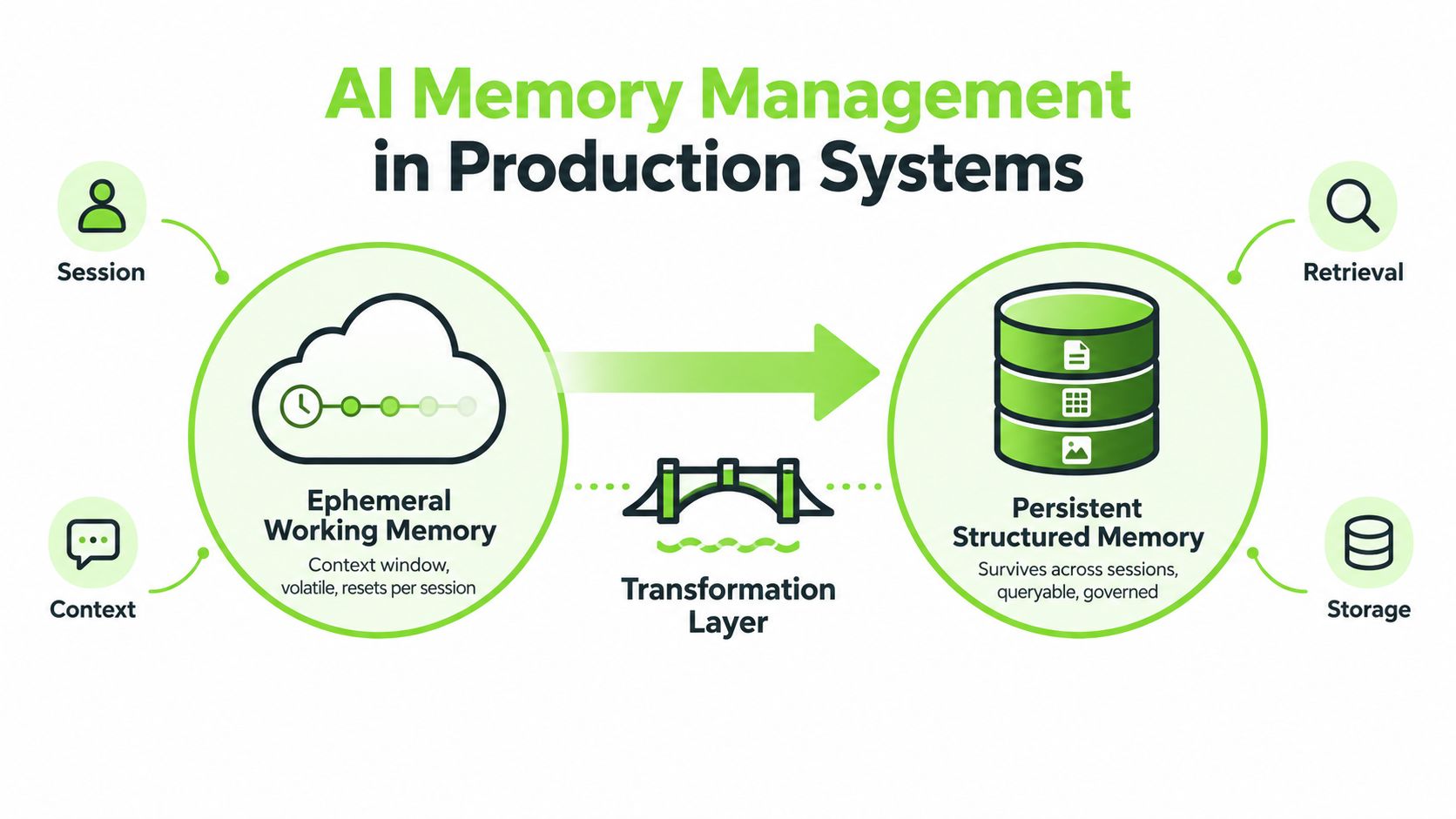
A context window is like a scratchpad. It holds the material needed for the current generation, but it is volatile, expensive to expand, and subject to attention degradation. Persistent memory is closer to a filing cabinet with rules. It can survive a session boundary, support structured queries, preserve provenance, and enforce access and retention policies.
A 2024 Berkeley evaluation report noted that standard large-language-model context limits commonly ranged from 2,000 to 32,000 tokens, while only a small number of models supported 128,000 tokens at that time. The report also found that performance generally declined as token length increased on aggregation tasks, where the model must combine information across a long input. The Berkeley evaluation report supports an important distinction: nominal capacity isn't the same as reliable memory.
The production vocabulary
Several terms make architecture discussions more precise:
- Grounded memory is a stored state connected to source evidence, timestamps, confidence, and the conditions under which it may be used.
- Authorized retrieval means the system filters candidate memories according to authenticated identity, tenant, role, resource attributes, and purpose before delivering them to the model.
- Fail-closed grounding means the system denies access, retrieves stronger evidence, or abstains when authorization or support is missing.
- Compaction transforms raw history into a smaller state representation while preserving the dependencies needed for future decisions.
- Provenance records where a claim came from, when it was created or changed, and which transformation produced the current representation.
For teams building stateful agents, AI employee memory explained offers a useful conceptual treatment of how context and durable memory differ. The implementation detail that matters most is not whether the system calls a store “memory.” It's whether engineers can inspect the record, trace it to evidence, and enforce its scope.
A context window can temporarily contain data that the user is authorized to see, but that doesn't make every possible retrieval authorized. The model shouldn't infer identity or tenant membership from natural language. The application must establish those facts outside the model and carry them through every memory operation.
Core Design Patterns for Persistent State
A production memory architecture usually combines several patterns rather than choosing one. The right composition depends on session scope, recovery needs, privacy boundaries, evidence quality, and operational cost.
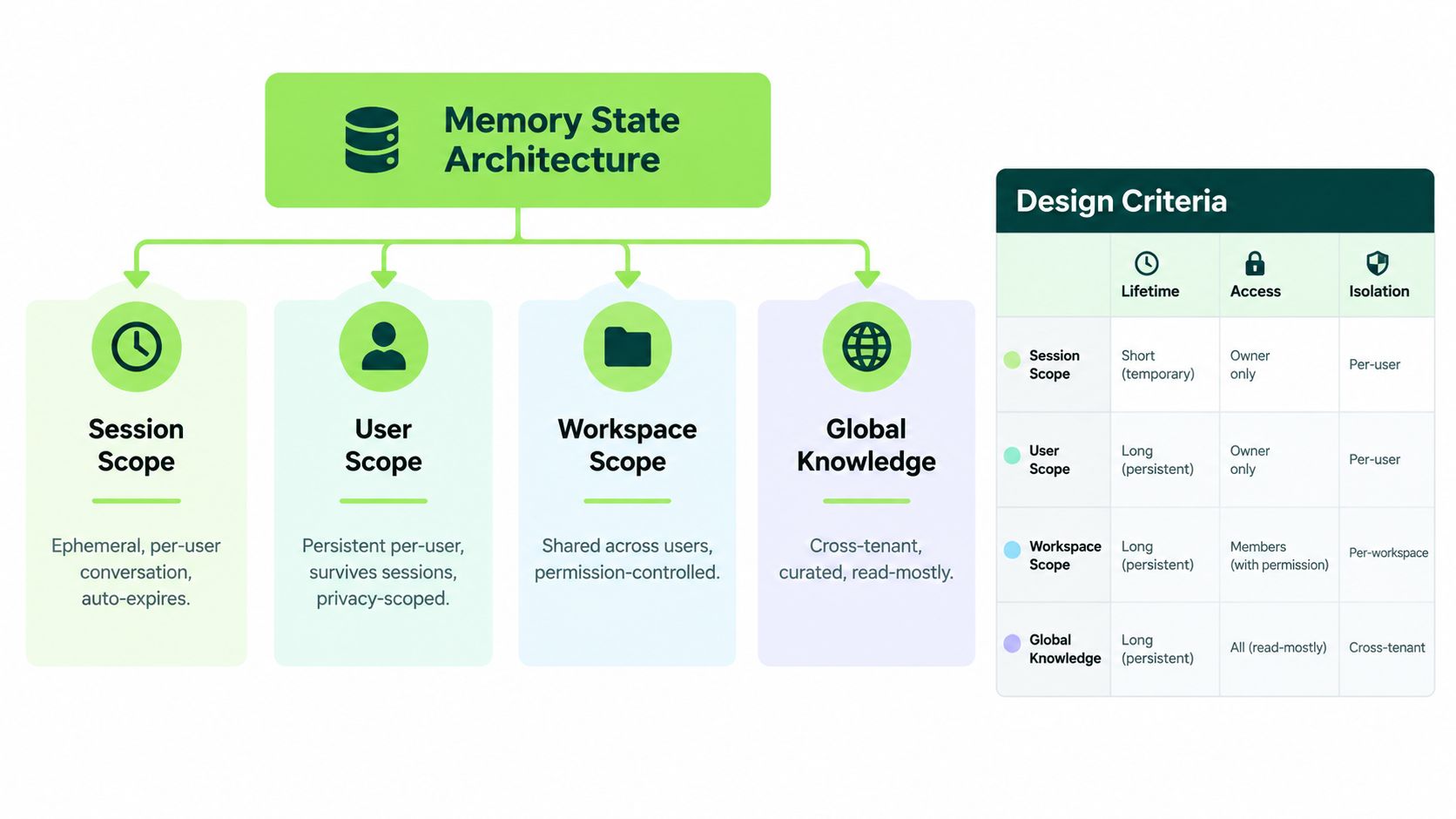
Scope comes before storage
Session state belongs to the current task or conversation. It should usually expire automatically and contain transient tool results, intermediate decisions, and user corrections that haven't earned durable status.
User state can survive sessions, but it needs a privacy boundary. A support agent might remember a user's communication preference, but that preference shouldn't become a workspace-wide rule.
Workspace state supports shared operations. It requires permission-aware writes and reads because one user's interaction may produce a record that affects other users.
Global knowledge should be curated and read-mostly. It may contain product policies or approved procedures, but it must remain distinct from tenant-specific experience and personal data.
That scope model prevents a common error: storing every useful-looking fact in one undifferentiated memory index. The index may retrieve semantically related text, but semantic similarity doesn't determine ownership or authority.
Compaction allocates information
Compaction isn't shortening text. It decides which dependencies survive and which details become recoverable only through the original record. The Focus autonomous-memory approach reduced total tokens by 22.7%, from 14.9 million to 11.5 million, while reporting identical performance on its stated SWE-bench Lite evaluation, with 3 successful tasks out of 5 for both compressed and uncompressed agents. The Focus evaluation demonstrates a bounded result, not a universal quality guarantee.
The safe pattern is to retain a compact structured state alongside recoverable source evidence. Store the claim, provenance, timestamp, confidence, dependencies, and a pointer to the underlying interaction. If the summary can't support a required action, retrieve the source or abstain.
For longer workflows, this AI agent guide for extended workflows is useful background on state that must persist while an agent performs multiple dependent steps. The engineering choice remains yours: consolidate based on state value and recoverability, not token count alone.
Retention and provenance must travel together
Retention should specify what triggers persistence, revision, expiration, and deletion. A time-to-live can remove obsolete state, but it doesn't resolve contradictions or prove that a surviving claim remains valid. Provenance makes those decisions inspectable.
Raw interaction history should generally remain outside the model context. The system can derive compact structured state from it, attach evidence and policy metadata, and retrieve only records authorized for the current generation step. This limits unnecessary exposure while preserving a path back to original material.
For teams designing the durable knowledge layer around these patterns, an AI knowledge base architecture provides relevant context on organizing retrievable information. The key boundary is that a knowledge base is not automatically a memory authority. Its records still need ownership, freshness, access rules, and evidence status.
Long Context Versus Purpose-Built Memory
A larger context window solves a temporary capacity problem. It doesn't automatically solve continuity, selective retrieval, temporal ordering, or policy enforcement. Long-context models can read more material, but production systems still need to decide what belongs in the prompt and whether that material is authorized.
The LoCoMo study tested conversational memory with conversations of about 10,000 tokens and 7,512 questions. Long-context language models and retrieval-augmented methods improved conversational-memory question answering by approximately 12% to 20%, yet remained about 36% below human performance overall and 41% behind humans on temporal reasoning. The LoCoMo study shows why more history isn't equivalent to dependable longitudinal memory.
Another long-context evaluation found that popular models often effectively used only 10% to 20% of available context, with performance degrading as reasoning complexity increased. Models advertised for 128,000 tokens showed degradation beyond roughly 10% of capacity in that evaluation. These results make a context window useful working memory, but a poor substitute for a selective, policy-aware state layer.
The architectural difference
| Dimension | Long-context window | Purpose-built memory layer |
|---|---|---|
| Lifetime | Usually tied to the current request or session | Can persist across sessions and workflows |
| Selection | Prompt construction or model attention | Explicit retrieval, ranking, and authorization |
| State model | Raw or lightly formatted context | Structured claims, records, events, and relationships |
| Governance | Often applied around prompt assembly | Can enforce admission, access, revision, retention, and deletion |
| Failure mode | Lost signal, attention dilution, context overflow | Missed retrieval, stale state, incorrect consolidation |
| Evidence | May preserve text without policy metadata | Can retain provenance and source references |
| Cost trade-off | More context can increase processing demand | Retrieval and storage add infrastructure complexity |
A persistent layer doesn't eliminate failure. It changes the failure surface into something engineers can test. The system may retrieve the wrong memory, fail to retrieve a relevant one, or consolidate conflicting observations incorrectly. Those failures are serious, but they can be represented as records, policies, and test cases rather than hidden inside a very large prompt.
The most reliable architecture uses both layers. Keep relevant working state in the context window, store durable information externally, and retrieve only the evidence needed for the current decision. Prometheus Agency's AI context insights offers additional perspective on why context selection matters as systems move beyond simple chat interactions.
Authorization, Tenant Boundaries, and Fail-Closed Grounding
The central security rule is simple: authority must precede autonomy. An agent may propose a retrieval query or an action, but authenticated policy and canonical state must decide what it may access and what it may do.
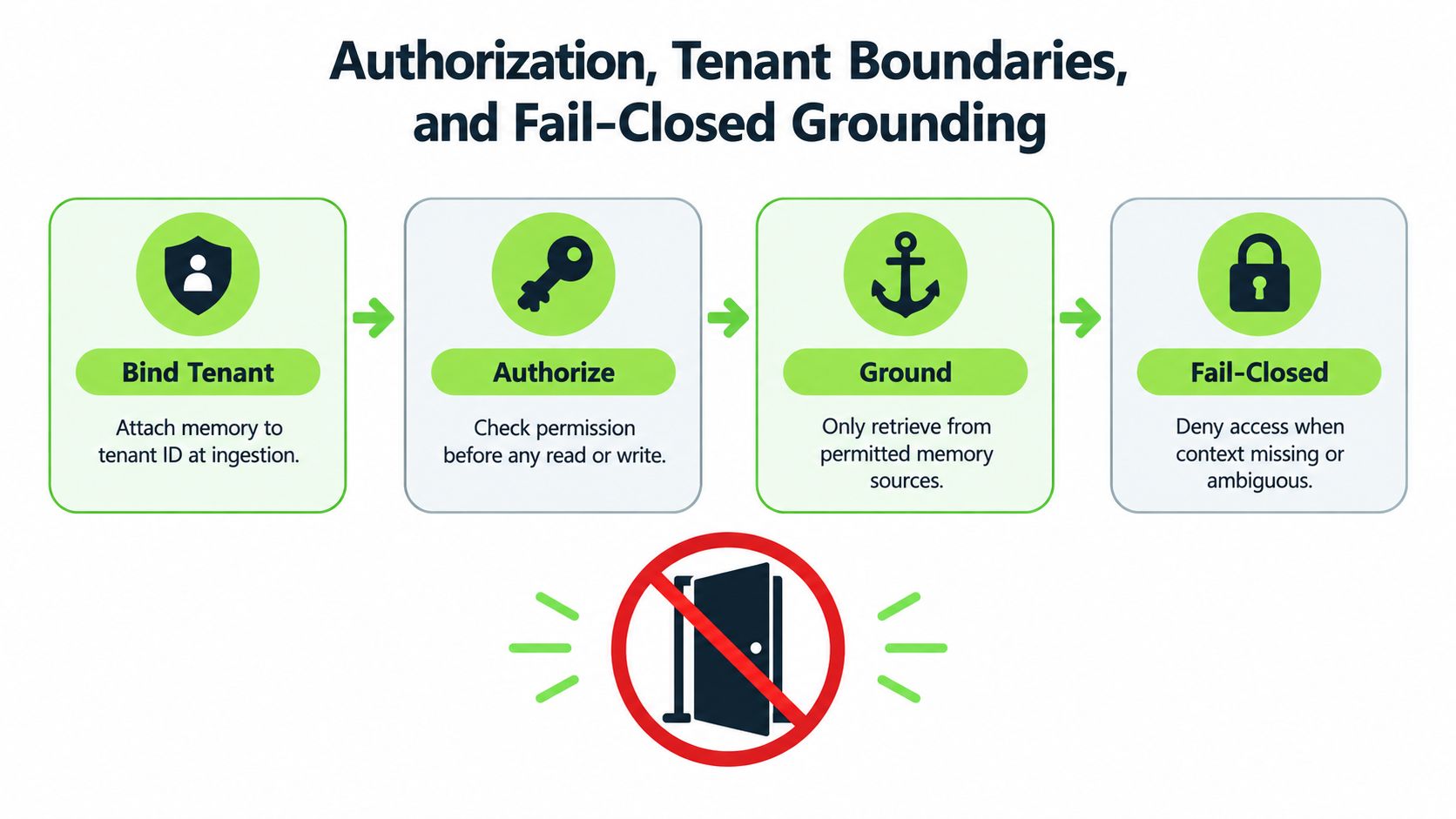
Bind tenant identity and authorization attributes to the request before the agent searches memory. Don't let the model infer a tenant from a company name in a message, and don't treat a prompt instruction such as “only use this customer's records” as an access-control mechanism.
A proposed vendor-neutral multitenant agent architecture applies resource-level attribute-based authorization before vector search and chunk-level filtering after retrieval. It enforces controls at three points, API-route middleware, routing-table resolution before selecting a vector store or model provider, and storage read time. The architecture proposal demonstrates a control pattern, not a breach-rate benchmark or a guarantee of security.
Enforce the boundary across the path
A safe retrieval path looks like this:
- Authenticate the request. Verify identity and tenant claims outside the model.
- Resolve policy. Determine which resources, memory scopes, tools, and operations the identity may use.
- Filter before search. Apply tenant and resource predicates before similarity search where the storage system supports it.
- Re-check returned chunks. Apply chunk-level authorization after retrieval because ranking systems can return mixed or insufficiently filtered candidates.
- Constrain downstream operations. Carry the same identity and policy context into tools, databases, caches, logs, and generated responses.
- Fail closed. Deny the request when identity or policy claims are missing, ambiguous, or inconsistent.
The tenant boundary extends beyond a relational database. It includes vector stores, embeddings, memory metadata, retrieval logs, caches, tool responses, and provenance records. AI access control guidance is especially relevant when teams map these controls across an existing application rather than building a memory service in isolation.
AWS guidance for multitenant AI data agents recommends propagating authenticated identity through the agent, tools, and database layer, validating tenant and role claims in an authenticated JWT, and enforcing PostgreSQL row-level security through a constrained database account. A database role that can bypass the intended policy undermines the control even if the SQL predicates are correct.
Ground claims, not just prompts
Fail-closed grounding applies after retrieval as well. A compact memory may say that a customer approved a change, but the summary isn't automatically sufficient evidence for a regulated action. The system should retrieve the source record, validate that the record remains current and authorized, or refuse to make the claim.
AletheionAGI's GQueries is one example of a grounding and evidence-control layer that works with existing LLMs, RAG pipelines, vector databases, and memory systems. Its relevant role is to provide persistent memory, authorized retrieval, provenance-aware evidence handling, and fail-closed delivery controls, rather than replace the underlying model or storage stack.
Metrics That Actually Matter for Production Memory
Recall and tokens per query are useful operational signals, but they don't tell you whether the system retrieved the right memory for the right person at the right time. A memory system can achieve strong retrieval while surfacing a private, stale, low-authority, or contradictory record.
Evaluation should separate the operations that teams often collapse into one score:
- Searching: Did the system locate candidate records?
- Recalling: Did it return the relevant evidence?
- Editing: Did it revise the correct state without damaging unrelated facts?
- Matching: Did it connect the request to the correct user, tenant, resource, or event?
- Comparing: Did it distinguish conflicting versions and temporal changes?
- Maintaining: Did structured state remain coherent after updates and consolidation?

Report operational failure, not only answer quality
A pre-deployment evaluation should publish denominators, memory versions, retrieval configuration, and failure categories. At minimum, track:
- Supported-claim precision: How often does an answer make a claim that the retrieved evidence supports?
- Harmful-memory rate: How often does a stored or retrieved memory create a materially unsafe recommendation or action?
- Stale-memory rate: How often does the system rely on information that should have expired or been revised?
- Deletion latency: How long does a deletion request take to propagate across raw history, summaries, embeddings, caches, logs, and derived state?
- Contradiction resolution: Does the system identify conflicts, preserve both records where appropriate, and select the authorized current version?
- Provenance retention: Can reviewers trace a generated claim to source evidence and transformation history?
- Authorization violations: Did any retrieval, tool call, cache lookup, or response cross a tenant or resource boundary?
- Abstention quality: Does the system refuse when evidence is insufficient, and does it avoid refusing when authorized evidence is adequate?
- Per-tenant performance: Do utility and safety results remain stable across tenants, roles, data densities, and boundary conditions?
A 2026 study of a human-inspired memory architecture tested retrieval under a 200,000-token context budget and achieved 70.1% raw retrieval accuracy versus 71.2% for direct retrieval, with overlapping 95% confidence intervals. The study's reported result supports a tunable trade-off between accuracy and storage. It doesn't demonstrate generally superior retrieval, and its preprint status calls for replication across domains, tenants, and update policies.
Treat refusal as a measurable capability
Selective forgetting can be a quality improvement. If a memory has expired, lacks authority, or conflicts with a stronger source, retaining it for the sake of recall can make the system worse. A refusal that exposes insufficient evidence is preferable to a fluent answer built on an unverified summary.
Frozen, versioned evaluations help teams distinguish a real improvement from a changed test set or a hidden denominator. The benchmark should test both successful retrieval and deliberate non-retrieval, including requests for private records, stale preferences, deleted facts, conflicting policies, and records outside the user's tenant.
Putting It Together and Shipping Safely
A safe rollout starts with policy, not embeddings. Define the authority model, memory scopes, permitted writers, revision rules, retention triggers, deletion obligations, and conditions for abstention before selecting a vector database or summarization strategy.
Then separate the system into explicit layers:
- Working state: Keep current-task context small enough to remain useful.
- Persistent state: Store durable claims and events outside the model context.
- Evidence links: Preserve provenance, timestamps, confidence, dependencies, and source recovery.
- Authorization: Bind identity and tenant attributes before every read and write.
- Grounding: Deliver only permitted evidence, and retrieve the source or abstain when a summary is insufficient.
- Evaluation: Test utility, safety, freshness, deletion, contradiction handling, and tenant isolation before launch.
Choose consolidation triggers based on state value and recoverability, not token count alone. A short summary can be more dangerous than a long transcript if it removes the qualification that made a claim safe to use.
Common anti-patterns deserve explicit rejection:
- Filtering only at the final prompt.
- Treating a model-generated summary as authoritative.
- Allowing the model to infer tenant or role membership.
- Using a database superuser, table owner, or row-level-security bypass role for agent access.
- Reusing workspace memory as global knowledge without policy review.
- Optimizing recall while ignoring stale, harmful, low-authority, or cross-boundary records.
- Deleting visible records while leaving embeddings, caches, logs, or derived summaries active.
OWASP's AI security research treats tenant isolation as more than database filtering. It extends the boundary to vector stores, memory metadata, retrieval logs, and provenance controls across ingestion, embedding, indexing, memory reads, generation, and tool execution. OWASP's multitenant isolation guidance provides a useful control map for reviewing the full data path.
Selective forgetting and refusal aren't defects to hide. They're signs that the memory subsystem understands scope, authority, and uncertainty. Build the system so those decisions are inspectable, testable, and recoverable.
AletheionAGI provides GQueries as a grounding and evidence-control layer for persistent memory, authorized retrieval, provenance, and fail-closed grounding across existing LLM, RAG, vector database, and agent stacks. Visit AletheionAGI to examine how its infrastructure can help you ship AI memory that preserves useful state without treating every remembered claim as authorized truth.