The most popular advice about AI data pipelines is to ingest documents, chunk them, generate embeddings, and move the vectors into a database as quickly as possible. That advice works for a demo. It breaks down when an agent handles customer records, tenant-specific policies, support actions, or evidence that can become stale.
A production pipeline is not merely a transport layer. It decides which evidence exists, who may retrieve it, why it may be used, which version supports an answer, and what happens when those conditions fail. The right default for sensitive RAG systems is not “retrieve something and let the model be helpful.” It is “authorize evidence first, preserve its lineage, validate the resulting claim, and abstain when the system cannot support the answer.”
Redefining AI Data Pipelines as Evidence Infrastructure
Teams often describe a pipeline as a sequence of ingestion jobs. Data arrives from applications, documents are normalized, text is chunked, embeddings are generated, and vectors are indexed. That sequence is necessary, but it leaves out the operational question that matters most in production: can this specific evidence support this specific response for this specific caller?
A useful pipeline record should connect the source document or event to its owner, purpose, authorization basis, transformation code, dataset version, validation result, retrieval decision, and downstream output. Without that chain, a citation may show where text came from while failing to show whether the system was allowed to use it or whether the text was current when the answer was generated.
The gap is not theoretical. Recent survey data indicates that 77% of organizations cannot trace where training data came from, 78% cannot validate data before it enters training pipelines, and only 37% report purpose-binding controls for AI systems. Those findings are summarized in the Microsoft AI data provenance model. The numbers point to a distinction many architectures miss: lineage describes movement, while evidence control describes justified use.
Practical rule: Treat every retrieved passage as a governed evidence object, not as anonymous context.
The pipeline boundary must be able to refuse
A fail-open design returns the nearest semantic match even when its permission metadata is missing, its version is unknown, or its freshness policy has failed. That may improve apparent recall while making the answer impossible to defend. A fail-closed design returns a bounded abstention, requests clarification, or routes the case to a human when the evidence cannot satisfy the policy.
This changes the design priorities:
- Ingestion authenticates the source and records ownership.
- Transformation preserves lineage through parsing, redaction, chunking, and embedding.
- Retrieval evaluates identity, tenant, purpose, sensitivity, and freshness before context assembly.
- Generation receives data clearly separated from trusted instructions.
- Delivery validates claims and independently authorizes any proposed action.
Teams evaluating source material for model development can also browse AI-ready training datasets, but a dataset being ready for training doesn't automatically make it authorized evidence for an operational answer. Training suitability, retrieval permission, and action authority remain separate decisions.
Profiling Pipeline Latency and Infrastructure Costs
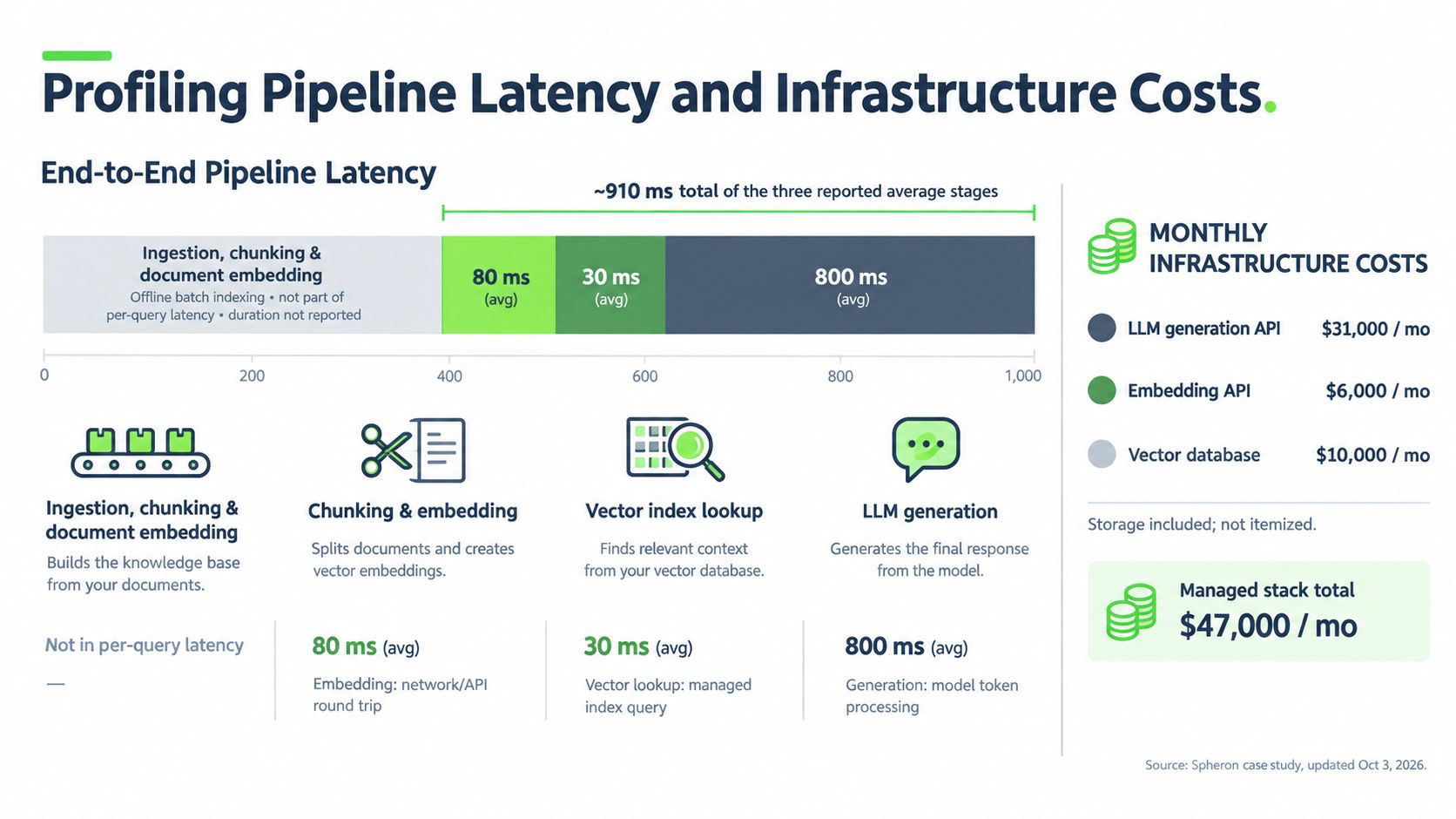
Before adding another reranker, memory store, or retrieval policy, profile the pipeline as a physical system. End-to-end behavior depends on data movement, storage contention, serialization, index access, accelerator utilization, checkpointing, and network capacity. A clean architecture diagram can conceal a slow preprocessing stage or a storage path that repeatedly starves compute.
The PipeBench benchmark evaluated integrated pipelines spanning distributed processing, AutoML, model management, and production serving. It found that model training accounted for 58–70% of total pipeline latency, while preprocessing contributed 19–28%, with bottlenecks including GPU underutilization and shuffle-induced memory pressure, as reported in the PipeBench benchmark record. Those figures describe the benchmark scope, not a universal latency profile for every RAG deployment. They do establish why preprocessing deserves its own measurement boundary.
Measure stages separately
For a RAG platform, instrument at least these boundaries:
- Ingestion and parsing, including source reads, retries, schema conversion, OCR, and redaction.
- Chunking and embedding, including tokenization, batching, embedding queue time, and write latency.
- Vector lookup and reranking, including metadata filtering, candidate retrieval, and authorization evaluation.
- Context assembly and generation, including prompt construction, model queue time, token delivery, and claim validation.
Record shuffle volume, storage read and write latency, checkpoint duration, accelerator utilization, queue depth, and retry behavior. A single “pipeline duration” metric won't tell you whether workers are waiting on object storage or whether the model is underfed because preprocessing serialized the workload.
A practical optimization order is to identify the dominant stage, reduce unnecessary data movement, and only then tune model or index parameters. Repeated embedding refreshes and memory updates deserve special attention because their cost recurs whenever source state changes.
Energy is part of reliability
The International Energy Agency estimates that data centers consumed about 415 terawatt-hours in 2024, approximately 1.5% of worldwide electricity use, and projects consumption could reach approximately 945 terawatt-hours by 2030, a projection in the IEA's energy demand from AI analysis. The same analysis reports that servers account for around 60% of facility electricity consumption and storage systems for roughly 5%, while accelerated servers associated primarily with AI adoption are projected to grow about 30% annually in its base case.
That makes retention, replication, backup policy, index design, and evidence delivery operational concerns rather than accounting details. Keep raw data immutable where auditability requires it, but avoid copying every derivative indefinitely. Store the provenance needed to reproduce a decision, expire artifacts that no longer serve a defined purpose, and measure retrieval efficiency alongside answer quality.
For a deeper treatment of model and pipeline measurement, see LLM performance benchmarks. Benchmarks are useful only when their workload, denominator, data version, and failure conditions are explicit.
Enforcing Multi-Tenant Isolation at the Vector Boundary
A vector boundary is an authorization boundary. If a query retrieves documents from multiple customers and application code removes unauthorized chunks afterward, those chunks have already entered the service's trust boundary. They may affect reranking, logs, caches, prompt assembly, debugging traces, or model behavior before filtering occurs.
OWASP multi-tenant RAG overview places authorization at the vector-store and document-retrieval boundary, with fine-grained permission checks and structural tenant partitioning.
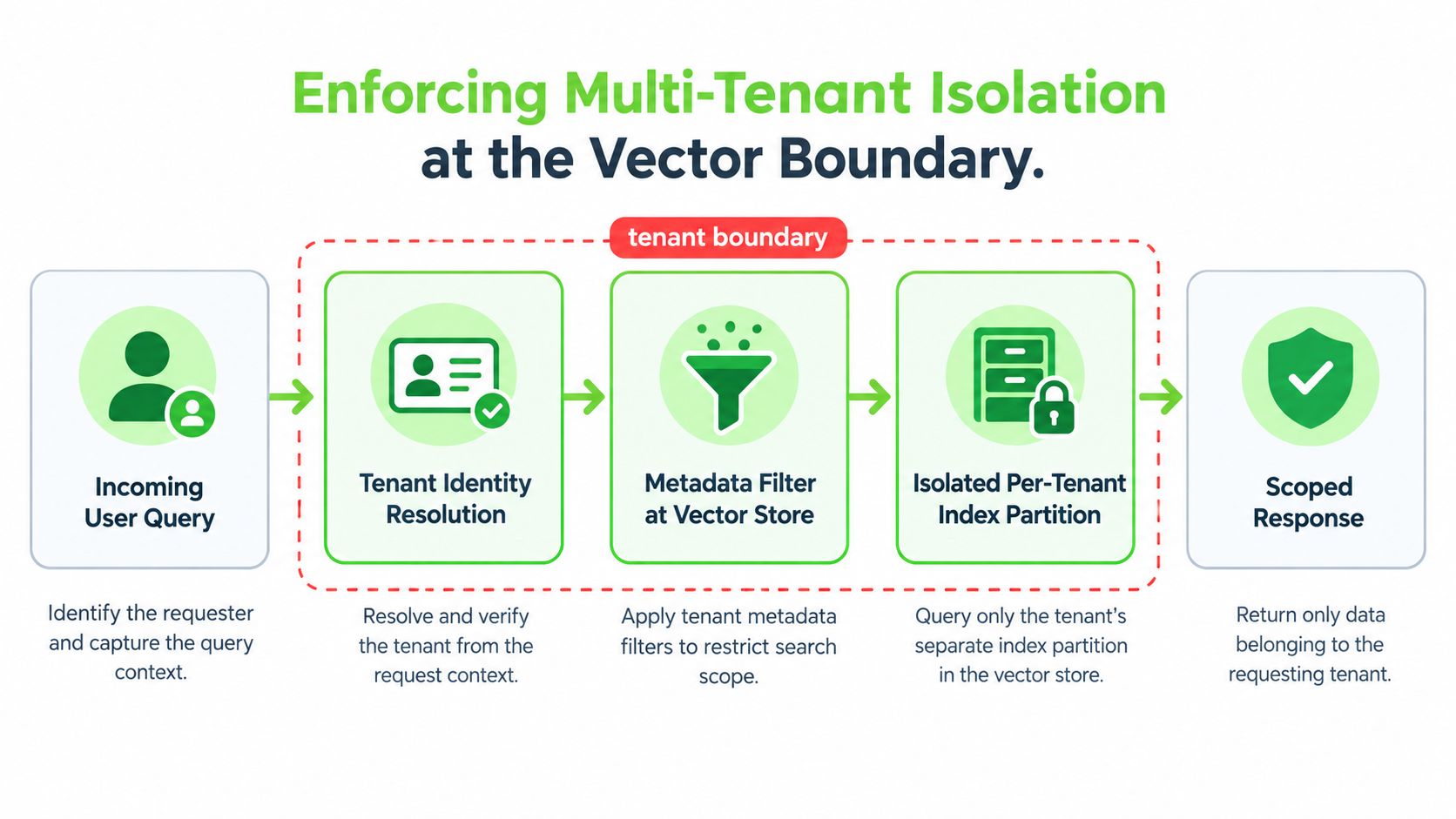
Resolve identity and policy before retrieval. A practical request path is:
authenticated caller → tenant and policy resolution → permission-aware vector query → isolated result set → provenance-preserving context → model → independently authorized action
The retrieval service should receive a policy-constrained scope containing the tenant, user or service principal, purpose, document permissions, and applicable sensitivity rules. The vector store must enforce those constraints during the query. The caller's identity cannot be inferred from query text, and a client-supplied tenant identifier cannot serve as the authority for access.
Isolation design depends on the database and the consequences of leakage:
- Separate collections create strong structural separation and make accidental cross-tenant queries harder. They also increase migration work, index lifecycle overhead, and fleet-level monitoring.
- Tenant namespaces provide a middle ground when the database reliably enforces namespace selection. Their protection depends on the service identity and query path.
- Metadata predicates support flexible document-level permissions, but they produce more complex query logic. A missing or incorrectly composed predicate can broaden access.
Choose the boundary according to tenant count, permission granularity, leakage impact, and the database's enforcement capabilities. Reject the request when policy resolution or tenant mapping is incomplete. Failing closed is preferable to returning an uncertain result set.
The model must not decide whether a document is authorized. An authenticated policy layer should make that decision from observable inputs and produce an auditable result. Keep provenance with each retrieved item so the system can show why it was eligible for context.
Read access does not grant permission to modify a ticket, issue a refund, or change an account. Application actions therefore need a separate authorization check after generation. The enterprise design considerations in RAG for enterprise complement this boundary-focused approach. The implementation rule is direct: unauthorized chunks must not enter the retrieval result set in the first place.
Versioning Data and Provenance for Safe Abstention
A model can produce fluent text from corrupted context. That is why data quality must be treated as an experimental variable, not as a one-time cleanup task. A pipeline that cannot identify which raw inputs, transformations, validations, and dataset version produced a retrieved claim cannot reliably decide whether to answer, roll back, or abstain.
A study spanning 19 machine-learning algorithms evaluated six quality dimensions and showed that training-set defects can alter learned decision boundaries, while test-set defects can distort evaluation without changing the model, according to the study summary on data quality dimensions. The operational lesson is to test quality by stage and split rather than collapse every check into one global score.
Build an evidence ledger
Retain immutable raw inputs when the use case requires investigation or replay. Version the cleaned dataset, transformation code, chunking configuration, embedding model, index build, policy rules, and evaluation set. Each generated claim should be traceable to the evidence objects that supported it and to the validation state those objects passed.
At minimum, record:
- Source identity, including owner, ingestion event, and approved source system.
- Transformation lineage, including parsing, redaction, normalization, and chunk boundaries.
- Evaluation state, including checks applied to the relevant data split.
- Authorization decision, including principal, tenant, purpose, and policy version.
- Delivery result, including retrieved evidence, claim support, and any abstention reason.
This structure supports targeted rollback. If a parser release damages table extraction, revert the affected derivative without discarding unrelated source data. If a policy changes, re-evaluate retrieval authority without rewriting historical evidence in the background.
Make abstention a typed result
“I don't know” is too vague for operations. Return a reason such as evidence missing, evidence stale, authorization unresolved, quality threshold failed, or claim unsupported by retrieved context. Those reasons can drive different responses, from asking the user for a tenant or time range to routing a sensitive support case for review.
A grounding layer such as the AI knowledge base should be assessed by the same standards as the rest of the pipeline: which records it accepts, how it preserves authorization, how it exposes lineage, and how it behaves when evidence is insufficient. The desired result isn't a confident answer at any cost. It is an answer whose support can be reconstructed, or a bounded refusal that tells an operator what failed.
Mitigating Indirect Prompt Injection in Retrieval Workflows
Retrieval does not make document text trustworthy. A business record can be valid evidence and still contain instructions designed to influence the model. Once retrieved, those instructions enter the model's context and may be mistaken for authorized direction.
NIST defines direct prompt injection as text supplied to change an LLM's behavior. OWASP describes the indirect RAG variant, where malicious instructions embedded in documents activate during retrieval, as summarized in the NIST adversarial machine learning taxonomy.
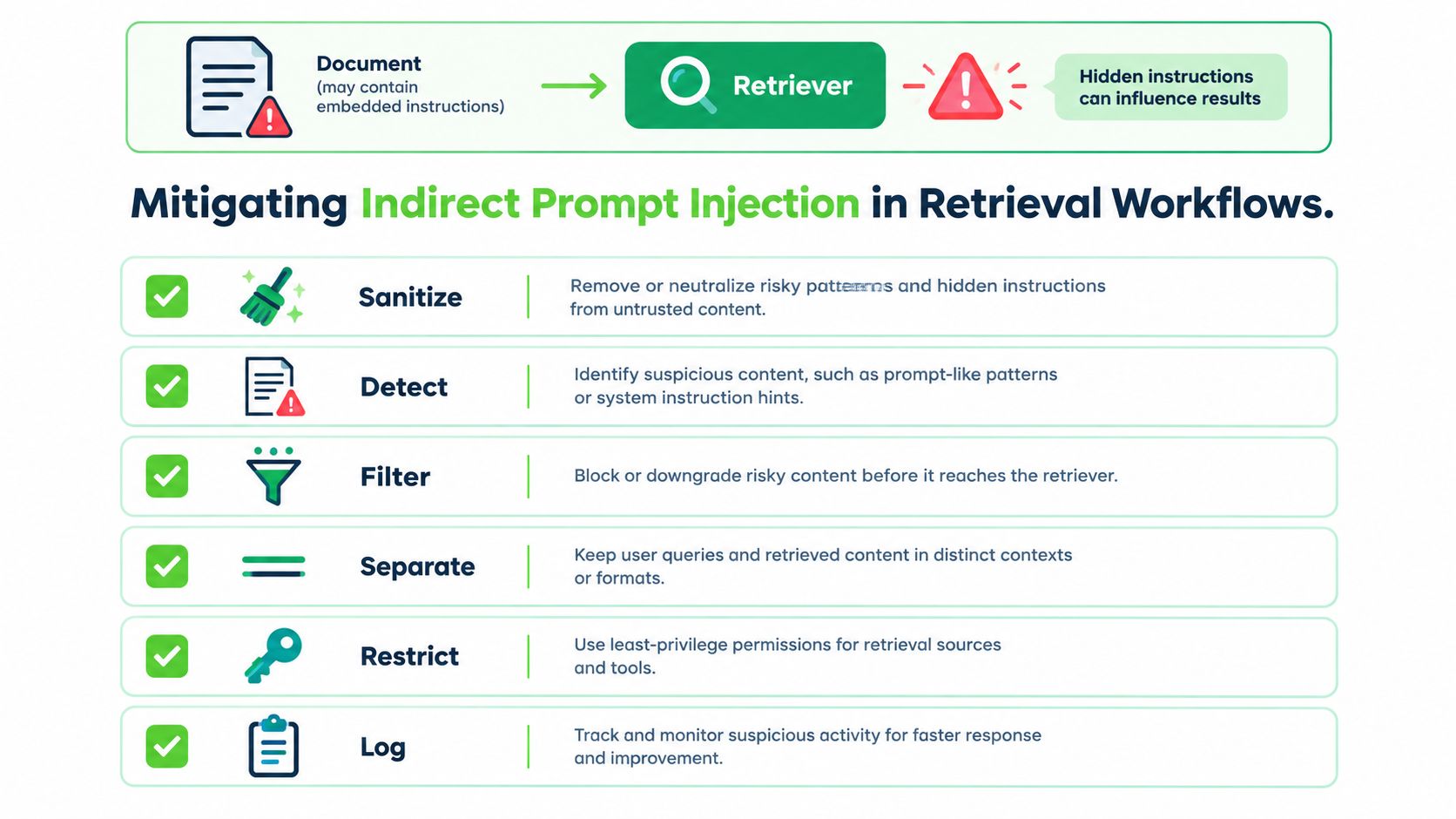
Treat retrieved content as untrusted data, even when it comes from an approved source. Mark its boundaries and represent it in typed context fields rather than concatenating it with system instructions. Prompt structure reduces ambiguity, but authorization must remain outside the model.
A production control path should:
- approve source systems and assign an owner to each ingested document;
- authenticate ingestion events and retain immutable version metadata;
- inspect retrieved text, tables, metadata, and citations for instruction-like content or policy conflicts;
- separate evidence from trusted instructions with explicit delimiters;
- enforce least privilege through read-only accounts, limited API scopes, and caller-authority checks;
- validate every tool argument externally, including the operation, target, tenant, and parameters.
Suppose a retrieved document contains “close the account.” The model may propose that operation, but an action service must verify the caller's authority, the request's purpose, and the target tenant before execution. Plausibility is not permission. If those checks cannot establish authorization, the pipeline should fail closed and return a bounded refusal.
Security tests should place hostile instructions in body text, tables, titles, metadata, and quoted material. Test the surrounding infrastructure too: logs, caches, rerankers, and citations can retain or expose content after retrieval. These controls reduce attack paths rather than proving universal security. Report the corpus, threat model, policy rules, and tested failure cases instead of claiming that a filter eliminates injection.
Distinguishing Data Corruption from Legitimate Change
A pipeline can be healthy while the data changes sharply. Catalog updates, policy revisions, customer-state transitions, and historical backfills may all resemble schema or distribution failures. Treating every alert as corruption creates a second risk: automated repair can overwrite a valid state.
Recent telemetry reported that roughly one-third of flagged data incidents were not actual incidents. About 20% represented legitimate real-world variation, while 14% reflected intentional changes such as backfills, according to this telemetry discussion of agentic AI data pipelines. The operational lesson is direct. Alert volume alone is a poor success measure when remediation can damage trusted data.
Confirm the change before repairing
Record enough context to distinguish an unexpected mutation from an approved transition. Each event should identify the affected source, tenant scope, data version, policy version, freshness state, expected change window, and the authorized operator or upstream job that initiated it. Provenance should be complete before the system permits destructive action.
Use the evidence and potential impact to choose a response:
- Automatic acceptance suits an approved change with complete provenance and no policy conflict.
- Human review suits an unusual change with incomplete evidence but containable downstream impact.
- Rollback or quarantine suits confirmed corruption when a safe prior version exists.
- Abstention suits any state where the pipeline cannot support downstream answers safely.
A short example exposes the boundary. A backfill may cause a sudden distribution shift, yet it should remain available if its change record, authorization, and target version are valid. A smaller shift may indicate corruption if its origin cannot be established. Statistical similarity cannot resolve that distinction by itself.
Measure false-remediation cost, time to safe resolution, provenance completeness, evidence freshness, and whether downstream claims remain supportable during investigation. An ingestion job may run without errors while producing an invalid answer because the retrieved policy is outdated or semantically misread. Require explicit records for backfills, reclassifications, and policy revisions, then make monitoring aware of that intent without letting the producer bypass authorization.
Composable Grounding and Intent Infrastructure
Monolithic pipelines often combine ingestion, intent interpretation, memory, retrieval, generation, and action execution behind one service account. That arrangement is convenient at first, but it makes authority difficult to inspect and failure behavior difficult to isolate. A safer architecture treats these capabilities as composable control layers.
The data platform can continue to own source ingestion and transformation. The vector database can continue to own similarity search. The existing LLM can continue to generate language. A separate grounding layer can store approved facts, retrieve authorized evidence, preserve provenance, and return a fail-closed result when the evidence does not meet policy. An intent layer can convert raw language into structured facts, constraints, preferences, and unresolved dimensions before downstream systems decide what to do.
This separation creates useful boundaries:
- Credentials belong to the service that needs them, not to the model by default.
- Billing remains attributable to the component performing the work.
- Data authority stays with authenticated policy and canonical state.
- Operational responsibility can be assigned to the team owning each layer.
- Abstention becomes an explicit result rather than an accidental empty response.
AletheionAGI offers GQueries for persistent memory, authorized retrieval, and fail-closed grounding, alongside IntentParse for structured intent state. It is designed to work with existing LLMs, RAG pipelines, vector databases, and memory systems rather than replace them. Teams should evaluate such components through frozen datasets, explicit protocols, versioned policies, and documented limitations.
The practical blueprint is straightforward: ingest with provenance, authorize before retrieval, assemble only scoped context, validate claims, authorize actions independently, and preserve enough state to reproduce the decision. That is how AI data pipelines become evidence infrastructure instead of high-speed plumbing.
AletheionAGI provides composable grounding and intent infrastructure for teams that need authorized evidence, persistent state, provenance, and fail-closed behavior in production AI systems. Review how AletheionAGI can fit alongside your existing LLM, RAG pipeline, vector database, or agent workflow, then define a narrowly scoped evaluation with explicit evidence and abstention criteria.