The most popular advice about AI agent memory is also the least reliable: keep the entire conversation, increase the context window, and let the model decide what matters. That approach confuses exposure with memory. A model may see an old fact and still use the wrong version, miss a relationship between distant events, or follow an instruction embedded in retrieved content.
Production memory is a controlled infrastructure layer. It decides what enters storage, what can be retrieved, which source is authoritative, how updates supersede earlier state, and when the agent must abstain. A vector database and a larger prompt can support that layer, but neither provides it by itself.
Why More Context Is Not Better Memory
A context window supplies information for one request. Memory gives an agent governed, persistent state that can be updated and reused across requests. That distinction matters whenever an agent handles customers, accounts, policies, or tasks whose details change.
A larger prompt can still produce several different failures:
- Retrieval failure: the relevant record never reaches the prompt.
- Selection failure: several plausible records arrive, and the model chooses the wrong one.
- Conflict failure: records disagree, but no rule identifies the current version.
- Staleness failure: an old fact remains available after it has been superseded.
- Authority failure: retrieved text is treated as permission to disclose data or call a tool.
In the published MemBench findings, several memory mechanisms fell from accuracies near 0.7 at 10,000-token settings to approximately 0.3 to 0.4 at 100,000 tokens in the published MemBench findings. This does not mean every long-context system behaves that way. It shows that more history does not replace admission rules, indexing, compression, relevance selection, or update policies.
Production memory needs five controls:
- Admission, which information deserves durable storage.
- Retrieval, which evidence fits the current task.
- Updating, how new information changes existing state.
- Capacity, how the system avoids becoming an unbounded transcript.
- Forgetting, how invalid or superseded information is suppressed.
Context still sets the information available during one model call. The overview of context as a deciding factor for AI helps explain that constraint. It does not establish memory quality. A longer window can expose more evidence while making stale, conflicting, or low-priority records harder to distinguish.
The four capabilities to test
MemoryAgentBench separates accurate retrieval, test-time learning, long-range understanding, and conflict resolution. That breakdown is more useful than one aggregate memory score because each capability indicates a different engineering problem.
A retrieval test checks whether the system found a record. A test-time learning task checks whether it incorporated new information during interaction. Long-range understanding checks whether it connects distant events. Conflict resolution checks whether it reconciles contradictory state instead of repeating whichever record ranked highest.
The benchmark reports that GPT-4o-based memory agents reached only 60% accuracy on single-hop conflict-resolution tasks, while multi-hop conflict-resolution performance reached no more than 7% for all evaluated methods in the MemoryAgentBench dataset. These results apply to defined benchmark tasks, not every model or deployment. They do show why storage capacity and operational memory quality require separate evaluation.
Practical rule: Treat each memory record as evidence with state. It is not automatically an instruction or permission for the agent to act.
The Three Memory Types Every Agent Uses
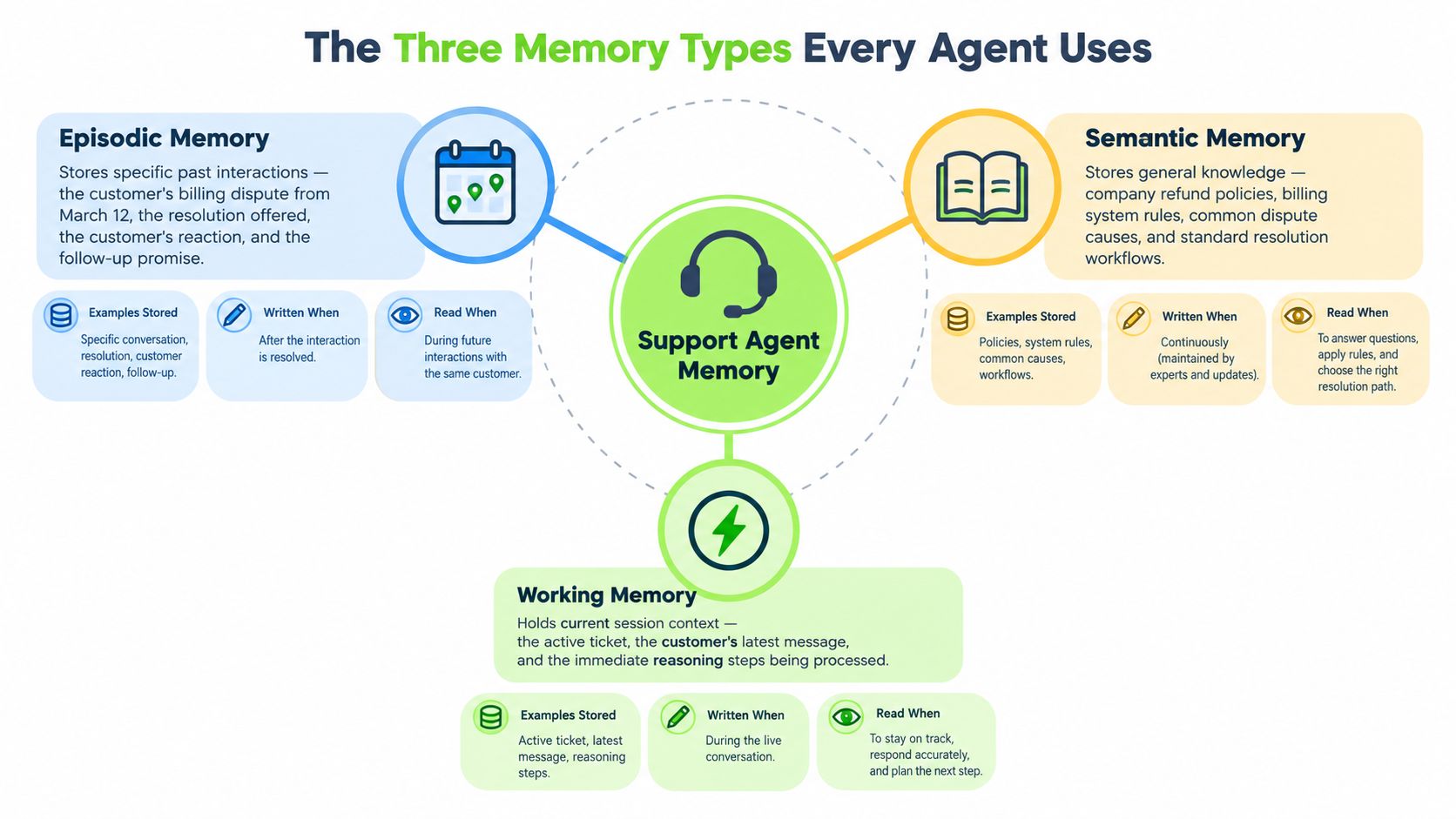
A support agent handling a billing dispute usually needs three memory types at the same time. Keeping them distinct makes ownership, retention, access control, and evaluation much easier.
Working memory handles the active turn
Working memory contains the state needed right now: the authenticated customer, active ticket, latest message, selected account, unresolved question, and tool results from the current workflow. It should be compact and explicit.
Suppose the customer says, “The duplicate charge is still showing.” Working memory should hold the ticket identifier, the payment event under review, the current authentication result, and the next permitted action. It shouldn't merge unrelated preferences or old cases into the active decision.
Working memory usually lives in the session or workflow state. It can include a short recent transcript, but it shouldn't be treated as the durable source of truth after the session ends.
Episodic memory records what happened
Episodic memory stores a specific interaction or event. For the billing case, that might include the customer's earlier report, the investigation performed, the refund offered, the customer's response, and a promised follow-up.
Write episodic memory when an event has future operational value, such as a resolution, failed troubleshooting step, customer commitment, or escalation. Read it when the agent needs continuity, for example, when the customer returns and asks why the earlier remedy hasn't worked.
Each episode needs timestamps, participants, outcome, and provenance. A raw transcript is rarely sufficient because it contains conversational scaffolding that can overwhelm the event that matters.
Semantic memory stores durable facts
Semantic memory represents general facts extracted from interactions or governed sources. In this example, it may contain the customer's verified account relationship, an applicable contract tier, a current refund policy, or a confirmed preference for email follow-up.
Semantic facts require stronger update rules than episodic records. If the customer changes their preferred contact channel, the new fact should supersede the old one. If a policy changes, the support agent should retrieve the current authorized policy rather than rely on a historical conversation that mentioned an earlier version.
Many teams also encounter procedural memory, which stores how work should be performed. A workflow such as “verify ownership, inspect the payment event, check the applicable policy, then request approval before issuing a refund” is procedural. It belongs closer to governed instructions and deterministic workflow logic than to untrusted user history.
The distinction aligns with broader discussions of three types of knowledge, but production systems need an additional boundary: memory describes state and experience, while policy determines authority.
A practical ownership map looks like this:
- Session service: working memory and temporary tool state.
- Event store: episodic records with timestamps and outcomes.
- Profile or state store: semantic facts with validity and supersession.
- Policy engine: procedural rules and authorization decisions.
- Retrieval layer: selection of evidence, not permission to act.
What Production Memory Must Be Measured On
A single accuracy score hides the failure mode that matters to the product. A support agent may retrieve the correct customer preference yet apply an obsolete plan status. A marketplace agent may recall a transaction but expose it across tenants. Retrieval-only evaluation misses both failures.
MemoryAgentBench offers a useful four-part evaluation model.
| Competency | What It Tests | Failure Mode It Catches |
|---|---|---|
| Accurate retrieval | Whether the relevant memory is found and selected | Missed evidence, noisy retrieval, wrong ranking |
| Test-time learning | Whether new information changes later behavior | The agent repeats an outdated assumption |
| Long-range understanding | Whether the agent connects distant events | Multi-step or multi-session reasoning breaks |
| Conflict resolution | Whether contradictory memories are reconciled | The agent accepts stale or unauthorized state |
Measure separate denominators
Track retrieval precision and recall separately from final-answer faithfulness. Add measures for current-state accuracy, stale-memory use, conflict detection, authorized evidence delivery, and safe abstention.
A dashboard should show these denominators independently. For one evaluation run, it might report whether the relevant record was retrieved, whether the record was current, whether the answer cited authorized evidence, and whether the resulting tool action was permitted. A retrieval success paired with an unsupported answer is different from a safe abstention caused by conflicting evidence. Combining both into one accuracy figure rewards confident guessing and hides where the system failed.
As noted earlier, longer context can degrade performance. Report task conditions and context size with every result, including the memory horizon, retrieval depth, model, prompt, and update protocol. Efficiency and capacity belong beside effectiveness because a system that meets an accuracy target only with excessive context or retrieval work may not be practical to operate.
Freeze the protocol before tuning
Use a fixed set of multi-session scenarios with versioned memory records. Inject controlled updates, contradictory statements, revoked permissions, and ambiguous evidence. Record the exact memories delivered to the model, the authority attached to each source, and the proposed action.
Agent traces make this review practical. Tools such as the DOM Studio developer docs for agent run traces illustrate the execution visibility teams need, although a trace viewer does not replace an evaluation protocol.
Publish limitations with every result. State whether the test measures retrieval, grounded answers, tool outcomes, or all three. A benchmark result about retrieval does not establish security, policy compliance, or reliable action execution. Evaluation must show whether memory retained the right state, resolved conflicts correctly, and allowed outdated information to be forgotten.
Architecture Patterns for Agent Memory
A memory architecture usually has separate write and read paths, with authority controls around both.
On the write path, the application receives an interaction, extracts candidate facts or events, assigns identity and tenant scope, attaches provenance, checks whether the information is allowed to persist, and either stores, updates, links, or rejects it. On the read path, the application authenticates the request, applies tenant and role filters, retrieves candidate evidence, validates freshness and authority, and passes only approved evidence into generation.
Retrieval-augmented memory
A retrieval-augmented memory pattern stores selected episodes and facts outside the model, then retrieves relevant records for a later task. Vector search works well for semantic similarity, while structured stores are better for identifiers, timestamps, permissions, and exact state. A hybrid design can combine embeddings with keyword, entity, relational, or SQL lookups.
The trade-off is operational complexity. More retrieval paths can improve coverage, but they also create more opportunities for inconsistent filters, duplicated facts, and unclear ranking logic. Every result should preserve its source identity, version, timestamp, scope, and confidence.
Consolidation and summarization
Raw events can be consolidated into compact state. For example, several conversations about a billing dispute might produce one current issue record, linked historical episodes, and a resolution outcome.
Summarization reduces prompt pressure, but it can destroy evidence if the system discards the underlying records. Keep summaries traceable to source events. A summary should be an index or convenience representation, not an unreviewable replacement for authoritative state.
Write-time filtering
Don't save everything. Write-time filters should distinguish durable user facts, transient conversation details, sensitive data, agent inferences, and policy content. The filter should also determine whether the current writer is allowed to create or modify a record.
Many systems fail in this way. An agent-generated inference can look like a user statement after embedding and storage. Store actor identity and source type explicitly, and make downstream retrieval aware of that distinction.
Grounding before generation
A grounding layer sits between retrieval and generation. It checks whether the selected evidence is authorized, current, attributable, and sufficient for the requested claim. It can return a bounded evidence set, require clarification, or fail closed when the conditions aren't met.
AletheionAGI's GQueries is one example of a grounding and memory infrastructure layer that works with existing LLMs, RAG pipelines, vector databases, and memory systems rather than replacing them. Its stated role is persistent memory, authorized retrieval, and fail-closed grounding, so evaluate it against the same workload-specific controls as any other infrastructure choice.
A canonical request path looks like this:
User and tenant identity → authorization service → memory and policy retrieval → provenance and freshness checks → claim validator → model response → deterministic tool gate.
The final tool gate matters. The model may propose a refund, account change, or data export. Authenticated policy and canonical application state must decide whether that action is permitted.
For a broader view of component boundaries, see this guide to AI agent architecture, then map each component to an explicit owner and failure behavior.
Grounding and Retrieval Controls That Hold
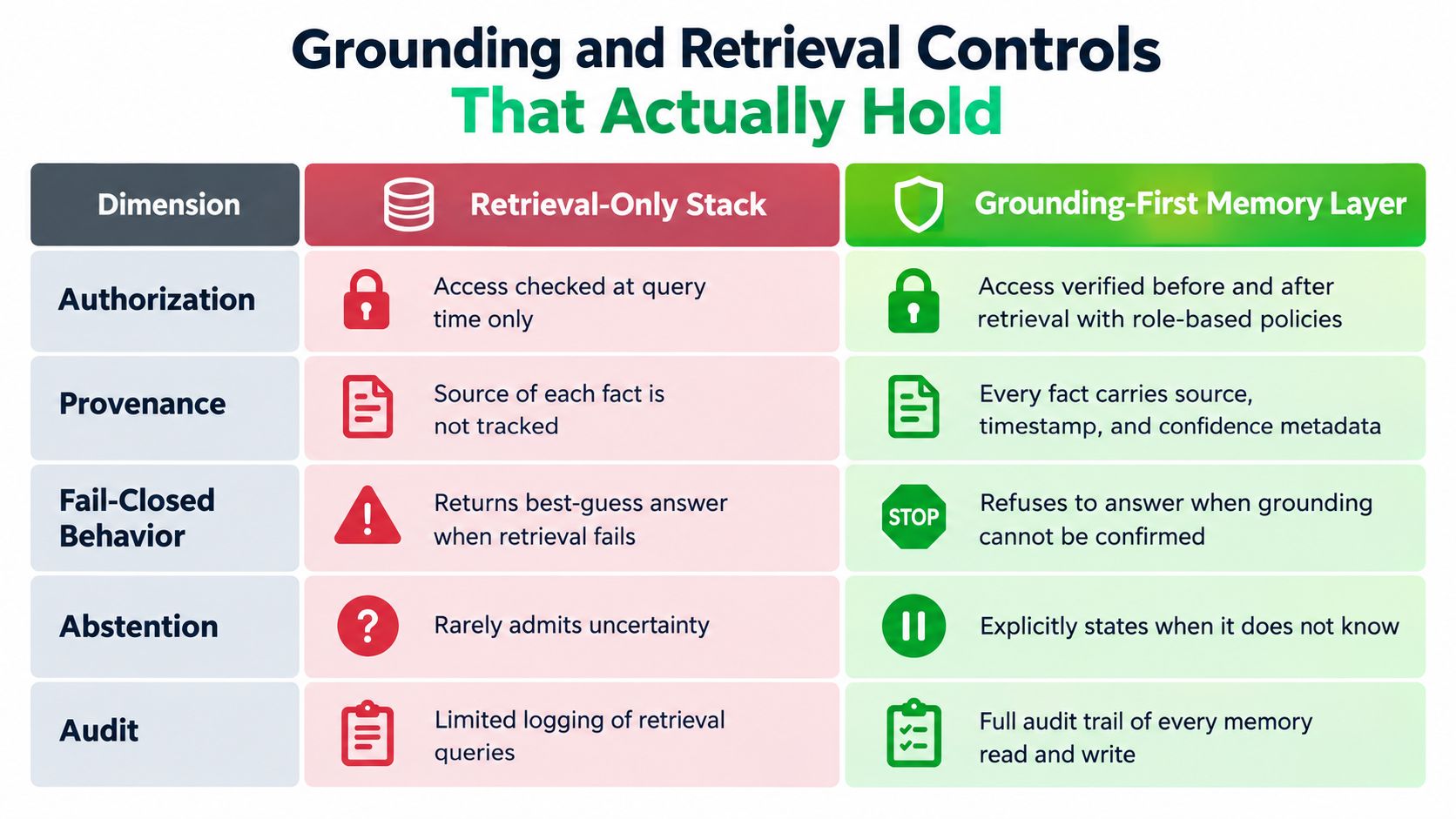
Retrieval-only systems answer one narrow question: which records resemble the query? Similarity is useful for finding candidates, but it does not establish authority, freshness, scope, or permission.
A grounding-first layer treats retrieved content as evidence that must clear additional checks. It gives the system defined points to reject unsupported inputs, expose uncertainty, and stop a proposed action before it reaches a tool. The model can still be wrong. The difference is that failure becomes observable and controllable.
| Decision criterion | Retrieval-only stack | Grounding-first memory layer |
|---|---|---|
| Authorization | Often applied at query time, leaving gaps between retrieval and generation | Applies identity, tenant, role, and resource checks before evidence is delivered |
| Provenance | May preserve document metadata inconsistently | Carries source, version, timestamp, actor, and lineage through the claim path |
| Fail-closed behavior | May generate a best-effort response when retrieval is weak | Can refuse, request clarification, or route to a human when grounding is unconfirmed |
| Abstention | Often treated as a poor user experience | Treated as a valid result when evidence is insufficient or conflicting |
| Audit | Logs queries and model calls | Logs memory writes, reads, delivered evidence, supported claims, and tool decisions |
Retrieved text is not trusted authority
OWASP classifies prompt injection as a leading risk for LLM applications and includes indirect attacks embedded in documents, emails, web pages, database records, and tool responses in its prompt injection guidance. Internal provenance does not make a memory record safe. It may still contain instructions intended to redirect the agent.
Separate evidence from authority. Retrieved text can support a proposed response, while authenticated permissions, canonical policy, and deterministic business rules decide which data may be disclosed and which tools may run. Give tools least-privilege credentials, then validate their arguments independently of the model.
Provenance must survive the pipeline
NIST treats data provenance as an operational control. Its guidance supports tracking source identity, lineage, metadata, modifications, deletions, and rectification history, while noting that provenance alone cannot prevent hallucination or unauthorized disclosure in the NIST Generative AI Risk Management Profile.
For every memory or document chunk, preserve:
- Origin: the source system and record identifier.
- Version: when the content was created or changed.
- Scope: tenant, user, account, and permitted roles.
- Authority: whether the record is policy, user-provided evidence, or an agent inference.
- Validity: when the fact was true and what superseded it.
- Delivery log: which model call received it and for which task.
For the retrieval mechanics behind this control layer, see this guide to retrieval-augmented generation, then add authorization before generation, claim validation after generation, and an independent decision point before any action executes.
The Hardest Memory Failure Is Stale-State Reasoning
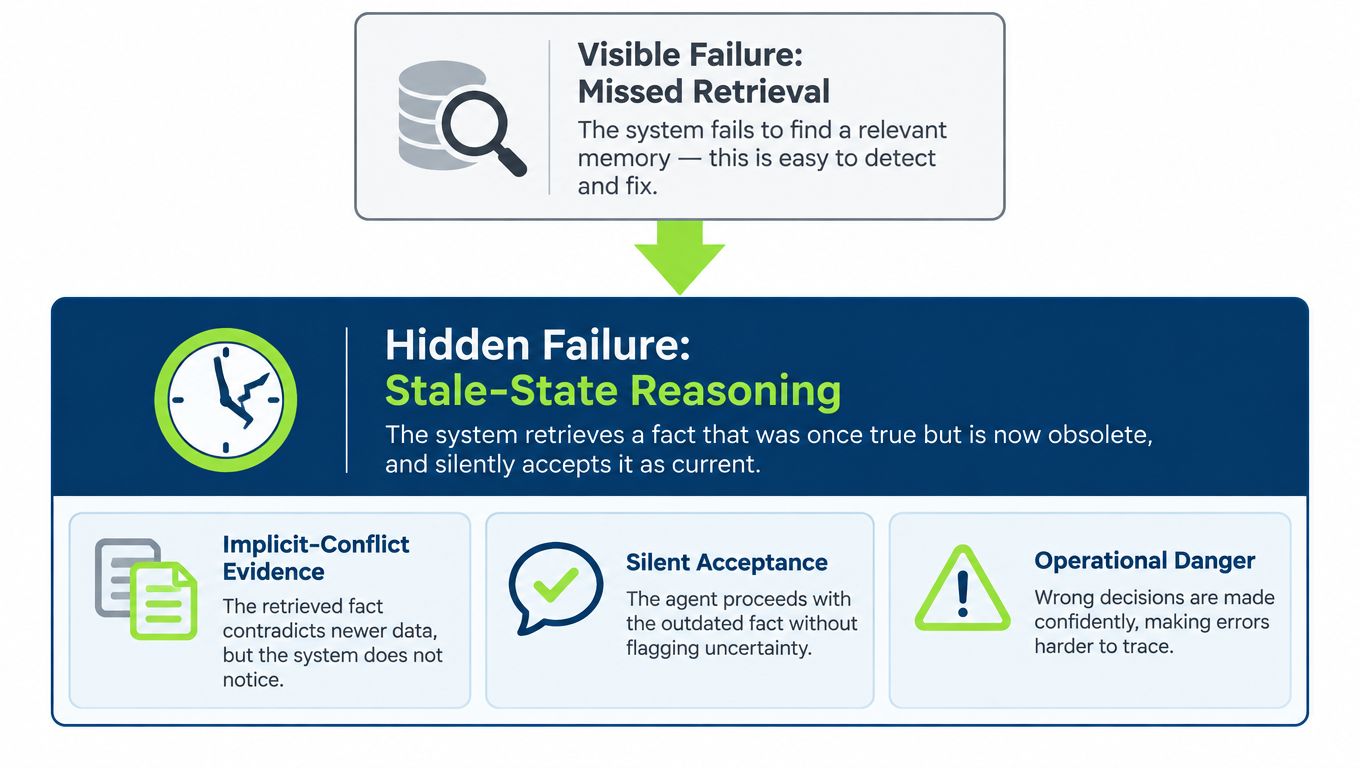
Missed retrieval is visible. The system returns no useful record, the agent asks for information again, and engineers can inspect the query and index.
Stale-state reasoning is harder. The system retrieves a fact that was once correct, combines it with newer evidence, and treats the obsolete fact as current without indicating the change. The answer can look coherent because the failure occurs in temporal reasoning, not in search.
The implicit-conflict benchmark described in the available results tested 400 expert-validated conflict scenarios, covering more than 100 everyday topics and contexts up to 150,000 tokens. The best evaluated model achieved only 55.2% overall accuracy in the reported implicit-conflict results. These conditions are specific, so the number shouldn't be treated as a general model ranking. It does show that an agent can encounter newer evidence and still accept an outdated assumption embedded in the question or downstream workflow.
Build state, not just memories
A versioned state-and-causality layer should attach more than an embedding to a record:
- Validity interval: when the fact became true and when it stopped being true.
- Source authority: who or what is permitted to establish the fact.
- Confidence: how directly the system observed it.
- Supersession link: which newer record replaces it.
- Dependency graph: which conclusions or actions relied on it.
- Conflict status: whether the system resolved, surfaced, or deferred the disagreement.
Consider a changed delivery address. The new address should not merely sit beside the old address as another semantically similar result. The record should invalidate the prior address for future deliveries, preserve the history for audit, and trigger review of any pending shipment decision that depended on the old value.
Memora's benchmark makes this operational concern explicit through Forgetting-Aware Memory Accuracy, or FAMA. The metric penalizes reliance on obsolete or invalidated memories and separates remembering observed information from reasoning over accumulated history and making recommendations in the Memora benchmark.
A safer memory layer may recall less than a permissive one because it knows when the evidence is obsolete.
Measure stale-memory acceptance directly. Inject controlled corrections, revoked authorizations, changed policies, and identity updates. Then record whether the agent used the old value, surfaced the conflict, selected the current value, or abstained.
For teams designing AI context management, the important design choice is not how much history to expose. It is how the system represents change and prevents dependent conclusions from surviving after their evidence has expired.
A Production Checklist for Shipping Agent Memory
Use this checklist before putting persistent memory behind a customer or employee workflow:
- Define the schema. Give every durable record a type, owner, tenant scope, source, timestamp, validity interval, confidence, and supersession relationship.
- Separate evidence from authority. Retrieved text can support reasoning, but policy and authenticated application state must control disclosure and action.
- Authorize before retrieval. Apply tenant, user, role, and resource filters before evidence reaches the model, then validate the delivered set again.
- Implement fail-closed paths. Missing, conflicting, stale, or unauthorized evidence should produce abstention, clarification, or escalation.
- Test forgetting. Measure current-state accuracy, stale-memory use, conflict detection, rollback, and appropriate abstention separately.
- Freeze the benchmark. Version the scenarios, memories, models, prompts, retrieval depth, and grading rules before publishing an internal result.
- Trace every claim. Log memory writes, reads, evidence delivered, claims supported, and tool decisions.
- Reproduce the workload. A retrieval result at a specified context budget doesn't establish tenant isolation, authorization correctness, provenance preservation, or safety for your application. One published architecture result reported 70.1% raw retrieval accuracy versus 71.2% for a raw-retrieval comparison at a 200,000-token context budget, with overlapping 95% confidence intervals, so the result should be reproduced against your own corpus and controls in the reported architecture evaluation.
No memory layer guarantees safe behavior on its own. The controls around identity, provenance, policy, validation, and abstention determine whether persistent state becomes useful infrastructure or a durable source of risk.
AletheionAGI provides grounding and memory infrastructure for persistent state, authorized retrieval, provenance-aware evidence, and fail-closed behavior across existing LLM, RAG, vector database, and memory stacks. Visit AletheionAGI to evaluate how those controls could fit into your agent architecture and benchmark protocol.